
Biden Administration Announces National Cybersecurity Strategy
On March 02, 2023, the Biden-Harris Administration unveiled the National Cybersecurity Plan to ensure that all Americans can enjoy the advantages of a secure digital environment. In this pivotal decade, the United States will reimagine cyberspace as a tool to achieve our goals in a way that is consistent with our values. These values include a commitment to economic security and prosperity, respect for human rights and fundamental freedoms, faith in our democracy and its institutions, and a commitment to creating a fair and diverse society. This goal cannot be achieved without a dramatic reorganisation of the United States’ cyberspace responsibilities, roles, and resources.
VISION- AIM
A more planned, organised, and well-resourced strategy to cyber protection is necessary for today’s rapidly developing world. State and non-state actors alike are launching creative new initiatives to challenge the United States. New avenues for innovation are opening up as next-generation technologies attain maturity and digital interdependencies are expanding. Thus, this Plan lays forth a plan to counter these dangers and protect the digital future. Putting it into effect can safeguard spending on things like infrastructure, clean energy, and the re-shoring of American industry.
The USA will create its digital environment by:
- Defensible if the cyber defence is comparatively easier, more effective, cheaper
- Resilient, where the impacts of cyberattacks and operator mistakes are lasting and little widespread.
- Values-aligned, where our most cherished values shape—and are in turn reinforced by— our digital world.
Already, the National Security Strategy, Executive Order 14028 (Improving the Nation’s Cybersecurity), National Security Memorandum 5 (Improving Cybersecurity for Critical Infrastructure Control Systems), M-22-09 (Moving the U.S. Government Toward Zero-Trust Cybersecurity Principles), and National Security Memorandum 10 (Improving Cybersecurity for Federal Information Systems) have all been issued to help secure cyberspace and our digital ecosystem (Promoting United States Leadership in Quantum Computing While Mitigating Risks to Vulnerable Cryptographic Systems). The Strategy builds upon previous efforts by acknowledging that the Internet serves not as an end in itself but as a means to a goal—the achievement of our highest ideals.
There are five key points that constitute the National Cybersecurity Strategy:
1. Defend Critical Infrastructure –
Defend critical infrastructure by, among other things: i) enacting cybersecurity regulations to secure essential infrastructure; (ii) boosting public-private sector collaboration; (iii) integrating federal cybersecurity centres; (iv) updating federal incident response plans and processes; and (v) modernising federal systems in accordance with zero trust principles.
2. Disrupt and Dismantle Threat Actors
Disrupt and dismantle threat actors, including by i) integrating military, diplomatic, information, financial, intelligence, and law enforcement competence, (ii) strengthening public-private sector collaborations, (iii) increasing the speed and scale of intelligence sharing and victim information, (iv) preventing the abuse of U.S.-based infrastructure, and (v) increasing disruption campaigns and other endeavours against ransomware operators;
3. Shape Market Forces to Drive Security and Resilience
The federal government can help shape market forces that drive security and resilience by doing the following: i) supporting legislative efforts to limit organisations’ ability to collect, use, transfer, and maintain personal information and providing strong protections for sensitive data (such as geolocation and health data), (ii) boosting IoT device security via federal research, development, sourcing, risk management efforts, and IoT security labelling programs, and (iii) instituting legislation establishing standards for the security of IoT devices. (iv) strengthening cybersecurity contract standards with government suppliers, (v) studying a federal cyber insurance framework, and (vi) using federal grants and other incentives to invest in efforts to secure critical infrastructure.
4. Invest in a Resilient Future
Invest in a resilient future by doing things like i) securing the Internet’s underlying infrastructure, (ii) funding federal cybersecurity R&D in areas like artificial intelligence, cloud computing, telecommunications, and data analytics used in critical infrastructure, (iii) migrating vulnerable public networks and systems to quantum-resistant cryptography-based environments, and (iv) investing hardware and software systems that strengthen the resiliency, safety, and security of these areas, (v) enhancing and expanding the nation’s cyber workforce; and (vi) investing in verifiable, strong digital identity solutions that promote security, interoperability, and accessibility.
5. Forge International Partnerships to Pursue Shared Goals
The United States should work with other countries to advance common interests, such as i) forming international coalitions to counter threats to the digital ecosystem; (ii) increasing the scope of U.S. assistance to allies and partners in strengthening cybersecurity; (iii) forming international coalitions to reinforce global norms of responsible state behaviour; and (v) securing global supply chains for information, communications, and operational technologies.
Conclusion:
The Strategy results from months of work by the Office of the National Cyber Director (“ONCD”), the primary cybersecurity policy and strategy advisor to President Biden and coordinates cybersecurity engagement with business and international partners. The National Security Council will oversee the Strategy’s implementation through ONCD and the Office of Management and Budget.
In conclusion, we can say that the National Cybersecurity Plan of the Biden administration lays out an ambitious goal for American cybersecurity that is to be accomplished by the end of the decade. The administration aims to shift tasks and responsibilities to those organisations in the best position to safeguard systems and software and to encourage incentives for long-term investment in cybersecurity to build a more cyber-secure future.
It is impossible to assess the cyber strategy in a vacuum. It’s critical to consider the previous efforts and acknowledge the ones that still need to be made. The implementation specifics for several aspects of the approach are left up to a yet-to-be-written plan.
Given these difficulties, it would be simple to voice some pessimism at this stage regarding the next effort that will be required. Yet, the Biden administration has established a vision for cybersecurity oriented towards the future, with novel projects that could fundamentally alter how the United States handles and maintains cybersecurity. The Biden administration raised the bar for cybersecurity by outlining this robust plan, which will be challenging for succeeding administrations to let go. Also, it has alerted Congress to areas where it will need to act.
References:
- https://www.whitehouse.gov/briefing-room/statements-releases/2023/03/02/fact-sheet-biden-harris-administration-announces-national-cybersecurity-strategy/
- https://www.huntonprivacyblog.com/2023/03/02/white-house-releases-national-cybersecurity-strategy/
- https://www.lawfareblog.com/biden-harris-administration-releases-new-national-cybersecurity-strategy

Related Blogs

Introduction
Digital arrest scams operate by fraudsters convincing individuals that they are under official scrutiny, often through fabricated notices, video calls, and staged procedures. The harm is not just technical, it is psychological. It works because it feels real.
It is in this context that the Central Bureau of Investigation has introduced ABHAY, an AI based chatbot intended to help individuals verify whether a notice issued in the name of the agency is genuine or not. At one level, this is a simple verification tool. But on closer inspection, it reflects a deeper shift in how cyber threats are being understood and dealt with.
Understanding ABHAY as a Public Interface
ABHAY is designed as a citizen facing mechanism. A person who receives a suspicious communication can use the tool to check its authenticity. This becomes particularly relevant in situations where individuals are pressured into immediate compliance.
What stands out here is the timing. Traditional responses to cybercrime begin after harm has occurred. Complaints are filed, investigations begin, and then some form of remedy follows. ABHAY, however, operates before that stage. It intervenes at the point where a person is still deciding whether to believe what they have received.
“The AI-powered notice verification chatbot, ABHAY, will allow the public to verify the genuineness of a notice purportedly issued by the CBI. In the context of digital arrest frauds, this provides a much required tool for the citizens,” a CBI spokesperson said.
While this may seem like a small shift, but it changes the logic of response. It introduces verification as a first step, rather than enforcement as a later one. Verification tools aim to interrupt that process at a preventive stage. At the same time, their effectiveness depends on awareness along with the precision and functionality of the ABHAY AI. A tool cannot assist if it is not known or trusted. This places some responsibility on institutions to ensure that such initiatives are communicated clearly and remain accessible.
Digital Arrest Scams and the Problem of Legitimacy
Digital arrest scams depend on imitation and make-believe; all tied up with instilling fear through social engineering. Fraudsters replicate the form and language of legal authority. They even use official looking documents, adopt institutional identities, and often create a controlled environment where the victim feels watched and isolated.
The law usually assumes that a reasonable person can distinguish between genuine and fake communication. But in these cases, that assumption begins to weaken. The more convincing the imitation, the harder it becomes to question it.
ABHAY attempts to address this very gap. It does not investigate or punish, it simply verifies. In doing so, it restores a basic distinction that has become blurred. The distinction between lawful authority and its digital imitation.
Legal Context and Emerging Questions
From a legal perspective, this development sits slightly outside conventional frameworks. Under the Information Technology Act, 2000, offences such as cheating by personation and identity misuse are recognized, but the emphasis is on post facto liability. Similarly, consumer protection law addresses misleading conduct after it has affected consumers.
ABHAY operates at an earlier stage. It functions in what may be called a pre liability space.
This raises certain questions, even if they are not immediately visible. When a state agency provides an AI based verification tool, what is the nature of reliance that can be placed on it. If an individual acts based on its output, does that create any expectation of accuracy or responsibility. These are not yet settled issues, but they are likely to become relevant as such tools become more common.
Conclusion
ABHAY reflects a subtle but important shift in approach. By allowing individuals to verify authenticity at the moment of interaction, it introduces a form of prevention and protection that is immediate and practical. At the same time, it opens up questions around reliability, accountability, and long-term integration of such tools into legal frameworks. These questions will need attention as similar technologies are adopted more widely.
For now, ABHAY represents an early attempt to respond to a changing problem. One where trust itself has become a site of vulnerability.
References

Introduction
A recent massive scam has been uncovered in the Indian state of Gujarat, where the Criminal Investigation Department (CID) has blacklisted 30,000 SIM cards that were used for illegal activities. The scam has created a huge uproar in the state, and its implications are significant. In this blog, we will discuss the details of the Gujarat scam and its impact on the state.
What is sim card fraud?
Sim card fraud occurs when someone uses a fake or cloned sim card to impersonate someone else. This allows the fraudster to gain access to sensitive information or conduct transactions on behalf of the victim. The use of fraudulent sim cards has become increasingly common in recent years, with scammers targeting individuals and businesses around the world.
The Gujarat Scam: The Gujarat scam involves the use of SIM cards for illegal activities such as extortion, blackmail, and cybercrime. The CID has identified that the SIM cards were obtained using fake documents and were used for illegal activities. The scam has been happening for a while, involving several individuals, including businessmen, politicians, and government officials.
The CID has conducted raids across the state and has arrested several individuals involved in the scam. They have also seized a significant amount of cash, mobile phones, and other electronic devices used for illegal activities. The investigation is ongoing, and more arrests are expected in the coming days.
The Gujarat scam is not an isolated incident, as similar scams have been reported in other parts of the country. The Telecom Regulatory Authority of India (TRAI) has also reported that several telecom operators are not following the regulations and are not verifying the authenticity of documents used to obtain SIM cards.
Impact on the State: The Gujarat scam has caused significant damage to the state’s reputation, and it has also affected the economy. The scam has highlighted the lack of regulation in the telecom industry, and it has exposed the loopholes in the system that criminals are exploiting.
The blacklisting of 30,000 SIM cards will affect several individuals who may have obtained them legally but were unaware of their use for illegal activities. The blacklisting may also impact businesses that rely on mobile phones for their operations.
The scam has also raised concerns about personal information and data safety. With the use of fake documents to obtain SIM cards, it is evident that personal information is not secure and can be easily misused. The government needs to take steps to ensure that personal information is protected and that the telecom industry is regulated to prevent such scams from happening in the future.
Steps Taken by the Government: The Gujarat scam has prompted the government to take action to prevent such incidents from happening in the future. The government has announced that it will implement stricter regulations in the telecom industry to prevent the misuse of SIM cards. The government has also announced that it will introduce a system to verify the authenticity of documents used to obtain SIM cards.
The government has also urged citizens to be vigilant and report any suspicious activity related to the misuse of SIM cards. The government has assured citizens that it will take strict action against those involved in the scam and that it will ensure the safety of personal information and data.
The TRAI has also taken steps to address the issue. It has directed telecom operators to verify the authenticity of documents used to obtain SIM cards and to follow the regulations. The TRAI has also introduced a new system to identify and deactivate inactive SIM cards.
Here are some key takeaways from the Gujarat Sim scam: These takeaways should be kept in mind to prevent such incidents from happening in the future and to ensure the safety of citizens and businesses.
Need for Stricter Regulations: The Gujarat Sim scam has highlighted the need for stricter regulations in the telecom industry. The government needs to ensure that telecom operators follow the regulations and verify the authenticity of documents used to obtain SIM cards. This will help prevent the misuse of SIM cards and illegal activities.
Importance of Personal Information Security: The scam has raised concerns about personal information and data safety. It is important to ensure that personal information is protected and that the telecom industry is regulated to prevent such scams from happening in the future.
Impact on Reputation and Economy: The Gujarat scam has caused significant damage to the state’s reputation, and it has also affected the economy. The blacklisting of 30,000 SIM cards will impact several individuals who may have obtained them legally but were unaware of their use for illegal activities. The scam has also raised concerns about the safety of businesses that rely on mobile phones for their operations.
Need for Vigilance: The government has urged citizens to be vigilant and report any suspicious activity related to the misuse of SIM cards. It is important for citizens to be aware of the regulations and to report any illegal activities to prevent such incidents from happening in the future.
Strong Action Against Criminals: The blacklisting of 30,000 SIM cards and the arrests made by the CID sends a strong message to those involved in illegal activities that they will not be spared. It is important for the government to take strict action against those involved in the scam to deter others from engaging in such activities.
Conclusion
The Gujarat scam has exposed vulnerabilities in the telecom industry and highlighted the need for stricter regulations to prevent such incidents from happening in the future. The blacklisting of 30,000 SIM cards has sent a strong message to those involved in illegal activities that they will not be spared. The government’s efforts to implement stricter regulations and ensure the safety of personal information and data are commendable. It is now up to the citizens to be vigilant and report any suspicious activity to prevent such incidents from happening in the future.
The telecom industry plays a vital role in the country’s development, and it is important to ensure that it is regulated to prevent the misuse of its services. Overall, the Gujarat Sim scam has highlighted the need for stricter regulations, personal information security, vigilance, and strong action against criminals.
Reference:

A video is being widely shared on social media showing devotees seated in a boat appearing stunned as a massive, multi-hooded snake—resembling the mythical Sheshnag—suddenly emerges from the middle of a water body.
The video captures visible panic and astonishment among the devotees. Social media users are sharing the clip claiming that it is from Vrindavan, with some portraying the sight as a divine or supernatural event. However, research conducted by the Cyber Peace Foundation found the viral claim to be false. Our research revealed that the video is not authentic and has been generated using artificial intelligence (AI).
Claim
On January 17, 2026, a user shared the viral video on Instagram with the caption suggesting that God had appeared again in the age of Kalyug. The post claims that a terrifying video from Vrindavan has surfaced in which devotees sitting in a boat were shocked to see a massive multi-hooded snake emerge from the water. The caption further states that devotees are hailing the creature as an incarnation of Sheshnag or Vasuki Nag, raising religious slogans and questioning whether the sight represents a divine sign. (The link to the post, its archive link, and screenshots are available.)
- https://www.instagram.com/reel/DTngN9FkoX0/?igsh=MTZvdTN1enI2NnFydA%3D%3D
- https://archive.ph/UuAqB
Fact Check:
Upon closely examining the viral video, we suspected that it might be AI-generated. To verify this, the video was scanned using the AI detection tool SIGHTENGINE, which indicated that the visual is 99 per cent AI-generated.
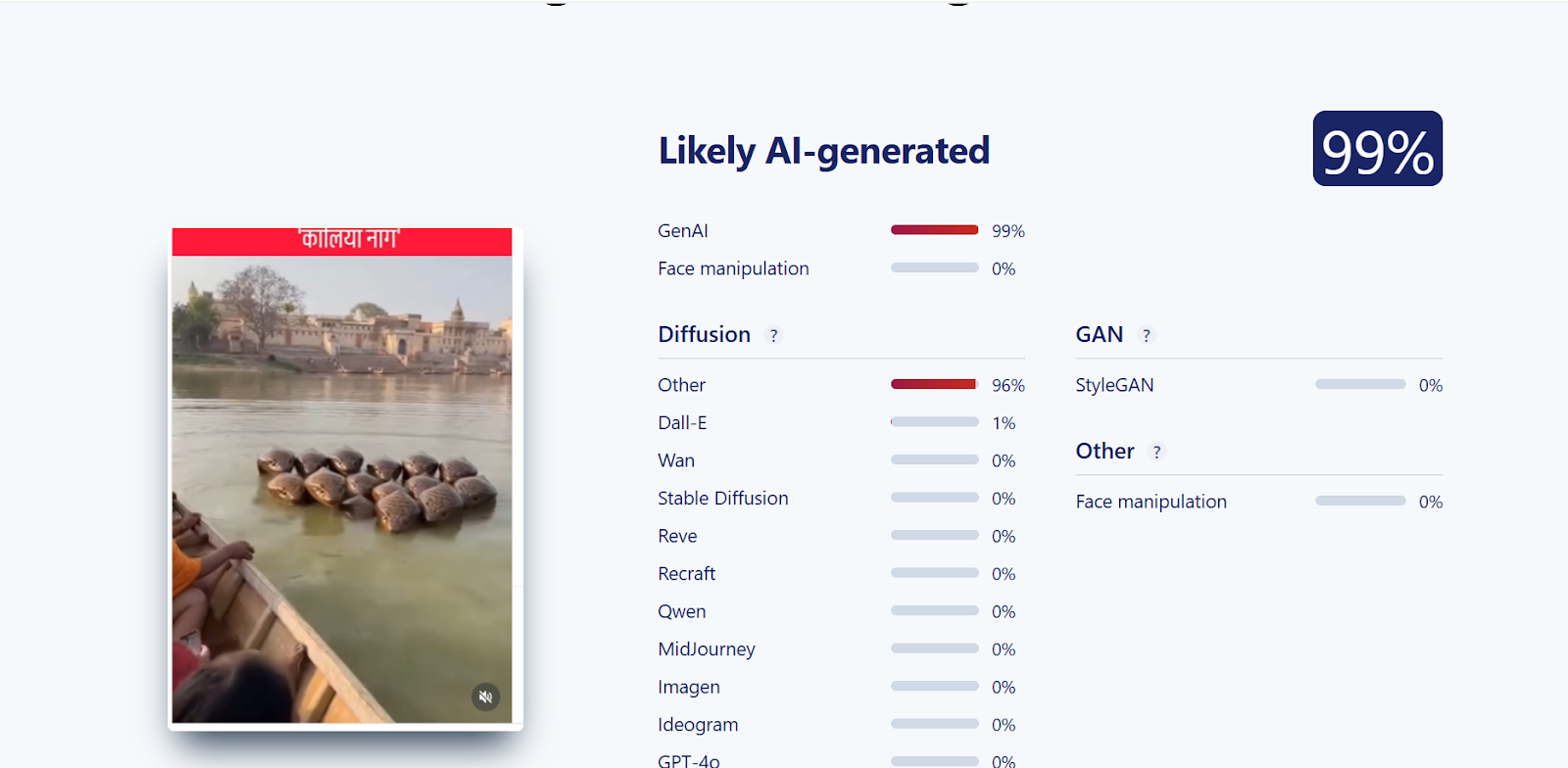
In the next step of the research , the video was analysed using another AI detection tool, HIVE Moderation. According to the results obtained, the video was found to be 62 per cent AI-generated.

Conclusion
Our research clearly establishes that the viral video claiming to show a multi-hooded snake in Vrindavan is not real. The clip has been created using artificial intelligence and is being falsely shared on social media with religious and sensational claims.
