
#FactCheck-Old Video of Thalapathy Vijay Falsely Shared as His Visit to Delhi’s Jantar Mantar Protest
Executive Summary
A video of Tamil Nadu Chief Minister Thalapathy Vijay is being widely circulated on social media with the claim that he reached Jantar Mantar in New Delhi and participated in an ongoing protest. CyberPeace Research Wing’s research found the viral claim to be misleading. During the research, we found an official clarification issued by the Delhi Police, which clearly refuted the claim and stated that the video was being shared with a false context.
Claim
A user on social media platform Instagram shared the viral video claiming that Thalapathy Vijay had reached Delhi’s Jantar Mantar and joined a protest there.
https://www.instagram.com/reels/Da-tsmSpC-V/
https://archive.ph/submit/?url
https://www.instagram.com/reels/Da-tsmSpC-V/

Fact Check
To verify the claim, we extracted multiple keyframes from the viral video and conducted a reverse image search using Google Lens. During the research, we found a similar image posted on Instagram on May 5, 2026, which contained visuals matching the viral video. The post did not mention any connection with a protest at Delhi’s Jantar Mantar.
https://www.instagram.com/p/DX8cmt6oqP9/

Further research revealed that the first major on-ground protest of the Cockroach Janta Party (CJP) was organised at Jantar Mantar on June 6, 2026. This confirms that the viral video, which is being linked to the CJP protest, is being shared with an incorrect context.

During further verification, we found a report published by BBC Tamil on May 4, 2026, which carried visuals similar to the viral video. https://www.bbc.com/tamil/articles/c202nd32v5ro

According to the BBC report, TVK (Tamilaga Vettri Kazhagam) leader Vijay won from the Perambur and Tiruchirappalli East assembly constituencies during the Tamil Nadu Assembly elections. The visuals in the viral video are related to Vijay’s political activities in Tamil Nadu and are not from Delhi’s Jantar Mantar. Additionally, the Delhi Police issued an official clarification stating that the claim linking the video to Jantar Mantar was false.
https://x.com/DCPNewDelhi/status/2078932755023577234?s=20

Conclusion
CyberPeace Research Wing’s research found that the viral video of Thalapathy Vijay is not from a protest at Delhi’s Jantar Mantar. The video is being circulated with a false and misleading claim. The Delhi Police has also officially denied the claim. Users are advised not to share such misleading content without verification.

Related Blogs
Procedural History:
The case started with a 2011 Madras High Court ruling that included the appellant’s personal information. In the case discussed, the court decided in 2024, the appellant went to the Madurai Bench of the Madras High Court to request that his name and other identifying information from that previous ruling be redacted. He argued that his right to privacy under Article 21 of the Indian Constitution was violated by the ongoing release of such private information into the public arena. He claimed that the revelation had hurt him in real ways, such as having his application for an Australian visa denied. Therefore, without compromising the ideals of open justice, the current procedures aimed to have the court recognize a person’s “Right to be Forgotten” within a broader framework of privacy and data protection.
Background and Factual Matrix
The appellant was charged under Sections 417 and 376 of the IPC. The trial court convicted him in 201, but later, the High Court in 2014 fully, completely and unconditionally acquitted him, which was not based on the benefit of doubt. Following the acquittal, he remarried and has three children. The judgment of both the High Court and the Trial Court has personal and intimate details about him. Being available in the public domain has caused him significant repercussions, as he was denied a visa to travel to Australia by authorities, citing the criminal cases. The appellant has filed a plea seeking a mandamus directing the Registrar General, Additional Registrar General, and Registrar (IT-Statistics) as R1, R2, R3 to redact his name and other identities from the acquittal judgment. He has sought a direction from Ikanoon Software Development Private Limited (R4) to reflect the redaction in its publication.
Issue
- Whether a writ of mandamus can lie against a High Court for redaction of personal details from its own judgment, or does such a prayer tantamount to a High Court issuing a writ against itself?
- Whether the High Court, being a Court of Record under Article 215 of the Indian Constitution, is entitled to preserve its record for perpetuity in its original form without any modification or redaction?
- Whether the ‘Right to be Forgotten' can be recognised and enforced in the absence of a specific statutory provision or Supreme Court direction, given that it constitutes an exception to the fundamental principle of open courts and open justice?
Adjudication and Reasoning
The division bench has allowed the Writ appeal and granted the following relief:
- R4 directed to take down the judgment in Crl.A. (MD) No.321 of 2011 dated 30.04.2014 forthwith.
- R1 to R3 directed to redact the name and other details of the Writ Petitioner relating to his identity from the judgment dated 30.04.2014 in Crl.A.(MD) No. 321 of 2011 and ensure that only the redacted judgment is available for publication or for uploading.
Rule
- Courts have a wide discretion in deciding whether to allow redaction or not. Such discretion can either be granted at the request of the party seeking redaction or, in appropriate cases, even suo moto by the court.
- The accused who have earned full, complete and unconditional acquittal without any benefit of doubt have a legitimate claim to move forward for redaction of personal information.
- The open Court doesn’t require absolute disclosure of all personal information, and the courts, while deciding the concern of privacy and the right to ensure that in litigations to leave behind parts of their past which are no longer relevant, have to balance the concept of open Court on the one hand and privacy concerns of a citizen on the other.
- As the High Court is the repository of a wide range of information and is entitled to preserve the original record in perpetuity. However, without diluting the sanctity of the original record, the public reflection of that record can be moderated to preserve the privacy of the person to whom that record pertains.
Reasoning
- Drawing on the judgment K.S. Puttaswamy v. Union of India, the court found Article 21 to protect not only informational privacy but also the "right to be forgotten," which gives individuals the right to request the deletion of any personal data when there is no longer any legitimate public interest in retaining such information. Such irreparable reputational damage is thus an infringement on constitutional privacy that demands judicial redaction.
- The court rejected the argument that a writ against its own order is impermissible, drawing a distinction between challenging the legal correctness of a judgment and seeking redaction of personal information. Allowing redaction will not question the validity of the judgment; rather, it will simply change its public appearance to ensure privacy.
- Since a High Court is a Court of Record with an obligation to preserve its judgments in their unaltered form forever, the court held here that such internal maintenance of complete records was not incompatible with the issuance of a redacted public version. Institutional integrity is maintained when the original kept in the archives is supplemented with a public version that masks the privacy areas.
- Open justice principles work to establish transparency, accountability, and public confidence, but these are not absolute. The court took a proportionality stance: personal identifiers, where they neither educate nor have precedential value and continue to inflict harm, may be expunged without affecting the established legal principles of judgment.
- Although the DPDP Act exempts courts from several statutory obligations, the court held that it can, by virtue of its inherent discretion, protect personal data, and in so doing, exercise that power without the need for any legislative command. Traditionally the Madras High Court rules provide for the possibility of restriction of certified copies, thus establishing redaction as feasible both legally and administratively.

Executive Summary
Following the tragic cruise accident at Bargi Dam in Jabalpur, a heartbreaking image of a woman lying unconscious in a river with a child resting on top of her has gone viral on social media. Users are claiming that the picture shows victims of the recent Bargi Dam accident. Research by CyberPeace Research Wing found that the viral claim is false. The circulating image was created using AI (Artificial Intelligence) and is now being misleadingly linked to the real tragedy. However, reports indicate that a similar real-life image of a mother and child did emerge after the accident.
Claim
An X user shared the viral image on May 1, 2026, claiming that despite wearing a life jacket, the mother lost her life while trying to save her child. The emotional post praised mothers’ sacrifice and linked the image directly to the Bargi Dam cruise mishap An X user shared the viral image on May 1, 2026, claiming that despite wearing a life jacket, the mother lost her life while trying to save her child. The emotional post praised mothers’ sacrifice and linked the image directly to the Bargi Dam cruise mishap
Fact Check
To verify the claim, we searched relevant keywords on Google but found no credible news reports connecting the viral image to the Bargi Dam accident. A closer examination of the image revealed multiple visual inconsistencies. The hands of the woman and child appear unnaturally merged at one point, while the woman’s eyebrows seem split into two sections. Such distortions are common indicators of AI-generated imagery.
We then analyzed the picture using AI detection tool Hive Moderation, which estimated nearly a 90% probability that the image was AI-generated.

During the research , we also found a clarification post from the official Facebook account of the Jabalpur District Collector, who stated that the viral image was AI-generated or sourced elsewhere and had no connection with the Bargi cruise accident.

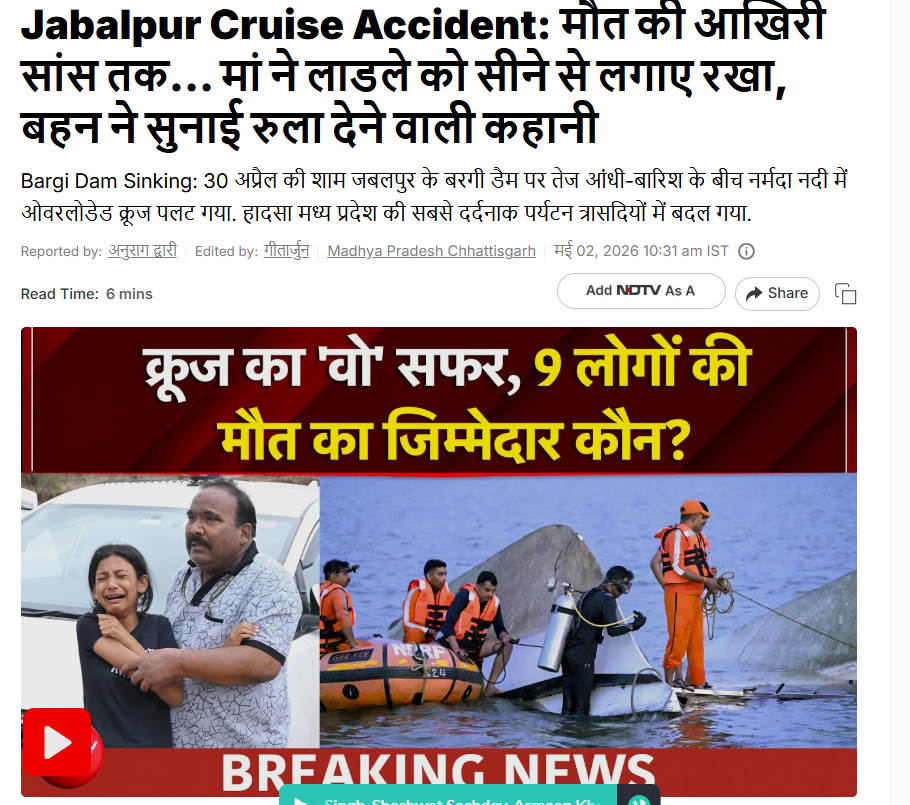
According to a report published by NDTV on May 2, 2026, the accident occurred on April 30 near Khamaria Island when an overloaded tourist cruise capsized amid strong winds, heavy rain, and rising waves. At least nine people died, while 28 others were rescued.
Conclusion
Our research confirms that the viral mother-child image being linked to the Bargi Dam tragedy is fake. The picture was created using AI and falsely circulated in connection with the real cruise accident.
.webp)
Introduction
Search engines have become indispensable in our daily lives, allowing us to find information instantly by entering keywords or phrases. Using the prompt "search Google or type a URL" reflects just how seamless this journey to knowledge has become. With millions of searches conducted every second, and Google handling over 6.3 million searches per minute as of 2023 (Statista), one critical question arises: do search engines prioritise results based on user preferences and past behaviours, or are they truly unbiased?
Understanding AI Bias in Search Algorithms
AI bias is also known as machine learning bias or algorithm bias. It refers to the occurrence of biased results due to human biases that deviate from the original training data or AI algorithm which leads to distortion of outputs and creation of potentially harmful outcomes. The sources of this bias are algorithmic bias, data bias and interpretation bias which emerge from user history, geographical data, and even broader societal biases in training data.
Common biases include excluding certain groups of people from opportunities because of AI bias. In healthcare, underrepresenting data of women or minority groups can skew predictive AI algorithms. While AI helps streamline the automation of resume scanning during a search to help identify ideal candidates, the information requested and answers screened out can result in biased outcomes due to a biased dataset or any other bias in the input data.
Case in Point: Google’s "Helpful" Results and Its Impact
Google optimises results by analysing user interactions to determine satisfaction with specific types of content. This data-driven approach forms ‘filter bubbles’ by repeatedly displaying content that aligns with a user’s preferences, regardless of factual accuracy. While this can create a more personalised experience, it risks confining users to a limited view, excluding diverse perspectives or alternative viewpoints.
The personal and societal impacts of such biases are significant. At an individual level, filter bubbles can influence decision-making, perceptions, and even mental health. On a societal level, these biases can reinforce stereotypes, polarise opinions, and shape collective narratives. There is also a growing concern that these biases may promote misinformation or limit users’ exposure to diverse perspectives, all stemming from the inherent bias in search algorithms.
Policy Challenges and Regulatory Measures
Regulating emerging technologies like AI, especially in search engine algorithms, presents significant challenges due to their intricate, proprietary nature. Traditional regulatory frameworks struggle to keep up with them as existing laws were not designed to address the nuances of algorithm-driven platforms. Regulatory bodies are pushing for transparency and accountability in AI-powered search algorithms to counter biases and ensure fairness globally. For example, the EU’s Artificial Intelligence Act aims to establish a regulatory framework that will categorise AI systems based on risk and enforces strict standards for transparency, accountability, and fairness, especially for high-risk AI applications, which may include search engines. India has proposed the Digital India Act in 2023 which will define and regulate High-risk AI.
Efforts include ethical guidelines emphasising fairness, accountability, and transparency in information prioritisation. However, a complex regulatory landscape could hinder market entrants, highlighting the need for adaptable, balanced frameworks that protect user interests without stifling innovation.
CyberPeace Insights
In a world where search engines are gateways to knowledge, ensuring unbiased, accurate, and diverse information access is crucial. True objectivity remains elusive as AI-driven algorithms tend to personalise results based on user preferences and past behaviour, often creating a biased view of the web. Filter bubbles, which reinforce individual perspectives, can obscure factual accuracy and limit exposure to diverse viewpoints. Addressing this bias requires efforts from both users and companies. Users should diversify sources and verify information, while companies should enhance transparency and regularly audit algorithms for biases. Together, these actions can promote a more equitable, accurate, and unbiased search experience for all users.
References
- https://www.bbc.com/future/article/20241101-how-online-photos-and-videos-alter-the-way-you-think
- https://www.bbc.com/future/article/20241031-how-google-tells-you-what-you-want-to-hear
- https://www.ibm.com/topics/ai-bias#:~:text=In%20healthcare%2C%20underrepresenting%20data%20of,can%20skew%20predictive%20AI%20algorithms
