
#FactCheck – Elephant Falls From Truck? No, This Elephant Fall Video Is AI-Manipulated
Executive Summary:
A video circulating on social media claims to show a live elephant falling from a moving truck due to improper transportation, followed by the animal quickly standing up and reacting on a public road. The content may raise concerns related to animal cruelty, public safety, and improper transport practices. A detailed examination using AI content detection tools, visual anomaly analysis indicates that the video is not authentic and is likely AI generated or digitally manipulated.
Claim:
The viral video (archive link) shows a disturbing scene where a large elephant is allegedly being transported in an open blue truck with barriers for support. As the truck moves along the road, the elephant shifts its weight and the weak side barrier breaks. This causes the elephant to fall onto the road, where it lands heavily on its side. Shortly after, the animal is seen getting back on its feet and reacting in distress, facing the vehicle that is recording the incident. The footage may raise serious concerns about safety, as elephants are normally transported in reinforced containers, and such an incident on a public road could endanger both the animal and people nearby.

Fact Check:
After receiving the video, we closely examined the visuals and noticed some inconsistencies that raised doubts about its authenticity. In particular, the elephant is seen recovering and standing up unnaturally quickly after a severe fall, which does not align with realistic animal behavior or physical response to such impact.
To further verify our observations, the video was analyzed using the Hive Moderation AI Detection tool, which indicated that the content is likely AI generated or digitally manipulated.
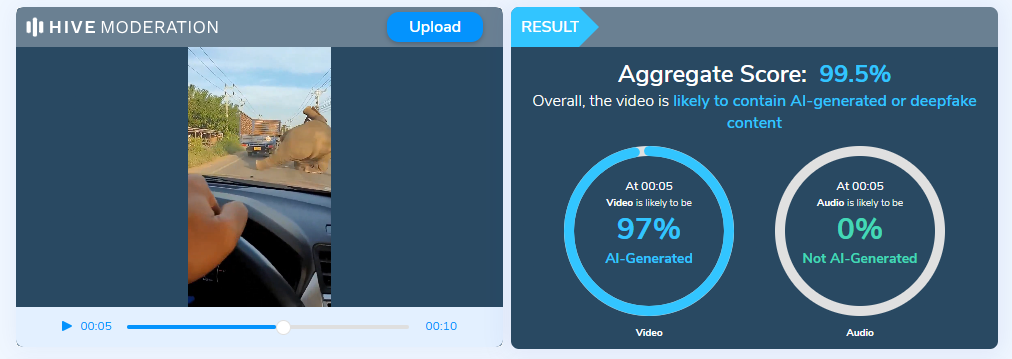
Additionally, no credible news reports or official sources were found to corroborate the incident, reinforcing the conclusion that the video is misleading.
Conclusion:
The claim that the video shows a real elephant transport accident is false and misleading. Based on AI detection results, observable visual anomalies, and the absence of credible reporting, the video is highly likely to be AI generated or digitally manipulated. Viewers are advised to exercise caution and verify such sensational content through trusted and authoritative sources before sharing.
- Claim: The viral video shows an elephant allegedly being transported, where a barrier breaks as it moves, causing the animal to fall onto the road before quickly getting back on its feet.
- Claimed On: X (Formally Twitter)
- Fact Check: False and Misleading

Related Blogs

The recent Promotion and Regulation of Online Gaming Act, 2025, that came into force in August, has been one of the most widely anticipated regulations in the digital entertainment industry. Among provisions such as promoting esports and licensing of online gaming, the legislation notably introduces a blanket ban on real-money gaming (RMG). The rationale behind this was to reduce its addictive effects, protect minors, and limit the circulation of black-money. However, in reality, the Act has spawned apprehension about the legislative process, regulatory redundancy, and unintended consequences that can shift users and revenue to offshore operators.
From Debate to Prohibition: How the Act was Passed
The Promotion and Regulation of Online Gaming Act was passed as a central law, providing the earlier fragmented state laws on online betting and gambling with an overarching framework. Proponents argue that, among other provisions, some kind of unified national framework was needed to deal with the scale of online betting due to its detrimental impact on young users. The current Act is a direct transition to criminalisation rather than the swings of self-regulation and partial restrictions used during the previous decade of incremental experiments in regulation. Stakeholders in the industry believe that this type of sudden, blanket action creates uncertainty and erodes confidence in the system in the long run. Further, critics have pointed out that the Bill was passed without adequate Parliamentary deliberation. A question has been raised about whether procedural safeguards were upheld.
Prohibition of Online RMG
Within the Indian context, a distinction has long been drawn between games of skill and games of chance, with the latter, like a lottery or a casino, being severely prohibited under state laws, whereas the former, like rummy or fantasy sports, have generally been allowed after being recognized as skill-based by court authorities. The Online Gaming Act of 2025 abolishes this distinction on the internet, thus banning all RMG actions that include cash transactions, regardless of skill or chance. The act also criminalises the advertising, facilitation, and hosting of such sites, thereby penalizing offshore operators with an Indian customer focus, and subjecting their payment gateways, app stores, and advertisers under its jurisdiction to penalties.
The Problem of Overlap
One potential issue that the Act presents is its overlap with the existing laws. The IT Rules 2023 mandate intermediaries in the gaming sector to appoint compliance officers, submit monthly reports, and undergo due diligence. The new Act introduces a three-level classification of games, whereas the advisories of the Central Consumer Protection Authority (CCPA) under the Consumer Protection Act treat online betting as an unfair trade practice.
This multiplicity of regulations builds a maze where different Ministries and state governments have overlapping jurisdiction. Policy experts caution that such an overlap can create enforcement challenges, punish players who act within the law, and leave offshore malefactors undetected.
Unintended Consequences: Driving Users Offshore
Outright prohibition will hardly ever remove demand; it will only push it out. Offshore sites have taken advantage of the situation as Indian operators like Dream11 shut down their money games after the ban. It has already been reported that there is aggressive advertising by foreign betting companies that are not registered in India, most of which have backend infrastructure that cannot be regulated by the Act (Storyboard18).
This diversion of users to unregulated markets has two main risks. First, Indian players are deprived of the consumer protection offered to them in local regulation, and their data can be sent to suspicious foreign organizations. Second, the government loses control over the money flow that can be transferred via informal channels or cryptocurrencies or other obscure systems. Industry analysts are alerting that such developments may only worsen the issue of black-money instead of solving it (IGamingBusiness).
Advertising, Age Gating, and Digital Rights
The Act has also strengthened advertisement regulations, aligning with advisories issued by the Advertising Standards Council of India, which prohibits the targeting of minors. However, critics believe that the application remains inadequately enforced, and children can with comparative ease access unregulated overseas applications. In the absence of complementary digital literacy programs and strong parental controls, these limitations can be effectively superficial instead of real.
Privacy advocates also warn that frequent prompts, vague messages, or invasive surveillance can weaken the digital rights of users instead of strengthening them. Overregulation has also been found to create banner blindness in global contexts where users ignore warnings without first clearly understanding them.
Enforcement Challenges
The Act puts a lot of responsibilities on many stakeholders, including the Ministry of Information and Broadcasting (MIB) and the Reserve Bank of India (RBI). Platforms like Google Play and Apple App Store are expected to verify government-approved lists of compliant gaming apps and remove non-compliant or banned ones, as directed by the MIB and the RBI. Although this pressure may motivate intermediaries to collaborate, it may also have a risk of overreach when it is applied unequally or in a political way.
According to the experts, the solution should be underpinned by technology itself. Artificial intelligence can be used to identify illegal advertisements, track illegal gaming in children, and trace payment streams. At the same time, the regulators should be able to issue final lists of either compliant or non-compliant applications to advise the consumers and intermediaries alike. Without such practical provisions, enforcement risks remaining patchy.
Online Gaming Rules
On 1 October 2025, the government issued a draft of the Online Gaming Rules in accordance with the Promotion and Regulation of Online Gaming Act. The regulations focus on the creation of the compliance frameworks, define the classification of the allowed gaming activities, and prescribe grievance-redressal mechanisms aiming to promote the protection of the players and procedural transparency. However, the draft does not revisit or soften the existing blanket prohibition on real-money gaming (RMG) and, hence, the questions about the effectiveness of enforcement and regulatory clarity remain open (Times of India, 2025).
Protecting Consumers Without Stifling Innovation
The ban highlights a larger conflict, i.e., the protection of the vulnerable users without stifling an industry that has traditionally contributed to innovation, jobs, and the collection of tax revenue. Online gaming has significantly added to the GST collections, and the sudden shakeup brings fiscal concerns (Reuters).
Several legal objections to the Act have already been brought, asking whether the Act is constitutional, especially as to whether the restrictions are proportional to the right to trade. The outcome of such cases will define the future trajectory of the digital economy of India (Reuters).
Way Forward
Instead of outright prohibition, a more balanced approach that incorporates regulation and consumer protection is suggested by the experts. Key measures could include:
- A definite difference between games of skill and games of chance, with proportionate regulation.
- Age confirmation and campaign against online illiteracy to protect the underage population.
- Enhanced advertising and payments compliance requirements and enforceable non-compliance penalty.
- Coordinated oversight among different ministries to prevent duplication and regulatory struggle.
- Leveraging AI and fintech to track illegal financial activities (black money flows) and developing innovation.
Conclusion
The Online Gaming Act 2025 addresses social issues, such as addiction, monetary risk, and child safety, that require governance interventions. However, the path it follows to this end, that of total prohibition, is more likely to spawn a new set of issues instead of providing solutions because it will send consumers to offshore sites, undermine consumer rights, and slow innovation.
For India, the real challenge is not whether to prohibit online money gaming but how to create a balanced, transparent, and enforceable framework that protects users while fostering a responsible gaming ecosystem. India can reduce the adverse consequences of online betting without keeping the industry in the shadows with better coordination, reasonable use of technology, and balanced protection.
References:
- India's Dream11, top gaming apps halt money-based games after ban
- India online gambling ban could drive punters to black market
- Offshore betting firms with backend ops in India not covered by online gaming law
- The Great Gamble: India’s Online Gaming Ban, The GST Battle, And What Lies Ahead.
- Game Over for Online Money Games? An Analysis of the Online Gaming Act 2025
- Government gambles heavily on prohibiting online money gaming
- Online gaming regulation: New rules to take effect from October 1; government stresses consultative approach with industry

Executive Summary
A video of Prime Minister Narendra Modi is being widely shared on social media, in which he appears to announce that all ration card holders will receive free mobile phones, provided no member of their family is a government employee. However, research by the CyberPeace has found this claim to be false. Our research reveals that the viral video is AI-generated and does not reflect any real announcement.
Claim:
An Instagram user shared the viral video with the caption, “If you have a ration card, you will get a free mobile phone.”
- Post link: https://www.instagram.com/reels/DWqDKWxy6lJ/
- Archived link: https://archive.ph/wip/dmpIf

Fact Check
To verify the claim, we first conducted a keyword-based search on Google. However, we did not find any credible media reports supporting such an announcement, raising doubts about the authenticity of the video. We then checked the official government welfare schemes portal, myscheme.gov.in, which provides verified information about central government schemes. No such scheme offering free mobile phones to ration card holders was found on the platform.

Conclusion
Our research confirms that the viral video is fake and AI-generated. There is no official announcement or credible report suggesting that ration card holders will receive free mobile phones under any government scheme. The video has been digitally manipulated using artificial intelligence and is being circulated with a misleading claim. This serves as another example of how AI-generated content can be used to spread misinformation.

Introduction
In this ever-evolving world of technology, cybercrimes and criminals continue to explore new and innovative methods to exploit and intimidate their victims. One of the recent shocking incidents has been reported from the city of Bharatpur, Rajasthan, where the cyber crooks organised a mock court session This complex operation, meant to induce fear and force obedience, exemplifies the daring and intelligence of modern hackers. In this blog article, we’ll go deeper into this concerning occurrence, delving into it to offer light on the strategies used and the ramifications for cybersecurity.to frighten their targets.
The Setup
The case was reported from Gopalgarh village in Bharatpur, Rajasthan, and has unfolded with a shocking twist -the father-son duo, Tahir Khan and his son Talim Khano — from Gopalgarh village in Bharatpur, Rajasthan, has been fooling people to gain their monetary gain by staging a mock court setting and recorded the proceedings to intimidate their victims into paying hefty sums. In the recent case, they have gained 2.69 crores through sextortion. the duo uses to trace their targets on social media platforms, blackmail them, and earn a hefty amount.
An official complaint was filed by a 69-year-old victim who was singled out through his social media accounts, his friends, and his posts Initially, they contacted the victim with a pre-recorded video featuring a nude woman, coaxing him into a compromising situation. As officials from the Delhi Crime Branch and the CBI, they threatened the victim, claiming that a girl had approached them intending to file a complaint against him. Later, masquerading as YouTubers, they threatened to release the incriminating video online. Adding to the charade, they impersonated a local MLA and presented the victim with a forged stamp paper alleging molestation charges. Eventually, posing as Delhi Crime Branch officials again, they demanded money to settle the case after falsely stating that they had apprehended the girl. To further manipulate the victim, the accused staged a court proceeding, recording it and subsequently sending it to him, creating the illusion that everything was concluded. This unique case of sextortion stands out as the only instance where the culprits went to such lengths, staging and recording a mock court to extort money. Furthermore, it was discovered that the accused had fabricated a letter from the Delhi High Court, adding another layer of deception to their scheme.
The Investigation
The complaint was made in a cyber cell. After the complaint was filed, the investigation was made, and it was found that this case stands as one of the most significant sextortion incidents in the country. The father-son pair skillfully assumed five different roles, meticulously executing their plan, which included creating a simulated court environment. “We have also managed to recover Rs 25 lakh from the accused duo—some from their residence in Gopalgarh and the rest from the bank account where it was deposited.
The Tricks used by the duo
The father-son The setup in the fake court scene event was a meticulously built web of deception to inspire fear and weakness in the victim. Let’s look at the tricks the two used to fool the people.
- Social Engineering strategies: Cyber criminals are skilled at using social engineering strategies to acquire the trust of their victims. In this situation, they may have employed phishing emails or phone calls to get personal information about the victim. By appearing as respectable persons or organisations, the crooks tricked the victim into disclosing vital information, giving them weapons they needed to create a sense of trustworthiness.
- Making a False Narrative: To make the fictitious court scenario more credible, the cyber hackers concocted a captivating story based on the victim’s purported legal problems. They might have created plausible papers to give their plan authority, such as forged court summonses, legal notifications, or warrants. They attempted to create a sense of impending danger and an urgent necessity for the victim to comply with their demands by deploying persuasive language and legal jargon.
- Psychological Manipulation: The perpetrators of the fictitious court scenario were well aware of the power of psychological manipulation in coercing their victims. They hoped to emotionally overwhelm the victim by using fear, uncertainty, and the possible implications of legal action. The offenders probably used threats of incarceration, fines, or public exposure to increase the victim’s fear and hinder their capacity to think critically. The idea was to use desperation and anxiety to force the victim to comply.
- Use of Technology to Strengthen Deception: Technological advancements have given cyber thieves tremendous tools to strengthen their misleading methods. The simulated court scenario might have included speech modulation software or deep fake technology to impersonate the voices or appearances of legal experts, judges, or law enforcement personnel. This technology made the deception even more believable, blurring the border between fact and fiction for the victim.
The use of technology in cybercriminals’ misleading techniques has considerably increased their capacity to fool and influence victims. Cybercriminals may develop incredibly realistic and persuasive simulations of judicial processes using speech modulation software, deep fake technology, digital evidence alteration, and real-time communication tools. Individuals must be attentive, gain digital literacy skills, and practice critical thinking when confronting potentially misleading circumstances online as technology advances. Individuals can better protect themselves against the expanding risks posed by cyber thieves by comprehending these technological breakthroughs.
What to do?
Seeking Help and Reporting Incidents: If you or anyone you know is the victim of cybercrime or is fooled by cybercrooks. When confronted with disturbing scenarios such as the imitation court scene staged by cybercrooks, victims must seek help and act quickly by reporting the occurrence. Prompt reporting serves various reasons, including increasing awareness, assisting with investigations, and preventing similar crimes from occurring again. Victims should take the following steps:
- Contact your local law enforcement: Inform local legal enforcement about the cybercrime event. Provide them with pertinent incident facts and proof since they have the experience and resources to investigate cybercrime and catch the offenders involved.
- Seek Assistance from a Cybersecurity specialist: Consult a cybersecurity specialist or respected cybersecurity business to analyse the degree of the breach, safeguard your digital assets, and obtain advice on minimising future risks. Their knowledge and forensic analysis can assist in gathering evidence and mitigating the consequences of the occurrence.
- Preserve Evidence: Keep any evidence relating to the event, including emails, texts, and suspicious actions. Avoid erasing digital evidence, and consider capturing screenshots or creating copies of pertinent exchanges. Evidence preservation is critical for investigations and possible legal procedures.
Conclusion
The setting fake court scene event shows how cybercriminals would deceive and abuse their victims. These criminals tried to use fear and weakness in the victim through social engineering methods, the fabrication of a false narrative, the manipulation of personal information, psychological manipulation, and the use of technology. Individuals can better defend themselves against cybercrooks by remaining watchful and sceptical.
