
#FactCheck: Old Salman Khan Video From 2019 Misleadingly Shared as Eid Post
Executive Summary:
A video of actor Salman Khan is being widely shared on social media with the claim that he posted a special video on the occasion of Eid. However, a research by the CyberPeace found the claim to be misleading. The viral video is not recent but dates back to 2019. Meanwhile, Salman Khan did share a different video with his family this year.
Claim:
On Facebook, a user shared the viral video on March 21, 2026, with the caption ,“Salman Khan shared a special video on Eid.”
Post link and archive link:

Fact Check
To verify the claim, we examined Salman Khan’s social media accounts. On his Instagram handle, we found a video posted on March 21, 2026, in which he is seen greeting fans from a bulletproof balcony along with his family on the occasion of Eid.

This video is completely different from the viral clip and has no connection to it. Further, we extracted keyframes from the viral video and conducted a reverse image search using Google Lens. During the research, we found the same video on Salman Khan’s Instagram account, where it was originally posted on June 5, 2019.
Post link:
https://www.instagram.com/p/ByVMS6alo76/?igsh=MTA3ZDBqdGlidmRhMQ%3D%3D

Conclusion:
The viral claim is misleading. The video being shared is not recent but from 2019. Salman Khan did share a video this year, but it is different from the one going viral.

Related Blogs

Executive Summary:
Traditional Business Email Compromise(BEC) attacks have become smarter, using advanced technologies to enhance their capability. Another such technology which is on the rise is WormGPT, which is a generative AI tool that is being leveraged by the cybercriminals for the purpose of BEC. This research aims at discussing WormGPT and its features as well as the risks associated with the application of the WormGPT in criminal activities. The purpose is to give a general overview of how WormGPT is involved in BEC attacks and give some advice on how to prevent it.
Introduction
BEC(Business Email Compromise) in simple terms can be defined as a kind of cybercrime whereby the attackers target the business in an effort to defraud through the use of emails. Earlier on, BEC attacks were executed through simple email scams and phishing. However, in recent days due to the advancement of AI tools like WormGPT such malicious activities have become sophisticated and difficult to identify. This paper seeks to discuss WormGPT, a generative artificial intelligence, and how it is used in the BEC attacks to make the attacks more effective.
What is WormGPT?
Definition and Overview
WormGPT is a generative AI model designed to create human-like text. It is built on advanced machine learning algorithms, specifically leveraging large language models (LLMs). These models are trained on vast amounts of text data to generate coherent and contextually relevant content. WormGPT is notable for its ability to produce highly convincing and personalised email content, making it a potent tool in the hands of cybercriminals.
How WormGPT Works
1. Training Data: Here the WormGPT is trained with the arrays of data sets, like emails, articles, and other writing material. This extensive training enables it to understand and to mimic different writing styles and recognizable textual content.
2. Generative Capabilities: Upon training, WormGPT can then generate text based on specific prompts, as in the following examples in response to prompts. For example, if a cybercriminal comes up with a prompt concerning the company’s financial information, WormGPT is capable of releasing an appearance of a genuine email asking for more details.
3. Customization: WormGPT can be retrained any time with an industry or an organisation of interest in mind. This customization enables the attackers to make their emails resemble the business activities of the target thus enhancing the chances for an attack to succeed.
Enhanced Phishing Techniques
Traditional phishing emails are often identifiable by their generic and unconvincing content. WormGPT improves upon this by generating highly personalised and contextually accurate emails. This personalization makes it harder for recipients to identify malicious intent.
Automation of Email Crafting
Previously, creating convincing phishing emails required significant manual effort. WormGPT automates this process, allowing attackers to generate large volumes of realistic emails quickly. This automation increases the scale and frequency of BEC attacks.
Exploitation of Contextual Information
WormGPT can be fed with contextual information about the target, such as recent company news or employee details. This capability enables the generation of emails that appear highly relevant and urgent, further deceiving recipients into taking harmful actions.
Implications for Cybersecurity
Challenges in Detection
The use of WormGPT complicates the detection of BEC attacks. Traditional email security solutions may struggle to identify malicious emails generated by advanced AI, as they can closely mimic legitimate correspondence. This necessitates the development of more sophisticated detection mechanisms.
Need for Enhanced Training
Organisations must invest in training their employees to recognize signs of BEC attacks. Awareness programs should emphasise the importance of verifying email requests for sensitive information, especially when such requests come from unfamiliar or unexpected sources.
Implementation of Robust Security Measures
- Multi-Factor Authentication (MFA): MFA can add an additional layer of security, making it harder for attackers to gain unauthorised access even if they successfully deceive an employee.
- Email Filtering Solutions: Advanced email filtering solutions that use AI and machine learning to detect anomalies and suspicious patterns can help identify and block malicious emails.
- Regular Security Audits: Conducting regular security audits can help identify vulnerabilities and ensure that security measures are up to date.
Case Studies
Case Study 1: Financial Institution
A financial institution fell victim to a BEC attack orchestrated using WormGPT. The attacker used the tool to craft a convincing email that appeared to come from the institution’s CEO, requesting a large wire transfer. The email’s convincing nature led to the transfer of funds before the scam was discovered.
Case Study 2: Manufacturing Company
In another instance, a manufacturing company was targeted by a BEC attack using WormGPT. The attacker generated emails that appeared to come from a key supplier, requesting sensitive business information. The attack exploited the company’s lack of awareness about BEC threats, resulting in a significant data breach.
Recommendations for Mitigation
- Strengthen Email Security Protocols: Implement advanced email security solutions that incorporate AI-driven threat detection.
- Promote Cyber Hygiene: Educate employees on recognizing phishing attempts and practising safe email habits.
- Invest in AI for Defense: Explore the use of AI and machine learning in developing defences against generative AI-driven attacks.
- Implement Verification Procedures: Establish procedures for verifying the authenticity of sensitive requests, especially those received via email.
Conclusion
WormGPT is a new tool in the arsenal of cybercriminals which improved their options to perform Business Email Compromise attacks more effectively and effectively. Therefore, it is critical to provide the defence community with information regarding the potential of WormGPT and its implications for enhancing the threat landscape and strengthening the protection systems against advanced and constantly evolving threats.
This means the development of rigorous security protocols, general awareness of security solutions, and incorporating technologies such as artificial intelligence to mitigate the risk factors that arise from generative AI tools to the best extent possible.

Executive Summary
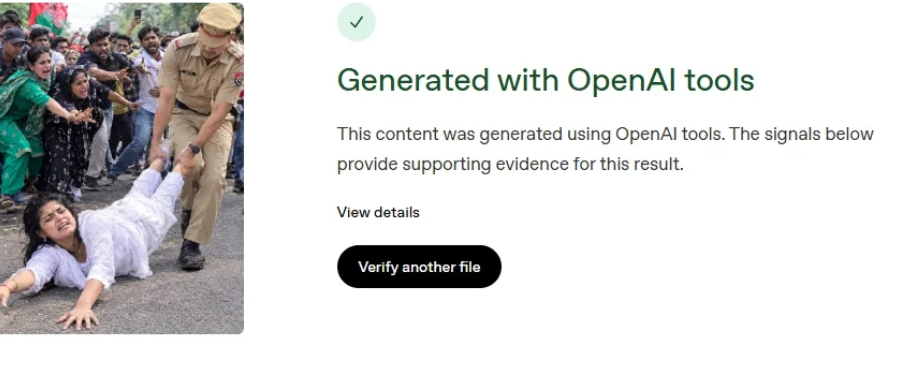
The Cockroach Janata Party had called for a protest on October 10, demanding the resignation of Chief Election Commissioner Gyanesh Kumar. Before the protest could take place, Delhi Police detained thousands of supporters. During the incident, several allegations of misconduct by Delhi Police personnel against women protesters and journalists also emerged. CyberPeace Research found that such allegations against Delhi Police had indeed been reported. However, this image is AI-generated.
Claim
Some images are being shared on social media with the claim that Delhi Police personnel held and dragged women protesters in an inappropriate manner. The first image shows a police personnel dragging a woman by her legs. The caption reads, “Things have crossed all limits in Delhi. Atrocities against women.”
https://ghostarchive.org/archive/1LyAy

Fact Check
Upon closely examining the viral images, we found that the woman depicted in both photographs appears to be the same. However, it seems implausible that the woman’s clothing would change in the middle of a protest.We then examined both images using OpenAI’s verification tool. The tool clearly indicated that both photographs were generated using artificial intelligence (AI).
Conclusion
Our research found that such allegations against Delhi Police were indeed reported. However, the viral image is AI-generated.
Executive Summary
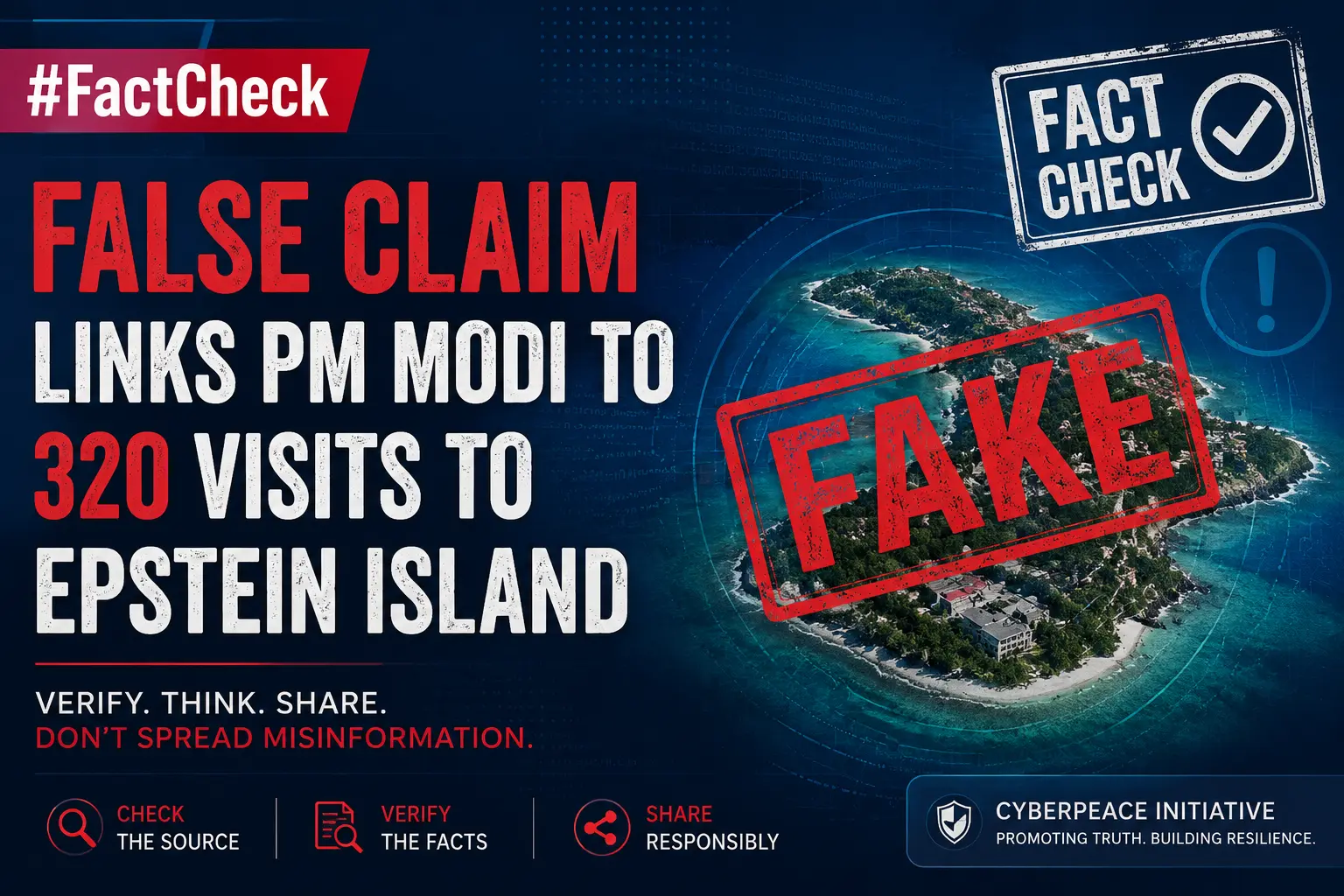
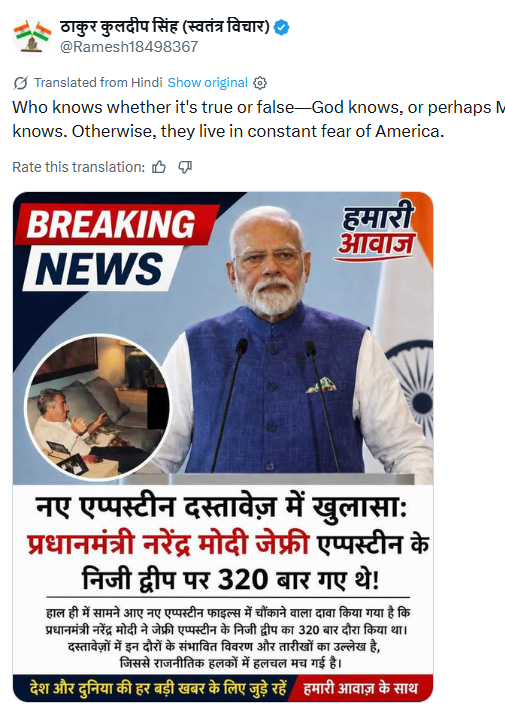
A viral social media post claims that the recently released Epstein files reveal that Prime Minister Narendra Modi visited Epstein Island more than 320 times. CyberPeace Research Wing research found that the claim is false. There is no evidence in the Epstein files suggesting that Prime Minister Modi visited Epstein Island over 320 times.
Claim:
An X user shared a viral graphic claiming that Prime Minister Narendra Modi had visited Epstein Island more than 320 times. https://x.com/Ramesh18498367/status/206501995913534715 , https://ghostarchive.org/archive/2V12W
Fact Check:
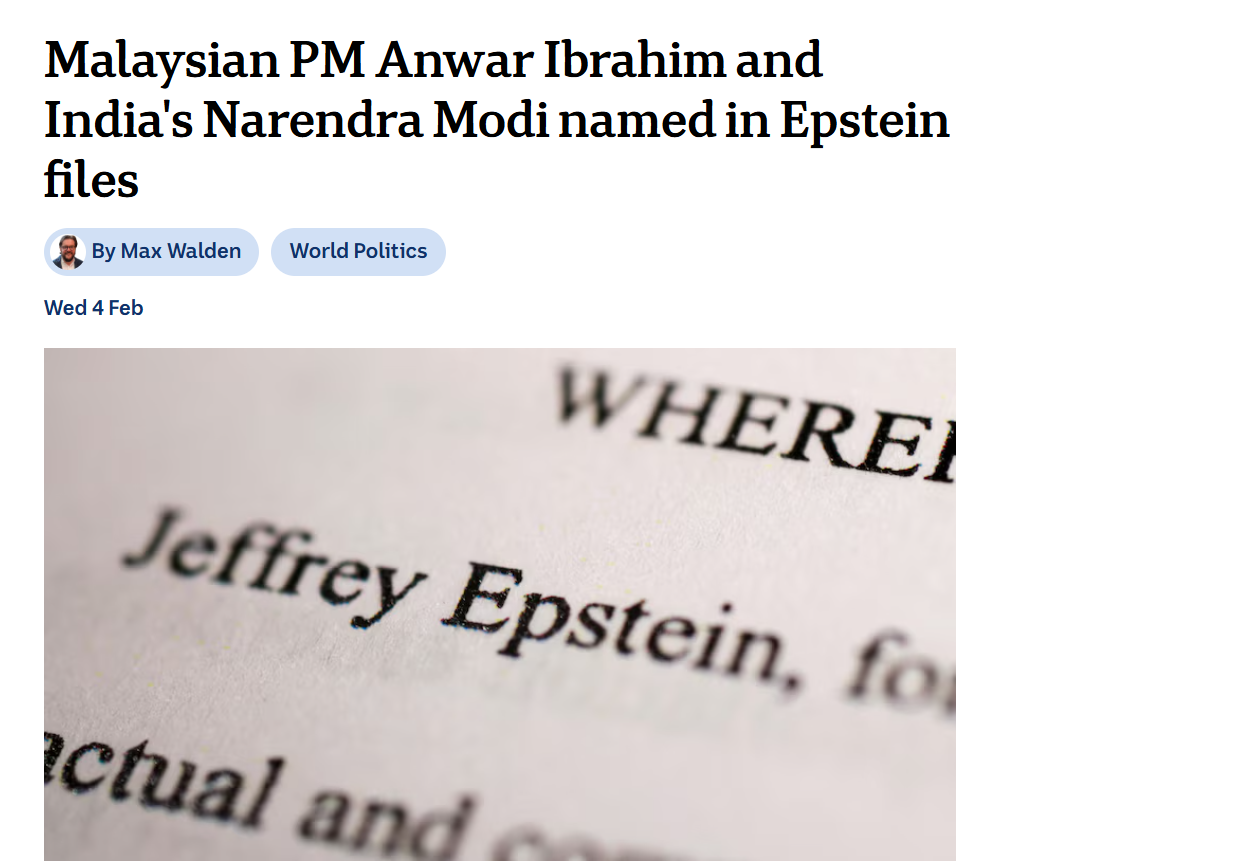
We first examined credible international media reports related to the Epstein files, particularly those mentioning Prime Minister Narendra Modi. During this process, we found a report published by the Australian Broadcasting Corporation (ABC) in February 2026. The report mentioned that the names of the Prime Ministers of India and Malaysia appeared in certain documents linked to the Epstein files. However, it clarified that references to Prime Minister Modi were limited to emails discussing his 2017 visit to Israel. The emails reportedly contained comments made by Jeffrey Epstein regarding the Prime Minister’s Israel visit. https://www.abc.net.au/news/2026-02-04/leaders-of-malaysia-india-named-in-epstein-files/106298458
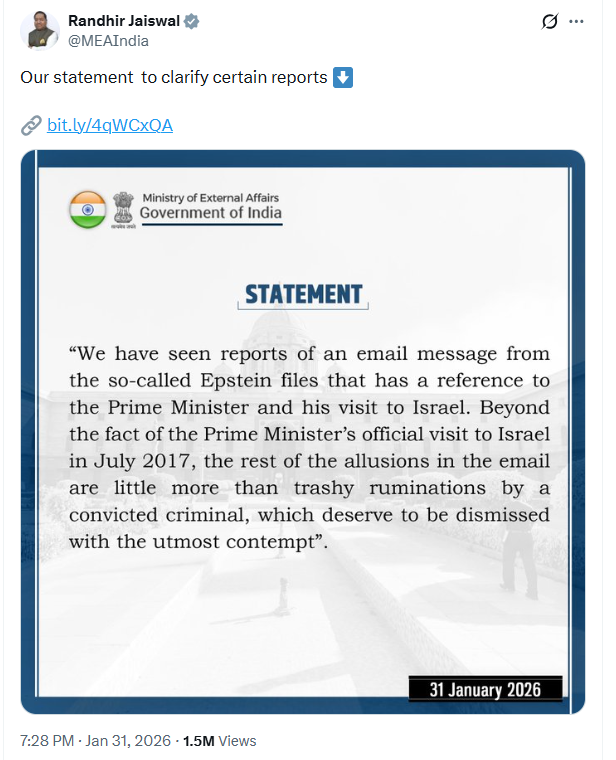
We also reviewed reports published by several other international media organizations. None of them contained any information supporting the viral claim that Prime Minister Modi visited Epstein Island more than 320 times. The Government of India also issued a clarification regarding references to Prime Minister Modi in the Epstein files. The clarification stated that, apart from references to his 2017 Israel visit, the files contain no other mention of the Prime Minister. The government further described subsequent claims and speculation on the matter as baseless.
https://x.com/MEAIndia/status/2017598414733840649?s=20
Conclusion:
The viral claim that the Epstein files reveal Prime Minister Narendra Modi visited Epstein Island more than 320 times is false. Available records, international media reports, and the Indian government's clarification do not support the claim.
