
#FactCheck-Old Kashmir operation visuals falsely shared as BSF action on Bangladeshi infiltrator at Tripura border
Executive Summary
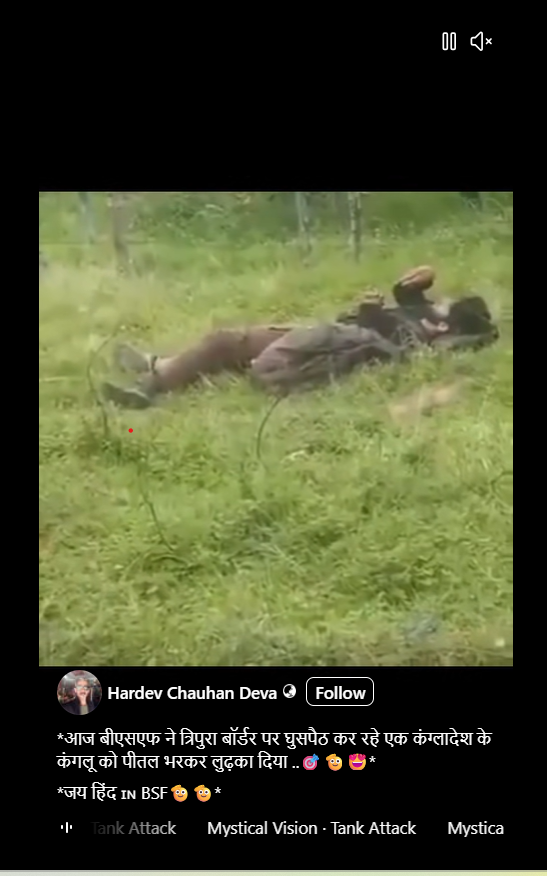
A video showing a body lying on the ground is being widely circulated on social media with the claim that it shows a Bangladeshi infiltrator who was killed by the Border Security Force (BSF) during an infiltration attempt along the Tripura border. CyberPeace Research Wing research found the claim to be misleading. While reports confirm that in June 2026 a Bangladeshi national was killed in BSF firing in Tripura’s Unakoti district, the viral video is unrelated to that incident.
Claim:
A Facebook reel shared the video claiming that BSF recently shot dead a Bangladeshi infiltrator at the Tripura border, and that the visuals depict the same incident. Link: https://www.facebook.com/reel/1561542888951793
Fact Check:
A reverse image search of keyframes from the viral video led to reports published by Bhaskar English, which carried the same visuals. The reports identified the deceased as Haris Nazir Dar, a Lashkar-e-Taiba terrorist, who was killed during Operation Akhal on 2 August 2025 in Jammu and Kashmir. https://www.bhaskarenglish.in/national/news/2-soldiers-martyred-in-jks-kulgam-3-terrorists-killed-135638183.html

Further verification also found similar coverage on WION, confirming the same context of the incident. https://www.youtube.com/watch?v=Uhk-7QjPKK8

Operation Akhal was a major joint counter-terrorism operation conducted in August 2025 in the Akhal forests of Kulgam district, South Kashmir, by the Indian Army’s Chinar Corps, Jammu and Kashmir Police, and the Special Operations Group (SOG). https://newsonair.gov.in/kulgam-encounter-joint-operation-continues-in-akhal-forests-three-terrorists-killed/

Conclusion:
The research confirms that the viral video claiming to show a Bangladeshi infiltrator killed by the BSF at the Tripura border is misleading. The footage is from an August 2025 counter-terrorism operation in Jammu and Kashmir and shows Lashkar-e-Taiba terrorist Haris Nazir Dar killed during Operation Akhal.

Related Blogs

Introduction
In a groundbreaking move, India's Reserve Bank has embarked on a transformative journey with its Central Bank Digital Currency (CBDC) project. As the world grapples with the evolving landscape of digital finance, the implications of India's CBDC initiative extend beyond its borders, potentially reshaping global payment systems. The Union Minister of State for Finance, Shri Pankaj Chaudhary, revealed that on October 7, 2022, the Reserve Bank of India released a proposal note on Central Bank Digital Currency (CBDC). Two pilot projects using blockchain-based technology are described in the concept note: Digital Rupee-Wholesale (e₹-W) and Digital Rupee-Retail (e₹-R). Launched on November 1, 2022, the bulk trading pilot aims to increase intermediary competitiveness, particularly in the resolution of trades in the secondary market involving sovereign debt. In parallel, on December 1, 2022, the retail banking pilot, known as e₹-R, got underway in a limited user group with eight banks taking part in stages.
The digital asset known as e₳-R is issued across financial institutions for Person-to-Person (P2P) and Person-to-Merchant (P2M) transactions. It is intended to serve as a virtual currency that represents legal money and exhibits characteristics similar to actual cash. Based on input gathered during the continuing trial phases, the RBI intends to progressively broaden the pilot project's scope.
Central Bank Digital Currency Pilot Projects
Central Bank Digital Currency (CBDC), which the Central Bank of India is promoting, may easily perform an essential part in payments made across borders, according to Reserve Bank Governor Shaktikanta Das. The CBDC is going to be expanded to the international financial markets after being implemented as a trial in both the retail and wholesale industries.
CBDC in International Payments
He emphasized that although physical currency will still exist, the CBDC will eventually replace all forms of money worldwide.
"CBDC is going to be the future currency of the world and it is necessary that every central bank, every country works on CBDC," he stated. He also stated that as worldwide commerce moves more and more around science and technology, CBDCs will play a significant role since they can effectively and affordably speed up payment processing across different countries. Regarding India's foreign exchange reserves, the governor stated that the selection to increase the resources as a safety net and protection versus contagion possibilities was made consciously.
CBDCs' Place in the Transnational Economic Revolution
In certain economies worldwide, having a CBDC internationally accessible could lead to more replacements for foreign currencies rather than the home currencies, which could cause financial aggregates to become volatile and change the mix of instruments of exchange.
CBDC may have benefits related to first-mover savings of scale, and other consequences even in everyday circumstances. If nations with global currencies have established CBDCs, they could strengthen current advantages and disadvantages, including consequences, particularly in terms of revenue. In a similar vein, CBDC might alter the structure of international liquidity while safeguarding asset supply. Additionally, and particularly if imposed abruptly, CBDC may, in certain circumstances, result in significant capital movements and associated repercussions on the foreign exchange rate as well as additional asset prices. Furthermore, nations may encounter difficulties in getting ready for virtual currencies issued by central banks.
The worldwide and international scope of CBDCs accessible to immigrants may become particularly apparent in situations where there is a widespread flight safety concern. In these circumstances, converting a CBDC into a foreign currency would make it possible for capital markets to deleverage more quickly. The elimination of debt challenges could show up as tight finance constraints and abrupt swings in foreign exchange markets if CBDCS expedited its flight from uncertainty.
Deposits of Foreign Exchange and Self-Dependency
Reserve Bank Governor Shaktikanta Das stated "We must rely on ourselves. We must maintain our robust reserves. In order to achieve that goal, we have been amassing quite substantial reserves, and the outside world has come to feel quite confident that India would be able to fulfil its contractual responsibilities to the international community no matter what the obstacles,"
Involvement of RBI in the Currency Market
Given that the trading community was confident that the Reserve Bank of India would be capable of and able to fulfil its contractual responsibilities, the value of the Indian rupee did not decline as dramatically. The RBI governor stated that the RBI does participate in the economy, but that "our engagement operates in two ways," he would not hesitate to acknowledge this.
The Value of Macroeconomic and Budgetary Cooperation
According to RBI Governor Das, the RBI makes purchases and sales of dollars based on the direction in which the financial sector is trending. However, the RBI does not intend to set a certain level for the rupee because it does not consider any specific threshold for the Indian rupee's conversion rate against the US dollar. He also emphasized how crucial it is for both the financial and monetary authorities to work together.
Conclusion
India's CBDC project signals a transformative shift in the global digital finance landscape. Governor Shaktikanta Das envisions CBDCs as the future global currency, emphasizing their role in international payments. The potential impact on financial systems, cross-border transactions, and the need for self-reliance underscore the significance of India's CBDC initiative in shaping the evolving dynamics of the digital economy. As the project progresses, close cooperation between financial and monetary authorities becomes imperative for navigating the challenges and opportunities associated with this groundbreaking venture.
References
- https://economictimes.indiatimes.com/news/economy/policy/central-bank-digital-currency-can-play-important-role-in-cross-border-payment-rbi-guv/articleshow/104706717.cms
- https://www.bis.org/cpmi/publ/d174.pdf
- https://bfsi.economictimes.indiatimes.com/news/fintech/explained-how-rbi-is-leveraging-upi-to-push-the-use-of-retail-cbdc/103591989
- https://www.imf.org/en/News/Articles/2022/02/09/sp020922-the-future-of-money-gearing-up-for-central-bank-digital-currency
- https://www.business-standard.com/economy/news/cbdc-pilot-projects-show-promising-results-rbi-governor-shaktikanta-das-123102601171_1.html

Executive Summary:
A morphed video of the actor Anup Soni popular on social media promoting IPL betting Telegram channel is found to be fake. The audio in the morphed video is produced through AI voice cloning. AI manipulation was identified by AI detection tools and deepfake analysis tools. In the original footage Mr Soni explains a case of crime, a part of the popular show Crime Patrol which is unrelated to betting. Therefore, it is important to draw the conclusion that Anup Soni is in no way associated with the betting channel.

Claims:
The facebook post claims the IPL betting Telegram channel which belongs to Rohit Khattar is promoted by Actor Anup Soni.

Fact Check:
Upon receiving the post, the CyberPeace Research Team closely analyzed the video and found major discrepancies which are mostly seen in AI-manipulated videos. The lip sync of the video does not match the audio. Taking a cue from this we analyzed using a Deepfake detection tool by True Media. It is found that the voice of the video is 100% AI-generated.


We then extracted the audio and checked in an audio Deepfake detection tool named Hive Moderation. Hive moderation found the audio to be 99.9% AI-Generated.

We then divided the video into keyframes and reverse searched one of the keyframes and found the original video uploaded by the YouTube channel named LIV Crime.
Upon analyzing we found that in the 3:18 time frame the video was edited, and altered with an AI voice.

Hence, the viral video is an AI manipulated video and it’s not real. We have previously debunked such AI voice manipulation with different celebrities and politicians to misrepresent the actual context. Netizens must be careful while believing in such AI manipulation videos.
Conclusion:
In conclusion, the viral video claiming that IPL betting Telegram channel promotion by actor Anup Soni is false. The video has been manipulated using AI voice cloning technology, as confirmed by both the Hive Moderation AI detector and the True Media AI detection tool. Therefore, the claim is baseless and misleading.
- Claim: An IPL betting Telegram channel belonging to Rohit Khattar promoted by Actor Anup Soni.
- Claimed on: Facebook
- Fact Check: Fake & Misleading

Introduction:
Welcome to the second edition of our blog on Digital forensics series. In our previous blog we discussed what digital forensics is, the process followed by the tools, and the subsequent challenges faced in the field. Further, we looked at how the future of Digital Forensics will hold in the current scenario. Today, we will explore differences between 3 particular similar sounding terms that vary significantly in functionality when implemented: Copying, Cloning and Imaging.
In Digital Forensics, the preservation and analysis of electronic evidence are important for investigations and legal proceedings. Replication of the data and devices is one of the fundamental tasks in this domain, without compromising the integrity of the original evidence.
Three primary techniques -- copying, cloning, and imaging -- are used for this purpose. Each technique has its own strengths and is applied according to the needs of the investigation.
In this blog, we will examine the differences between copying, cloning and imaging. We will talk about the importance of each technique, their applications and why imaging is considered the best for forensic investigations.
Copying
Copying means duplicating data or files from one location to another. When one does copying, it implies that one is using standard copy commands. However, when dealing with evidence, it might be hard to use copy only. It is because the standard copy can alter the metadata and change the hidden or deleted data .
The characteristics of copying include:
- Speed: copying is simpler and faster,compared to cloning or imaging.
- Risk: The risk involved in copying is that the metadata might be altered and all the data might be captured.
Cloning
It is the process where the transfer of the entire contents of a hard drive or a storage device is done on another storage device. This process is known as cloning . This way, the cloning process captures both the active data and the unallocated space and hidden partitions, thus containing the whole structure of the original device. Cloning is generally used at the sector level of the device. Clones can be used as the working copy of a device .
Characteristics of cloning:
- bit-for-bit replication: cloning keeps the exact content and the whole structure of the original device.
- Use cases: cloning is used when it is needed to keep the original device intact for further examination or a legal affair.
- Time consuming: Cloning is usually longer in comparison to simple copying since it involves the whole detailed replication. Though it depends on various factors like the size of the storage device, the speed of the devices involved, and the method of cloning.
Imaging:
It is the process of creating a forensic image of a storage device. A forensic image is a replica copy of every bit of data that was on the source device, this including the allocated, unallocated, and the available slack space .
The image is then used for analysis and investigation, and the original evidence is left untouched. Images can’t be used as the working copies of a device. Unlike cloning, which produces working copies, forensic images are typically used for analysis and investigation purposes and are not intended for regular use as working copies.
Characteristics of Imaging:
- Integrity: Imaging ensures the integrity and authenticity of the evidence produced
- Flexibility: Forensic image replicas can be mounted as a virtual drive to create image-specific mode for analysis of data without affecting the original evidence .
- Metadata: Imaging captures metadata associated with the data, thus promoting forensic analysis.
Key Differences
- Purpose: Copying is for everyday use but not good for forensic investigations requiring data integrity. Cloning and imaging are made for forensic preservation.
- Depth of Replication: Cloning and imaging captures the entire storage device including hidden, unallocated, and deleted data whereas copying may miss crucial forensic data.
- Data Integrity: Imaging and cloning keep the integrity of the original evidence thus making them suitable for legal and forensic use. Which is a critical aspect of forensic investigations.
- Forensic Soundness: Imaging is considered the best in digital forensics due to its comprehensive and non-invasive nature.
- Cloning is generally from one hard disk to another, where as imaging creates a compressed file that contains a snapshot of the entire hard drive or a specific partitions
Conclusion
Therefore, copying, cloning, and imaging all deal with duplication of data or storage devices with significant variations, especially in digital forensic. However, for forensic investigations, imaging is the most selected approach due to the correct preservation of the evidence state for any analysis or legal use . Therefore, it is essential for forensic investigators to understand these rigorous differences to avail of real and uncontaminated digital evidence for their investigation and legal argument.
