
#FactCheck: Old Dubai Airport Video Falsely Shared as Delhi Airport Footage After Heavy Rain
Executive Summary
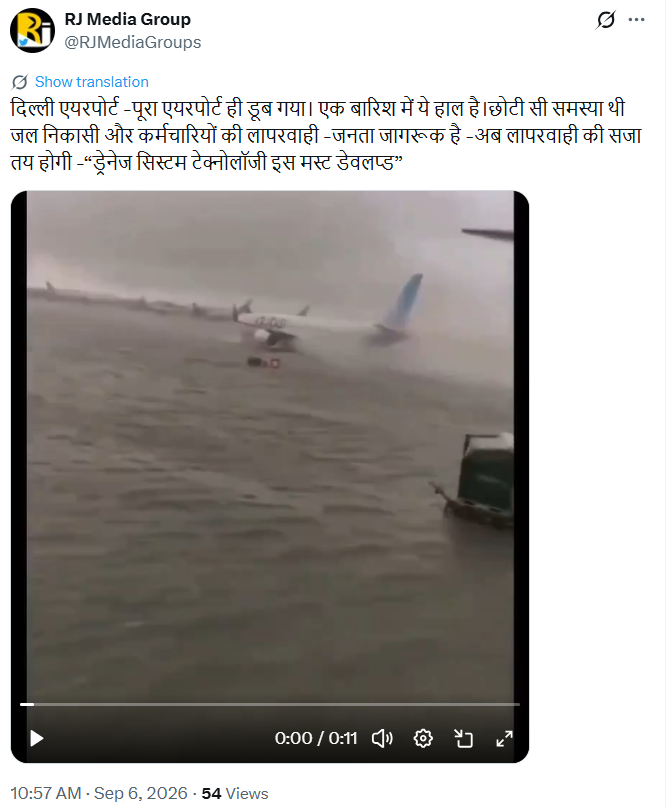
A post is being widely circulated on social media claiming that the entire Delhi airport was submerged following heavy rainfall. The post questions the airport’s drainage system and attributes the situation to the negligence of its staff. The post further claims that the airport’s arrangements were exposed after just one spell of rain and that its drainage system needs to be upgraded using better technology. A research by the research wing of CyberPeace found that the viral video is not from Delhi airport but dates back to April 2024. At the time, heavy rainfall in Dubai caused flood-like conditions at the airport, affecting flight operations on waterlogged runways as well. Thus, an old video from Dubai is being falsely shared on social media as footage of Delhi airport.
Claim:
A user on the social media platform X (formerly Twitter) shared the viral video with the caption: “Delhi Airport — the entire airport is submerged. This is the situation after just one spell of rain. A minor issue of drainage and negligence by the staff — the public is aware — now the negligence will be punished. ‘The drainage system technology must be developed.’”
https://x.com/RJMediaGroups/status/2096470339060736149
Factcheck
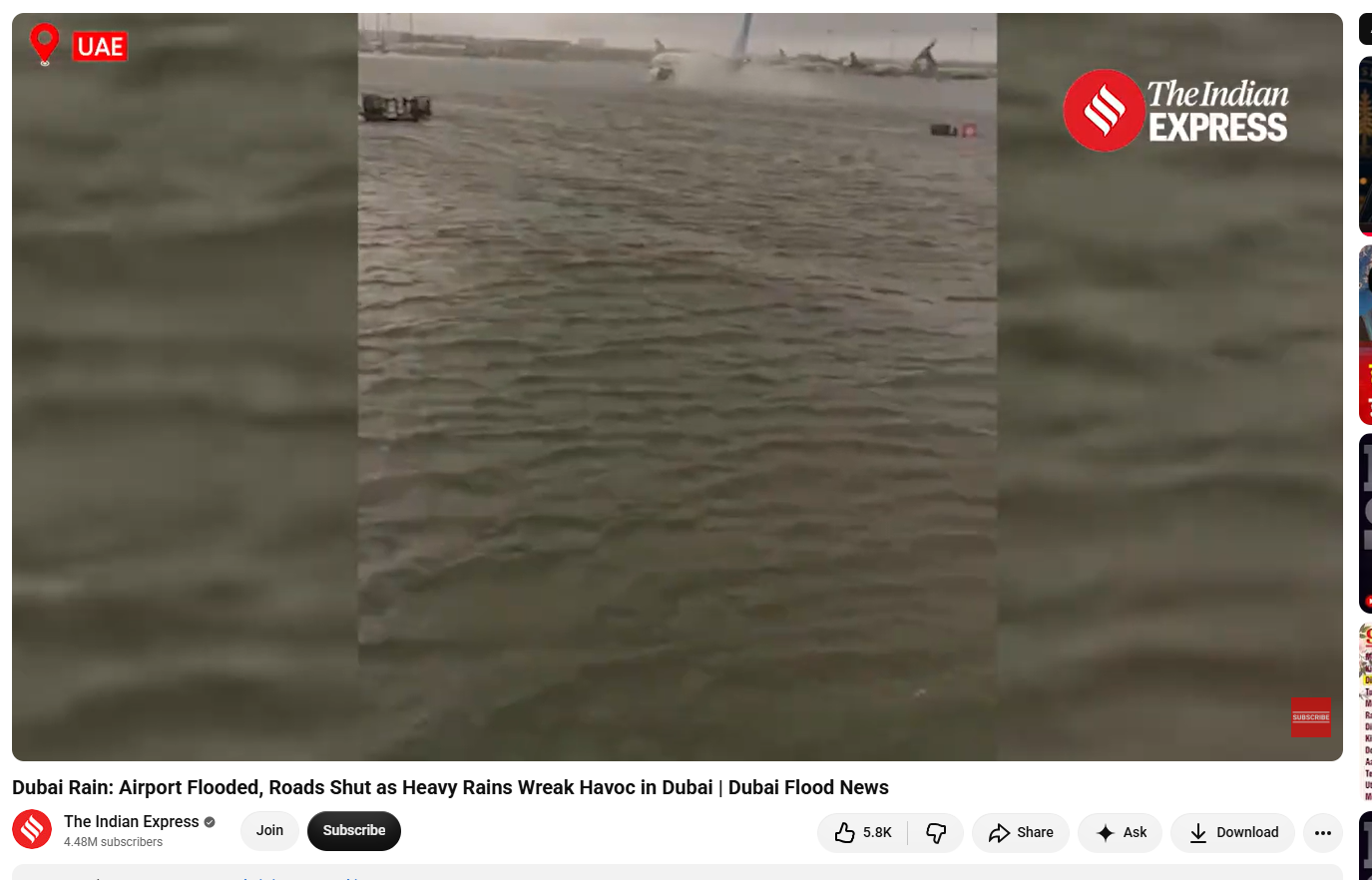
As part of our investigation, we conducted a reverse image search of keyframes from the video. During the search, we found the original video on a YouTube channel named The Indian Express, which was uploaded on April 17, 2024. According to the video description, the incident took place in Dubai. The post link and screenshot are provided below.
https://www.youtube.com/watch?v=O9F1qTMIO5M
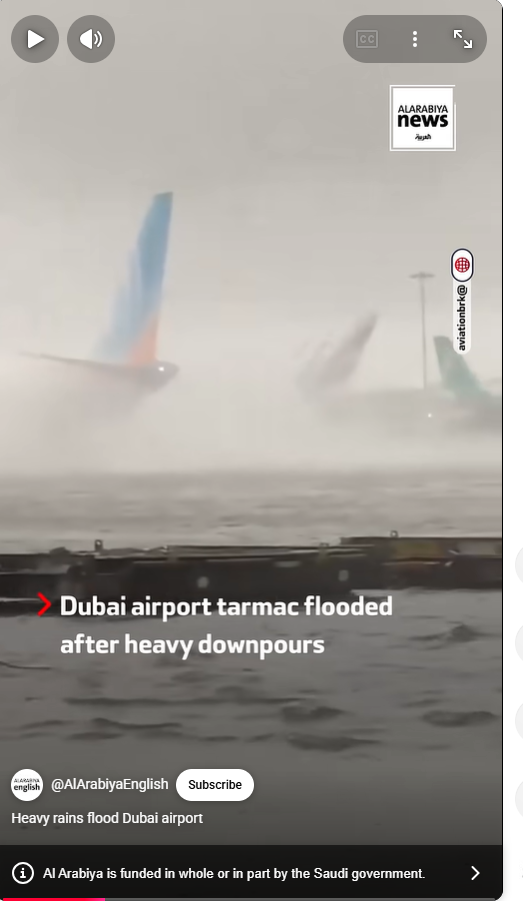
During our investigation, we found visuals similar to those in the viral video on the YouTube channel AlArabiyaEnglish. The video was uploaded on April 16, 2024. According to the information provided in the video description, several parts of the UAE were affected by flooding following sudden heavy rainfall on April 16, 2024. The heavy rains also affected operations at Dubai Airport, disrupting several flights. According to the report, the UAE recorded a record 254 mm of rainfall in less than 24 hours. In view of the adverse weather conditions, Dubai Airport advised passengers to travel only if absolutely necessary. The post link and screenshot are provided below.
https://www.youtube.com/shorts/KzIstkiOdp4
Conclusion:
Our investigation found that the viral video does not show Delhi Airport after heavy rainfall. The visuals are actually from Dubai Airport, where severe rainfall in the UAE in April 2024 led to flooding and disruptions to airport operations. Therefore, the viral video is old and has been falsely shared on social media with the misleading claim that it shows the current condition of Delhi Airport.

Related Blogs
Executive Summary
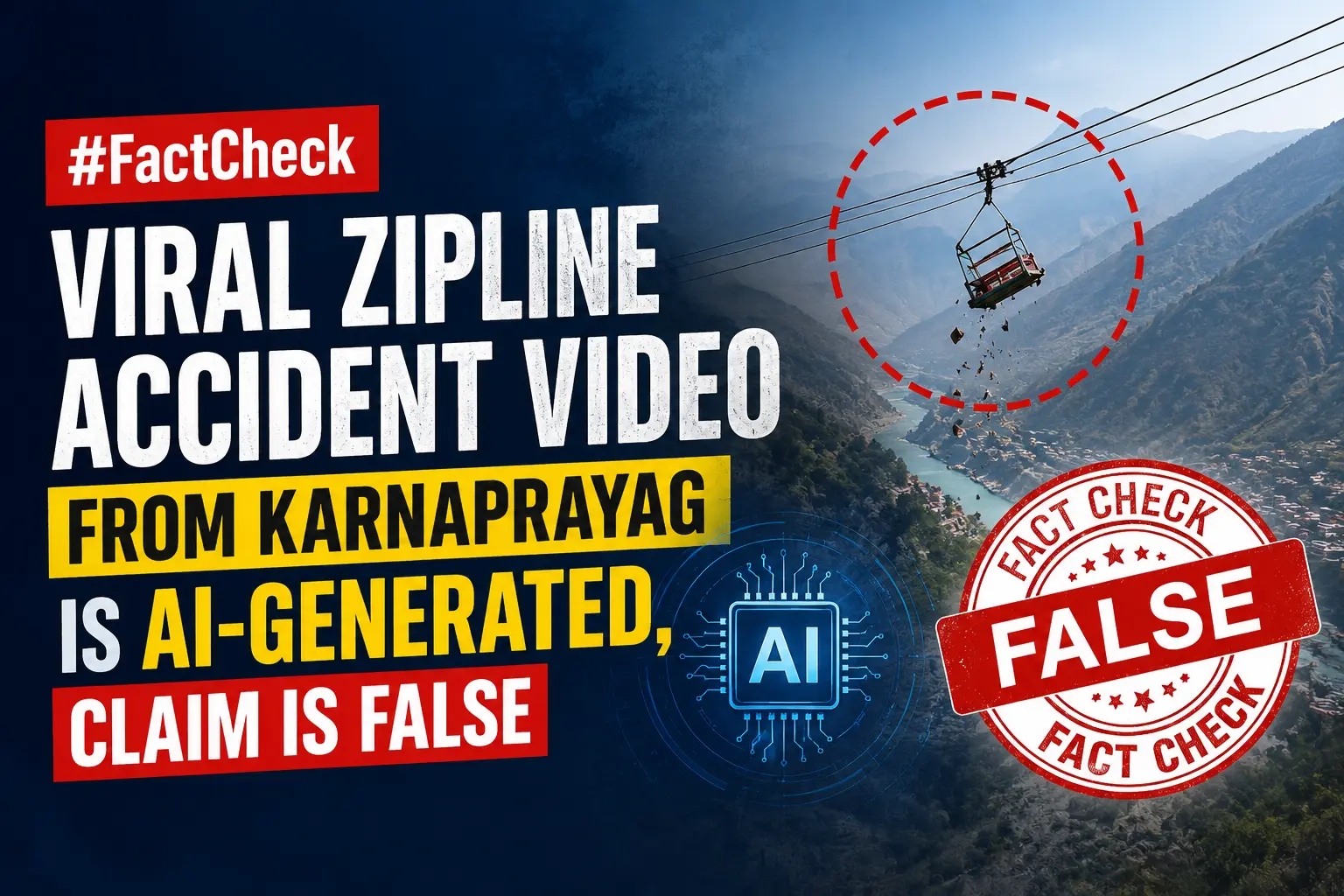
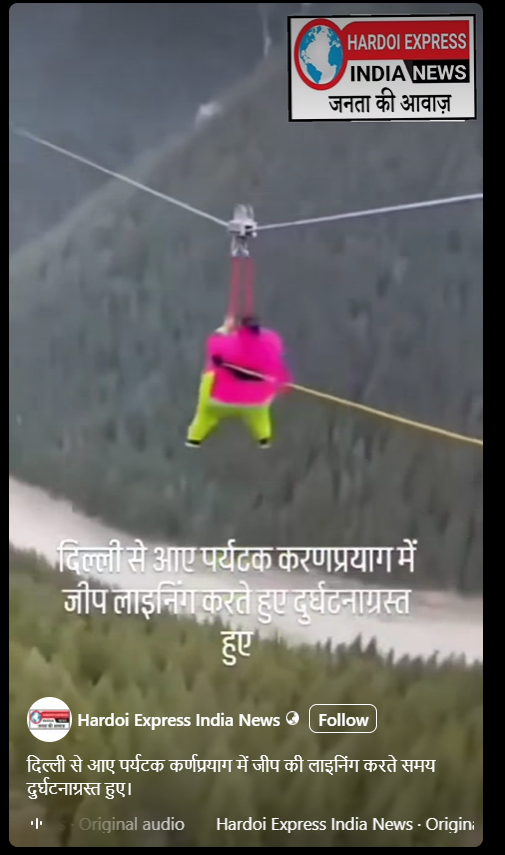
A video is being shared on social media claiming that a female tourist from Delhi fell into a deep gorge during ziplining in Karnaprayag. In the viral video, a woman dressed in bright pink and yellow clothes is seen ziplining amidst high mountains, when suddenly the zipline wire breaks and she falls from a significant height into a deep gorge. Social media users are sharing this video, presenting it as a real incident. Research by the CyberPeace Research Wing revealed that the claim of a Delhi woman tourist's death during a zipline accident in Karnaprayag is baseless. The viral video is AI-generated.
Claim
According to the claim, this accident took place in Karnaprayag, Uttarakhand, where a female tourist from Delhi became a victim of this horrific mishap. Several social media users are claiming that the woman died in this accident.
https://www.facebook.com/reel/26108544868822432
Fact Check
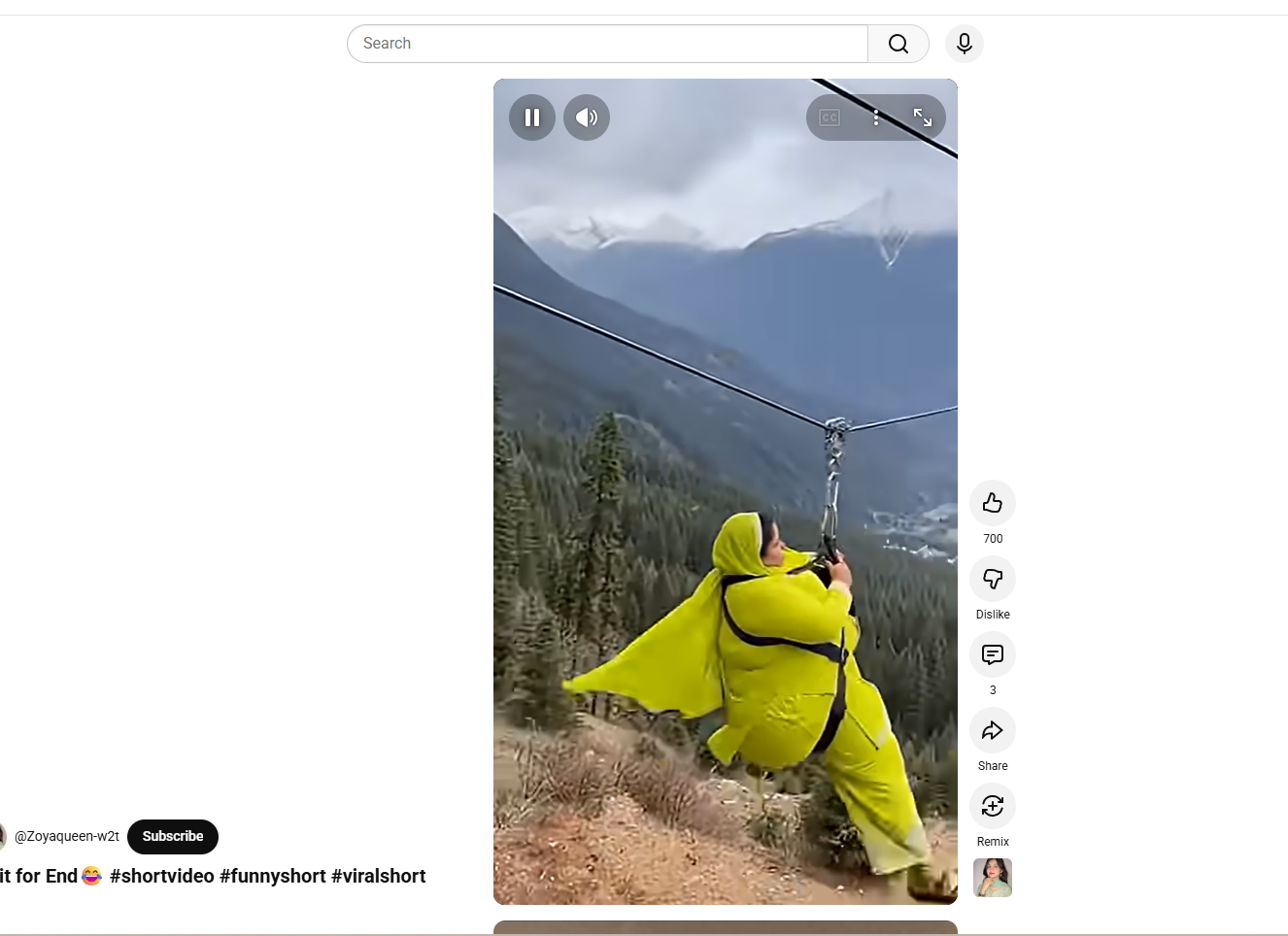
To investigate the video viral as a zipline accident in Karnaprayag, we conducted a reverse search of its keyframes. During this, we found the video uploaded as a Short on a Pakistani YouTube channel, @Zoyaqueen-w2t, on June 2, 2026. Hashtags like '#funnyshorts' were used in the caption of this video. Scanning this account revealed that several other fictional videos related to similar zipline accidents have also been uploaded here. Apart from this, the video was also shared with funny hashtags in some social media posts from May 2026.
https://www.youtube.com/shorts/Gzha_J7Fqv0
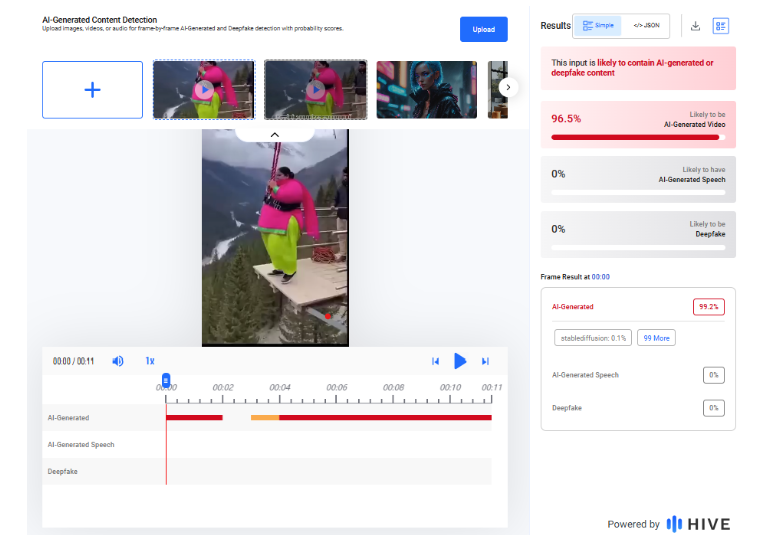
Following this, searching with relevant keywords yielded no credible media reports regarding any such zipline accident in Karnaprayag, Uttarakhand, in recent times. Subsequently, we scanned the viral video of the alleged zipline accident using the AI detection tool 'Hive Moderation'. During the analysis, the tool classified the video as highly likely to be AI-generated, with a score of 99.2%.
Conclusion
From the evidence gathered in our research , it is clear that the claim regarding the death of a female tourist from Delhi during a zipline accident in Karnaprayag is baseless. The viral video is not of a real incident, but is AI-generated.
Executive Summary
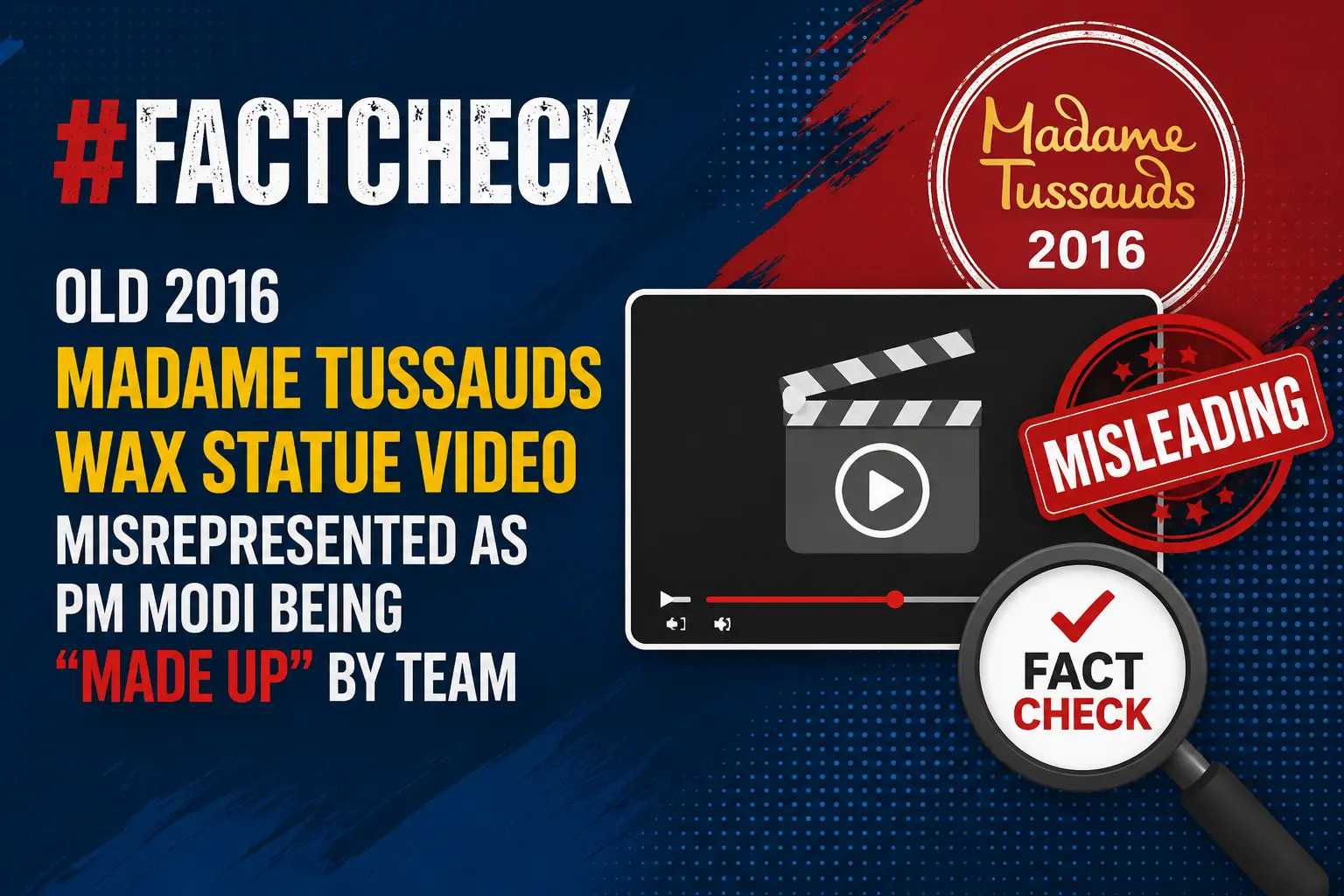
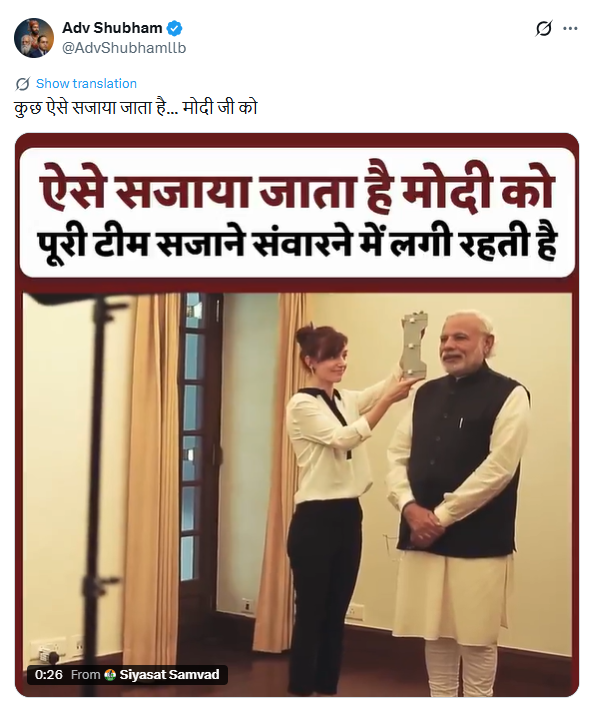
A video of Prime Minister Narendra Modi is being widely shared on social media with the claim that he is being “made up” or styled by a team, with users attempting to mock him using the footage. The clip is being circulated with misleading captions suggesting it shows the Prime Minister undergoing makeup and grooming by a dedicated team. CyberPeace Foundation Research Wing, in its research, found that the viral claim is false. In fact, the viral video is not recent, but from 2016. At that time, a statue of PM Modi was to be installed at Madame Tussauds Museum. A team of artists and experts visited the Prime Minister's residence to take measurements for the statue. This misleading claim has been circulating on social media for several years. We have previously fact-checked this claim and exposed the truth.
Claim
An X user named “Adv Shubham” shared the viral video on May 27, 2026, with the caption:“This is how Modi Ji is styled…”The post also claims that the Prime Minister is regularly “made up” by a team.
- https://x.com/AdvShubhamllb/status/2059682034289946746
- https://perma.cc/FVM9-PQBP
Fact Check
The viral video is not recent. It dates back to 2016 and is related to a completely different context. During the investigation, we found the same footage on the official YouTube channel of Madame Tussauds London, uploaded on March 16, 2016.

According to the video details, it shows the process of taking measurements for a wax statue of Prime Minister Narendra Modi for installation at Madame Tussauds. A team of artists and experts had visited the Prime Minister’s residence in Delhi for this purpose.
Conclusion
The viral claim that Prime Minister Narendra Modi is being “made up” by a team is false. The footage is from 2016 and shows a measurement session conducted for his wax statue at Madame Tussauds Museum.

Introduction
Betting has long been associated with sporting activities and has found a growing presence in online gaming and esports globally. As the esports industry continues to expand, Statista has projected that it will reach a market value of $5.9 billion by 2029. As such, associated markets have also seen significant growth. In 2024, this segment accounted for an estimated $2.5 billion globally. While such engagement avenues are popular among international audiences, they also bring attention to concerns around regulation, integrity, and user protection. As esports builds its credibility and reach, especially among younger demographics, these aspects become increasingly important to address in policy and practice.
What Does Esports Betting Involve?
Much like traditional sports, esports engagement in some regions includes the practice of wagering on teams, players, or match outcomes. But it is inherently more complex. The accurate valuation of odds in online gaming and esports can be complicated by frequently updated game titles, changing teams, and shifting updates to game mechanics (called metas- most effective strategies). Bets can be placed using real money, virtual items like skins (digital avatars), or increasingly, cryptocurrency.
Esports and Wagering: Emerging Issues and Implications
- Legal Grey Areas: While countries like South Korea and some USA states have dedicated regulations for esports betting and licensed bookmaking, most do not. This creates legal grey areas for betting service providers to access unregulated markets, increasing the risk of fraud, money laundering, and exploitation of bettors in those regions.
- The Skill v/s Chance Dilemma: Most gambling laws across the world regulate betting based on the distinction between ‘games of skill’ and ‘games of chance’. Betting on the latter is typically illegal, since winning depends on chance. But the definitions of ‘skill’ and ‘chance’ may vary by jurisdiction. Also, esports betting often blurs into gambling. Outcomes may depend on player skill, but in-game economies like skin betting and unpredictable gameplay introduce elements of chance, complicating regulation and making enforcement difficult.
- Underage Gambling and Addiction Risks: Players are often minors and are exposed to the gambling ecosystem due to gamified betting through reward systems like loot boxes. These often mimic the mechanics of betting, normalising gambling behaviours among young users before they fully understand the risks. This can lead to the development of addictive behaviours.
- Match-Fixing and Loss of Integrity: Esports are particularly susceptible to match-fixing because of weak regulation, financial pressures, and the anonymity of online betting. Instances like the Dota 2 Southeast Asia Scandals (2023) and Valorant match-fixing in North America (2021) can jeopardise audience trust and sponsorships. This affects the trustworthiness of minor tournaments, where talent is discovered.
- Cybersecurity and Data Risks: Esports betting apps collect sensitive user data, making them an attractive target for cybercrime. Bettors are susceptible to identity theft, financial fraud, and data breaches, especially on unlicensed platforms.
Way Forward
To strengthen trust, ensure user safety, and protect privacy within the esports ecosystem, responsible management of betting practices can be achieved through targeted interventions focused on:
- National-Level Regulations: Countries like India have a large online gaming and esports market. It will need to create a regulatory authority along the lines of the UK’s Gambling Commission and update its gambling laws to protect consumers.
- Protection of Minors: Setting guardrails such as age verification, responsible advertising, anti-fraud mechanisms, self-exclusion tools, and spending caps can help to keep a check on gambling by minors.
- Harmonizing Global Standards: Since esports is inherently global, aligning core regulatory principles across jurisdictions (such as through multi-country agreements or voluntary industry codes of conduct) can help create consistency while avoiding overregulation.
- Co-Regulation: Governments, esports organisers, betting platforms, and player associations should work closely to design effective, well-informed policies. This can help uphold the interests of all stakeholders in the industry.
Conclusion
Betting in esports is inevitable. But the industry faces a double dilemma- overregulating on the one hand, or letting gambling go unchecked, on the other. Both can be detrimental to its growth. This is why there is a need for industry actors like policymakers, platforms and organisers to work together to harmonise legal inconsistencies, protect vulnerable users and invest in forming data security. Forming industry-wide ethics boards, promoting regional regulatory dialogue, and instating transparency measures for betting operators can be a step in this direction to ensure that esports evolves into a mature, trusted global industry.
