
#FactCheck: Old Dance Video From Punjab College Falsely Linked to Protest Against CEC Gyanesh Kumar
Executive Summary:
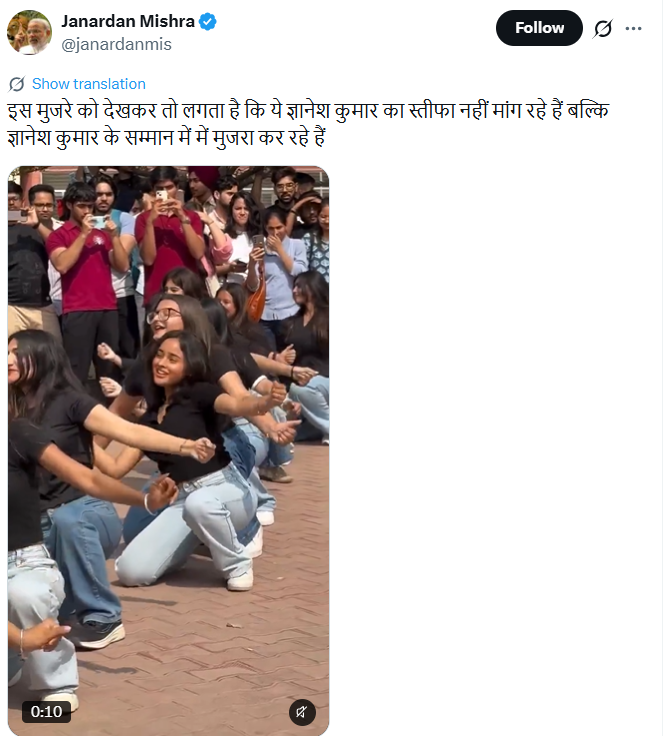
A video of girls dancing is being shared on social media. The video is being circulated with the claim that it shows a recent protest against Chief Election Commissioner Gyanesh Kumar. Social media users are sharing the video as footage from the protest and attempting to link it to the ongoing developments. However, CyberPeace Research found the viral claim to be false. Our research found that the video is not recent. The viral video is from an event organised at a college under Panjab University and has no connection with the ongoing protests against Chief Election Commissioner Gyanesh Kumar.
Claim:
A user on the social media platform X (formerly Twitter) shared the viral video on October 5, 2026, with the caption: “Looking at this mujra, it seems they are not demanding Gyanesh Kumar’s resignation, but rather performing a mujra in his honour.” The post link, archive link, and screenshot are provided below.
https://x.com/janardanmis/status/2107092458731614355
Fact Check
To verify the authenticity of the viral claim, we conducted a reverse image search using keyframes from the video. During the search, we found the same video uploaded on the Instagram account named “SD Flash Zoom” on March 7, 2026. Upon examining the Instagram account, we found that the page posts videos related to dance programmes organised at Goswami Ganesh Dutta Sanatan Dharma College (GGDSD College), affiliated with Panjab University. The post link and screenshot are provided below.
https://www.instagram.com/p/DVkLftuCW_G/

During our research, we found another video uploaded on the same account on March 9, 2026. Watch the video. The visuals seen in this video match those in the viral video, confirming that both videos are from the same event. The post link and screenshot are provided below.
https://www.instagram.com/p/DVqRuIdiQ7t/

Conclusion
The evidence gathered during our research makes it clear that the video being shared on social media as footage of a protest against Chief Election Commissioner Gyanesh Kumar is not recent. The viral video is actually from an event held at SD College in Punjab in March 2026. Therefore, the claim that the video shows a protest against Chief Election Commissioner Gyanesh Kumar is misleading.

Related Blogs

Introduction
In September 2025, social media feeds were flooded with strikingly vintage saree-type portraits. These images were not taken by professional photographers, but AI-generated images. More than a million people turned to the "Nano Banana" AI tool of Google Gemini, uploading their ordinary selfies and watching them transform into Bollywood-style, cinematic, 1990s posters. The popularity of this trend is evident, as are the concerns of law enforcement agencies and cybersecurity experts regarding risks of infringement of privacy, unauthorised data sharing, and threats related to deepfake misuse.
What is the Trend?
This trend in AI sarees is created using Google Geminis' Nano Banana image-editing tool, editing and morphing uploaded selfies into glitzy vintage portraits in traditional Indian attire. A user would upload a clear photograph of a solo subject and enter prompts to generate images of cinematic backgrounds, flowing chiffon sarees, golden-hour ambience, and grainy film texture, reminiscent of classic Bollywood imagery. Since its launch, the tool has processed over 500 million images, with the saree trend marking one of its most popular uses. Photographs are uploaded to an AI system, which uses machine learning to alter the pictures according to the description specified. The transformed AI portraits are then shared by users on their Instagram, WhatsApp, and other social media platforms, thereby contributing to the viral nature of the trend.
Law Enforcement Agency Warnings
- A few Indian police agencies have issued strong advisories against participation in such trends. IPS Officer VC Sajjanar warned the public: "The uploading of just one personal photograph can make greedy operators go from clicking their fingers to joining hands with criminals and emptying one's bank account." His advisory had further warned that sharing personal information through trending apps can lead to many scams and fraud.
- Jalandhar Rural Police issued a comprehensive warning stating that such applications put the user at risk of identity theft and online fraud when personal pictures are uploaded. A senior police officer stated: "Once sensitive facial data is uploaded, it can be stored, analysed, and even potentially misused to open the way for cyber fraud, impersonation, and digital identity crimes.
The Cyber Crime Police also put out warnings on social media platforms regarding how photo applications appear entertaining but can pose serious risks to user privacy. They specifically warned that selfies uploaded can lead to data misuse, deepfake creation, and the generation of fake profiles, which are punishable under Sections 66C and 66D of the IT Act 2000.
Consequences of Such Trends
The massification of AI photo trends has several severe effects on private users and society as a whole. Identity fraud and theft are the main issues, as uploaded biometric information can be used by hackers to generate imitated identities, evading security measures or committing financial fraud. The facial recognition information shared by means of these trends remains a digital asset that could be abused years after the trend has passed. ‘Deepfake’ production is another tremendous threat because personal images shared on AI platforms can be utilised to create non-consensual artificial media. Studies have found that more than 95,000 deepfake videos circulated online in 2023 alone, a 550% increase from 2019. The images uploaded can be leveraged to produce embarrassing or harmful content that can cause damage to personal reputation, relationships, and career prospects.
Financial exploitation is also when fake applications in the guise of genuine AI tools strip users of their personal data and financial details. Such malicious platforms tend to look like well-known services so as to trick users into divulging sensitive information. Long-term privacy infringement also comes about due to the permanent retention and possible commercial exploitation of personal biometric information by AI firms, even when users close down their accounts.
Privacy Risks
A few months ago, the Ghibli trend went viral, and now this new trend has taken over. Such trends may subject users to several layers of privacy threats that go far beyond the instant gratification of taking pleasing images. Harvesting of biometric data is the most critical issue since facial recognition information posted on these sites becomes inextricably linked with user identities. Under Google's privacy policy for Gemini tools, uploaded images might be stored temporarily for processing and may be kept for longer periods if used for feedback purposes or feature development.
Illegal data sharing happens when AI platforms provide user-uploaded content to third parties without user consent. A Mozilla Foundation study in 2023 discovered that 80% of popular AI apps had either non-transparent data policies or obscured the ability of users to opt out of data gathering. This opens up opportunities for personal photographs to be shared with anonymous entities for commercial use. Exploitation of training data includes the use of personal photos uploaded to enhance AI models without notifying or compensating users. Although Google provides users with options to turn off data sharing within privacy settings, most users are ignorant of these capabilities. Integration of cross-platform data increases privacy threats when AI applications use data from interlinked social media profiles, providing detailed user profiles that can be taken advantage of for purposeful manipulation or fraud. Inadequacy of informed consent continues to be a major problem, with users engaging in trends unaware of the entire context of sharing information. Studies show that 68% of individuals show concern regarding the misuse of AI app data, but 42% use these apps without going through the terms and conditions.
CyberPeace Expert Recommendations
While the Google Gemini image trend feature operates under its own terms and conditions, it is important to remember that many other tools and applications allow users to generate similar content. Not every platform can be trusted without scrutiny, so users who engage in such trends should do so only on trustworthy platforms and make reliable, informed choices. Above all, following cybersecurity best practices and digital security principles remains essential.
Here are some best practices:-
1.Immediate Protection Measures for User
In a nutshell, protection of personal information may begin by not uploading high-resolution personal photos into AI-based applications, especially those trained for facial recognition. Instead, a person can play with stock images or non-identifiable pictures to the degree that it satisfies the program's creative features without compromising biometric security. Strong privacy settings should exist on every social media platform and AI app by which a person can either limit access to their data, content, or anything else.
2.Organisational Safeguards
AI governance frameworks within organisations should enumerate policies regarding the usage of AI tools by employees, particularly those concerning the upload of personal data. Companies should appropriately carry out due diligence before the adoption of an AI product made commercially available for their own use in order to ensure that such a product has its privacy and security levels as suitable as intended by the company. Training should instruct employees regarding deepfake technology.
3.Technical Protection Strategies
Deepfake detection software should be used. These tools, which include Microsoft Video Authenticator, Intel FakeCatcher, and Sensity AI, allow real-time detection with an accuracy higher than 95%. Use blockchain-based concepts to verify content to create tamper-proof records of original digital assets so that the method of proposing deepfake content as original remains very difficult.
4.Policy and Awareness Initiatives
For high-risk transactions, especially in banks and identity verification systems, authentication should include voice and face liveness checks to ensure the person is real and not using fake or manipulated media. Implement digital literacy programs to empower users with knowledge about AI threats, deepfake detection techniques, and safe digital practices. Companies should also liaise with law enforcement, reporting purported AI crimes, thus offering assistance in combating malicious applications of synthetic media technology.
5.Addressing Data Transparency and Cross-Border AI Security
Regulatory systems need to be called for requiring the transparency of data policies in AI applications, along with providing the rights and choices to users regarding either Biometric data or any other data. Promotion must be given to the indigenous development of AI pertaining to India-centric privacy concerns, assuring the creation of AI models in a secure, transparent, and accountable manner. In respect of cross-border AI security concerns, there must be international cooperation for setting common standards of ethical design, production, and use of AI. With the virus-like contagiousness of AI phenomena such as saree editing trends, they portray the potential and hazards of the present-day generation of artificial intelligence. While such tools offer newer opportunities, they also pose grave privacy and security concerns, which should have been considered quite some time ago by users, organisations, and policy-makers. Through the setting up of all-around protection mechanisms and keeping an active eye on digital privacy, both individuals and institutions will reap the benefits of this AI innovation, and they shall not fall on the darker side of malicious exploitation.
References
- https://www.hindustantimes.com/trending/amid-google-gemini-nano-banana-ai-trend-ips-officer-warns-people-about-online-scams-101757980904282.html%202
- https://www.moneycontrol.com/news/india/viral-banana-ai-saree-selfies-may-risk-fraud-warn-jalandhar-rural-police-13549443.html
- https://www.parliament.nsw.gov.au/researchpapers/Documents/Sexually%20explicit%20deepfakes.pdf
- https://www.mckinsey.com/capabilities/quantumblack/our-insights/the-state-of-ai-in-2023-generative-ais-breakout-year
- https://www.mckinsey.com/capabilities/quantumblack/our-insights/the-state-of-ai-in-2023-generative-ais-breakout-year
- https://socradar.io/top-10-ai-deepfake-detection-tools-2025/

Introduction
CyberPeace Chronicles is a one-stop for the latest edition of news, updates, and findings in global cyberspace. As we step into the cyberage, it is pertinent that we need to incorporate cybersecurity practices in our day-to-day activities. From laptops to automated homes and cars, we are all surrounded by technology in some form or another. Thus, with the increased dependency, we need to eradicate the scope of vulnerabilities and threats around us and create robust and sustainable safety mechanisms for us and future generations.
What, When and How?
- WIN-RAR Update: CVE-2023-33831, a serious vulnerability, was identified in WinRAR versions prior to 6.23 in April 2023. When users attempted to access seemingly harmless files inside ZIP archives, this vulnerability allowed attackers to run arbitrary code. Cybercriminals transmitted malware families like DarkMe, GuLoader, and Remcos RAT by taking advantage of this vulnerability. It is essential to update WinRAR to version 6.23 or later in order to protect your computer and your data. Follow the following steps to secure your device -
- Checking Your Current WinRAR Version
- Downloading the Latest WinRAR Version
- Installing the Updated WinRAR
- Completing the Installation
- Verifying the Update
- Cleaning Up
- Indonesian Hacker Groups Target Indian Digital Infrastructure: As India geared up to host the G20 delegation as part of the Leadership Summit, various reports pointed towards different forms and intensity-based cyber attacks on Indian organisations and digital infrastructure. Tech firms in India have been successful in tracing the origination of the attacks to be from Indonesia. It is believed that hacker groups backed by anti-India elements have been trying to target the digital resources of India. Organisations and central agencies like Computer Emergency Response Team (CERT-In), National Critical Information Infrastructure Protection Centre (NCIIPC), I4C (Indian Cybercrime Coordination Centre), Delhi Police, Intelligence Bureau (IB), Research and Analysis Wing (R&AW), National Investigation Agency (NIA) and Central Bureau of Investigation (CBI) have constantly been working in keeping the Digital interests of India safe and secure, and with the ongoing G20 summit, it is very pertinent to be mindful of potential threats prevailing to prepare counter tactics for the same.
- CLOP Ransomware: The CL0P ransomware is thought to have initially surfaced in 2019 and was developed by a cybercriminal organisation that spoke Russian. The threat actor FIN11 (also known as TA505 and Snakefly), who is notorious for being financially driven, is frequently connected to the CL0P ransomware, which had its roots at the beginning of 2019. By utilising this technique, CL0P has targeted businesses utilising the "Accellion FTA" file transfer appliance's vulnerable version. Accordingly, it has been asserted that the following vulnerabilities have been used to access victim data and maybe switch to victim networks. Numerous well-publicized attacks carried out by CL0P have had an impact on organisations all across the world. Especially for Managed File Transfer (MFT) programmes, the CL0P performers are well known for their talent in developing zero-day vulnerabilities. The gang went after Accellion File Transfer Appliance (FTA) devices in both 2020 and 2021, then early in 2023, they went after Fortran/Linoma GoAnywhere MFT servers, and then later in June, they went after MOVEit transfer deployments. Up to 500 organisations are thought to have been harmed by this aggressive operation. Some of the ways to mitigate the risk are as follows:
- Regular Software Updates: Updating programmes and systems helps prevent known security flaws that fraudsters frequently exploit.
- Employee Training: Employee training can significantly lower the likelihood of successful penetration by educating staff members about phishing scams and safe internet conduct.
- Network Segmentation: By separating networks and restricting lateral movement, a ransomware attack's potential effects can be reduced.
- Regular Data backups: Data backups can lessen the effects of encryption and deter payment by regularly backing up data and storing it offsite.
- Security solutions: Putting in place effective cybersecurity measures like firewalls, intrusion detection systems, and cutting-edge endpoint protection can greatly improve an organisation's defences.
- Increased scrutiny for SIM card vendors: As phishing and smishing scams are on the rise in India, the Telecom Regulatory Authority of India (TRAI) has repeatedly issued notifications and consultation papers to address this growing concern. Earlier this year, TRAI notified that promotional calling will not be continued from 10-digit personal numbers. Instead, companies will now have to take authorised 9-digit numbers for promotional calls and SMSs. Similarly, to increase the efficiency of the same, TRAI has laid down that all the SIM card vendors will now have to be verified again, and any discrepancy found against any of the vendors will lead to blacklisting and penal actions against the vendor.
Conclusion
In conclusion, the digital landscape in 2023 is rife with both opportunities and challenges. The recent discovery of a critical vulnerability in WinRAR underscores the importance of regularly updating software to protect against malicious attacks. It is imperative for users to follow the provided steps to secure their devices and safeguard their data. Furthermore, the cyber threat landscape continues to evolve, with Indonesian hacker groups targeting Indian digital infrastructure, particularly during significant events like the G20 summit. Indian organisations and cybersecurity agencies are working diligently to defend against these threats and ensure the security of digital assets. The emergence of ransomware attacks, exemplified by the CL0P ransomware, serves as a stark reminder of the need for robust cybersecurity measures. Regular software updates, employee training, network segmentation, data backups, and advanced security solutions are crucial components of a comprehensive defence strategy against ransomware and other cyber threats. Additionally, the Telecom Regulatory Authority of India's efforts to enhance security in the telecommunications sector, such as stricter verification of SIM card vendors, demonstrate a proactive approach to addressing the rising threat of phishing and smishing scams. In this dynamic digital landscape, staying informed and implementing proactive cybersecurity measures is essential for individuals, organisations, and nations to protect their digital assets and maintain a secure online environment. Vigilance, collaboration, and ongoing adaptation are key to meeting the challenges posed by cyber threats in 2023 and beyond.
AI systems have grown in both popularity and complexity on which they operate. They are enhancing accessibility for all, including people with disabilities, by revolutionising sectors including healthcare, education, and public services. We are at the stage where AI-powered solutions that can help people with mental, physical, visual or hearing impairments perform everyday and complex tasks are being created.
Generative AI is now being used to amplify human capability. The development of tools for speech-to-text and image recognition is helping in facilitating communication and interaction for visually or hearing-impaired individuals, and smart prosthetics are providing tailored support. Unfortunately, even with these developments, PWDs have continued to face challenges. Therefore, it is important to balance innovation with ethical considerations aand ensuring that these technologies are designed with qualities like privacy, equity, and inclusivity in mind.
Access to Tech: the Barriers Faced by PWDs
PWDs face several barriers while accessing technology. Identifying these challenges is important as they lack computer accessibility, in the use of hardware and software, which has become a norm in life nowadays. Website functions that only work when users click with a mouse, self-service kiosks without accessibility features, touch screens without screen reader software or tactile keyboards, and out-of-order equipment, such as lifts, captioning mirrors and description headsets, are just some difficulties that they face in their day-to-day life.
While they are helpful, much of the current technology doesn’t fully address all disabilities. For example, many assistive devices focus on visual or mobility impairments, but they fall short of addressing cognitive or sensory conditions. In addition to this, these solutions often lack personalisation, making them less effective for individuals with diverse needs. AI has significant potential to bridge this gap. With adaptive systems like voice assistants, real-time translation, and personalised features, AI can create more inclusive solutions, improving access to both digital and physical spaces for everyone.
The Importance of Inclusive AI Design
Creating an Inclusive AI design is important. It ensures that PWDs are not excluded from technological advancements because of the impairments that they are suffering from. The concept of an ‘inclusive or universal’ design promotes creating products and services that are usable for the widest possible range of people. Tech Developers have an ethical responsibility to create advancements in AI that serve everyone. Accessibility features should be built into the core design. They should be treated as a practice rather than an afterthought. However, bias in AI development often stems from data of a non-representative nature, or assumptions can lead to systems that overlook or poorly serve PWDs. If AI algorithms are trained on limited or biased data, they risk excluding marginalised groups, making ethical, inclusive design a necessity for equity and accessibility.
Regulatory Efforts to Ensure Accessible AI
In India, the Rights of Persons with Disabilities Act of 2016 impresses upon the need to provide PWDs with equal accessibility to technology. Subsequently, the DPDP Act of 2023 highlights data privacy concerns for the disabled under section 9 to process their data.
On the international level, the newly incorporated EU’s AI Act mandates measures for transparent, safe, and fair access to AI systems along with including measures that are related to accessibility.
In the US, the Americans with Disabilities Act of 1990 and Section 508 of the 1998 amendment to the Rehabilitation Act of 1973 are the primary legislations that work on promoting digital accessibility in public services.
Challenges in implementing Regulations for AI Accessibility for PWDs
Defining the term ‘inclusive AI’ is a challenge. When working on implementing regulations and compliance for the accessibility of AI, if the primary work is left undefined, it makes the task of creating tools to address the issue an issue. The rapid pace of tech and AI development has more often outpaced legal frameworks in development. This leads to the creation of enforcement gaps. Countries like Canada and tech industry giants like Microsoft and Google are leading forces behind creating accessible AI innovations. Their regulatory frameworks focus on developing AI ethics with inclusivity and collaboration with disability rights groups.
India’s efforts in creating an inclusive AI include the redesign of the Sugamya Bharat app. The app had been created to assist PWDs and the elderly. It will now be incorporating AI features specifically to assist the intended users.
Though AI development has opportunities for inclusivity, unregulated development can be risky. Regulation plays a critical role in ensuring that AI-driven solutions prioritise inclusivity, fairness, and accessibility, harnessing AI’s potential to empower PWDs and contribute to a more inclusive society.
Conclusion
AI development can offer PWDs unprecedented independence and accessibility in leading their lives. The development of AI while keeping inclusivity and fairness in mind is needed to be prioritised. AI that is free from bias, combined with robust regulatory frameworks, together are essential in ensuring that AI serves equitably. Collaborations between tech developers, policymakers, and disability advocates need to be supported and promoted to build AI systems. This will in turn work towards bridging the accessibility gaps for PWDs. As AI continues to evolve, maintaining a steadfast commitment to inclusivity will be crucial in preventing marginalisation and advancing true technological progress for all.
References
- https://www.business-standard.com/india-news/over-1-4k-accessibility-related-complaints-filed-on-govt-app-75-solved-124090800118_1.html
- https://www.forbes.com/councils/forbesbusinesscouncil/2023/06/16/empowering-individuals-with-disabilities-through-ai-technology/ .
- https://hbr.org/2023/08/designing-generative-ai-to-work-for-people-with-disabilities
- Thehttps://blogs.microsoft.com/on-the-issues/2018/05/07/using-ai-to-empower-people-with-disabilities/andensur,personalization
