
How do militaries of the modern age protect their networks from cyber-attacks?
In the digital era of the present day, a nation’s strength no longer gets measured only by the number of missiles or aircraft it has in its inventory. Rather, it also calls for defending the digital borders. Major infrastructures like power grids and dams are increasingly being targeted by cyberattacks in the global security environment that modern militaries operate in. When communication channels are vulnerable to an information breach, cybersecurity becomes a crucial component of national defence.
Why is cybersecurity a crucial national security concern in the modern era?
The technologies and procedures that shield digital devices, networks, and systems from unwanted access or attacks are referred to as cybersecurity. Cyberattacks are silent in the context of national security, in contrast to conventional warfare. They are swift and are also capable of causing a massive disruption without even a single case of physical infiltration. However, hostile states, terrorist organisations, or criminal networks may be able to steal any classified information or disrupt military infrastructure due to a cybersecurity breach in a military network.
To fully comprehend the significance of cybersecurity, let's examine the various approaches, such as:
- Protecting critical infrastructures- Today's nations rely heavily on digital networks to run vital services like banking, transportation, electricity, water supply, and healthcare. Therefore, a cyberattack on these systems could cause problems across the country and interfere with our daily activities. Therefore, it is also seen that the military forces of a nation closely work in synergy with other government agencies and private organizations to create a strong ecosystem of security in this sector.
- Safeguarding military operations in the present age- The armed forces heavily rely on digital tools for communication, mission planning, surveillance, and coordination. In case the cyber intruders get access to those systems, then a lot of major operational hurdles can come up in the form of breach of mission details, disruption of channels, and compromise of the confidentiality of military operations. These are certain conditions that make cybersecurity an important aspect for protecting the physical bases and the security architectures.
- Preventing cyber warfare- With the evolution of the geopolitical landscape, state and non-state actors are now resorting to cyberattacks to gather intelligence, disrupt security networks, and influence political outcomes. Still, strong cybersecurity can help nations to ensure, detect, defend, and respond to threats in an effective manner.
- Securing government databases- The government databases are known for storing sensitive information about the citizens, military assets, diplomatic data, and vital information related to major national infrastructures. If these get compromised, then it can weaken the strategic position of the nation and put the national security of the nation at a grave risk. Therefore, it becomes necessary to protect government data as a priority.
How can countries improve their cybersecurity defences?
Countries all over the world are developing their cyber capabilities using a variety of tactics to protect against the increasing number of cyber threats. A few of these can be interpreted as;
- Creating cyber defence units- The majority of contemporary armed forces have created specialised cyber domains devoted to threat identification. Their responsibilities have been centred on keeping an eye on those dangers, stopping intrusions, and reacting quickly to cyberattacks.
- Public-Private Partnerships- To safeguard vital industries like energy grids, financial networks, and communication systems, the government collaborates with private businesses and technology suppliers. Additionally, these collaborations foster innovation to improve the overall defence against cyberattacks.
- Establishing international collaborations- Cyber threats do not respect our borders. As a result, which countries are increasing their share of intelligence, best practices, and defensive strategies with their allies? Groups like NATO have conducted a joint cyber defence exercise to prepare for dealing with a digital future.
However, these collaborations can help to develop a united front against cybercrime.
Core Pillars of the modern military cyber defence
The modern defence strategies have been built upon several key designated pillars that are designed to prevent, detect, and respond to cyber threats, which can be mentioned as;
- Cyberspace as an operational domain- Militaries have now begun to treat cyberspace like the land, air, sea, and space as domains where wars can both begin and also end. Developing some dedicated cyber units to conduct digital operations to defend networks and engage in a range of counter-cyber activities when required.
- Active and proactive defence- Instead of passively waiting for the attacks to happen, real-time monitoring tools are used for blocking the threats that arise. Proactive defence goes a step further by hunting for potential threats before they can reach the networks.
- • Protection of vital infrastructures- The armed forces collaborate closely with civilian organisations and agencies to secure vital infrastructures that are important to the country. Critical infrastructure is protected from cyberattacks by layered defence, which includes encryption, stringent access control, and ongoing monitoring.
- • Strengthening alliances- Countries can develop a strong and well-coordinated defence system by exchanging intelligence to carry out cooperative cyber operations.
- Fostering innovation for the development of a workforce- Cyber threats evolve at a rapid pace, which calls for the military to invest in advanced technologies like AI-driven systems, secure cloud technologies, besides ensure continuous training related to cybersecurity.
Conclusion
The modern militaries have adopted the method of protecting digital networks to defend their land and seas. Cybersecurity has become the new line of defence to protect government data and vital defence infrastructure from serious and unseen threats. The countries are building a secure, robust, and resilient digital future with the aid of solid alliances, cutting-edge technologies, knowledgeable workers, and a proactive defence strategy.
References
- https://www.ssh.com/academy/cyber-defense-strategy-dod-perspective#:~:text=Defence%20organizations%20are%20prime%20targets,SSH%20Key%20Management%20and%20Compliance
- https://www.fortinet.com/resources/cyberglossary/cyber-warfare#:~:text=Advanced%20endpoint%20security%20adds%20proactive,information%20by%20halting%20unauthorized%20transfers
- https://medium.com/@lynnfdsouza/the-impact-of-cyber-warfare-on-modern-military-strategies-c77cf6d1a788
- https://ccoe.dsci.in/blog/why-cybersecurity-is-critical-for-national-defense-protecting-countries-in-the-digital-age

Related Blogs

Introduction
By the morning of May 19, 2026, many Indians woke up to see a worrying message being circulated on WhatsApp and X (formerly Twitter) stating that the government proposed to appropriate all gold stored in the temples, convert it to cash by some new scheme, and further, regard temple towers, doors, etc., gilded with gold as the "Strategic Gold Reserves of India." The panic spread immediately; religious communities were enraged, and online arguments broke out. By afternoon, the rumour was out of control. The catch was that this whole thing was false.
The Rise of Misinformation: An Old Problem with a New Engine
Misinformation is an ancient phenomenon. Folk scholars have observed for centuries that fabrications, rumours, and hoaxes move through the same channels and follow the same patterns as reliable news, deriving their credibility from repetition rather than proof and relying on social networks for believability.
A seminal 2017 study published in the Journal of Economic Perspectives by Allcott and Gentzkow discovered that fake news articles were far more widely shared than the most popular legitimate news articles in the run-up to the 2016 United States presidential election. The study additionally discovered that nearly 62% of all American adults get at least a fraction of their news through social media, a reality the researchers posited would allow fake news to spread wide and far through unvetted channels.
India is an even more extreme case; on a platform such as WhatsApp, where researcher Kiran Garimella, working for MIT, estimates that 50 billion messages are transmitted every single day in India alone, misinformation is less something that spreads and more something that simply exists.
The Science of Viral Misinformation
The temple gold rumour took a course typical of conspiracy theories. A dramatic, provocative rumour that simultaneously appealed to religious, state, and financial safety was received by an audience already conditioned to mistrust its leaders. In Science, 2018, MIT researchers Vosoughi, Roy, and Aral mapped the very mechanism at scale: it revealed false information to propagate about six times more than true information, reaching about three times as many people. The study further concluded that falsehoods were 70% more likely to be shared than true stories and that the 'engine' of false information spread was not bots and algorithms but humans. The simple reason was that humans prefer something that is novel, surprising, and alarming.
Pariser further elaborated this process within his book Filter Bubble; as algorithms mainly show users what conforms with their existing beliefs, people are put in individual echo chambers, and their tendency to share emotional or falsified content results in corrections often failing to keep up.
The Importance of Fact-Checking and Official Sources
The government reacted to this with a swift and concise response, and an official statement released by the Ministry of Finance on 19 May 2026 cautioned citizens that all legal government policies are declared only through official press releases, government websites, and appropriate agencies and not via social media forwards.
India has a dedicated institutional resource for exactly this purpose. The PIB Fact Check Unit (FCU), established in November 2019 under the Press Information Bureau, has now published over 2,900 fact-checks covering false claims about government policies, schemes, deepfakes, AI-generated content, fabricated notifications, and fraudulent websites. Citizens can submit suspicious content directly to the FCU via WhatsApp (+91 8799711259) or through factcheck.pib.gov.in: The service is free, confidential, and designed to be accessible.
The Risks of Sharing Unverified Information
Beyond confusion and unnecessary anxiety, the spread of unverified information carries concrete risks. Allcott and Gentzkow's research found that individuals who consumed more ideologically homogeneous information were substantially more likely to believe false headlines, a pattern that holds regardless of education or political affiliation.
In India, where WhatsApp research has documented that approximately 13% of images shared in politically active groups constitute known misinformation, the consequences have at times extended well beyond digital confusion.
Advisory for Citizens: Verify, Inoculate, and Share Responsibly
Becoming responsible digital citizens is more than just exercising passive vigilance. An important concept every digital citizen ought to know was formulated by John Cook, Stephan Lewandowsky, and Ullrich Ecker in a 2017 PLOS ONE paper: it is called "prebunking."
Debunking seeks to counter a falsehood once it is believed, while prebunking builds resilience in advance of the exposure, similar to how a vaccine inoculates the body to protect against a disease. Prebunking is implemented through an inoculation technique wherein individuals are warned about the presence of likely future misinformation, about the subject and the typical manipulative tactics that the misinformation may use. Exposure, even in an attenuated form, arms individuals with the wherewithal to recognise and disregard the actual misinformation once it appears. What this means in practice is that informed, aware citizens, capable of analysing how misinformation is crafted, are unlikely to fall for a new rumour of this nature.
What should be kept in mind?
- Wait before sharing: A prompt sense of fear, anger, or desire to share a post is not a call to immediate dissemination but an exercise in caution.
- Prebunk yourself and others: Be mindful of subjects that persistently generate falsehoods like government schemes, religious matters, economic policy, and national security.
- Refer to official sources only: The authenticity of claims related to any government scheme can be cross-checked on PIB.gov.in, relevant ministries, or the PIB Fact Check WhatsApp number, 8799711259.
- Identify filter bubbles: Repeated confirmation of your own beliefs and concerns indicates an algorithmic bubble.
- Do not amplify ambiguity: Circulating information merely as a matter of cautious verification has damaging repercussions.
- Rectify what has been shared: Issue the correction to the same recipients as the false information.
Conclusion
The swift clarifications issued by the government in May 2026 and fact-check systems by PIB have helped contain the panic, but the role of the government cannot be seen as the sole bulwark against misinformation. An informed citizenry, digitally and information literate to such an extent that they know how misinformation is created and circulated, is our strongest defence against fake news. It is not only the ability to fact-check but also to detect manipulative attempts before misinformation goes viral. Check before you share. Stop before you panic. When in doubt, check the PIB Fact Check.
References
[3] https://www.pib.gov.in/PressReleasePage.aspx?PRID=2247720
[4] Allcott, Hunt and Matthew Gentzkow. (2017). "Social Media and Fake News in the 2016 Election." Journal of Economic Perspectives 31(2): 211–23
[5] Vosoughi, Soroush, Deb Roy, and Sinan Aral. (2018). "The Spread of True and False News Online." Science 359(6380): 1146–1151
[6] Cook, John, Stephan Lewandowsky, and Ullrich K. H. Ecker. (2017). "Neutralizing misinformation through inoculation: Exposing misleading argumentation techniques reduces their influence." PLOS ONE 12(5): e0175799.
[7] Garimella, Kiran and Dean Eckles. (2020/2023). "Images and Misinformation in Political Groups: Evidence from WhatsApp in India.
[8] Christakis, Nicholas A. and James H. Fowler. (2011). Connected: The Surprising Power of Our Social Networks and How They Shape Our Lives.
[9] Pariser, Eli. (2011/2012). The Filter Bubble: What the Internet Is Hiding from You.
Executive Summary
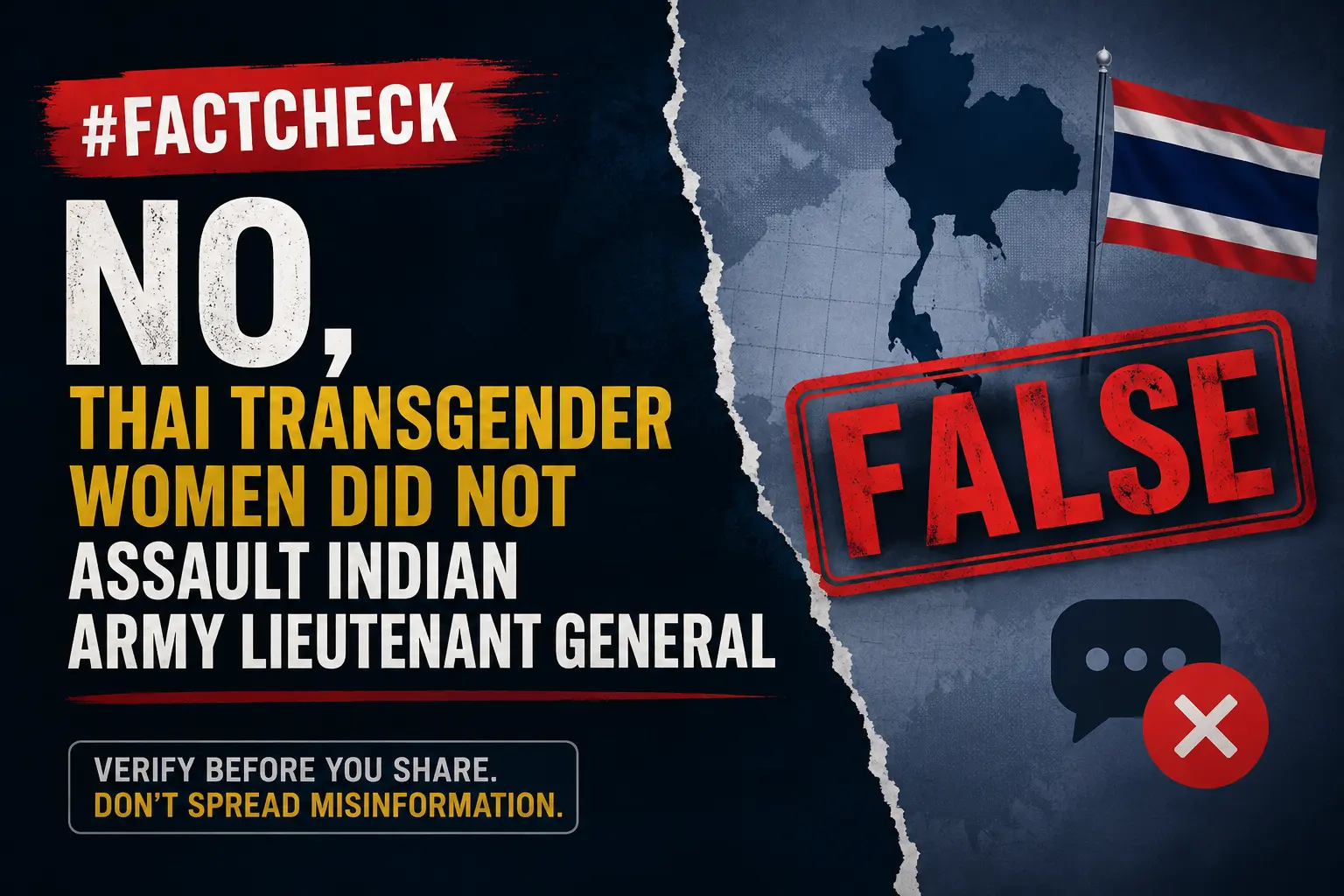
A video is rapidly going viral on social media, with the claim that transgender women assaulted an Indian Army officer in Thailand. The post further claims that the officer had failed to pay the agreed amount, following which the incident took place. A research by CyberPeace’s research wing found that the viral video is fake. In fact, the video shows an incident that took place in Pattaya, Thailand, in December 2025. The 52-year-old Indian national, Raj Jasuja, was allegedly assaulted by a group of transgender women following a dispute over payment for sexual services. Therefore, the claim made in the post is false.
Claim:
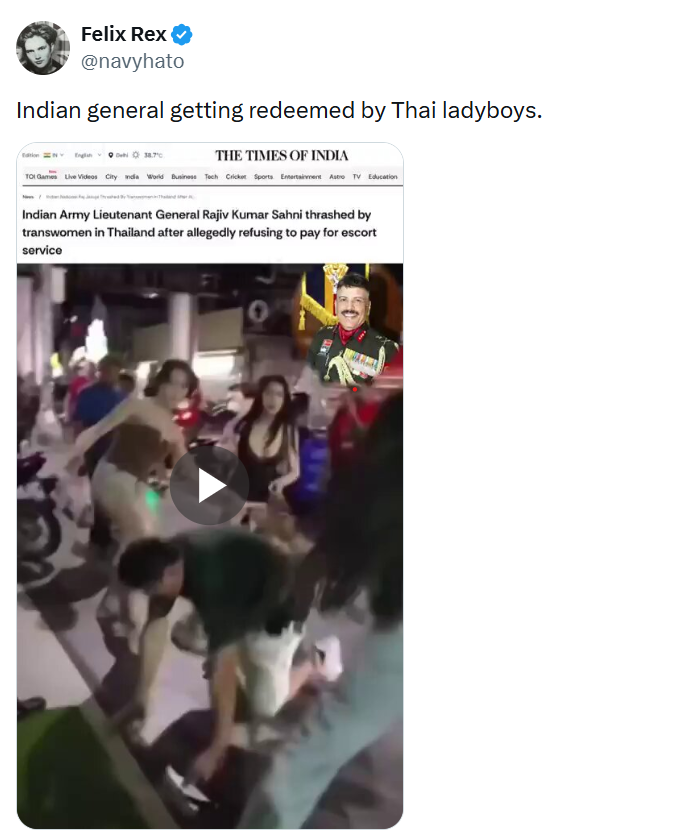
A video shared on social media claims that transgender women assaulted an Indian Army general in Thailand.
https://x.com/navyhato/status/2094322001490116659
https://archive.ph/Scfgd
Fact Check:
To verify the claim, we conducted a Google search using relevant keywords but found no credible media reports confirming that Indian Army Lieutenant General Rajiv Kumar Sahni was involved in the incident. During the subsequent research, we compared the viral screenshot with the original report published by The Times of India. The comparison revealed that the original headline, “Indian national Raj Jasuja thrashed by transwomen in Thailand after allegedly refusing to pay for escort service,” had been digitally altered to read, “Indian Army Lieutenant General Rajiv Kumar Sahni thrashed by transwomen in Thailand after allegedly refusing to pay for escort service.” Further, both the viral screenshot and the original report display the same breadcrumb trail — “News / Indian National Raj Jasuja Thrashed By Transwomen In T…”. This provides further evidence that the headline in the viral screenshot was digitally manipulated.
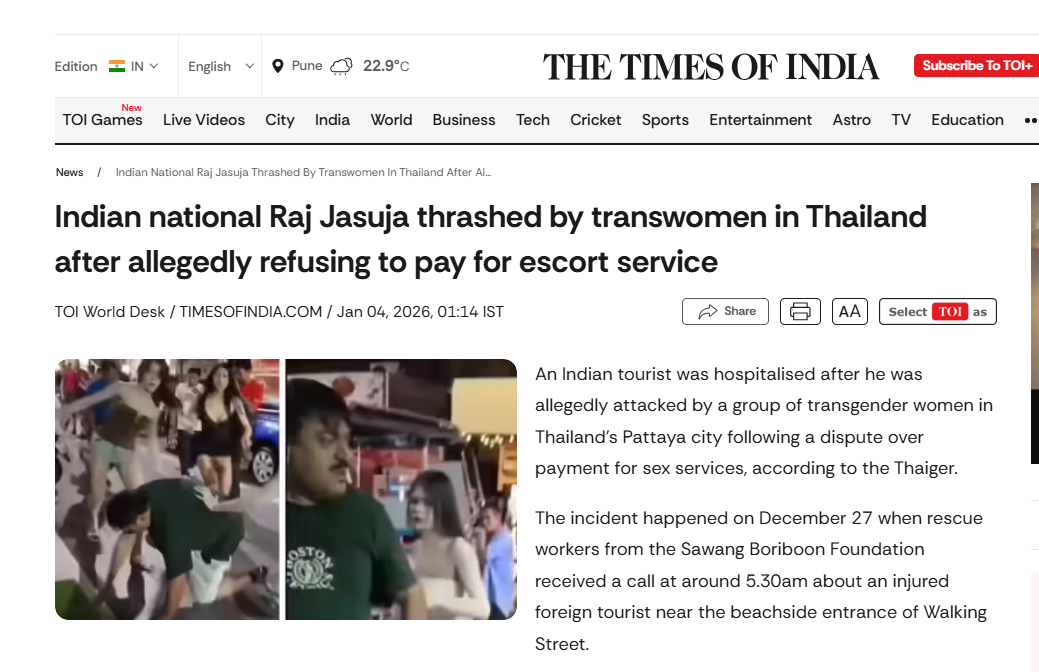
After establishing the context of the viral claim, we conducted a Google search using relevant keywords. During the search, we found a report published on The Indian Express website on January 5, 2026, which featured the same visuals as those seen in the viral video. According to the report, a 52-year-old Indian tourist was allegedly assaulted by a group of transgender women in Pattaya, Thailand. The incident reportedly stemmed from a dispute over an unpaid fee for sexual services. The viral video, recorded on December 27, shows three transgender women allegedly assaulting the man with slippers. According to the report, the dispute escalated after the man allegedly refused to pay the amount demanded and attempted to leave the spot in a car. One of the transgender women reportedly accused him of refusing to make the payment. He was subsequently kicked and beaten before emergency responders intervened.
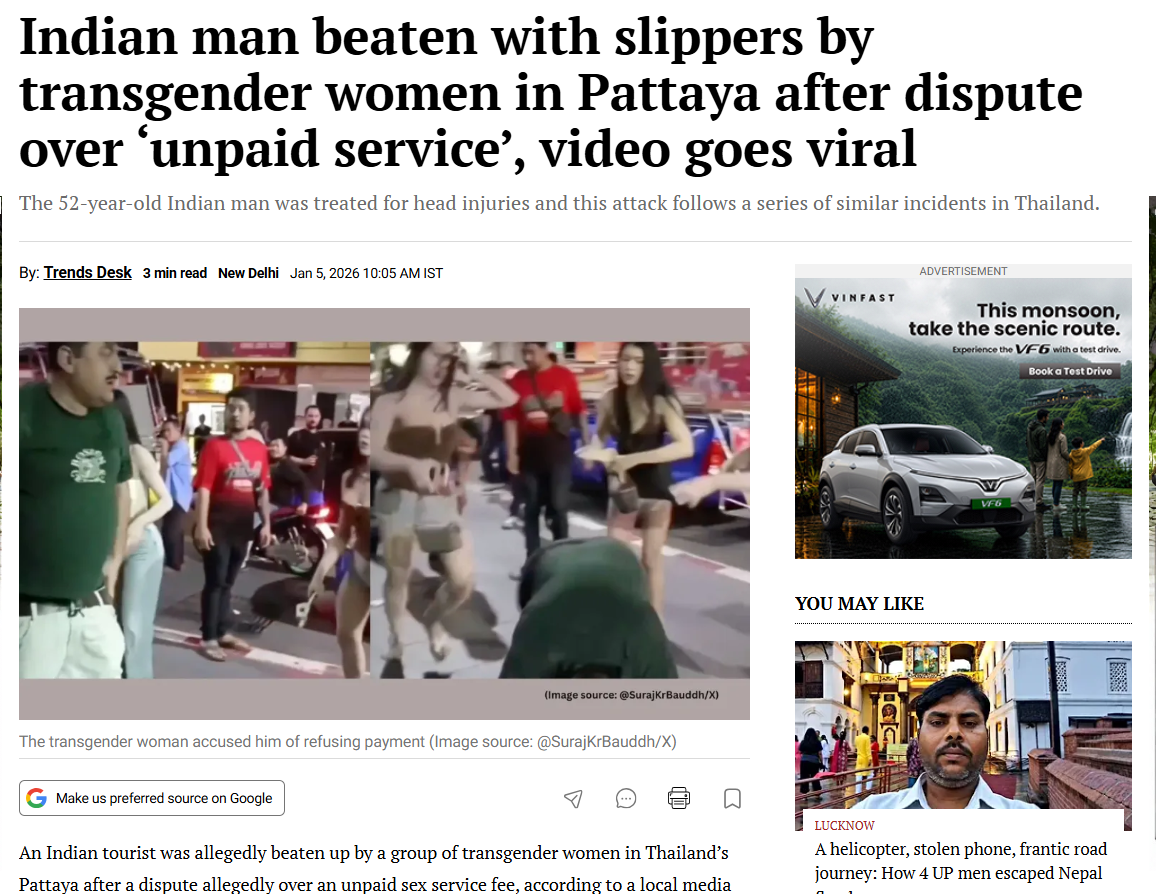
In the next step of our research, we found another report published on the India Today website on January 5, 2026. The report featured the same visuals as those seen in the viral video. According to the report, the incident took place on the morning of December 27, 2025, in the Walking Street area of Pattaya, Thailand.
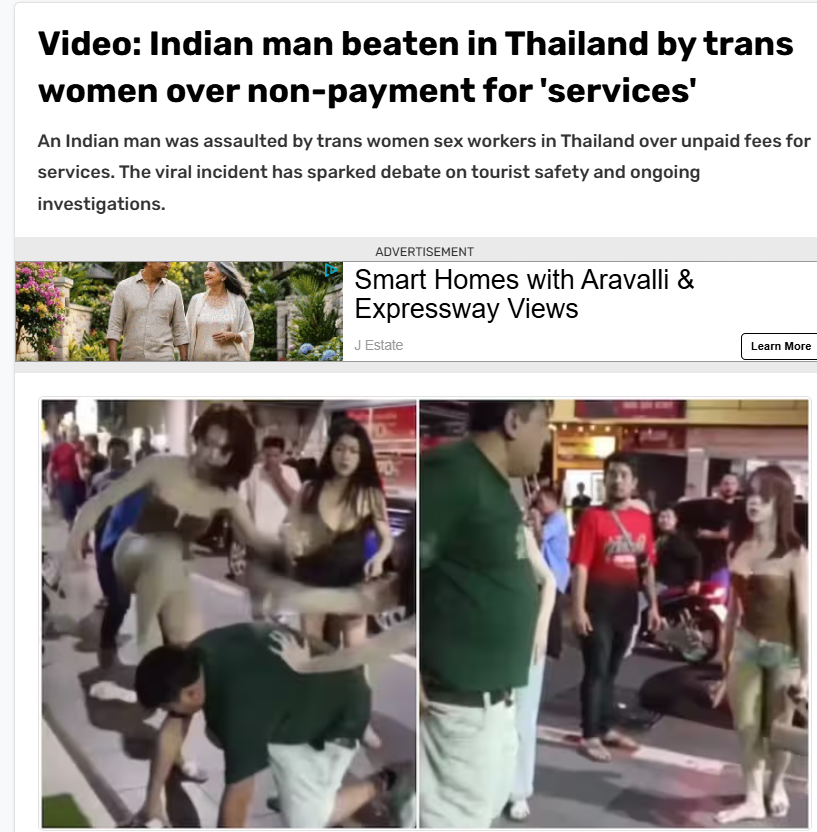
Conclusion:
Our research found that the claim that Indian Army Lieutenant General Rajiv Kumar Sahni was assaulted in Thailand is false. The viral video actually shows an incident that took place in Pattaya, Thailand, in December 2025, in which 52-year-old Indian national Raj Jasuja was allegedly assaulted by a group of transgender women following a dispute over payment for sexual services. The viral post falsely links the incident to an Indian Army officer, thereby misrepresenting the identity of the person involved.

There has been a struggle to create legal frameworks that can define where free speech ends and harmful misinformation begins, specifically in democratic societies where the right to free expression is a fundamental value. Platforms like YouTube, Wikipedia, and Facebook have gained a huge consumer base by focusing on hosting user-generated content. This content includes anything a visitor puts on a website or social media pages.
The legal and ethical landscape surrounding misinformation is dependent on creating a fine balance between freedom of speech and expression while protecting public interests, such as truthfulness and social stability. This blog is focused on examining the legal risks of misinformation, specifically user-generated content, and the accountability of platforms in moderating and addressing it.
The Rise of Misinformation and Platform Dynamics
Misinformation content is amplified by using algorithmic recommendations and social sharing mechanisms. The intent of spreading false information is closely interwoven with the assessment of user data to identify target groups necessary to place targeted political advertising. The disseminators of fake news have benefited from social networks to reach more people, and from the technology that enables faster distribution and can make it more difficult to distinguish fake from hard news.
Multiple challenges emerge that are unique to social media platforms regulating misinformation while balancing freedom of speech and expression and user engagement. The scale at which content is created and published, the different regulatory standards, and moderating misinformation without infringing on freedom of expression complicate moderation policies and practices.
The impacts of misinformation on social, political, and economic consequences, influencing public opinion, electoral outcomes, and market behaviours underscore the urgent need for effective regulation, as the consequences of inaction can be profound and far-reaching.
Legal Frameworks and Evolving Accountability Standards
Safe harbour principles allow for the functioning of a free, open and borderless internet. This principle is embodied under the US Communications Decency Act and the Information Technology Act in Sections 230 and 79 respectively. They play a pivotal role in facilitating the growth and development of the Internet. The legal framework governing misinformation around the world is still in nascent stages. Section 230 of the CDA protects platforms from legal liability relating to harmful content posted on their sites by third parties. It further allows platforms to police their sites for harmful content and protects them from liability if they choose not to.
By granting exemptions to intermediaries, these safe harbour provisions help nurture an online environment that fosters free speech and enables users to freely express themselves without arbitrary intrusions.
A shift in regulations has been observed in recent times. An example is the enactment of the Digital Services Act of 2022 in the European Union. The Act requires companies having at least 45 million monthly users to create systems to control the spread of misinformation, hate speech and terrorist propaganda, among other things. If not followed through, they risk penalties of up to 6% of the global annual revenue or even a ban in EU countries.
Challenges and Risks for Platforms
There are multiple challenges and risks faced by platforms that surround user-generated misinformation.
- Moderating user-generated misinformation is a big challenge, primarily because of the quantity of data in question and the speed at which it is generated. It further leads to legal liabilities, operational costs and reputational risks.
- Platforms can face potential backlash, both in instances of over-moderation or under-moderation. It can be considered as censorship, often overburdening. It can also be considered as insufficient governance in cases where the level of moderation is not protecting the privacy rights of users.
- Another challenge is more in the technical realm, including the limitations of AI and algorithmic moderation in detecting nuanced misinformation. It holds out to the need for human oversight to sift through the misinformation that is created by AI-generated content.
Policy Approaches: Tackling Misinformation through Accountability and Future Outlook
Regulatory approaches to misinformation each present distinct strengths and weaknesses. Government-led regulation establishes clear standards but may risk censorship, while self-regulation offers flexibility yet often lacks accountability. The Indian framework, including the IT Act and the Digital Personal Data Protection Act of 2023, aims to enhance data-sharing oversight and strengthen accountability. Establishing clear definitions of misinformation and fostering collaborative oversight involving government and independent bodies can balance platform autonomy with transparency. Additionally, promoting international collaborations and innovative AI moderation solutions is essential for effectively addressing misinformation, especially given its cross-border nature and the evolving expectations of users in today’s digital landscape.
Conclusion
A balance between protecting free speech and safeguarding public interest is needed to navigate the legal risks of user-generated misinformation poses. As digital platforms like YouTube, Facebook, and Wikipedia continue to host vast amounts of user content, accountability measures are essential to mitigate the harms of misinformation. Establishing clear definitions and collaborative oversight can enhance transparency and build public trust. Furthermore, embracing innovative moderation technologies and fostering international partnerships will be vital in addressing this cross-border challenge. As we advance, the commitment to creating a responsible digital environment must remain a priority to ensure the integrity of information in our increasingly interconnected world.
References
- https://www.thehindu.com/opinion/op-ed/should-digital-platform-owners-be-held-liable-for-user-generated-content/article68609693.ece
- https://www.thehindu.com/opinion/op-ed/should-digital-platform-owners-be-held-liable-for-user-generated-content/article68609693.ece
- https://hbr.org/2021/08/its-time-to-update-section-230
- https://www.cnbctv18.com/information-technology/deepfakes-digital-india-act-safe-harbour-protection-information-technology-act-sajan-poovayya-19255261.htm
