
#FactCheck-Mock Drill Video from Kishtwar Falsely Shared as Terror Attack in Jammu & Kashmir
Executive Summary
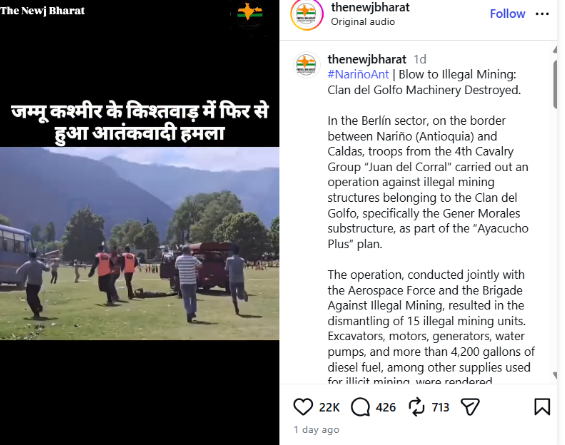
A video is going viral on social media showing ‘injured’ security personnel being carried into ambulances. The clip is being shared with claims that a terrorist attack recently took place in Kishtwar. The video surfaced nearly a year after the terror attack in Pahalgam on April 22, 2025, adding to confusion among users online. Research by CyberPeace Research Wing found that the claim is false. The viral video is actually from a mock drill conducted in Kishtwar, not a real terror incident.
Claim
An Instagram user ‘thenewjbharat’ shared the video on April 30, 2026, claiming that a terrorist attack had taken place again in Kishtwar.
https://www.instagram.com/thenewjbharat/
Fact Check
To verify the claim, we extracted keyframes from the viral video and conducted a reverse image search using Google Lens. This led us to the same clip uploaded on April 24, 2026 by an Instagram user ‘kishtwar_breaking_news’. According to the post, the video shows a mock drill conducted by local authorities to assess emergency preparedness. Officials and rescue teams participated in the exercise.

We also found a related news video uploaded on April 23, 2026, by the YouTube channel of Daily Excelsior, which featured visuals matching the viral clip. The report confirmed that the drill was carried out to evaluate readiness for emergency situations.

Conclusion
Our research confirms that the viral video does not show a real terrorist attack. It is footage from a mock drill conducted in Kishtwar and is being falsely shared with misleading claims.

Related Blogs
Introduction
The Digital Personal Data Protection (DPDP) Act 2023 of India is a significant transition for privacy legislation in this age of digital data. A key element of this new law is a requirement for organisations to have appropriate, user-friendly consent mechanisms in place for their customers so that collection, use or removal of an individual's personal data occurs in a clear and compliant manner. As a means of putting this requirement into practice, the Ministry of Electronics and Information Technology (MeitY) issued a comprehensive Business Requirements Document (BRD) in June 2025 to guide organizations, as well as Consent Managers, on how to create a Consent Management System (CMS). This document establishes the technical and functional framework by which organizations and individuals (Data Principals) will exercise control over the way their data is gathered, used and removed.
Understanding the BRD and Its Purpose
BRD represents an optional guide created as part of the "Code for Consent" programme run by MeitY in India. The purpose of the BRD is to provide guidance to startups, digital platforms and other enterprises on how to create a technology system that supports management of user consent per the requirements of the DPDP Act. Although the contents of the BRD do not carry any legal weight, it lays out a clear path for organisations to create their own consent mechanisms using best practices that align with the principles of transparency, accountability and purpose limitation in the DPDP Act.
The goal is threefold:
- Enable complete consent lifecycle management from collection to withdrawal.
- Empower individuals to manage their consents actively and transparently.
- Support data fiduciaries and processors with an interoperable system that ensures compliance.
Key Components of the Consent Management System
The BRD proposes the development of a modular Consent Management System (CMS) that provides users with secure APIs and user-friendly interfaces. This system will allow for a variety of features and modules, including:
- Consent Lifecycle Management – consent should be specific, informed and tied to an explicit purpose. The CMS will manage the collection, validation, renewal, updates and withdrawal of consent. Each transaction of consent will create a tamper-proof “consent artifact,” which will include the timestamp of creation as well as an ID identifying the purpose for which it was given.
- User Dashboard – A user will be able to view and modify the status of their active, expired or withdrawn consent and revoke access at any time via the multilingual user-friendly interface. This would make the system accessible to people from different regions and cultures.
- Notification Engine – The CMS will automatically notify users, fiduciaries and processors of any action taken with respect to consent, in order to ensure real-time updates and accountability.
- Grievance Redress Mechanism – The CMS will include a complaints mechanism that allows users to submit complaints related to the misuse of consent or the denial of their rights. This will enable tracking of the complaint resolution status, and will allow for escalation if necessary.
- Audit and Logging – As part of the CMS's internal controls for compliance and regulatory purposes, the CMS must maintain an immutable record of every instance of consent for auditing and regulatory review. The records must be encrypted, time-stamped, and linked permanently to a user and purpose ID.
- Cookie Consent Management – A separate module will enable users to manage cookie consent for websites separately from any other consents.
Roles and Responsibilities
The BRD identifies the various stakeholders involved and their associated responsibilities.
- Data Principals (Users): The user has full authority to give, withhold, amend, or revoke their consent for the use of their personal data, at any time.
- Data Fiduciaries (Companies): Companies (the fiduciaries) must collect the data principals' consents for each particular reason and must only begin processing a data subject's personal data after validating that consent through the CMS. Companies must also provide the data principals with any information or notifications needed, as well as how to resolve their complaints.
- Data Processors: Data Processors must strictly adhere to the consent stated in the CMS, and Data Processors may only process personal data on behalf of the Data Fiduciary.
- Consent Managers: The Consent Managers are independent entities that are registered with the Data Protection Board. They are responsible for administering the CMS, allowing users to manage their consent across different platforms.
This layered structure ensures transparency and shared responsibility for the consent ecosystem.
Technical Specifications and Security
The following principles of the DPDP Act must be followed to remain compliant with the DPDP Act.
- End-to-End Encryption: All exchanges of data with users must be encrypted using a minimum of TSL 1.3 and also encrypting within that standard.
- API-First Approach: API’s will be utilized to validate, withdraw and update consent in a secured manner using external sources.
- Interoperability/Accessibility: The CMS needs to allow for users to utilize several different languages (e.g. Hindi, Tamil, etc.) and be appropriate for use with various types of mobile devices and different abilities.
- Data Retention Policy: The CMS should also include automatic deletion of consent data (when the consent has expired or has been withdrawn) in order to maintain compliance with data retention limits.
Legal Relevance and Timelines
While the BRD itself is not enforceable, it is directly aligned with the upcoming enforcement of the DPDP Act, 2023. The Act was passed in August 2023 but is expected to come into effect in stages, once officially notified by the central government. Draft implementation rules, including those defining the role of Consent Managers, were released for public consultation in early 2025.
For businesses, the BRD serves as an early compliance tool—offering both a conceptual roadmap and technical framework to prepare before the law is enforced. Legal experts have described it as a critical resource for aligning data governance systems with emerging regulatory expectations.
Implications for Businesses
Organizations that collect and process user data will be required to overhaul their consent workflows:
- No blanket consents: Every data processing activity must have explicit, separate consent.
- Granular audit logs: Companies must maintain tamper-proof logs for every consent action.
- Integration readiness: Enterprises need to integrate their platforms with third-party or in-house CMS platforms via the specified APIs.
- Grievance redress and user support: Systems must be in place to handle complaints and withdrawal requests in a timely, verifiable manner.
Failing to comply once the DPDP Act is in force may expose companies to penalties, reputational damage, and potential regulatory action.
Conclusion
The BRD on Consent Management of India is a forward-looking initiative laying a technological framework that is an essential component of the DPDP Act concerning user consent; Although not yet a legal document, it provides an extent of going into all the necessary discipline for companies to prepare. As data protection grows in importance, developing consent mechanisms based on security, transparency, and the needs of the user is no longer just a regulatory requirement, but rather a requirement for the development of trust. This is the time for businesses to establish or implement CMS solutions that support this objective to be better equipped for the future of data governance in India.
References
- https://d38ibwa0xdgwxx.cloudfront.net/whatsnew-docs/8d5409f5-d26c-4697-b10e-5f6fb2d583ef.pdf
- https://ssrana.in/articles/ministry-releases-business-requirement-document-for-consent-management-under-the-dpdp-act-2023/
- https://dpo-india.com/Blogs/consent-dpdpa/
- https://corporate.cyrilamarchandblogs.com/2025/06/the-ghost-in-the-machine-the-recent-business-requirement-document-on-consent/
- https://www.mondaq.com/india/privacy-protection/1660964/analysis-of-the-business-requirement-document-for-consent-management-system

Executive Summary
A video showing flames and thick smoke rising over a densely populated city at night is being widely circulated on social media. The video is being shared with the claim that it shows the actual visuals of explosions and destruction caused by an attack on Iran. CyberPeace Research Wing ’s research found the viral claim to be false. Our research revealed that the video is not real footage but an AI-generated video, which is being circulated with a false claim.
Claim
A user on social media platform Instagram shared the viral video on July 17, 2026, claiming that it shows the real visuals of an attack on Iran and the massive explosions caused by it.
https://www.instagram.com/reel/Da1_gaXyyoP/?utm_source=ig_web_copy_link&igsh=NTc4MTIwNjQ2YQ==

Fact Check
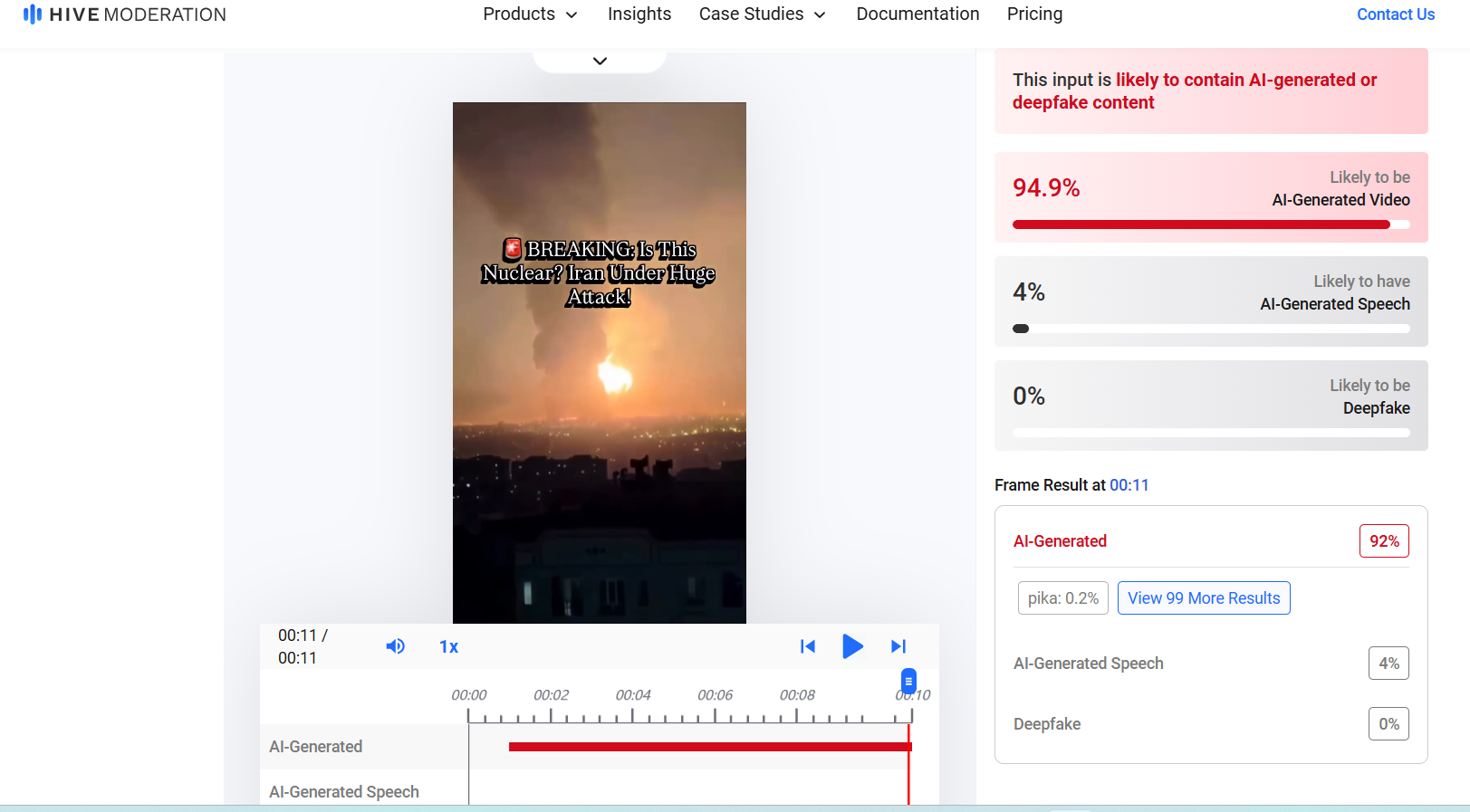
To verify the authenticity of the viral claim, we extracted multiple keyframes from the video and conducted a reverse image search using Google Lens. During the research, we did not find any credible news report, verified video, or authentic source confirming that the footage was related to any attack on Iran. To further examine the authenticity of the video, we analysed it using multiple AI detection tools. First, we scanned the video using Hive Moderation. The tool’s analysis indicated that the video had a 94.9% probability of being AI-generated, suggesting that the footage may have been created using Artificial Intelligence.
For additional verification, we analysed the video using DetectVideo AI. The tool also indicated that the video was likely AI-generated, with an estimated 80% probability.

We further checked the video using another AI detection tool, AI or Not, which suggested that the footage had a 64% probability of being AI-generated.

At the final stage of verification, we used WasIt.AI, which also indicated that the video was likely AI-generated, with an 88% probability.

Conclusion
CyberPeace Research Wing ’s research found that the viral video does not show real footage of an attack on Iran.The video was created using Artificial Intelligence (AI) and is being falsely shared as authentic visuals of explosions and destruction caused by an attack on Iran. Users are advised to verify such sensational claims before sharing them online.
Executive Summary
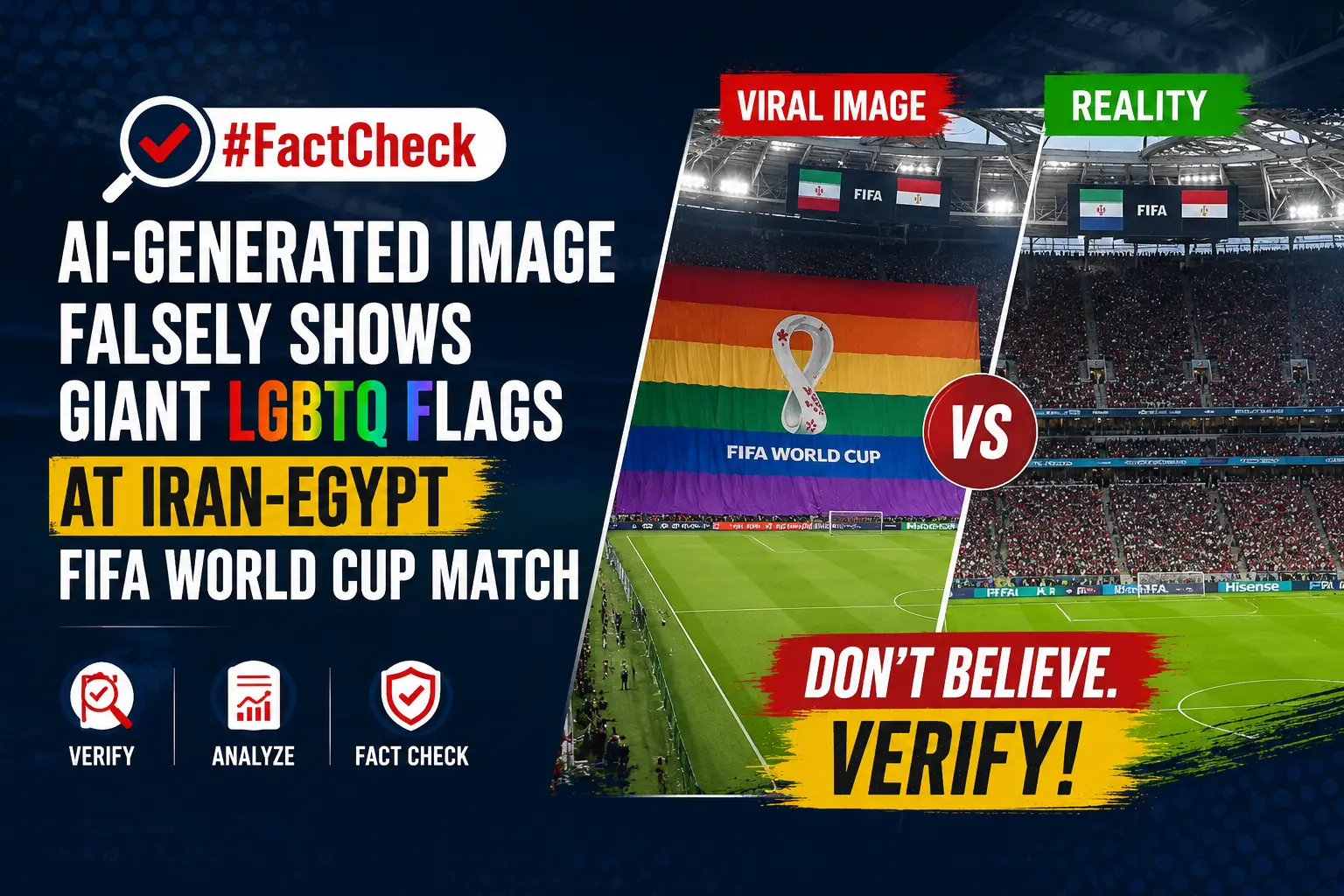
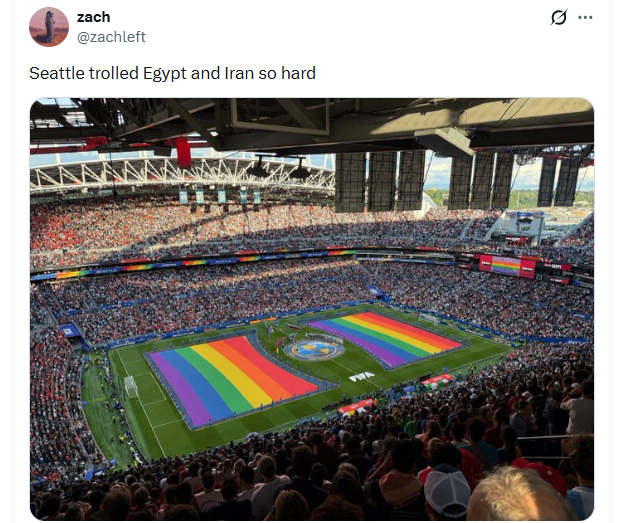
An image is being widely shared on social media claiming that during the 2026 FIFA World Cup match between Iran and Egypt in Seattle, Washington, the stadium hosted a “Pride Match,” with massive LGBTQ rainbow flags spread across the pitch before kickoff. Users claim the image shows FIFA allowing rainbow flags inside the stadium during the match. CyberPeace Research Wing's research found the claim to be misleading. There is no evidence that FIFA or the official organizers displayed giant rainbow flags across the pitch during the pre-match ceremony. The viral image has been digitally altered and does not depict an actual scene from the event.
Claim
On June 27, 2026, an X (formerly Twitter) user shared the image with the caption, “Seattle trolled Egypt and Iran so hard.” Similar posts were also circulated on Facebook and other social media platforms in Spanish and Arabic. https://perma.cc/9QUF-Y7LG ,https://x.com/zachleft/status/2070727350288068687/
FactCheck
The image began circulating after the June 26 FIFA World Cup match between Iran and Egypt ended in a 1-1 draw. Iran (Team Melli) had a stoppage-time goal disallowed, leaving the team short of qualifying for the tournament’s 32-team knockout stage, while Egypt advanced alongside Belgium from the top of Group G. https://www.abs-cbn.com/sports/othersports/2026/6/29/iran-team-to-fly-home-monday-following-world-cup-exit-1334

Further research found that Egyptian and Iranian officials had objected to pro-LGBTQ celebrations surrounding the fixture. Seattle authorities had designated the match as part of the city's Pride celebrations well before the World Cup draw determined which teams would play there. Under Iranian Islamic law, homosexuality is illegal and can be punishable by death. In Egypt, same-sex relations are often prosecuted under broadly worded laws relating to "debauchery" or "immorality. https://www.barrons.com/news/in-seattle-lgbtq-and-world-cup-are-feted-except-by-iran-egypt-f6d970dc.

We also examined the viral image using OpenAI’s image verification tool, which detected the presence of SynthID—an invisible watermark embedded by Google in AI-generated content. This indicates that the image was created or modified using AI tools.

In addition, we reviewed the live broadcasts of the match by Fox Sports and Universo. Both broadcasts showed only the national flags of Iran and Egypt displayed on the pitch before kickoff. No giant rainbow flags appeared during the pre-match ceremony.

Conclusion
Our research found the viral claim to be misleading. There is no evidence that FIFA or the official organizers displayed massive rainbow flags across the pitch during the Iran vs Egypt World Cup match. The viral image is digitally altered, contains indicators of AI generation, and does not represent an actual moment from the event.
