
#FactCheck-Mock drill video falsely linked to death of Indian sailor in Gulf of Oman
Executive Summary
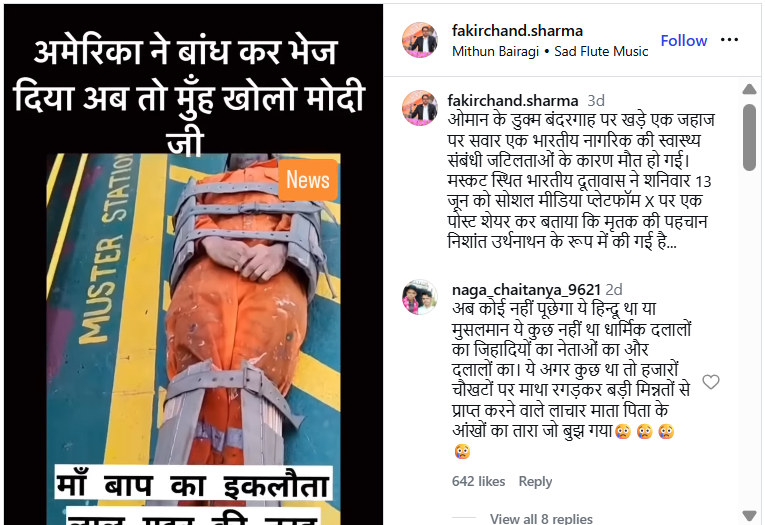
Amid reports of attacks on ships in the Gulf of Oman that led to the death of three Indian nationals, a video showing a person lying injured on a ship is being widely circulated on social media. The clip is being shared with the claim that the United States sent the body of a deceased Indian sailor to India in a “wrapped” condition. CyberPeace Research Wing research found the claim to be misleading. The viral video is unrelated to any recent incident involving Indian nationals and is, in fact, from a mock drill conducted on board a ship.
Claim:
An Instagram user ‘fakirchand.sharma’ shared the video on June 15, 2026, claiming that an Indian sailor, identified as Nishant Urthnathan, died due to health complications on a vessel anchored at Duqm port, Oman. The post further alleged that the United States returned the body in a “wrapped” condition, sparking outrage on social media. https://www.instagram.com/fakirchand.sharma/reel/DZlsxj9TIaS , https://perma.cc/C9SF-J8ZR
Fact Check:
A reverse image search of keyframes from the viral video led to an Instagram account ‘bipul_raja_vlogs’, where the same video was posted on June 10, 2026. The original caption clearly stated that the visuals were from a fire drill conducted on board a ship. https://www.instagram.com/p/DZbnZlGPAlL

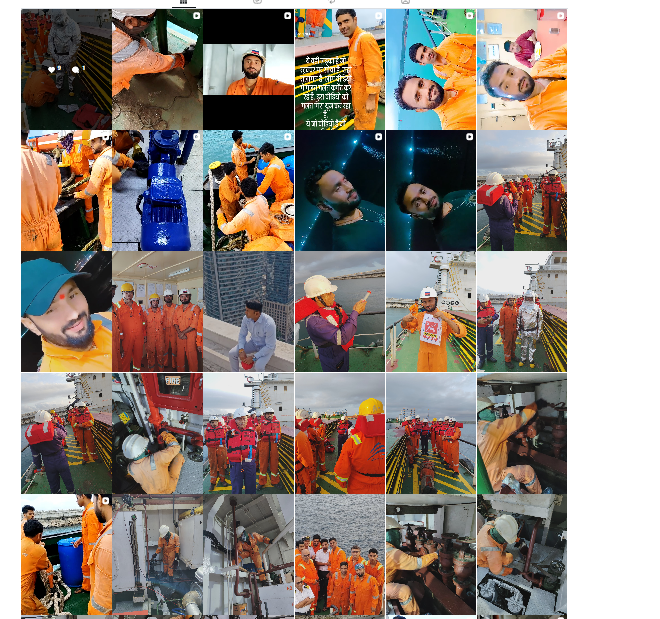
Further posts from the same account on June 15 and June 17, 2026, also show similar mock drill visuals and clarify that the content is being misused online. The account features multiple posts related to routine ship operations and training exercises. https://www.instagram.com/p/DZnEXOzCc2X
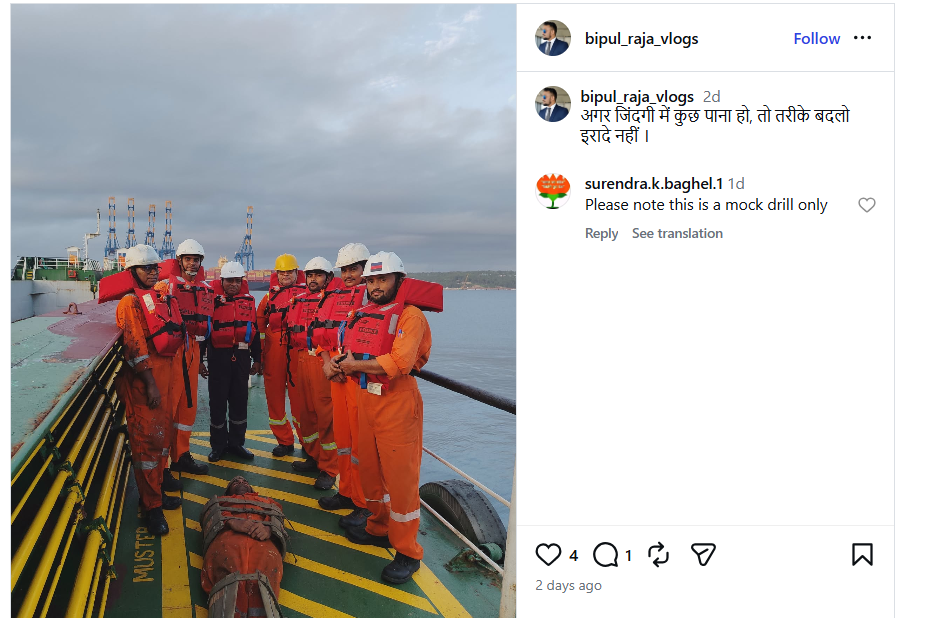
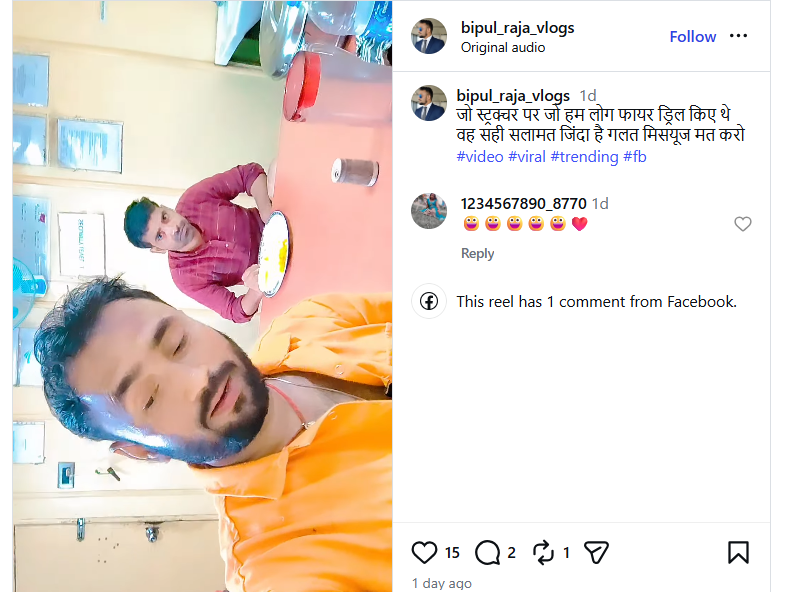
The profile also contains several other photos and videos of crew members working on the ship. We also checked the YouTube channel linked in this profile, “Sunnybabu,” where a mock drill video was uploaded on January 21, 2026. https://www.instagram.com/bipul_raja_vlogs
Conclusion:
The research confirms that the viral video is unrelated to the death of any Indian sailor in the Gulf of Oman. The clip actually shows a mock drill conducted on a ship and is being falsely shared with a misleading narrative.

Related Blogs

Introduction
Cybercrime in India is developing at a rapid rate in terms of depth and volume, with culprits leveraging technology, anonymity, and social engineering to exploit unsuspecting victims. In a high-profile instance of coordinated police action, the Delhi Police Crime Branch recently cracked a large-scale pan-India cybercrime syndicate with its arms stretching across Delhi, Rajasthan, and Uttar Pradesh. The syndicate used to be involved in a range of cybercrimes, from sextortion and online fraud to fake call centres and cloning of bank accounts. With over ₹5 crore of illicit financial transactions revealed, the operation highlights the critical role of proactive cyber policing, data security and public awareness in India's war against digital crime.
A Multi-State Operation: Crime Network across States
On May 24, 2025, on receiving a tip-off, the Delhi Police conducted a specific raid in New Ashok Nagar to catch a suspect consignment said to be used for cybercrime. This resulted in a multi-layered investigation that revealed a large crime syndicate. Police recovered 28 mobile phones, 30 SIM cards, 15 debit cards, 8 cheque books, and two laptops, equipment said to have been used in crimes ranging from sextortion to fake loan scams.
Three of the initial arrests revealed the use of fake kits like pre-activated SIMs and counterfeit documents to create phoney digital identities and bank accounts. They were being used to bypass KYC norms and make untraceable transactions, illustrating how cyber thieves exploit digital identity as well as financial authentication loopholes in the system.
Fake Call Centre Falsely Claiming to be a Lender
Tracing the leads, the investigation then led the police to Mundka, a semi-residential and industrial area in Delhi, where a fake call centre in the name of a loan assistance service was operating. Suspects were allegedly operating the business. With deceptive scripts, their telemarketing staff lured victims with the offer of instant personal loans. When a prospective victim replied favorably and was willing to go further, he was asked to send identification documents and was then forced to pay a "processing fee." Once the payment was made, the accused would cut off contact immediately, leaving the victims shortchanged.
During the raid, seven individuals were apprehended, six of whom were trained tele-callers with a reasonable level of technical skill. In spite of possessing educational certificates and receiving a meagre pay of between ₹8,000 and ₹9,000 a month, these individuals had been enticed into the cybercrime network, demonstrating how educated youth are now more commonly being exploited or recruited by such scam networks in return for quick money.
Uncovering the Sextortion Racket
The most shocking disclosure was that of a sextortion racket being run from New Ashok Nagar, a residential area located in West Delhi, New Delhi. Suspects tricked victims with fraudulent Facebook profiles, contacted them on Messenger, and then changed to WhatsApp video calls. Pornographic videos were played on such calls while the reactions of the victim were secretly recorded. These were later utilised for extortion by threatening to share them with the whole world. The ability of such a group to blackmail and psychologically manipulate the victims indicates the psychological nature of cybercrime and the need for online safety education.
Impact and Significance: A Wake-Up Call for Law Enforcement and Public Awareness
This crackdown is uncovering some ominous trends that reflect the changing face of cybercrime in India. The syndicate's framework highlights the organised and multi-state nature of cybercrime, mostly operating through systemic loopholes. Misuse of social media sites and fintech apps is also rampant, and these are being leveraged for scams, sextortion, and monetary fraud. One of the most concerning trends is young people becoming more engaged in cybercrime, either out of economic necessity or enticed by easy cash. Most of these scams increasingly involve psychological manipulation, particularly in sextortion, where shame and fear are employed as tools. Digital identity fraud has also been facilitated through false documents and lenient Know Your Customer (KYC) checks, with fraudsters being able to evade verification processes.
These observations underscore the necessity of strong reporting channels. There also needs to be an urgent implementation of stringent verification standards in the telecom and banking industries, along with extensive community-level digital literacy initiatives to sensitise citizens to online threats and preventive measures.
CyberPeace Vision: Building a Safe Digital India
India needs a multi-level cyber security approach, comprising people awareness, AI-driven detection systems, and coordination of inter-state policing. Precedence needs to be given to:
- Capacity building of cyber police units.
- Real-time exchange of scam intelligence among law enforcement.
- Schools, colleges, and workplaces should be aware of digital hygiene.
- Rehabilitation of cyber-offenders, especially youth.
- Countering online misinformation and disinformation through fact-checking and public education campaigns
- Ensuring inclusivity in cyber safety policies so vulnerable populations, including rural users, senior citizens, and linguistic minorities, are not left behind
The breakdown of the syndicate is a major victory, but the absence of difficulty with which these networks function highlights the need for cybercrime prevention initiatives, not after the fact.
Conclusion
The Delhi Police bust of a pan-India cybercrime gang is evidence of the increasing reach and audacity of cyber crooks from one corner of India to another. From sextortion and social engineering to financial fraud and identity theft on the web, the bust demonstrates how deep and pervasive cybercrime gangs have become. It is also a reminder that anyone can get entangled and that education, awareness, and early reporting are our best defence. With India's online presence expanding day by day, our collective cyber awareness must keep pace. The fight against cybercrime will not be won only by arrests, but through a national effort to secure our digital spaces.
References
- https://indianexpress.com/article/cities/delhi/delhi-police-cyber-crime-syndicate-10047218/
- https://www.thehindu.com/news/cities/Delhi/delhi-police-bust-pan-india-cybercrime-syndicate/article69652694.ece#:~:text=The%20Delhi%20police%20have%20dismantled,and%20an%20orchestrated%20sextortion%20racket.
- https://cybercrime.gov.in/
- https://www.ncrb.gov.in/
- https://economictimes.indiatimes.com/wealth/save/online-scams-are-on-the-rise-learn-about-the-latest-tricks-fraudsters-are-using-to-identify-frauds-and-protect-yourself/articleshow/114162295.cms?from=mdr
Introduction
The world has been surfing the wave of technological advancements and innovations for the past decade, and it all pins down to one device – our mobile phone. For all mobile users, the primary choices of operating systems are Android and iOS. Android is an OS created by google in 2008 and is supported by most brands like – One+, Mi, OPPO, VIVO, Motorola, and many more and is one of the most used operating systems. iOS is an OS that was developed by Apple and was introduced in their first phone – The iPhone, in 2007. Both OS came into existence when mobile phone penetration was slow globally, and so the scope of expansion and advancements was always in favor of such operating systems.
The Evolution
iOS
Ever since the advent of the iPhone, iOS has seen many changes since 2007. The current version of iOs is iOS 16. However, in the course of creating new iOS and updating the old ones, Apple has come out with various advancements like the App Store, Touch ID & Face ID, Apple Music, Podcasts, Augmented reality, Contact exposure, and many more, which have later become part of features of Android phone as well. Apple is one of the oldest tech and gadget developers in the world, most of the devices manufactured by Apple have received global recognition, and hence Apple enjoys providing services to a huge global user base.
Android
The OS has been famous for using the software version names on the food items like – Pie, Oreo, Nougat, KitKat, Eclairs, etc. From Android 10 onwards, the new versions were demoted by number. The most recent Android OS is Android 13; this OS is known for its practicality and flexibility. In 2012 Android became the most popular operating system for mobile devices, surpassing Apple’s iOS, and as of 2020, about 75 percent of mobile devices run Android.
Android vs. iOS
1. USER INTERFACE
One of the most noticeable differences between Android and iPhone is their user interface. Android devices have a more customizable interface, with options to change the home screen, app icons, and overall theme. The iPhone, on the other hand, has a more uniform interface with less room for customization. Android allows users to customize their home screen by adding widgets and changing the layout of their app icons. This can be useful for people who want quick access to certain functions or information on their home screen. IOS does not have this feature, but it does allow users to organize their app icons into folders for easier navigation.
2. APP SELECTION
Another factor to consider when choosing between Android and iOS is the app selection. Both platforms have a wide range of apps available, but there are some differences to consider. Android has a larger selection of apps overall, including a larger selection of free apps. However, some popular apps, such as certain music streaming apps and games, may be released first or only available on iPhone. iOS also has a more curated app store, meaning that all apps must go through a review process before being accepted for download. This can result in a higher quality of apps overall, but it can also mean that it takes longer for new apps to become available on the platform. iPhone devices tend to have less processing power and RAM. But they are generally more efficient in their use of resources. This can result in longer battery life, but it may also mean that iPhones are slower at handling multiple tasks or running resource-intensive apps.
3. PERFORMANCE
When it comes to performance, both Android and iPhone have their own strengths and weaknesses. Android devices tend to have more processing power and RAM. This can make them faster and more capable of handling multiple tasks simultaneously. However, this can also lead to Android devices having shorter battery life compared to iPhones.
4. SECURITY
Security is an important consideration for any smartphone user, and Android and iPhone have their own measures to protect user data. Android devices are generally seen as being less secure than iPhones due to their open nature. Android allows users to install apps from sources other than the Google Play Store, which can increase the risk of downloading malicious apps. However, Android has made improvements in recent years to address this issue. Including the introduction of Google Play Protect, which scans apps for malware before they are downloaded. On the other hand, iPhone devices have a more closed ecosystem, with all apps required to go through Apple‘s review process before being available for download. This helps reduce the risk of downloading malicious apps, but it can also limit the platform’s flexibility.
Conclusion
The debate about the better OS has been going on for some time now, and it looks like it will get more comprehensive in the times to come, as netizens go deeper into cyberspace, they will get more aware and critical of their uses and demands, which will allow them to opt for the best OS for their convenience. Although the Andriod OS, due to its integration, stands more vulnerable to security threats as compared to iOS, no software is secure in today’s time, what is secure is its use and application hence the netizen and the platforms need to increase their awareness and knowledge to safeguard themselves and the wholesome cyberspace.

Introduction
Misinformation regarding health is sensitive and can have far-reaching consequences. These include its effect on personal medical decisions taken by individuals, lack of trust in conventional medicine, delay in seeking treatments, and even loss of life. The fast-paced nature and influx of information on social media can aggravate the situation further. Recently, a report titled Health Misinformation Vectors in India was presented at the Health of India Summit, 2024. It provided certain key insights into health-related misinformation circulating online.
The Health Misinformation Vectors in India Report
The analysis was conducted by the doctors at First Check, a global health fact-checking initiative alongside DataLEADS, a Delhi-based digital media and technology company. The report covers health-related social media content that was posted online from October 2023 to November 2024. It mentions that among all the health scares, misinformation regarding reproductive health, cancer, vaccines, and lifestyle diseases such as diabetes and obesity is the most prominent type that is spread through social media. Misinformation regarding reproductive health includes illegal abortion methods that often go unchecked and even tips on conceiving a male child, among other things.
In order to combat this misinformation, the report encourages stricter regulations regarding health-related content on digital media, inculcating technology for health literacy and misinformation management in public health curricula and recommending tech platforms to work on algorithms that prioritise credible information and fact-checks. Doctors state that people affected by life-threatening diseases are particularly vulnerable to such misinformation, as they are desperate to seek options for treatment for themselves and their family members to have a chance at life. In a diverse society, with the lack of clear and credible information, limited access to or awareness about tools that cross-check content, and low digital literacy, people gravitate towards alternate sources of information which also fosters a sense of disengagement among the public overall. The diseases mentioned in the report, which are prone to misinformation, are life-altering and require attention from healthcare professionals.
CyberPeace Outlook
Globally, there are cases of medically-unqualified social media influencers who disperse false/mis- information regarding various health matters. The topics covered are mostly associated with stigma and are still undergoing research. This gap allows for misinformation to be fostered. An example is misinformation regarding PCOS( Polycystic Ovary Syndrome) which is circulating online.
In the midst of all of this, YouTube has released a new feature that aligns with combating health misinformation, trying to bridge the gap between healthcare professionals and Indians who look for trustworthy health-related information online. The initiative includes a feature that allows doctors, nurses, and other healthcare professionals to sign up for a health information source license. This would help by labeling all their informative videos, as addressed- from a healthcare professional. Earlier, this feature was available only for health organisations including a health source information panel and health content shelves, but this step broadens the scope for verification of licenses of individual healthcare professionals.
As digital literacy continues to grow, methods of seeking credible information, especially regarding sensitive topics such as health, require a combined effort on the part of all the stakeholders involved. We need a robust strategy for battling health-related misinformation online, including more awareness programmes and proactive participation from the consumers as well as medical professionals regarding such content.
References
- https://timesofindia.indiatimes.com/india/misinformation-about-cancer-reproductive-health-is-widespread-in-india-impacting-medical-decisions-says-report/articleshow/115931612.cms
- https://www.ndtv.com/india-news/cancer-misinformation-prevalent-in-india-trust-in-medicine-crucial-report-7165458
- https://www.newindian.in/ai-driven-health-misinformation-poses-threat-to-indias-public-health-report/
- https://www.etvbharat.com/en/!health/youtube-latest-initiative-combat-health-misinformation-india-enn24121002361
- https://blog.google/intl/en-in/products/platforms/new-ways-for-registered-healthcare-professionals-in-india-to-reach-people-on-youtube/
- https://www.bbc.com/news/articles/ckgz2p0999yo
