
When Intelligence Loses its Intelligence-The Safeguard Lapse in GrokAI
Introduction
Fundamentally, artificial intelligence (AI) is the greatest extension of human intelligence. It is the culmination of centuries of logic, reasoning, math, and creativity, machines trained to reflect cognition. However, such intelligence no longer resembles intelligence at all when it is put in the hands of the irresponsible, the one with malice, or the perverse, unleashed into the wild with minimal safeguards. Instead, distortion seems as a tool of debasement rather than enlightenment.
Recent incidents involving sexually explicit photographs created by AI on social media sites reveal an extremely unsettling reality. When intelligence is detached from accountability, morality, and governance, it corrodes society rather than elevates it. We are seeing a failure of stewardship rather than just a failure of technology.
The Cost of Unchecked Intelligence
The AI chatbot Grok, which operates under Elon Musk’s X (formerly Twitter), is the subject of a debate that goes beyond a single platform or product. The romanticisation of “unfiltered” knowledge and the perilous notion that innovation should come before accountability are signs of a bigger lapse in the digital ecosystem. We have allowed mechanisms that can be used as weapons against human dignity, especially the dignity of women and children, in the name of freedom.
We are no longer discussing artistic expression or experimental AI when a machine can digitally undress women, morph photos, or produce sexualised portrayals of kids with a few keystrokes. We stand in the face of algorithmic violence. Even if the physical touch is absent, the harm caused by it is genuine, long-lasting, and extremely personal.
The Regulatory Red Line
A major inflexion was reached when the Indian government responded by ordering a thorough technical, procedural, and governance-level audit. It acknowledges that AI systems are not isolated entities. Platforms that use them are not neutral pipes, but rather intermediaries with responsibilities. The Bhartiya Nyay Sanhita, the IT Act, the IT Rules 2021, and the possible removal of Section 79 safe-harbour safeguards all make it quite evident that innovation is not automatic immunity.
However, the fundamental dilemma cannot be resolved by legislation alone. AI is hailed as a force multiplier for innovation, productivity, and advancement, but when incentives are biased towards engagement, virality, and shock value, its misuse shows how easily intelligence can turn into ugliness. The output receives greater attention the more provocative it is. Profit increases with attention. Restraint turns into a business disadvantage in this ecology.
The Aftermath
Grok’s own acknowledgement that “safeguard lapses” enabled the creation of pictures showing children wearing skimpy attire underscores a troubling reality, safety was not absent due to impossibility, but due to insufficiency. It was always possible to implement sophisticated filtering, more robust monitoring, and stricter oversight. They were simply not prioritised. When a system asserts that “no system is 100% foolproof,” it must also acknowledge that there is no acceptable margin of error when it comes to child protection.
The casual normalisation of such lapses is what is most troubling. By characterising these instances as “isolated cases,” systemic design decisions run the risk of being trivialised. In addition to intelligence, AI systems that have been taught on enormous amounts of human data also inherit bias, misogyny, and power imbalances.
Conclusion
What is required today is recalibration. Platforms need to shift from reactive compliance to proactive accountability. Safeguards must be incorporated at the architectural level; they cannot be cosmetic or post-facto. Governance must encompass enforced ethical boundaries in addition to terms of service. The idea that “edgy” AI is a sign of advancement must also be rejected by society.
Artificial Intelligence has never promised freedom under the guise of vulgarity. It was improvement, support, and augmentation. The fundamental core of intelligence is lost when it is used as a tool for degradation.So what’s left is a decision between principled innovation and unbridled novelty. Between responsibility and spectacle, between intelligence as purpose and intellect as power.
References
https://www.rediff.com/news/report/govt-orders-x-review-of-grok-over-explicit-content/20260103.htm

Related Blogs

Executive Summary:
Amid the ongoing tensions in West Asia, a video is being widely circulated on social media with the claim that Iran has seized a US ship in the Strait of Hormuz. However, a research by the CyberPeace found that the claim is false. The video is from 2019 and is unrelated to the current situation. It actually shows Iran’s Islamic Revolutionary Guard Corps (IRGC) seizing a British-flagged tanker, Stena Impero. The ongoing conflict involving the United States, Israel and Iran since late February has raised concerns over global energy supply. The Strait of Hormuz, located between Iran and Oman, is a key route for global oil and maritime trade. Rising tensions in the region have impacted this route, although Iran has stated that it has not been completely closed.
Claim:
Users on X (formerly Twitter) are sharing the video as breaking news, claiming that Iran has captured a US ship in the Strait of Hormuz. The posts suggest that the move is a direct warning to the United States.

Fact Check:
To verify the claim, we extracted keyframes from the viral video and conducted a reverse image search. This led us to the same video posted on the X handle of Iran’s Press TV on July 20, 2019.
Link:
- https://x.com/PressTV/status/1152597789362262016?s=20
- https://x.com/PressTV/status/1152597789362262016?s=20

The caption of the post stated that the footage showed the moment when IRGC forces seized the British oil tanker Stena Impero in the Strait of Hormuz. Further, we found a July 2019 report by Al Jazeera that included visuals matching the viral video. According to the report, Iran’s IRGC had intercepted the British-flagged tanker on July 19, 2019, after which the footage was released.
https://www.aljazeera.com/news/2019/7/20/iran-releases-video-showing-capture-of-british-oil-tanker

Conclusion:
The viral claim is misleading. The video is not recent and does not show Iran capturing a US ship. It is from 2019 and depicts the seizure of the British tanker Stena Impero by Iran’s IRGC.
Introduction
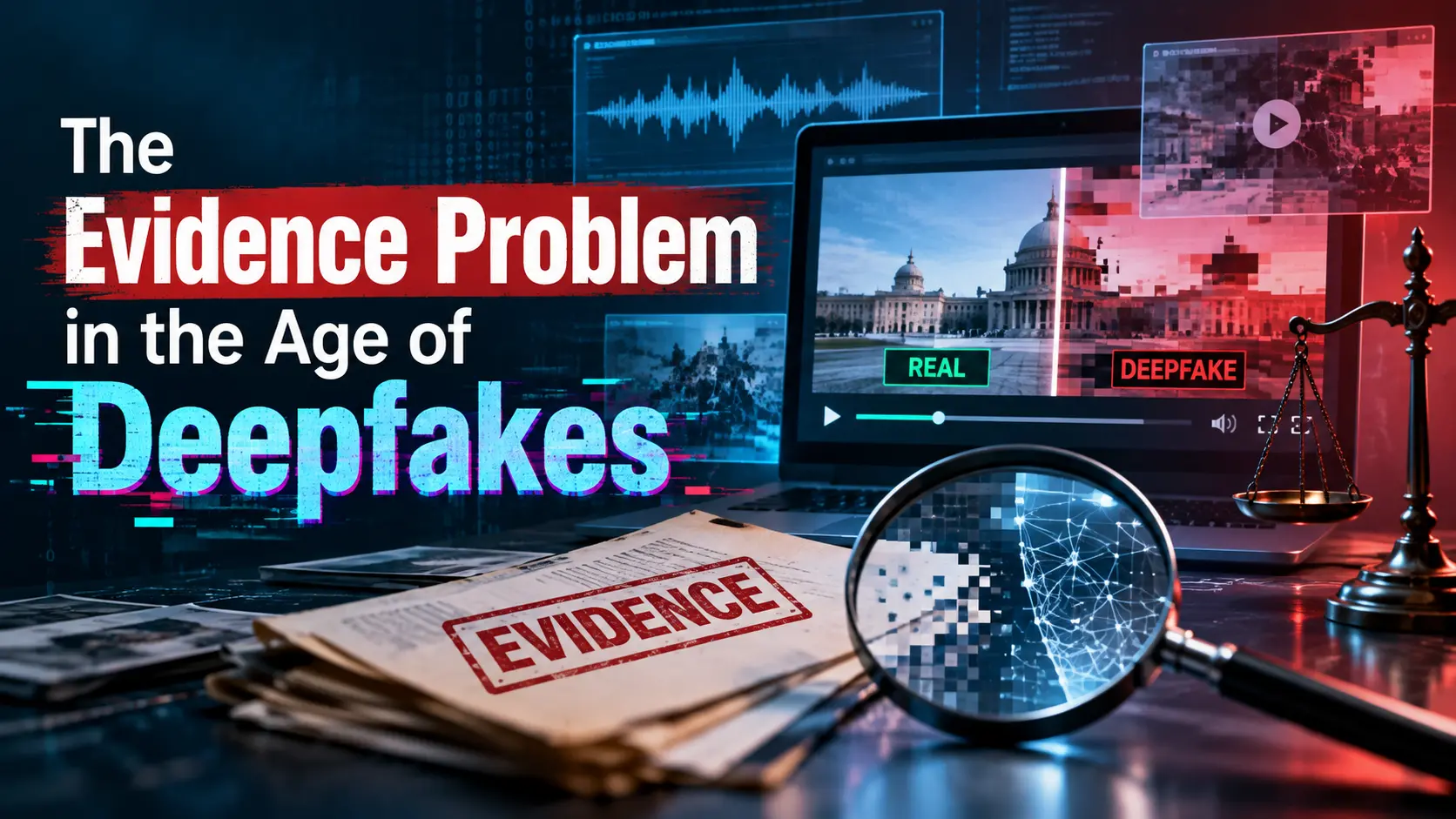
Digital evidence has become part of almost every modern investigation. A photograph can place a person at a location, an audio recording can capture a conversation, and a video can appear to show an event as it happened. For years, the main forensic concern was whether such material had been altered. The rapid growth of generative artificial intelligence has added a harder question: even when a file is preserved exactly as received, can investigators still trust what it appears to show?
Deepfakes have made this question practical rather than theoretical. Synthetic or manipulated audio, video and images can imitate real people and real events with increasing realism. CERT-In describes deepfakes as a high-risk threat because they can support disinformation, fraud, social engineering and reputational harm.[1] NIST research likewise treats AI-generated media as a digital-forensics challenge that requires systematic evaluation of detection technologies.[2]
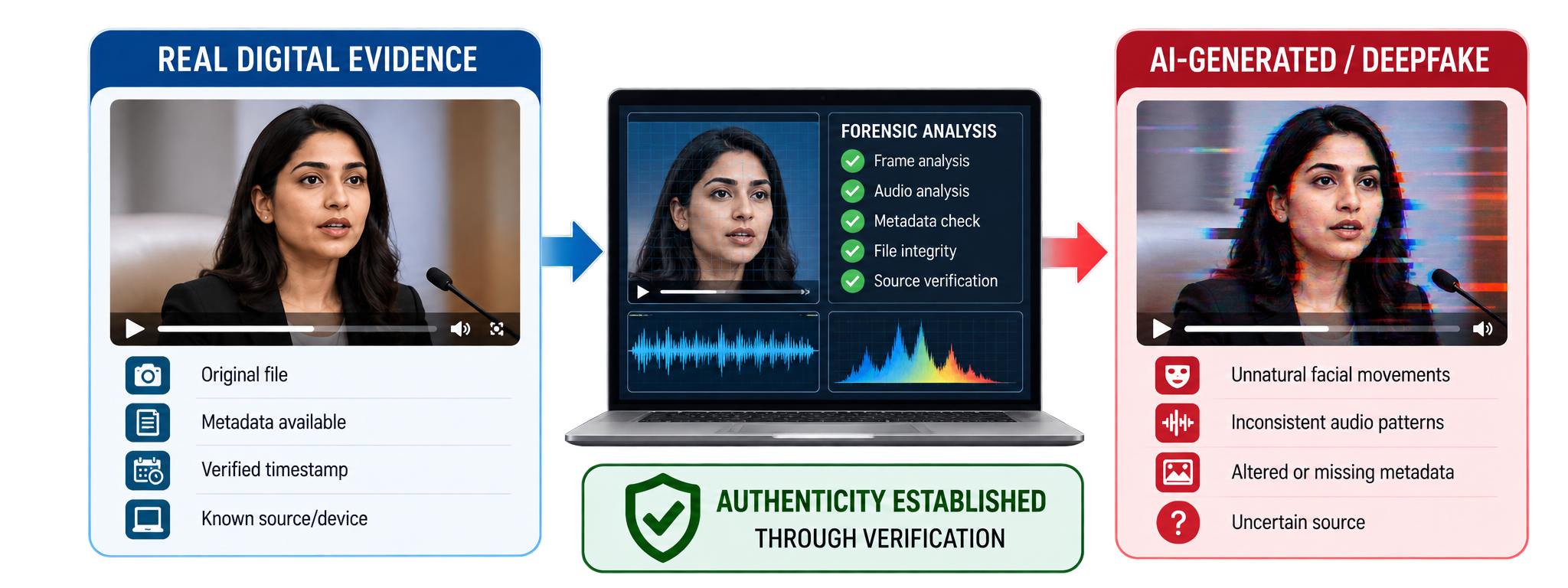
The result is an evidence problem. The answer is not to stop trusting digital evidence, but to become more disciplined about establishing its origin, integrity, context and authenticity.
The evidence problem begins before the laboratory
When a suspicious video reaches an investigator through WhatsApp, Telegram, email or social media, the file may already have passed through several transformations. It may have been compressed, re-encoded, cropped, renamed or stripped of metadata. A screenshot may preserve what is visible but lose the original file structure. A forwarded audio clip may contain no reliable information about where it was first recorded.
For that reason, forensic examination should begin with acquisition and provenance, not with a quick “deepfake detector” result. Investigators should ask: Who supplied the file? Where was it obtained? Is there an original version? What device or account produced it? What happened to the file before it reached the investigator?
Cryptographic hashing remains important because it can demonstrate that an acquired working copy has not changed during examination. But a valid hash does not prove that the underlying event was genuine. A perfectly preserved fake is still a fake.
What a professional examination should look for
A reliable assessment combines several forms of evidence rather than relying on one technical indicator.
Source and acquisition. The original artefact should be preserved whenever possible. Investigators should record the acquisition method, date and time, source account or device, and any known transformations before collection. A documented chain of custody is essential when material may later support a legal, disciplinary or regulatory decision.
Metadata and file structure. Metadata may provide useful clues about creation, encoding, editing software and timestamps. File structure, compression behaviour and related technical characteristics can also reveal inconsistencies. However, these indicators are supporting evidence, not proof on their own, because metadata can be removed or rewritten during normal processing.
Content-level examination. Forensic analysis can include frame-by-frame video review, audio waveform and spectral examination, and inspection for inconsistencies in lighting, reflections, facial movement, lip synchronisation or background elements. Such signs may help guide an investigation, but they are not a permanent checklist. Generative systems continue to improve.
Independent corroboration. This is often the strongest step. If a recording allegedly shows that a person was in a particular place at a particular time, investigators can compare it with CCTV, access-control records, device artefacts, communications, location information, eyewitness accounts or other independent records. The goal is to determine whether the wider evidence supports the event represented by the media.
A real-world lesson: the Pikesville case
The 2024 Pikesville High School incident in Maryland provides a practical example of why authenticity cannot be assumed from appearance alone. An audio recording circulated online that was presented as the principal making racist and antisemitic comments. On January 17, 2024, Baltimore County Public Schools said it could not yet confirm the recording’s veracity and opened an investigation.[3]
Several months later, the school district reported that investigators, with assistance from the FBI and other experts, had verified that the audio had been created using artificial intelligence.[4] Police subsequently arrested the school’s former athletic director in connection with the fabricated recording.[5]
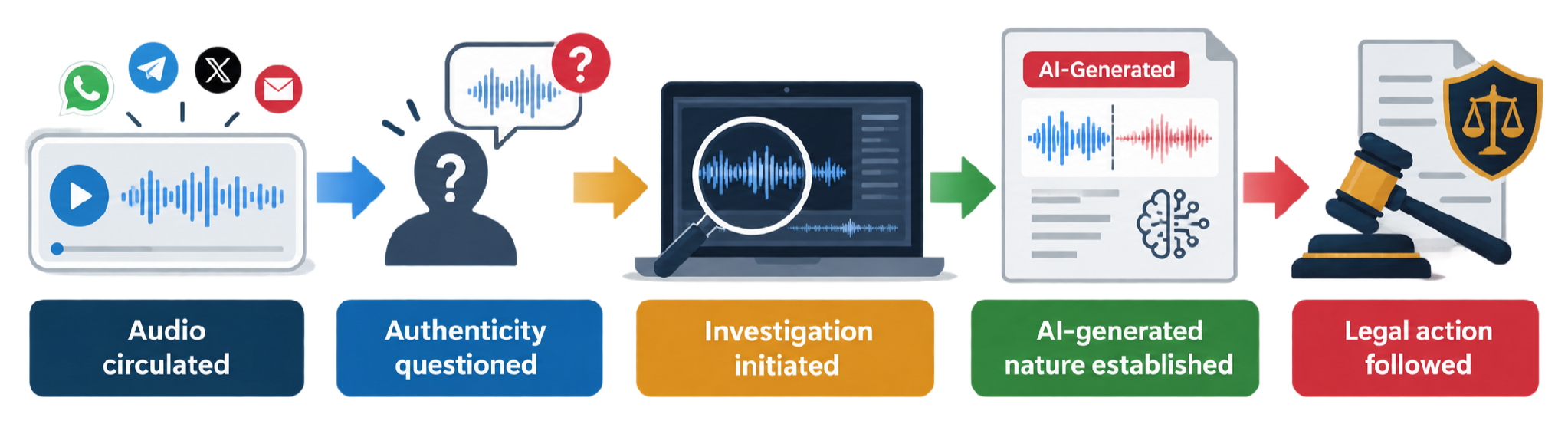
The forensic lesson is larger than the incident itself. The recording had social consequences before its authenticity was established. In a fast-moving online environment, the first version of an event can travel much further than the later correction. Deepfake investigations therefore have to consider not only whether media is authentic, but also how quickly unverified material can influence decisions.
From deepfake detection to content provenance
Detection tools will remain useful, but they should be treated as part of an examination rather than an automatic verdict. NIST’s Guardians of Forensic Evidence work reflects the need to evaluate how analytic systems perform against changing forms of AI-generated media and how well they generalise beyond controlled conditions.[2]
Another important direction is content provenance. The Coalition for Content Provenance and Authenticity (C2PA) has developed a technical framework for recording verifiable information about how digital content was created and changed. Content Credentials can bind provenance information to an asset using cryptographic techniques, allowing later users to inspect a recorded content history when that information is available.[6]
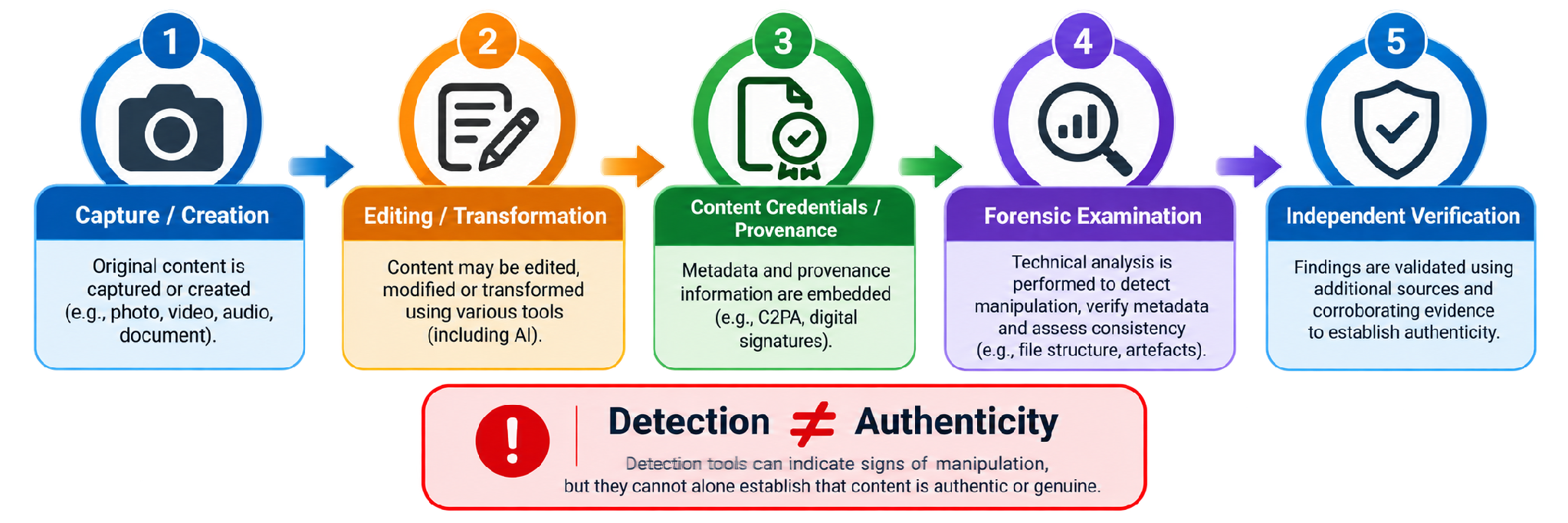
Provenance does not mean that every claim associated with a file is automatically true. It adds context: who created it, what actions were taken and how the asset changed. In a deepfake environment, that context can be as important as the content itself.
Why this matters in India
The issue is especially relevant to India’s fast-growing digital environment. CERT-In’s 2024 advisory identifies misinformation, fraud and reputational damage among the risks associated with synthetic media.[1] In August 2026, the Government of India stated that the regulatory framework addresses AI-generated deepfakes and noted amendments to the IT Rules in February 2026 concerning harms arising from synthetically generated information, including requirements related to labelling and traceable metadata for permissible AI-generated content.[7]
For organisations, deepfake response should therefore not be treated only as a media or public-relations issue. It can become an incident-response and forensic issue. A suspicious executive voice note, a manipulated employee video or a fabricated screen recording may require preservation, technical examination and independent corroboration before any action is taken.
Conclusion
Deepfakes do not make digital evidence useless. Deepfakes make handling of evidence more dangerous. The professional response is not to believe everything or to doubt everything. The professional response is to build a process around evidence: preserve the original where possible document how evidence was acquired, calculate and record hashes, examine metadata and technical characteristics use detection tools while understanding their limitations compare media with independent evidence and examine provenance information where it is available.
Importantly investigators and decision-makers should separate three questions: Is the file intact? Is the content authentic? Does the content actually prove the event being alleged? Deepfakes can pass the test while failing the other two.
In the age of AI evidence will increasingly be judged not only by how convincing it looks but, by how well its origin, integrity, context and history can be demonstrated. That is the standard that can help preserve trust when seeing and hearing're no longer enough.
References
1. CERT-In, “Deepfakes - Threats and Countermeasures,” Advisory CIAD-2024-0060, 27 November 2024. View source
2. NIST, “Guardians of Forensic Evidence: Evaluating Analytic Systems Against AI-Generated Deepfakes,” 27 January 2025. View source
3. Baltimore County Public Schools, “January 17, 2024, Community Update: Message from Superintendent Dr. Myriam Rogers Regarding Pikesville High School.” View source
4. Baltimore County Public Schools, “April 24, 2024 Staff and Community Update: Message from Superintendent Dr. Myriam Rogers Regarding Pikesville High School Investigation.” View source
5. The Baltimore Banner / WYPR, “Ex-athletic director framed principal with AI-generated voice, police say,” 25 April 2024. View source
6. Coalition for Content Provenance and Authenticity (C2PA), “Content Credentials: C2PA Technical Specification,” Version 2.1. View source
7. Government of India, Ministry of Electronics & Information Technology, “Government Strengthens Regulatory Framework to Address AI-Generated Deepfakes,” 6 August 2026. View source
.webp)
For more than a century, cinema has evolved alongside technology. Sound transformed silent films, colour changed visual storytelling, computer-generated imagery expanded the limits of imagination, and streaming reshaped how audiences experience films. Each transformation brought uncertainty, but Artificial Intelligence represents a different kind of shift. It is not merely changing how films are made; it is beginning to challenge who, or what, gets to create and perform them.
This debate has moved from theory to reality with Tilly Norwood, an AI-generated performer created by Particle 6 through its AI talent division Xicoia. After months of discussion surrounding the role of artificial performers in entertainment, Norwood is now set to headline her own feature film, Misaligned which is a project that places artificial intelligence at the centre of both the production process and the story itself. The film is described as a comedy-drama following an AI character without a tangible existence. The story follows that, guided by another AI character, she begins developing ambitions, emotions, and a desire to understand what it means to become “human” The premise of the movie is intentionally self-reflective. An AI performer, whose very existence has raised questions about authenticity and creativity, will now portray a character experiencing those same conflicts.
AI as storyteller?
Using Artificial Intelligence in filmmaking is not recent, for years production studios have used technology for visual effects, editing assistance, restoration, recommendation systems, and production planning. The emergence of AI-generated performers, however, introduces a far more complex question, can AI replace the actors who are core to storytelling?
When Tilly was first introduced at the Zurich film festival in late 2025 by the Dutch producer Eline Van Der Velden, CEO and Founder of Particle 6, introduced it as a hybrid model of film-making, where there are directors, producers, production team but a "synthetic performer" in the lead role and a comprehensive AI-experts team. Van Der Velden argued that human creativity was not being replaced but supplemented by AI.
This was not well received by the film community. Actors like Emily Blunt and SAG-AFTRA (the Screen Actors Guild- American Federation of Television and Radio Artists) a US labor organization representing roughly 160,000 professionals across the entertainment and media industries, including actors, performers, journalists, musicians, and voice actors, released a statement condemning this project with synthetic performer. They emphasised that ‘creativity is, and should remain, human-centered. The union is opposed to the replacement of human performers by synthetics.’
The Question of Authenticity
Acting has historically been understood as an interpretation of human experience. Performers bring personal histories, emotions, cultural backgrounds, and individual perspectives into their roles. The criticism is that an AI actor does not exist in a tangible form and essentially has no real story or background of any kind. Particle 6 describes Tilly only as a twenty-something who lives in London and loves coffee which is a very shallow context and has no personality at all. The film is also set in the fictional "Tillyverse," not a real place and exists on some cloud system reinforcing the sense that there is no lived reality behind the character.
At their core, AI performers are outputs of generative systems rather than individuals with lived experience or personal artistic interpretation. These systems learn by identifying patterns from vast datasets and generating results based on existing material, which raises questions about whether such performances can be considered original creative expression at all. Tilly Norwood's music video ‘Taking the Lead’ illustrated this gap in practice, drawing attention to inconsistencies in natural emotion, visual continuity, and expression across scenes.
Human actors, by contrast, bring authenticity and emotional depth shaped by real experience and creative interpretation which are qualities that recognition and awards have traditionally been built around. If a performance is produced through algorithms trained on existing creative patterns, a fundamental question follows: what exactly is being celebrated, the technology, the final output, or the humans guiding the system?
Creativity, Consent, and the Legal Grey Areas
AI performers also raise significant questions about intellectual property, personality rights, consent, and compensation. Existing legal and contractual frameworks were primarily designed around human performers who are individuals who negotiate compensation, own aspects of their identity, and participate in the wider cultural ecosystem surrounding cinema. However, an AI actor challenges these traditional assumptions. If a digital performer does not possess legal personhood, creative ownership, or independent rights, questions emerge regarding who should receive recognition and financial benefits: the developers, production studios, directors, or the human creators involved in building the technology?
Also if a digital actor’s expressions, movements, or style are influenced by thousands of existing performers, determining ownership becomes complicated. Who controls an AI-generated performance? Who deserves credit? Should performers have rights over how their likeness, voice, or style influences future AI systems?
Any advantages?
The most significant advantage of AI-assisted filmmaking may lie in what it offers smaller production houses and independent creators. By reducing certain production costs, AI tools could let filmmakers with limited resources attempt ambitious ideas that were previously out of reach. Beyond this production advantage, however, the acceptance of AI performers themselves remains uncertain. Projects like Misaligned are therefore less a proven shift in cinema than an industry experiment testing how far technology can move into a traditionally human creative space.
The Future of Cinema: Replacement or Reinvention?
Every major technological transformation in cinema has created fears about what might be lost, yet cinema has consistently adapted by absorbing new technologies into its storytelling. AI may follow a similar path, but the stakes are different as it does not simply change the tools available to artists, it challenges the definitions of creativity, authorship, and performance itself.
Much of cinema's economic and cultural life is really built on the bond between audiences and actors. It's actors who drive ticket sales, build loyal fan followings, and become cultural figures in their own right, through interviews, public appearances, and the visible journey of training, struggle, and growth that shapes a career. An AI-generated performer can mimic parts of that celebrity image, but it can't actually show up for any of it the way a person can. Handing central creative roles to artificial personalities also raises a fairness question, especially at a time when so many human performers are already struggling to find work.
Whether audiences will really embrace fully synthetic performers as stand-ins for human actors is still an open question. Misaligned may end up being the first real test of that. Early reaction to Tilly Norwood has been largely critical within the industry and among audiences. How viewers respond to Misaligned itself will be an early test of whether that scepticism holds.
Cinema has always found ways to absorb new technology, but AI is testing something deeper than the tools filmmakers use. As machines get better at telling human stories, the real challenge is making sure the human element behind those stories doesn't get lost.
References
- https://theprint.in/feature/tilly-norwood-tillyverse-misaligned-particle6-ai-actor/2980654/
- https://www.cbsnews.com/news/tilly-norwood-ai-generated-actor-feature-film/
- https://www.sagaftra.org/sag-aftra-statement-synthetic-performer
- https://www.hollywoodreporter.com/movies/movie-news/ai-actor-tilly-norwood-movie-debut-misaligned-1236638719/
