
#FactCheck: False Claims Circulate Linking Former CEC Achal Kumar Jyoti to EVM Chip Manufacturing
Executive Summary
A viral social media post featuring a picture of former Chief Election Commissioner Achal Kumar Jyoti claims he served as the chairman of the company manufacturing EVM microchips and altered EVM settings at the behest of PM Modi. According to a research done by CyberPeace's research wing, the claim that former Chief Election Commissioner Achal Kumar Jyoti was the chairman of an EVM chip manufacturing company and altered EVMs at the behest of PM Modi is completely false.
Claim
Social media posts circulated statements claiming: "PM Modi ordered EVM tampering; the company manufacturing EVM memory chips confessed. Will the SC take note, cancel all elections from 2014 to 2019, and send Modi to life imprisonment?"
https://x.com/RatnakarGedam/status/2090639442411470936?s=20

Fact-Check
Relevant keyword searches yield no credible news reports, official statements, or legal documentation supporting claims that Achal Kumar Jyoti tampered with EVMs or issued any such confession. Achal Kumar Jyoti served as the Chief Election Commissioner of India from July 6, 2017, to January 22, 2018. Prior to this, he was a 1975-batch IAS officer of the Gujarat cadre who served in various administrative roles, including Chief Secretary of Gujarat.
https://www.eci.gov.in/former-cec-ec?utm_source

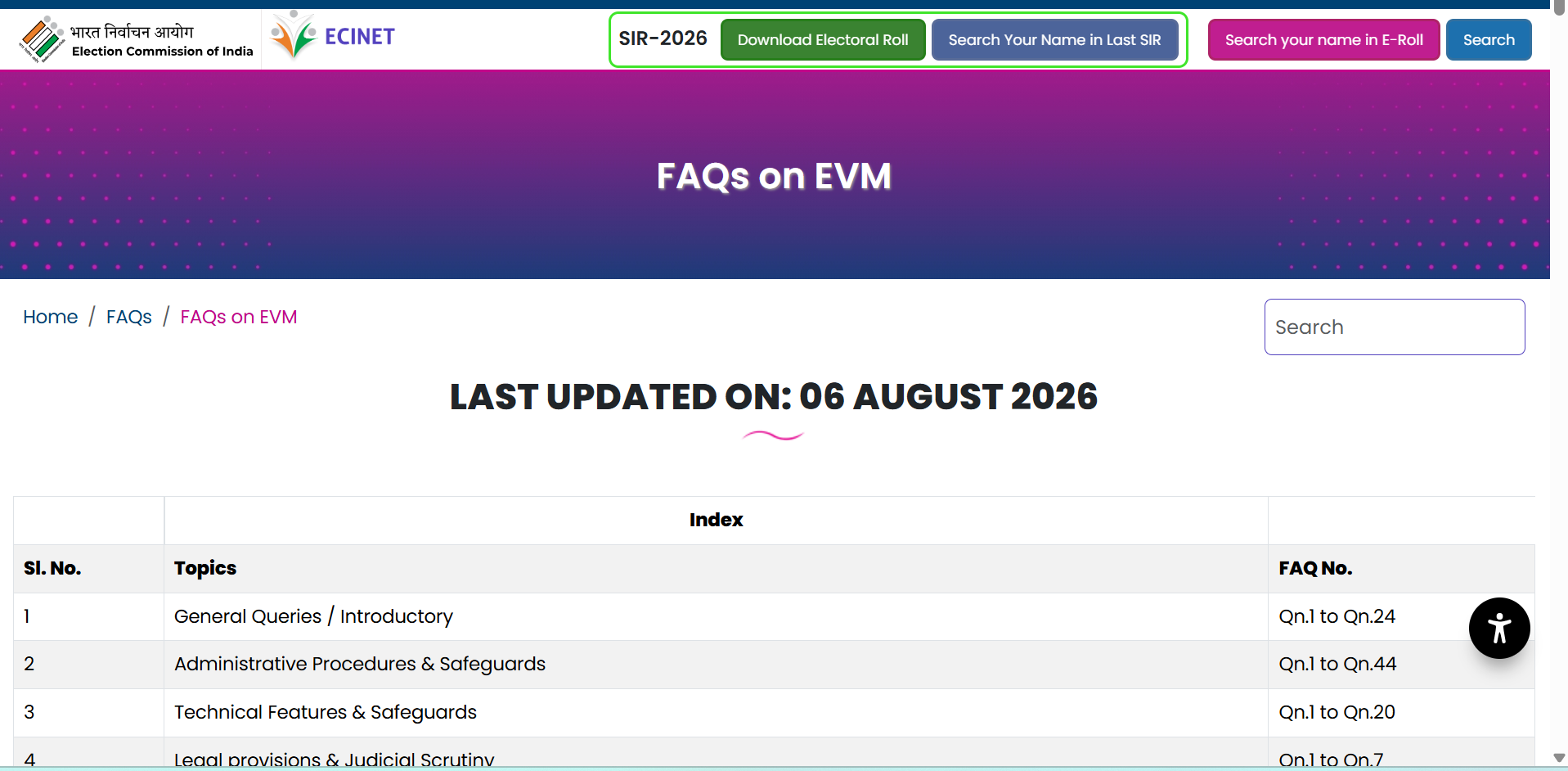
According to official information, Electronic Voting Machines (EVMs) used in Indian elections are manufactured exclusively by two Public Sector Undertakings (PSUs): Bharat Electronics Limited (BEL) and Electronics Corporation of India Limited (ECIL). Official records confirm that Achal Kumar Jyoti was never appointed as the Chairman or Director of BEL, ECIL, or any entity manufacturing microchips for EVMs.
https://www.eci.gov.in/evm-faqs/?utm_source
Conclusion
The claim that former Chief Election Commissioner Achal Kumar Jyoti headed an EVM chip manufacturing company and tampered with voting machines is completely fabricated and baseless.

Related Blogs
Introduction
You ask an app for directions to a street you've driven down a hundred times. You let autocomplete finish your sentence before you've decided what you meant to say. You take a photo of a document instead of reading it, trusting the summary a model hands back. None of these moments feel like a loss. Each one is, on its own, a reasonable trade of effort for convenience. But add them up across a year, a career, an industry, and you start to wonder what exactly we've been trading away. Every technology wave produces its own founding myth. For AI, the myth is that intelligence can be manufactured at scale, bottled into a model, and dispensed on demand - cheaper, faster, and eventually better than the human original. It's a seductive story, and one we've been telling ourselves so uncritically that we've stopped noticing what it costs.
The casualties of this bet are rarely dramatic. Nobody announces that a skill has quietly atrophied, or that a habit of independent judgement has gone unused long enough to weaken. These losses don't show up as headlines; they show up later, as gaps, when the system that was supposed to think for us turns out not to have been thinking at all. Ford Motor Company's recent decision to rehire around 350 veteran engineers, after leaning heavily on AI-driven quality systems, is a small but telling data point.¹ The lesson isn't that automation failed outright — it's that a process can be automated without the judgement that made the process work ever being captured in the first place. That distinction between automating a task and actually preserving the human expertise behind it is the real subject of this AI moment.
How Organisations Are Using AI in Decision-Making
More organisations are now leaning on AI not just to execute tasks, but to help shape decisions. Deloitte's 2026 Global Human Capital Trends survey found that 60% of executives now regularly use AI to support their decisions, and the same report cites Gartner's projection that by 2027, half of all business decisions will be augmented or automated by AI agents. Companies like Netflix and Amazon are often pointed to as examples of this working well using AI to enhance recommendations and logistics while keeping people involved in the interpretation, generating significant value in the process. Elsewhere, results have been more mixed: MIT's "State of AI in Business 2025" study found that 95% of generative AI pilots showed no measurable P&L impact within six months, often because this initiative failed to integrate feedback or adapt to context rather than because the underlying model was flawed. Critics have noted the study used a narrow definition of success (six-month, bottom-line ROI), so the figure may understate the value AI creates in ways that aren't captured on the P&L. Notably, this is not an argument against using AI. It is an argument about how we use it and why the human-in-the-loop principle, keeping people actively involved in judgement rather than passively rubber-stamping outputs, is not a compliance checkbox but the thing that determines whether automation actually works. That distinction, between automating a task and preserving the human expertise behind it, is the point of contention.
Finding the Balance
The lesson isn't to use AI less, it's to be deliberate about where it sits in the process. The strongest results come from pairing AI's speed with human judgement, not swapping one for the other. That means keeping a clear owner for important decisions, checking that the model is optimising for the right goal, and treating its output as a strong first draft rather than a final answer. Used this way, AI doesn't replace thinking, it gives good judgement more room to work.
Two Framings We Should Retire
Conversations about AI adoption keep falling into two lazy framings. The first is AI versus humans, as if technology and workforce are locked in a zero-sum contest for relevance. The second is AI versus jobs, reducing every discussion to headcount and displacement. Both are legitimate concerns, but they crowd out a more urgent question: as AI gets embedded deeper into how decisions are made, what happens to the quality of the decisions themselves? This is not a question about whether AI is useful and it plainly is. It is a question about what gets quietly outsourced along with the task, and whether anyone notices before it matters.
Why “Wisdom of Crowds” Does Not Automatically Apply to AI
A comforting analogy often gets reached for: surely, with millions of people using the same models, errors will average out, the way independent forecasters tend to converge on accurate estimates.² That analogy breaks down where it matters most. The wisdom-of-crowds effect depends on independent thinking, genuinely diverse information, and an aggregation mechanism that does not distort the signal. When millions of people query the same underlying model, those conditions collapse. Everyone draws from the same statistical engine, trained on overlapping data, tuned toward similar “safe” answers. The apparent agreement is not corroboration, it is an echo. This creates a genuinely new risk: AI can be confidently, fluently, and uniformly wrong across an entire organisation at once, without the friction that would normally surface an error in a single person's judgement.
The Casualties, Named Plainly
Several things erode quietly when organisations are not deliberate about integrating AI into decisions. Independent judgement is the first casualty of the willingness to form a view before checking what the model says. Verification effort follows: generative AI collapses retrieval and generation into one fluent output, and people invest less effort checking something that already sounds complete and well-reasoned. Diversity of thought narrows as more decision-makers lean on the same handful of models for research and drafting, quietly reducing the range of framings available when it matters most. Accountability becomes harder to trace when a recommendation generated by a model and passed along with minimal scrutiny creates a strange vacuum where a decision was made but nobody quite owns it. And informational anchoring sets in, where a signal becomes a coordination point simply because everyone is looking at it, regardless of its accuracy.
Why Human-in-the-Loop Is a Design Requirement
“Human in the loop” often becomes a rubber-stamp step rather than genuine scrutiny. That is a mistake, because the functions humans provide are structural, not decorative. Context that a model cannot infer history, relationships, unstated constraints shapes whether a reasonable-sounding answer is right in a specific situation. Domain expertise built over years lets someone recognise when a fluent answer is subtly wrong. Ethical judgement decides trade-offs a model has no standing to make on an organisation's behalf. Accountability means someone can be asked why a decision was made and answer from reasoning, not from “the system recommended it.” And the rarest function of all is the willingness to challenge a convincing answer and resisting the very fluency that makes AI output persuasive.
What This Looks Like in Practice
For organisations, the goal is not slowing AI adoption but being deliberate about where human judgement stays load-bearing. AI output should default to draft status until a qualified person has actively tested its logic against context the model lacks. Teams using the same AI tools for analysis should build in a step that actively seeks disagreement, rather than assuming convergence means correctness. Ford's decision to bring engineers back to lead design reviews is instructive: expertise, once encoded into a system, is not safe to let atrophy in the people who built it.³ Verification should be visible and required for decisions with real financial, legal, safety, or reputational consequences. And organisations should track which decisions were AI-assisted and who owned the final call, so accountability stays traceable rather than quietly disappearing.
Conclusion
Decades ago, management thinkers warned that automating a broken process only helps an organisation fail faster. The AI era raises the stakes on that warning: judgement itself, the hard-won capacity to reason well under uncertainty, can be automated away without anyone deciding to give it up. Machines already process information faster than any team of people. What they cannot yet do is originate the wisdom that comes from human experience, accountability, and the willingness to be told one is wrong. That capacity erodes not because AI is powerful, but because organisations stop deliberately exercising it. The real task ahead is not resisting AI, but ensuring that as it takes on more of the work of deciding, humans deliberately keep hold of the responsibility of deciding.
References
- https://www.assemblymag.com/articles/100186-ford-rehires-veteran-engineers-to-improve-ai-vehicle-quality
- https://finance.yahoo.com/technology/ai/articles/ford-rehires-veteran-engineers-ai-144332497.html
- https://finance.yahoo.com/technology/ai/articles/ford-rehires-more-300-engineers-162210705.html
- https://www.msn.com/en-us/money/other/ford-rehires-hundreds-of-engineers-after-ai-struggles-to-improve-quality/ar-AA26P4QB?ocid=BingNewsSerp
- https://www.foxbusiness.com/technology/ford-rehires-experienced-engineers-after-ai-misses-mark
- https://www.livemint.com/opinion/online-views/artificial-wisdom-of-crowds-jobs-crisis-ai-technology-automation-openai-model-11785009289768.html
- https://www.deloitte.com/us/en/insights/topics/talent/human-capital-trends/2026/decision-making-with-ai.html
- https://www.hpcwire.com/aiwire/2026/03/04/deloittes-state-of-ai-2026-why-enterprise-execution-is-falling-behind-adoption/ and Legal.io summary: https://www.legal.io/blog/5719519/MIT-Report-Finds-95-of-AI-Pilots-Fail-to-Deliver-ROI-Exposing-GenAI-Divide
- https://www.marketingaiinstitute.com/blog/mit-study-ai-pilots

Introduction
Data Breaches have taken over cyberspace as one of the rising issues, these data breaches result in personal data making its way toward cybercriminals who use this data for no good. As netizens, it's our digital responsibility to be cognizant of our data and the data of one's organization. The increase in internet and technology penetration has made people move to cyberspace at a rapid pace, however, awareness regarding the same needs to be inculcated to maximise the data safety of netizens. The recent AIIMS cyber breach has got many organisations worried about their cyber safety and security. According to the HIPPA Journal, 66% of healthcare organizations reported ransomware attacks on them. Data management and security is the prime aspect of clients all across the industry and is now growing into a concern for many. The data is primarily classified into three broad terms-
- Personal Identified Information (PII) - Any representation of information that permits the identity of an individual to whom the information applies to be reasonably inferred by either direct or indirect means.
- Non-Public Information (NPI) - The personal information of an individual that is not and should not be available to the public. This includes Social Security Numbers, bank information, other personal identifiable financial information, and certain transactions with financial institutions.
- Material Non-Public Information (MNPI) - Data relating to a company that has not been made public but could have an impact on its share price. It is against the law for holders of nonpublic material information to use the information to their advantage in trading stocks.
This classification of data allows the industry to manage and secure data effectively and efficiently and at the same time, this allows the user to understand the uses of their data and its intensity in case of breach of data. Organisations process data that is a combination of the above-mentioned classifications and hence in instances of data breach this becomes a critical aspect. Coming back to the AIIMS data breach, it is a known fact that AIIMS is also an educational and research institution. So, one might assume that the reason for any attack on AIIMS could be either to exfiltrate patient data or could be to obtain hands-on the R & D data including research-related intellectual properties. If we postulate the latter, we could also imagine that other educational institutes of higher learning such as IITs, IISc, ISI, IISERs, IIITs, NITs, and some of the significant state universities could also be targeted. In 2021, the Ministry of Home Affairs through the Ministry of Education sent a directive to IITs and many other institutes to take certain steps related to cyber security measures and to create SoPs to establish efficient data management practices. The following sectors are critical in terms of data protection-
- Health sector
- Financial sector
- Education sector
- Automobile sector
These sectors are generally targeted by bad actors and often data breach from these sectors result in cyber crimes as the data is soon made available on Darkweb. These institutions need to practice compliance like any other corporate house as the end user here is the netizen and his/her data is of utmost importance in terms of protection.Organisations in today's time need to be in coherence to the advancement in cyberspace to find out keen shortcomings and vulnerabilities they may face and subsequently create safeguards for the same. The AIIMS breach is an example to learn from so that we can protect other organisations from such cyber attacks. To showcase strong and impenetrable cyber security every organisation should be able to answer these questions-
- Do you have a centralized cyber asset inventory?
- Do you have human resources that are trained to model possible cyber threats and cyber risk assessment?
- Have you ever undertaken a business continuity and resilience study of your institutional digitalized business processes?
- Do you have a formal vulnerability management system that enumerates vulnerabilities in your cyber assets and a patch management system that patches freshly discovered vulnerabilities?
- Do you have a formal configuration assessment and management system that checks the configuration of all your cyber assets and security tools (firewalls, antivirus management, proxy services) regularly to ensure they are most securely configured?
- Do have a segmented network such that your most critical assets (servers, databases, HPC resources, etc.) are in a separate network that is access-controlled and only people with proper permission can access?
- Do you have a cyber security policy that spells out the policies regarding the usage of cyber assets, protection of cyber assets, monitoring of cyber assets, authentication and access control policies, and asset lifecycle management strategies?
- Do you have a business continuity and cyber crisis management plan in place which is regularly exercised like fire drills so that in cases of exigencies such plans can easily be followed, and all stakeholders are properly trained to do their part during such emergencies?
- Do you have multi-factor authentication for all users implemented?
- Do you have a supply chain security policy for applications that are supplied by vendors? Do you have a vendor access policy that disallows providing network access to vendors for configuration, updates, etc?
- Do you have regular penetration testing of the cyberinfrastructure of the organization with proper red-teaming?
- Do you have a bug-bounty program for students who could report vulnerabilities they discover in your cyber infrastructure and get rewarded?
- Do you have an endpoint security monitoring tool mandatory for all critical endpoints such as database servers, application servers, and other important cyber assets?
- Do have a continuous network monitoring and alert generation tool installed?
- Do you have a comprehensive cyber security strategy that is reflected in your cyber security policy document?
- Do you regularly receive cyber security incidents (including small, medium, or high severity incidents, network scanning, etc) updates from your cyber security team in order to ensure that top management is aware of the situation on the ground?
- Do you have regular cyber security skills training for your cyber security team and your IT/OT engineers and employees?
- Do your top management show adequate support, and hold the cyber security team accountable on a regular basis?
- Do you have a proper and vetted backup and restoration policy and practice?
If any organisation has definite answers to these questions, it is safe to say that they have strong cyber security, these questions should not be taken as a comparison but as a checklist by various organisations to be up to date in regard to the technical measures and policies related to cyber security. Having a strong cyber security posture does not drive the cyber security risk to zero but it helps to reduce the risk and improves the fighting chance. Further, if a proper risk assessment is regularly carried out and high-risk cyber assets are properly protected, then the damages resulting from cyber attacks can be contained to a large extent.

Executive Summary
Amid rising tensions in the Middle East following attacks on Iran by the United States and Israel, a video is being shared on social media claiming that it shows a recent attack at Dubai International Airport. Research by the CyberPeace found the viral claim to be false. Our research revealed that the viral video is not real but has been created using artificial intelligence technology.
Claim:
An Instagram user shared the viral video on March 1, 2026, claiming it shows an attack at Dubai Airport. The link to the post, the archive link, and a screenshot are provided below.

Fact Check:
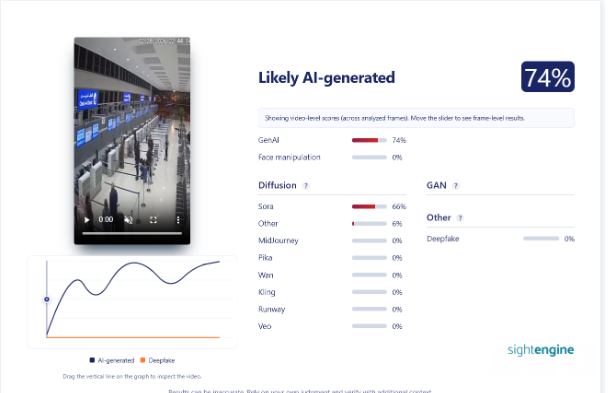
To verify the viral claim, we searched Google using relevant keywords. However, we did not find any credible media report confirming the claim.On closely examining the viral video, we noticed several unusual visuals and technical inconsistencies, raising suspicion that it might be AI-generated. To verify this, we scanned the video using the AI detection tool Sightengine. According to the results, around 74 percent of the video shows the likelihood of being AI-generated.
Conclusion:
Our research found that the viral video is not real but has been created using artificial intelligence technology.
