
The Quiet Casualties of the AI Era │ How Organisations Are Using AI for Decision-Making and Why Human Judgement Still Matters
Introduction
You ask an app for directions to a street you've driven down a hundred times. You let autocomplete finish your sentence before you've decided what you meant to say. You take a photo of a document instead of reading it, trusting the summary a model hands back. None of these moments feel like a loss. Each one is, on its own, a reasonable trade of effort for convenience. But add them up across a year, a career, an industry, and you start to wonder what exactly we've been trading away. Every technology wave produces its own founding myth. For AI, the myth is that intelligence can be manufactured at scale, bottled into a model, and dispensed on demand - cheaper, faster, and eventually better than the human original. It's a seductive story, and one we've been telling ourselves so uncritically that we've stopped noticing what it costs.
The casualties of this bet are rarely dramatic. Nobody announces that a skill has quietly atrophied, or that a habit of independent judgement has gone unused long enough to weaken. These losses don't show up as headlines; they show up later, as gaps, when the system that was supposed to think for us turns out not to have been thinking at all. Ford Motor Company's recent decision to rehire around 350 veteran engineers, after leaning heavily on AI-driven quality systems, is a small but telling data point.¹ The lesson isn't that automation failed outright — it's that a process can be automated without the judgement that made the process work ever being captured in the first place. That distinction between automating a task and actually preserving the human expertise behind it is the real subject of this AI moment.
How Organisations Are Using AI in Decision-Making
More organisations are now leaning on AI not just to execute tasks, but to help shape decisions. Deloitte's 2026 Global Human Capital Trends survey found that 60% of executives now regularly use AI to support their decisions, and the same report cites Gartner's projection that by 2027, half of all business decisions will be augmented or automated by AI agents. Companies like Netflix and Amazon are often pointed to as examples of this working well using AI to enhance recommendations and logistics while keeping people involved in the interpretation, generating significant value in the process. Elsewhere, results have been more mixed: MIT's "State of AI in Business 2025" study found that 95% of generative AI pilots showed no measurable P&L impact within six months, often because this initiative failed to integrate feedback or adapt to context rather than because the underlying model was flawed. Critics have noted the study used a narrow definition of success (six-month, bottom-line ROI), so the figure may understate the value AI creates in ways that aren't captured on the P&L. Notably, this is not an argument against using AI. It is an argument about how we use it and why the human-in-the-loop principle, keeping people actively involved in judgement rather than passively rubber-stamping outputs, is not a compliance checkbox but the thing that determines whether automation actually works. That distinction, between automating a task and preserving the human expertise behind it, is the point of contention.
Finding the Balance
The lesson isn't to use AI less, it's to be deliberate about where it sits in the process. The strongest results come from pairing AI's speed with human judgement, not swapping one for the other. That means keeping a clear owner for important decisions, checking that the model is optimising for the right goal, and treating its output as a strong first draft rather than a final answer. Used this way, AI doesn't replace thinking, it gives good judgement more room to work.
Two Framings We Should Retire
Conversations about AI adoption keep falling into two lazy framings. The first is AI versus humans, as if technology and workforce are locked in a zero-sum contest for relevance. The second is AI versus jobs, reducing every discussion to headcount and displacement. Both are legitimate concerns, but they crowd out a more urgent question: as AI gets embedded deeper into how decisions are made, what happens to the quality of the decisions themselves? This is not a question about whether AI is useful and it plainly is. It is a question about what gets quietly outsourced along with the task, and whether anyone notices before it matters.
Why “Wisdom of Crowds” Does Not Automatically Apply to AI
A comforting analogy often gets reached for: surely, with millions of people using the same models, errors will average out, the way independent forecasters tend to converge on accurate estimates.² That analogy breaks down where it matters most. The wisdom-of-crowds effect depends on independent thinking, genuinely diverse information, and an aggregation mechanism that does not distort the signal. When millions of people query the same underlying model, those conditions collapse. Everyone draws from the same statistical engine, trained on overlapping data, tuned toward similar “safe” answers. The apparent agreement is not corroboration, it is an echo. This creates a genuinely new risk: AI can be confidently, fluently, and uniformly wrong across an entire organisation at once, without the friction that would normally surface an error in a single person's judgement.
The Casualties, Named Plainly
Several things erode quietly when organisations are not deliberate about integrating AI into decisions. Independent judgement is the first casualty of the willingness to form a view before checking what the model says. Verification effort follows: generative AI collapses retrieval and generation into one fluent output, and people invest less effort checking something that already sounds complete and well-reasoned. Diversity of thought narrows as more decision-makers lean on the same handful of models for research and drafting, quietly reducing the range of framings available when it matters most. Accountability becomes harder to trace when a recommendation generated by a model and passed along with minimal scrutiny creates a strange vacuum where a decision was made but nobody quite owns it. And informational anchoring sets in, where a signal becomes a coordination point simply because everyone is looking at it, regardless of its accuracy.
Why Human-in-the-Loop Is a Design Requirement
“Human in the loop” often becomes a rubber-stamp step rather than genuine scrutiny. That is a mistake, because the functions humans provide are structural, not decorative. Context that a model cannot infer history, relationships, unstated constraints shapes whether a reasonable-sounding answer is right in a specific situation. Domain expertise built over years lets someone recognise when a fluent answer is subtly wrong. Ethical judgement decides trade-offs a model has no standing to make on an organisation's behalf. Accountability means someone can be asked why a decision was made and answer from reasoning, not from “the system recommended it.” And the rarest function of all is the willingness to challenge a convincing answer and resisting the very fluency that makes AI output persuasive.
What This Looks Like in Practice
For organisations, the goal is not slowing AI adoption but being deliberate about where human judgement stays load-bearing. AI output should default to draft status until a qualified person has actively tested its logic against context the model lacks. Teams using the same AI tools for analysis should build in a step that actively seeks disagreement, rather than assuming convergence means correctness. Ford's decision to bring engineers back to lead design reviews is instructive: expertise, once encoded into a system, is not safe to let atrophy in the people who built it.³ Verification should be visible and required for decisions with real financial, legal, safety, or reputational consequences. And organisations should track which decisions were AI-assisted and who owned the final call, so accountability stays traceable rather than quietly disappearing.
Conclusion
Decades ago, management thinkers warned that automating a broken process only helps an organisation fail faster. The AI era raises the stakes on that warning: judgement itself, the hard-won capacity to reason well under uncertainty, can be automated away without anyone deciding to give it up. Machines already process information faster than any team of people. What they cannot yet do is originate the wisdom that comes from human experience, accountability, and the willingness to be told one is wrong. That capacity erodes not because AI is powerful, but because organisations stop deliberately exercising it. The real task ahead is not resisting AI, but ensuring that as it takes on more of the work of deciding, humans deliberately keep hold of the responsibility of deciding.
References
- https://www.assemblymag.com/articles/100186-ford-rehires-veteran-engineers-to-improve-ai-vehicle-quality
- https://finance.yahoo.com/technology/ai/articles/ford-rehires-veteran-engineers-ai-144332497.html
- https://finance.yahoo.com/technology/ai/articles/ford-rehires-more-300-engineers-162210705.html
- https://www.msn.com/en-us/money/other/ford-rehires-hundreds-of-engineers-after-ai-struggles-to-improve-quality/ar-AA26P4QB?ocid=BingNewsSerp
- https://www.foxbusiness.com/technology/ford-rehires-experienced-engineers-after-ai-misses-mark
- https://www.livemint.com/opinion/online-views/artificial-wisdom-of-crowds-jobs-crisis-ai-technology-automation-openai-model-11785009289768.html
- https://www.deloitte.com/us/en/insights/topics/talent/human-capital-trends/2026/decision-making-with-ai.html
- https://www.hpcwire.com/aiwire/2026/03/04/deloittes-state-of-ai-2026-why-enterprise-execution-is-falling-behind-adoption/ and Legal.io summary: https://www.legal.io/blog/5719519/MIT-Report-Finds-95-of-AI-Pilots-Fail-to-Deliver-ROI-Exposing-GenAI-Divide
- https://www.marketingaiinstitute.com/blog/mit-study-ai-pilots

Related Blogs

Executive Summary
A video is being widely shared on social media showing a man in an army uniform jumping from a height, losing balance mid-air, and appearing to meet with an accident. The clip is being circulated as a real-life incident. However, a research by the CyberPeace found the claim to be false. The viral video is not real but AI-generated.
Claim
On social media platform Facebook, a user shared the video with a caption suggesting it shows a real accident, warning against risky stunts.
- https://archive.ph/BH6dl#selection-347.0-347.122
- https://www.facebook.com/ashok.yadav.9041083/posts/1593460528549619/

Fact Check
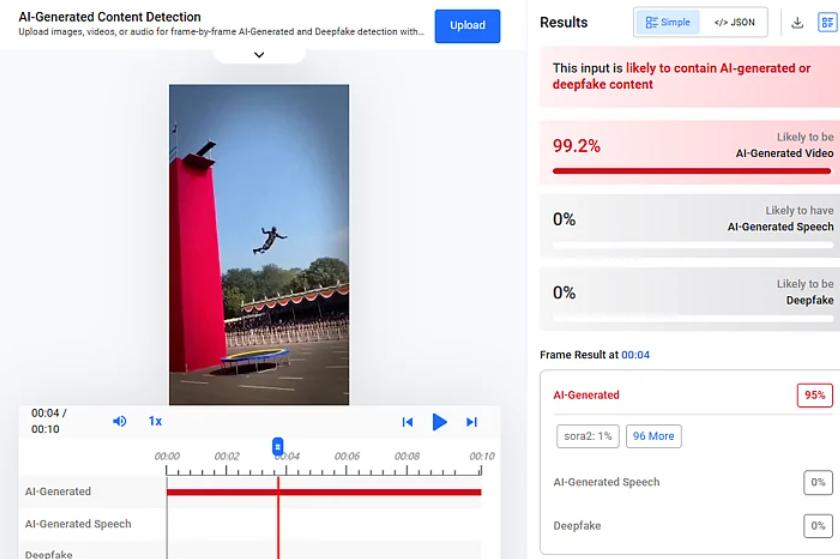
To verify the claim, we conducted a reverse image search using Google Lens but found no credible news reports or official sources mentioning such an incident. A closer look at the video revealed several inconsistencies commonly associated with AI-generated content. For instance, the person appears to disappear momentarily while falling, the head is not clearly visible after impact, and the background audio seems unnatural. We further analyzed the video using AI detection tools. On Hive Moderation, the video showed a 99.2% probability of being AI-generated.
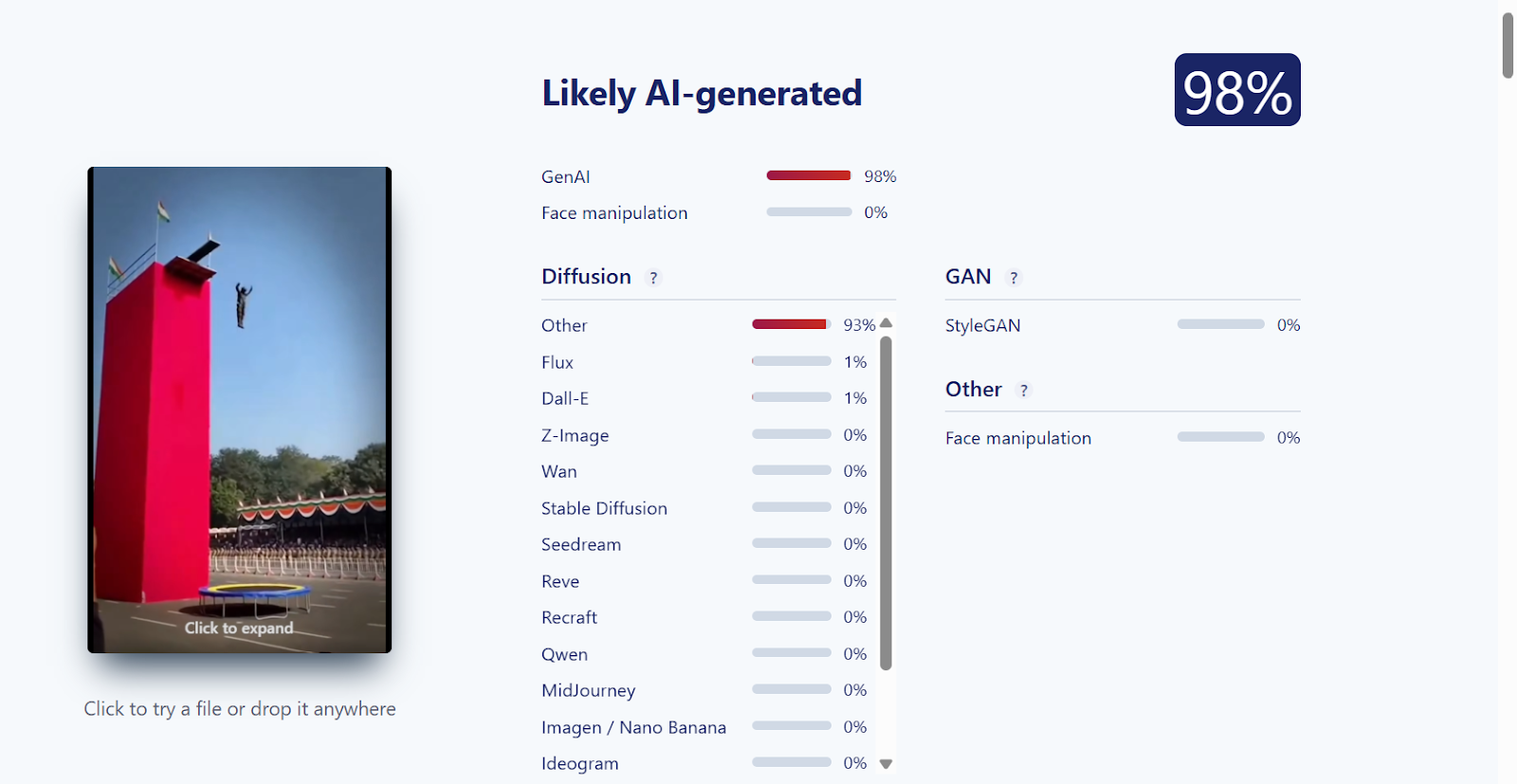
Additionally, analysis using Sightengine indicated a 98% likelihood that the video was synthetically created.
Conclusion
The viral claim is false. The video does not depict a real incident but is an AI-generated clip. It has been shared with a misleading narrative, and there is no evidence to support the claim that it shows an actual accident.
.webp)
Introduction
Deepfake have become a source of worry in an age of advanced technology, particularly when they include the manipulation of public personalities for deceitful reasons. A deepfake video of cricket star Sachin Tendulkar advertising a gaming app recently went popular on social media, causing the sports figure to deliver a warning against the widespread misuse of technology.
Scenario of Deepfake
Sachin Tendulkar appeared in the deepfake video supporting a game app called Skyward Aviator Quest. The app's startling quality has caused some viewers to assume that the cricket legend is truly supporting it. Tendulkar, on the other hand, has resorted to social media to emphasise that these videos are phony, highlighting the troubling trend of technology being abused for deceitful ends.
Tendulkar's Reaction
Sachin Tendulkar expressed his worry about the exploitation of technology and advised people to report such videos, advertising, and applications that spread disinformation. This event emphasises the importance of raising knowledge and vigilance about the legitimacy of material circulated on social media platforms.
The Warning Signs
The deepfake video raises questions not just for its lifelike representation of Tendulkar, but also for the material it advocates. Endorsing gaming software that purports to help individuals make money is a significant red flag, especially when such endorsements come from well-known figures. This underscores the possibility of deepfakes being utilised for financial benefit, as well as the significance of examining information that appears to be too good to be true.
How to Protect Yourself Against Deepfakes
As deepfake technology advances, it is critical to be aware of potential signals of manipulation. Here are some pointers to help you spot deepfake videos:
- Look for artificial facial movements and expressions, as well as lip sync difficulties.
- Body motions and Posture: Take note of any uncomfortable body motions or discrepancies in the individual's posture.
- Lip Sync and Audio Quality: Look for mismatches between the audio and lip motions.
- background and Content: Consider the video's background, especially if it has a popular figure supporting something in an unexpected way.
- Verify the legitimacy of the video by verifying the official channels or accounts of the prominent person.
Conclusion
The popularity of deepfake videos endangers the legitimacy of social media material. Sachin Tendulkar's response to the deepfake in which he appears serves as a warning to consumers to remain careful and report questionable material. As technology advances, it is critical that individuals and authorities collaborate to counteract the exploitation of AI-generated material and safeguard the integrity of online information.
Reference
- https://www.news18.com/tech/sachin-tendulkar-disturbed-by-his-new-deepfake-video-wants-swift-action-8740846.html
- https://www.livemint.com/news/india/sachin-tendulkar-becomes-latest-victim-of-deepfake-video-disturbing-to-see-11705308366864.html

Executive Summary
A video featuring the newly appointed Chief of Army Staff (COAS), General Dhiraj Seth, is going viral on social media. The video claims that he made controversial remarks regarding Operation Sindoor and alleged that the previous military leadership hid the bodies of Indian soldiers martyred during the operation. It further claims that Defence Minister Rajnath Singh and Prime Minister Narendra Modi were also kept unaware of the matter. CyberPeace Research Wing research found the claim to be misleading. The research revealed that the viral video was digitally manipulated using artificial intelligence (AI), and the voice heard in the video is not authentic.
Claim
A viral video shared on social media platform X claims that newly appointed Chief of Army Staff (COAS) General Dhiraj Seth said that the bodies of Indian soldiers martyred during Operation Sindoor were hidden and that Defence Minister Rajnath Singh and Prime Minister Narendra Modi were not informed about it. https://archive.ph/oaOgB , https://x.com/InsiderWB/status/2072434480543899826

Fact Check
To verify the viral claim, we searched the internet using relevant keywords including “General Dhiraj Seth statement on Operation Sindoor”, “Operation Sindoor martyrs”, and “dead bodies hidden.” However, we did not find any credible media report stating that Army Chief General Dhiraj Seth made the remarks attributed to him in the viral video. We also checked the official social media handles of the Indian Army, but found no official statement or information supporting the viral claim. During the research, several keyframes from the viral video were extracted and analysed through reverse image search. The search led us to an ANI report published on July 1, 2026, whose watermark is also visible in the viral video. The original footage shows General Dhiraj Seth addressing the public after assuming charge as the Chief of Army Staff. We carefully reviewed General Dhiraj Seth’s entire address but found no mention of hiding the bodies of martyred soldiers or any statement related to the viral claim. The same address was also shared on the official platform of the Indian Army. The video review confirmed that it does not contain any such remarks.
https://www.facebook.com/reel/1592505052458589

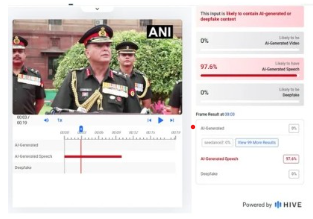
During the analysis, it was also observed that the name tag on General Dhiraj Seth’s uniform appears distorted in several frames. Such inconsistencies are commonly seen in AI-generated or digitally manipulated videos. To verify the authenticity of the video, we analysed it using multiple AI detection tools. The results from all the tools were consistent. Hive Moderation’s analysis indicated a high probability that the viral media contains AI-generated or deepfake content.
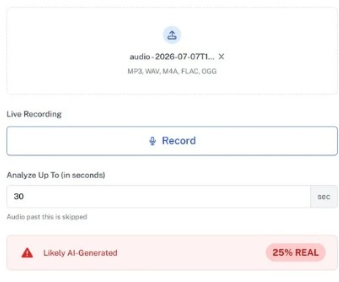
Undetectable AI’s analysis also concluded that the voice heard in the viral video was likely generated using artificial intelligence (AI).
Conclusion
Our research found that the viral video is not authentic. There is no evidence that Chief of Army Staff General Dhiraj Seth ever accused the previous military leadership of concealing the bodies of soldiers martyred during Operation Sindoor. The video has been digitally manipulated, and the claim being circulated on social media is misleading.
