
#FactCheck - Misleading Video of Dubai Airport Attack Circulates Online, Found AI-Generated
Executive Summary
Amid rising tensions in the Middle East following attacks on Iran by the United States and Israel, a video is being shared on social media claiming that it shows a recent attack at Dubai International Airport. Research by the CyberPeace found the viral claim to be false. Our research revealed that the viral video is not real but has been created using artificial intelligence technology.
Claim:
An Instagram user shared the viral video on March 1, 2026, claiming it shows an attack at Dubai Airport. The link to the post, the archive link, and a screenshot are provided below.

Fact Check:
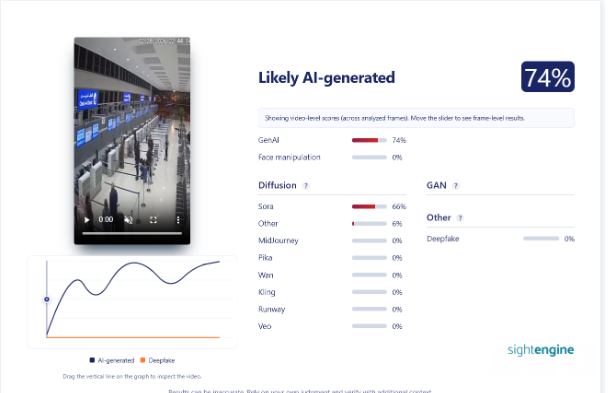
To verify the viral claim, we searched Google using relevant keywords. However, we did not find any credible media report confirming the claim.On closely examining the viral video, we noticed several unusual visuals and technical inconsistencies, raising suspicion that it might be AI-generated. To verify this, we scanned the video using the AI detection tool Sightengine. According to the results, around 74 percent of the video shows the likelihood of being AI-generated.
Conclusion:
Our research found that the viral video is not real but has been created using artificial intelligence technology.

Related Blogs

Executive Summary
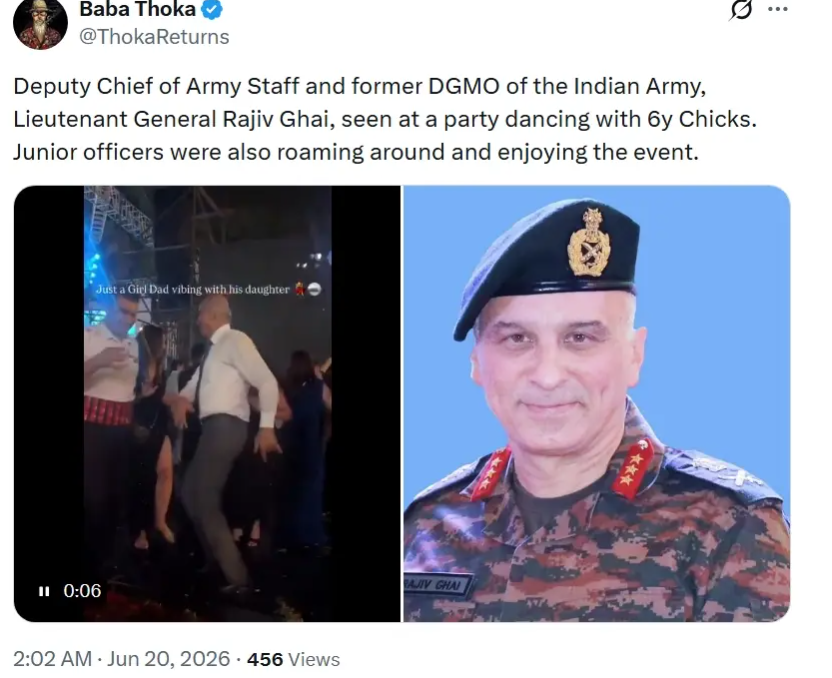
A video circulating on social media claims to show the Deputy Chief of Army Staff and former DGMO of the Indian Army, Lieutenant General Rajiv Ghai, dancing with a young woman at a party. Users sharing the clip further allege that other junior military officers were also present at the event. CyberPeace Research Wing research found the claim to be misleading. The viral video has no connection with the Indian Army, Lt Gen Rajiv Ghai, or any official military function. The person seen in the video is actually the father of content creator Akanksha Sehgal, who has featured him in multiple videos on her social media accounts.
Claim:
A Pakistani handle ‘Baba Thoka’ shared the video on X, alleging that Lt Gen Rajiv Ghai was seen dancing with young women at a party and that junior officers were also present.
- https://x.com/ThokaReturns/status/2068069535715147896?s=20
- https://archive.ph/H9EA0
Fact Check:
A reverse image search of keyframes from the viral video led to the same clip being found on Instagram handle ‘akku_sehgal_’, posted on December 14, 2025. The video caption read: “POV – when your dad and your music taste match.”

Further examination of the content creator Akanksha Sehgal’s Instagram profile showed multiple videos featuring the same father-daughter duo, confirming that the man in the viral clip frequently appears in her content.

Conclusion:
The viral video claiming to show Lieutenant General Rajiv Ghai dancing at a party is misleading. The individual seen in the video is not the senior Indian Army officer but the father of content creator Akanksha Sehgal.

Introduction
The Department of Telecommunications (DoT) has launched the 'Digital Intelligence Platform (DIP)'and the 'Chakshu' facility on the Sanchar Saathi portal to combat cybercrimes and financial frauds. Union telecom, IT and railways minister Ashwini Vaishnaw announced the initiatives, stating that the government has been working to counter cyber frauds at national, organizational, and individual levels. The Sanchar Saathi portal has successfully tackled such attacks, and the two new portals will further enhance the capacity to check any kind of cyber security threat.
The Digital Intelligence Platform is a secure and integrated platform for real-time intelligence sharing, information exchange, and coordination among stakeholders, including telecom operators, law enforcement agencies, banks, financial institutions, social media platforms, and identity document issuing authorities. It also contains information regarding cases detected as misuse of telecom resources.
The 'Chakshu' facility allows citizens to report suspected fraud communication received over call, SMS, or WhatsApp with the intention of defrauding, such as KYC expiry, bank account/payment wallet/SIM/gas connection/electricity connection, sextortion, impersonations a government official/relative for sending money, and disconnection of all mobile numbers by the Department of Telecommunications.
The launch of these proactive initiatives or steps represents another significant stride by the Ministry of Communications and the Department of Telecommunications in combating cybersecurity threats to citizens' digital assets.
In this age of technology, there is a reason to be concerned about the threats posed by cybercrooks to individuals and organizations. The risk of using digital means for communication, e-commerce, and critical infrastructure has increased significantly. It is important to have proper measures in place to prevent cybercrime and destructive behavior. The Department of Telecommunication has unveiled "Chakshu," a digital intelligence portal aimed at combating cybercrimes. This platform seeks to enhance the country's cyber defense capabilities by providing enforcement agencies with effective tools and actionable intelligence for countering cybercrimes, including financial frauds.
Digital Intelligence Platform (DIP)
Digital Intelligence Platform (DIP) developed by the Department of Telecommunications is a secure and integrated platform for real-time intelligence sharing, information exchange and coordination among the stakeholders i.e. Telecom Service Providers(TSPs), law enforcement agencies (LEAs), banks and financial institutions(FIs), social media platforms, identity document issuing authorities etc. The portal also contains information regarding the cases detected as misuse of telecom resources. The shared information could be useful to the stakeholders in their respective domains. It also works as a backend repository for the citizen-initiated requests on the Sanchar Saathi portal for action by the stakeholders. The DIP is accessible to the stakeholders through secure connectivity, and the relevant information is shared based on their respective roles. However, the platform is not accessible to citizens.
What is Chakshu?
Chakshu, which means “eye” in Hindi, is a new feature on the Sanchar Saathi portal. This citizen-friendly platform allows you to report suspicious communication you receive via calls, SMS, or WhatsApp. “Chakshu” is a new advanced tool to safeguard against modern-day cybercriminal activities. Chakshu is a sophisticated design that uses the latest technologies for assembling and analyzing digital information and provides law enforcement agencies with useful data on what should be done next. Below are some of its attributes.
Here are some examples of what you can report:
- Fraudulent messages claiming your KYC (Know Your Customer)details need to be updated.
- Fraudulent requests to update your bank account, payment wallet, or SIM card details.
- Phishing attempts impersonating government officials or relatives asking for money.
- Fraudulent threats of disconnection of your sim connections.
How Chakshu Aims to crackdown Cybercrime and Financial Frauds
Chakshu is a new tool on the Sanchar Saathi platform that invites individuals to report suspected fraudulent communications received by phone, SMS, or WhatsApp. These fraudulent activities may include attempts to deceive individuals through schemes such as KYC expiry or update requests for bank accounts, payment wallets, SIM cards, gas connections, and electricity connections, sextortion, impersonation of government officials or relatives for financial gain, or false claims of mobile number disconnection by the Department of Telecommunications.
The tool is well-designed and equipped to help the investigators with actionable intelligence and insights, enabling LEAs to conduct targeted investigations on financial frauds and cyber-crimes; the tool helps in gathering a comprehensive data analysis and evidence collection capability by mapping out the connection between individuals, organizations and illicit activities, it, therefore, allows the law enforcement agencies in dismantling criminal activities and help the law enforcement agencies.
Chakshu’s Impact
India has launched Chakshu, a digital intelligence tool that strengthens the country's cybersecurity policy. Chakshu employs modern technology and real-time data analysis to enhance India's cyber defenses. Law enforcement can detect and neutralize possible threats by taking proactive approach to threat analysis and prevention before they become significant crises. Chakshu also improves the resilience of critical infrastructure and digital ecosystems, safeguarding them against cyber-attacks. Overall, Chakshu plays an important role in India's cybersecurity posture and the protection of national interests in the digital era.
Where can Chaksu be accessed?
Chakshu can be accessed through the government's Sanchar Saathi web portal:https://sancharsaathi.gov.in
Conclusion
The launch of the Digital Intelligence Platform and Chakshu facility is a step forward in safeguarding citizens from cybercrimes and financial fraud. These initiatives use advanced technology and stakeholder collaboration to empower law enforcement agencies. The Department of Telecommunications' proactive approach demonstrates the government's commitment to cybersecurity defenses and protecting digital assets, ensuring a safer digital environment for citizens and critical infrastructure.
References
- https://telecom.economictimes.indiatimes.com/news/policy/dot-launches-digital-intelligence-portal-chakshu-facility-to-curb-cybercrimes-financial-frauds/108220814
- https://bankingfrontiers.com/digital-intelligence-platform-launched-to-curb-cybercrime-financial-fraud/
- https://www.business-standard.com/india-news/calcutta-hc-justice-abhijit-gangopadhyay-sends-his-resignation-to-prez-cji-124030500367_1.html
- https://www.the420.in/dip-chakshu-government-launches-powerful-weapons-against-cybercrime/
- https://pib.gov.in/PressReleaseIframePage.aspx?PRID=2011383

Executive Summary:
A morphed video of the actor Anup Soni popular on social media promoting IPL betting Telegram channel is found to be fake. The audio in the morphed video is produced through AI voice cloning. AI manipulation was identified by AI detection tools and deepfake analysis tools. In the original footage Mr Soni explains a case of crime, a part of the popular show Crime Patrol which is unrelated to betting. Therefore, it is important to draw the conclusion that Anup Soni is in no way associated with the betting channel.

Claims:
The facebook post claims the IPL betting Telegram channel which belongs to Rohit Khattar is promoted by Actor Anup Soni.

Fact Check:
Upon receiving the post, the CyberPeace Research Team closely analyzed the video and found major discrepancies which are mostly seen in AI-manipulated videos. The lip sync of the video does not match the audio. Taking a cue from this we analyzed using a Deepfake detection tool by True Media. It is found that the voice of the video is 100% AI-generated.


We then extracted the audio and checked in an audio Deepfake detection tool named Hive Moderation. Hive moderation found the audio to be 99.9% AI-Generated.

We then divided the video into keyframes and reverse searched one of the keyframes and found the original video uploaded by the YouTube channel named LIV Crime.
Upon analyzing we found that in the 3:18 time frame the video was edited, and altered with an AI voice.

Hence, the viral video is an AI manipulated video and it’s not real. We have previously debunked such AI voice manipulation with different celebrities and politicians to misrepresent the actual context. Netizens must be careful while believing in such AI manipulation videos.
Conclusion:
In conclusion, the viral video claiming that IPL betting Telegram channel promotion by actor Anup Soni is false. The video has been manipulated using AI voice cloning technology, as confirmed by both the Hive Moderation AI detector and the True Media AI detection tool. Therefore, the claim is baseless and misleading.
- Claim: An IPL betting Telegram channel belonging to Rohit Khattar promoted by Actor Anup Soni.
- Claimed on: Facebook
- Fact Check: Fake & Misleading
