
#FactCheck-Fake post falsely attributes EVM-related remark to US Secretary Marco Rubio
Executive Summary
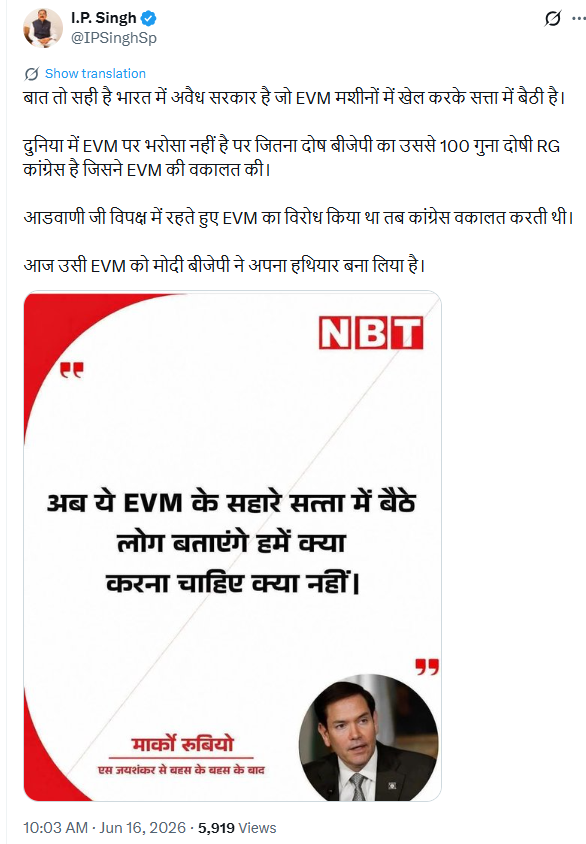
A social media post card featuring a photo of US Secretary of State Marco Rubio, carrying the logo of Navbharat Times, is being widely circulated online. The post claims that Rubio made a remark criticizing the Indian government, allegedly stating that “those in power through EVMs should tell us what to do and what not to do.” CyberPeace Research Wing research found the claim to be false. There is no evidence of Marco Rubio making any such statement, and the viral post card is fabricated.
Claim:
A post shared by SP leader IP Singh alleged that the US Secretary made comments questioning the legitimacy of the Indian government and EVM-based elections, further linking it to broader political criticism of EVMs.
Post link: https://x.com/IPSinghSp/status/2066740933396492706?s=20, https://archive.ph/submit/?url
Fact Check:
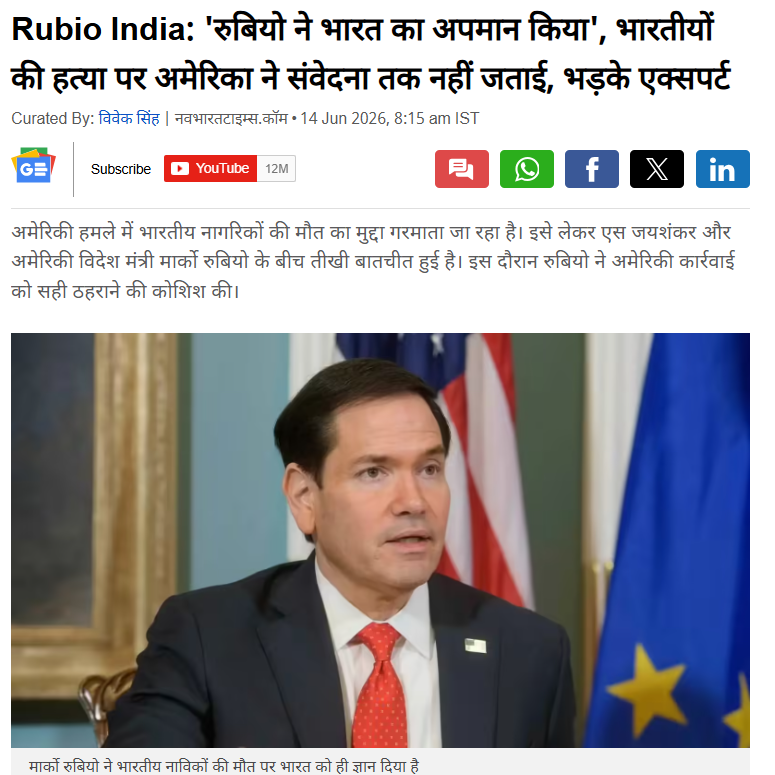
A keyword search of the alleged statement revealed no credible reports or official records of Marco Rubio making any such remark. Additionally, a review of Navbharat Times’ official social media handles did not show any such post card being published, indicating that the viral graphic is not authentic. Further examination of recent statements by Marco Rubio showed no reference to EVMs or the Indian electoral system. Instead, a Navbharat Times report dated June 14 covered a different issue related to tensions in the Hormuz Strait, where Rubio commented on the killing of Indian sailors during a maritime incident and emphasized compliance with US directives for commercial vessels. https://navbharattimes.indiatimes.com/world/america/marco-rubio-remarks-on-killing-of-indian-sailors-in-hormuz-strait-insult-of-india-says
Conclusion:
The research confirms that US Secretary of State Marco Rubio did not make any statement regarding EVMs or the Indian government. The viral post card is fake and misleading.

Related Blogs
Introduction
In January 2026, the Basic Act on the Development of Artificial Intelligence and the Establishment of a Foundation for Trustworthiness came into effect in South Korea, establishing one of the first national AI laws in the world. The bill, enacted by the National Assembly of Korea in December 2024 and implemented from January 22, 2026, aims to strike a balance between the rapid advancement of technology and clear safeguards against risks, as well as transparency, accountability, and responsible AI use. It puts Seoul and the European Union on the frontline of developing legal systems for artificial intelligence and indicates a long-term goal of becoming an AI power on the global stage.
What the AI Basic Act Covers
The AI Basic Act consists of 19 separate AI bills that are merged into a single piece of legislation that covers the lifecycle of AI, including research and development, deployment, and utilisation. It is very wide in its coverage: it refers to any AI system that influences the Korean market or users inside the country, irrespective of the country in which it is created. The law does not apply to national defence and security applications.
The law defines key concepts like artificial intelligence, generative AI, and high-impact AI and establishes the principles of ethical AI, safety, user rights, industry support, and national policy coordination. It also offers a legal foundation for the activities of the government to promote AI innovation without jeopardising the common good.
Fundamentally, the AI Basic Act is designed to establish a culture of trust between businesses and the government/citizens. It does not prohibit AI technologies and does not excessively limit innovation. Instead, it creates the framework of responsible development and economic growth.
Guardrails for Safety and Accountability
One of the defining features of the AI Basic Act is its risk-based approach. Rather than considering all AI systems as similar, it makes a distinction between ordinary and high-impact AI systems, the ones applied in sectors where the wrong or unsafe decision can have a major impact on the safety, rights, or critical infrastructure of the population. Some of them can be seen in healthcare, transportation, financial services, education, and public services.
The high-impact AI operators must integrate risk management plans, human controls, and surveillance systems. In critical decision-making situations, human control should be available at all times; that is, machines can help but not override human control where human safety or other human rights are involved.
The law enables the regulators to perform on-site checks, demand documentation, and conduct compliance investigations. Fines for breaches may go up to 30 million Korean won (approximately 21,000 US dollars). It has a one-year period of transition that is based on guidance but not enforcement, thus allowing companies time to implement compliance measures before imposing fines.
These requirements contribute to enhancing accountability by defining who is accountable for the safety outcomes. The law in South Korea is placed in the ecosystem, as opposed to the methods in which industry self-governance alone is utilised.
Transparency and Labelling Requirements
The AI Basic Act is based on transparency. The legislation ensures that users are notified before an AI system is operating, particularly with the generation of AI outputs that could be confused with human-created material. As an example, AI-generated text, images, video, or audio that may be difficult to distinguish between reality and fake must have obvious labels or watermarks to allow users to understand the source of the content.
The necessity to label is meant to fight misinformation, misleading activities, and unintended influence on the perception of the people. It is based on international anxiety regarding AI-generated content, such as deepfakes, manipulated media, and misleading online advertisements that have already been addressed separately in policy by South Korea, as well as discussions of data governance.
The transparency is also applied to the process of decision-making in AI systems. Developers and operators should be able to give explicit information about the way in which high-impact systems make their conclusions so that those who are victims of automated decisions can seek meaningful explanations. Although specific explainability criteria are in the process of being developed, the law grounds the principle that AI cannot act behind the scenes in situations where crucial decisions are being made.
Data Privacy and User Protection
The AI governance practice in South Korea is complementary to its current data protection laws, the Personal Information Protection Act (PIPA), which is broadly regarded as equivalent to major international data protection regulations like the GDPR in regard to personal data laws. The AI Basic Act provides an explanation as to how the data can be gathered, processed, and utilised within AI systems with regard to privacy rights, particularly in areas of high impact.
The law does not supersede the personal data protection policies, but it sets certain conditions on how AI developers must address the data to be utilised in training, testing, and running AIs. Operators will be required to document their data workflows and demonstrate how they guard the privacy of their users, including by transparency and consent mechanisms where necessary. This can assist in ensuring that the information that is utilised in AI functions is regulated by definite norms, and it is more difficult to avoid privacy requirements in the name of innovation.
Accountability and Governance Infrastructure
The AI Basic Act establishes a national policy framework of AI governance. The National Artificial Intelligence Strategy Committee, chaired by the President, is at the top and proposes the overall AI policy and aligns it with national objectives. The organisations that would support this are the specialised organisations that deal with safety, risk assessment, and research and the policy centre that would analyse the effects of AI on society and assist in its adoption by the industry.
This institutional structure facilitates strategic guidance as well as operational control. It is through incorporating AI governance in the administration of the people, but not into the market forces, that South Korea wishes to have the ethical and societal concerns become part of the sectors and agencies.
Promoting Innovation and Industrial Support
Although the AI Basic Act does not disregard regulation, it is not a law of restrictions. It also offers legal justification for research and development, human capital, and the growth of the AI industry, with special consideration for startups and small and medium-sized businesses. The legislation promotes AI clusters, long-term funding programmes, and policies to bring foreign talent to the Korean AI ecosystem.
This bidimensional approach of compliance and support is indicative of the broader desire of Korea to become one of the leading AI powers in the world, along with the US and China. The government has pointed out that it will encourage trust by having clear and predictable rules that will attract investment and maintain innovation and not stifle it.
What This Means Globally
The AI Basic Act of South Korea is not only interesting in its contents but also in its timing. It is also among the first thorough AI legislations to come into force in the world, and it beats the gradual regulatory implementations in other parts of the globe, like the European Union. Its system incorporates a principle-based framework, transparency requirements, accountability regulations, and industrial support, which reflects a contrasting model to either pure prescriptive risk regulation or lax self-regulation models elsewhere.
Other critics, such as industry groups and civil society organisations, have suggested that some of the protections may be more explicit, in particular to those who are harmed by AI systems, or to establish high-impact categories. Nonetheless, the framework sets a benchmark upon which most nations will pay close attention when they establish their own AI regimes.
Conclusion
The AI Basic Act puts South Korea at the forefront of national AI regulation, including very well-developed guardrails that enforce transparency, ethical control, accountability, and data protection in addition to fostering innovation. It recognises that AI could lead to economic and social advantages, yet also actual risks, particularly when systems are opaque, autonomous, or widely implemented. South Korea has gone holistically in responsible AI governance by integrating human oversight, labelling requirements, risk management planning, and governance infrastructure into law to be emulated by other countries in the years to come.
Sources
- https://www.theguardian.com/world/2026/jan/29/south-korea-world-first-ai-regulation-laws
- https://www.oecd.org/content/dam/oecd/en/publications/reports/2025/10/artificial-intelligence-and-the-labour-market-in-korea_af668423/68ab1a5a-en.pdf
- https://asianintelligence.ai/south-korea
- https://aibasicact.kr/
- https://aibusinessweekly.net/p/south-korea-ai-basic-act-takes-effect-jan22-2026
- https://asiadaily.org/news/12112/

In the 21st century, wars are no longer confined to land, sea, and air. Rather, they are increasingly playing out across the digital domain, where effective dominance over networks, data, and communications determines who holds the upper hand. Among these, 5G networks are becoming a defining factor on modern battlefields. The ultra-low latency, massive bandwidth capability, and the ability to connect many devices at a single time are transforming the scale and level of military operations, intelligence, and logistics. This unprecedented connectivity is also met with a host of cybersecurity vulnerabilities that the governments and the militaries have to address.
As India faces a challenging security environment, the emergence of 5G presents both an opportunity and a dilemma. On one hand, it can enhance our command, control, surveillance and battlefield coordination. On the other hand, it also exposes the military and the security establishments to risks of espionage and supply chain vulnerabilities. So in this case, it will be important to strike a balance between innovation and security for turning 5G into a strength rather than a liability.
How can 5G networks be a military asset?
In comparison to its predecessors, 5G is not just about faster downloads. Rather, it is a complete overhaul of network architectures that are designed to support services and technologies according to modern technological requirements. In terms of military application of 5G networks, it can prove a series of game-changing capabilities, such as:-
- Enhanced Command and Control in the form of real-time data sharing between troops, UAVs, Radar systems and the Command Cells to ensure a faster and coordinated decision-making approach.
- Tactical Situational Awareness with the help of 5G-enabled devices can give soldiers instant updates on the terrain, troop movements, or positions and enemy movements.
- Advanced Intelligence, Surveillance and Reconnaissance (ISR) with high-resolution sensors, radars and UAVs that can operate at their full potential by transmitting vast data streams with minimal legacy.
However, 5G networks can also help to become a key component of the communication component of the military command establishments that would allow machines, sensors and human operators to function as a single and integrated force.
Understanding the importance of 5G networks as the Double-Edged Swords of Connectivity-
The potential of 5G is undeniable, but its vulnerabilities cannot be ignored. Because they are software-driven and reliant on dense networks of small cells. For the military, this shows that adversaries could exploit their weaknesses to disrupt the communication, jam signals, and intercept sensitive data, leaving behind some key risks, such as;
- Cybersecurity threats from software-based architectures make 5G networks prone to malware and data breaches.
- Supply chain risks can arise from reliance on foreign hardware and software components with raising fears of embedded backdoors or compromised systems.
- Signal jamming and interface in terms of millimetre-wave spectrum, 5G signals are vulnerable to disruption in contested environments.
- There can also be insider threats and physical sabotage over personnel or unsecured installations that could compromise network integrity.
Securing the Backbone: Cyber Defence Imperatives
To safeguard 5G networks as the backbone for future warfare, the defence establishments need to adopt a layered, proactive cybersecurity strategy. Several measures can be considered, such as;
- Ensuring robust encryption and authentication to protect sensitive data, which requires the installation of advanced protocols like Subscription Concealed Identifiers and zero-trust frameworks to eliminate implicit trust.
- Investing in domestic R&D for 5G components to reduce dependency on foreign suppliers. India’s adoption of the 5Gi standard is a step in this direction, but upgrading it into a military grade remains vital.
- To ensure collaboration across different sectors, the defence forces need to work with civilian agencies and private telecoms support providers to create unified standards and best practices.
Thus, with embedding cybersecurity into every layer of the 5G architecture, India can work in the direction to reduce risks to maintain its operational resilience.
The geopolitical domains of 5G Network as a tool of warfare-
The introduction of 5G networks has definitely come as a tool of technological advancement in the communication sector. But at the same time, it has also posed a geopolitical context as well. The strategic competition between the US and China to dominate the 5G infrastructure has global security implications. For India, aligning closely with either of the blocs will pose a risk to its strategic autonomy, but pursuing non-alignment can give India some leverage to develop its capability on its own.
In this case, partnerships with the QUAD with the US, Japan and Australia can open avenues for cooperating on shared standards, cost sharing, and interoperability in 5G-enabled military systems. Learning from countries like the US and Israel, which are developing their defence communication and network infrastructure to secure 5G networks, or revisiting existing frameworks like COMCASA or BECA with the US can serve as platforms to explore joint protocols for 5G networks.
Conclusion: Opportunities and the way forward-
The 5G network is becoming a part of the central nervous system of the future battlefields. It can offer immense opportunities for India to modernise its defence capabilities and enhance the situational awareness by integrating AI-driven systems. The future lies in adopting a balanced strategy by developing indigenous capabilities, forging trusted partnerships, embedding cybersecurity into every layer of the networking architecture and preparing a skilled workforce to analyse and counter evolving threats. However, by adopting a foresighted preparedness, India can turn the double-edged sword of 5G into a decisive advantage by ensuring that it not only adapts to the digital battlefield, rather India can also lead it.
References
- https://chanakyaforum.com/5g-poised-to-usher-in-a-paradigm-shift-in-military-communications
- https://www.ijert.org/secure-5g-network-architecture-for-armed-forces
- https://www.airforce-technology.com/sponsored/data-is-becoming-more-powerful-than-any-weaponry-on-the-battlefield-and-5g-is-the-backbone/
- https://www.upguard.com/blog/how-5g-technology-affects-cybersecurity
- https://agileblue.com/exploring-the-impact-of-5g-technology-on-cybersecurity-practices/

Executive Summary
A video featuring popular comedian Rajpal Yadav has recently gone viral on social media, claiming that he is currently lodged in Tihar Jail in connection with a loan default and cheque bounce case. In connection with this, another video showing Bollywood superstar Shah Rukh Khan is being widely shared online. In the viral clip, Khan is purportedly seen saying that he would help Rajpal Yadav get out of jail and also offer him a role in his upcoming film. However, research by the CyberPeace found the viral video to be fake. The clip is a deepfake, in which the audio has been manipulated using artificial intelligence. In the original video, Shah Rukh Khan is speaking about his life and personal experiences. Although several prominent Bollywood personalities have expressed support for Rajpal Yadav, the claims made in the viral video are misleading.
Claim
An Instagram user named “ayubeditz” shared the viral video on February 11, 2026, with the caption: “Rajpal Yadav bhai, stay strong, we are all with you — Shah Rukh Khan.” The link to the post and its archived version are provided below.

Fact Check
To verify the claim, we extracted key frames from the viral video and conducted a Google reverse image search. This led us to the original video uploaded on a YouTube channel titled “Locarno Film Festival” on August 11, 2024. According to the available information, Shah Rukh Khan was sharing insights about his life and career during a conversation with the festival’s Artistic Director, Giona A. Nazzaro. This raised strong suspicion that the viral video had been edited using AI.

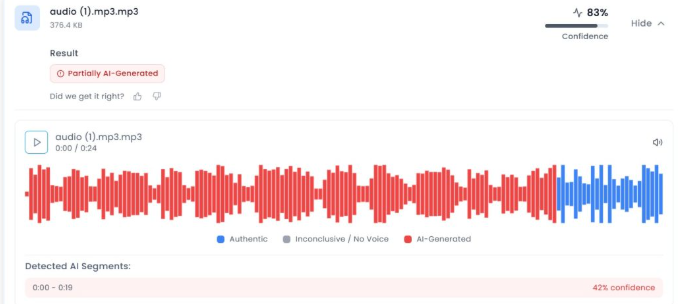
To further examine the authenticity of the audio, we analysed it using AI detection tools. The audio was first checked using Aurigin.ai, which indicated an 83 percent probability that the voice in the viral clip was AI-generated.
Conclusion
The CyberPeace’s research confirmed that the claim associated with Shah Rukh Khan’s viral video is false. The video is a deepfake in which the audio has been altered using artificial intelligence. In the original footage, Khan was discussing his life and experiences, and he did not make any statement about helping Rajpal Yadav.
