#FactCheck-Fake Frontline Cover Claiming ‘Vijay Wave’ Goes Viral During Tamil Nadu Polls
Executive Summary
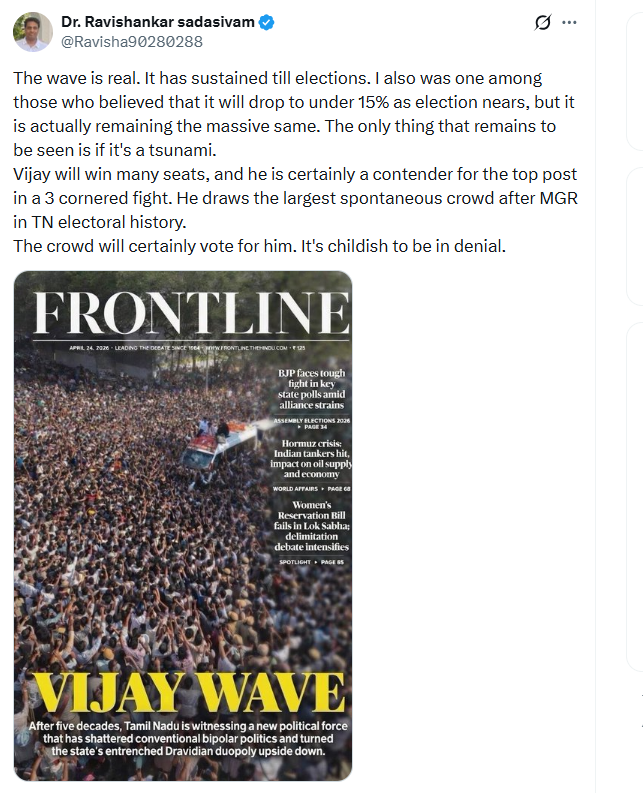
As Tamil Nadu voted in the 2026 Assembly elections, with 84.69 percent polling recorded on April 23, a purported cover page of Frontline magazine began circulating on social media. The viral image featured a massive rally crowd of South Indian actor and Tamilaga Vetri Kazhagam (TVK) chief Joseph Vijay, claiming that a “Vijay Wave” had emerged in the state. The alleged cover also stated that Tamil Nadu was witnessing a new political force after five decades, one that had challenged the dominance of Dravida Munnetra Kazhagam (DMK) and All India Anna Dravida Munnetra Kazhagam (AIADMK).
However, research by the CyberPeace Research Wing found that the viral cover page is fake. Frontline magazine has not published any such edition, and its latest issue is related to health.
Claim:
X user “Dr. Ravishankar Sadasivam” shared the viral image on April 22, 2026, claiming the “wave is real” and suggesting that Vijay could emerge as a top contender in a three-cornered contest. The post further claimed that after MGR, Vijay was drawing the largest spontaneous crowds in Tamil Nadu politics.
Fact Check:
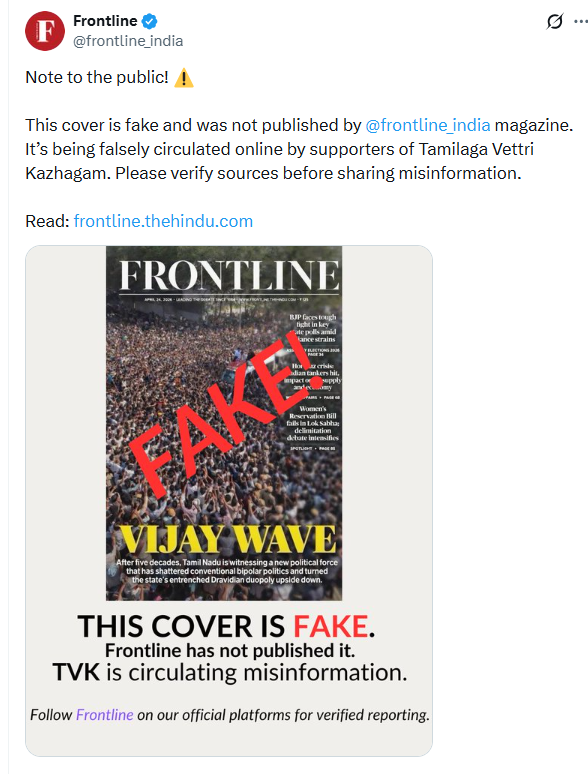
To verify the claim, relevant keyword searches were conducted online. During the research, a clarification post from Frontline magazine’s official X account, shared on April 22, 2026, was found. In the post, the publication clearly stated that the viral cover page was fake and had not been published by the magazine. It further said that the fabricated cover was being circulated online by supporters of TVK.
A review of the official Frontline website also found no edition carrying such a cover page.

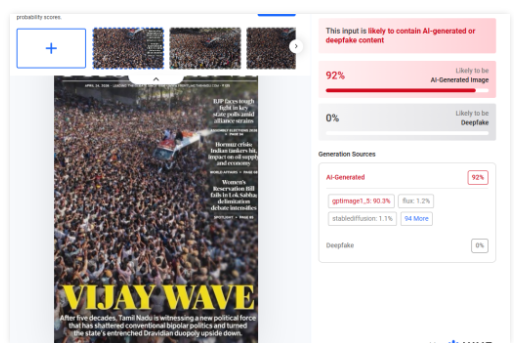
Additionally, the viral image was analyzed using the AI detection tool Hive Moderation, which rated it as 92 percent likely to be AI-generated.
Conclusion:
The claim that Frontline magazine published a cover story on a “Vijay Wave” during the Tamil Nadu Assembly elections is false. The viral cover page is fake and is being circulated online to mislead people.
Related Blogs

Executive Summary
A video clip of Indian Army Chief Upendra Dwivedi is being widely shared across social media platforms with the claim that he criticised the Indian government's policy towards Taliban-ruled Afghanistan. In the viral clip, the Army Chief is allegedly heard saying that India is doing nothing except sending money to the Taliban government due to the Centre’s failed policies.
However, CyberPeace Research Wing research found the claim to be false. The viral video is a deepfake. In the original footage, General Upendra Dwivedi was speaking about Operation Sindoor and the preparedness of the Indian Armed Forces for a possible “Operation Sindoor 2.0.” He made no remarks regarding the Taliban or the government’s Afghanistan policy.
Claim
An X user named “XaQil” shared the viral video on May 31, 2026, with the caption:“Due to failed policies of the Central Government, India is doing nothing except sending Money to Taliban government. How can money alone do everything?” — Army Chief General Upendra Dwivedi.

Fact Check
In the viral video, General Dwivedi is purportedly heard making remarks about India’s Afghanistan policy, the Taliban, Pakistan, Iran, and India’s diplomatic position. To verify the claim, we searched for the original source of the video. A reverse image search of key frames led us to the authentic footage posted by news agency ANI on its official X account on May 30, 2026.

In the original video, General Dwivedi was responding to a question about Operation Sindoor. He stated that the operation was still ongoing, hostilities had only paused temporarily, and that the Indian Armed Forces were fully prepared if “Operation Sindoor 2.0” became necessary.
He also spoke about enhancing coordination among the three services and maintaining operational readiness.”
No part of his statement mentioned the Taliban, Afghanistan, Pakistan, Iran, or criticism of the Central Government.
Further corroboration came from media reports covering the same event. According to a report published by Navbharat Times on May 30, 2026, General Dwivedi made the remarks during the passing-out parade of the 150th course of the National Defence Academy (NDA), where he attended as the chief guest. He reiterated that the armed forces were fully prepared for “Operation Sindoor 2.0” if required.

Since the content of the viral clip did not match the original statement, we examined it using InVID’s MeVer Deepfake Detector. The tool flagged signs of AI manipulation and indicated that the video had likely been altered.

Conclusion
Cyber Peace Foundation found that the viral video purportedly showing Army Chief General Upendra Dwivedi criticising the Indian government’s policy towards the Taliban is a deepfake. The Army Chief made no such remarks. The original video was recorded during an NDA event, where he spoke about Operation Sindoor and the preparedness of the Indian Armed Forces for a possible future operation. The viral clip has been manipulated using AI to spread a false narrative.
.webp)
For more than a century, cinema has evolved alongside technology. Sound transformed silent films, colour changed visual storytelling, computer-generated imagery expanded the limits of imagination, and streaming reshaped how audiences experience films. Each transformation brought uncertainty, but Artificial Intelligence represents a different kind of shift. It is not merely changing how films are made; it is beginning to challenge who, or what, gets to create and perform them.
This debate has moved from theory to reality with Tilly Norwood, an AI-generated performer created by Particle 6 through its AI talent division Xicoia. After months of discussion surrounding the role of artificial performers in entertainment, Norwood is now set to headline her own feature film, Misaligned which is a project that places artificial intelligence at the centre of both the production process and the story itself. The film is described as a comedy-drama following an AI character without a tangible existence. The story follows that, guided by another AI character, she begins developing ambitions, emotions, and a desire to understand what it means to become “human” The premise of the movie is intentionally self-reflective. An AI performer, whose very existence has raised questions about authenticity and creativity, will now portray a character experiencing those same conflicts.
AI as storyteller?
Using Artificial Intelligence in filmmaking is not recent, for years production studios have used technology for visual effects, editing assistance, restoration, recommendation systems, and production planning. The emergence of AI-generated performers, however, introduces a far more complex question, can AI replace the actors who are core to storytelling?
When Tilly was first introduced at the Zurich film festival in late 2025 by the Dutch producer Eline Van Der Velden, CEO and Founder of Particle 6, introduced it as a hybrid model of film-making, where there are directors, producers, production team but a "synthetic performer" in the lead role and a comprehensive AI-experts team. Van Der Velden argued that human creativity was not being replaced but supplemented by AI.
This was not well received by the film community. Actors like Emily Blunt and SAG-AFTRA (the Screen Actors Guild- American Federation of Television and Radio Artists) a US labor organization representing roughly 160,000 professionals across the entertainment and media industries, including actors, performers, journalists, musicians, and voice actors, released a statement condemning this project with synthetic performer. They emphasised that ‘creativity is, and should remain, human-centered. The union is opposed to the replacement of human performers by synthetics.’
The Question of Authenticity
Acting has historically been understood as an interpretation of human experience. Performers bring personal histories, emotions, cultural backgrounds, and individual perspectives into their roles. The criticism is that an AI actor does not exist in a tangible form and essentially has no real story or background of any kind. Particle 6 describes Tilly only as a twenty-something who lives in London and loves coffee which is a very shallow context and has no personality at all. The film is also set in the fictional "Tillyverse," not a real place and exists on some cloud system reinforcing the sense that there is no lived reality behind the character.
At their core, AI performers are outputs of generative systems rather than individuals with lived experience or personal artistic interpretation. These systems learn by identifying patterns from vast datasets and generating results based on existing material, which raises questions about whether such performances can be considered original creative expression at all. Tilly Norwood's music video ‘Taking the Lead’ illustrated this gap in practice, drawing attention to inconsistencies in natural emotion, visual continuity, and expression across scenes.
Human actors, by contrast, bring authenticity and emotional depth shaped by real experience and creative interpretation which are qualities that recognition and awards have traditionally been built around. If a performance is produced through algorithms trained on existing creative patterns, a fundamental question follows: what exactly is being celebrated, the technology, the final output, or the humans guiding the system?
Creativity, Consent, and the Legal Grey Areas
AI performers also raise significant questions about intellectual property, personality rights, consent, and compensation. Existing legal and contractual frameworks were primarily designed around human performers who are individuals who negotiate compensation, own aspects of their identity, and participate in the wider cultural ecosystem surrounding cinema. However, an AI actor challenges these traditional assumptions. If a digital performer does not possess legal personhood, creative ownership, or independent rights, questions emerge regarding who should receive recognition and financial benefits: the developers, production studios, directors, or the human creators involved in building the technology?
Also if a digital actor’s expressions, movements, or style are influenced by thousands of existing performers, determining ownership becomes complicated. Who controls an AI-generated performance? Who deserves credit? Should performers have rights over how their likeness, voice, or style influences future AI systems?
Any advantages?
The most significant advantage of AI-assisted filmmaking may lie in what it offers smaller production houses and independent creators. By reducing certain production costs, AI tools could let filmmakers with limited resources attempt ambitious ideas that were previously out of reach. Beyond this production advantage, however, the acceptance of AI performers themselves remains uncertain. Projects like Misaligned are therefore less a proven shift in cinema than an industry experiment testing how far technology can move into a traditionally human creative space.
The Future of Cinema: Replacement or Reinvention?
Every major technological transformation in cinema has created fears about what might be lost, yet cinema has consistently adapted by absorbing new technologies into its storytelling. AI may follow a similar path, but the stakes are different as it does not simply change the tools available to artists, it challenges the definitions of creativity, authorship, and performance itself.
Much of cinema's economic and cultural life is really built on the bond between audiences and actors. It's actors who drive ticket sales, build loyal fan followings, and become cultural figures in their own right, through interviews, public appearances, and the visible journey of training, struggle, and growth that shapes a career. An AI-generated performer can mimic parts of that celebrity image, but it can't actually show up for any of it the way a person can. Handing central creative roles to artificial personalities also raises a fairness question, especially at a time when so many human performers are already struggling to find work.
Whether audiences will really embrace fully synthetic performers as stand-ins for human actors is still an open question. Misaligned may end up being the first real test of that. Early reaction to Tilly Norwood has been largely critical within the industry and among audiences. How viewers respond to Misaligned itself will be an early test of whether that scepticism holds.
Cinema has always found ways to absorb new technology, but AI is testing something deeper than the tools filmmakers use. As machines get better at telling human stories, the real challenge is making sure the human element behind those stories doesn't get lost.
References
- https://theprint.in/feature/tilly-norwood-tillyverse-misaligned-particle6-ai-actor/2980654/
- https://www.cbsnews.com/news/tilly-norwood-ai-generated-actor-feature-film/
- https://www.sagaftra.org/sag-aftra-statement-synthetic-performer
- https://www.hollywoodreporter.com/movies/movie-news/ai-actor-tilly-norwood-movie-debut-misaligned-1236638719/

Executive Summary
A 57-second video featuring India’s Chief of Army Staff Upendra Dwivedi is widely circulating on social media. The clip is being shared with the claim that the Army chief admitted India had “betrayed” Iran by providing the location of an Iranian naval ship to Israel, allegedly leading to its destruction The video is spreading amid heightened tensions in West Asia involving United States, Israel, and Iran. According to posts sharing the claim, the Iranian naval vessel IRIS Dena, which had participated in a naval event in Visakhapatnam and was returning to Iran with around 130 personnel onboard, was torpedoed by a US submarine near the southern coast of Sri Lanka on March 4 while sailing in the Indian Ocean.
In the viral clip, the speaker—presented as the Indian Army chief—appears to say that India informed Israel about the exact location of the Iranian ship after it left Indian waters, describing Israel as a strategic ally and suggesting that the attack occurred in international waters. The clip also claims that India had no direct involvement in the alleged joint US-Israel torpedo strike.
However, research conducted by the CyberPeace found the claim to be false. Our research shows that the video does not contain a genuine statement from Army Chief Upendra Dwivedi and is in fact a manipulated clip.
Claim
On X (formerly Twitter), a page named GPX (@GPX_Press) shared the video on March 9 with the caption: “India confesses it BETRAYED Iran by leaking the location of an Iranian ship to Israel, leading to its total destruction!”

Fact Check
During the verification process, researchers noticed a ticker in the viral video reading “Raisina Dialogue 2026 × Firstpost.” Using this clue, we conducted a keyword search on YouTube and located a video uploaded by Firstpost on March 7 titled “India’s Army Chief Speaks on Op Sindoor, Pakistan and Future of Warfare | Raisina Dialogue 2026.”
In the 21-minute interview, Army Chief Upendra Dwivedi is seen speaking with strategic affairs expert Harsh V. Pant. According to the video description, the discussion focuses on lessons from Operation Sindoor and the evolving nature of modern warfare.

The viral clip appears to be taken from this interview. However, throughout the conversation, Dwivedi does not mention any conflict involving the United States, Israel, and Iran, nor does he refer to the sinking of an Iranian naval ship in the Indian Ocean. This indicates that the circulating clip has been edited and misrepresented to create a misleading narrative.
For additional verification, the viral video was analyzed using the AI detection tool Hive Moderation. The results suggested a 99.9% probability that the speech in the clip was generated using AI, indicating manipulation of the original footage.

Conclusion
The research makes it clear that the viral video does not reflect an authentic statement by India’s Army Chief Upendra Dwivedi. The clip has been altered and the audio appears to be AI-generated. In other words, the circulating video is a deepfake being shared with a misleading claim.