
#FactCheck- AI-Generated Video Falsely Claims Iran Attack on Apple, Microsoft in Israel
Executive Summary:
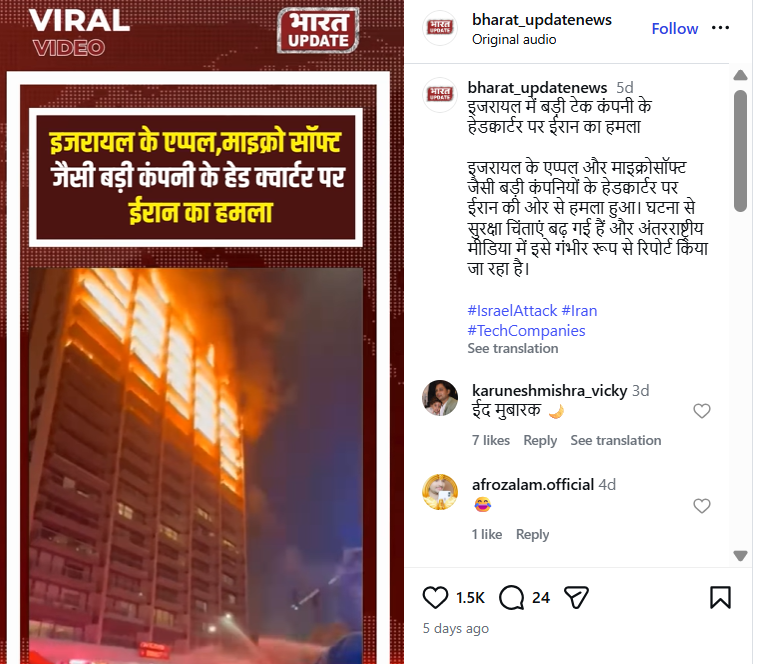
Amid the ongoing conflict in West Asia involving the United States, Israel and Iran, a video is being widely circulated on social media with the claim that Iran attacked the headquarters of tech giants Apple and Microsoft in Israel. The clip shows a building engulfed in flames, with firefighters attempting to douse the fire. However, research by the CyberPeace found that the viral video is AI-generated and is being falsely linked to the ongoing conflict to spread misinformation.
Claim:
An Instagram user ‘bharat_updatenews’ shared the video on March 19, 2026, claiming that Iran had launched an attack on major tech company headquarters, including Apple and Microsoft, in Israel. The post suggested that the incident had raised serious security concerns and was being widely reported by international media.
Link: https://www.instagram.com/bharat_updatenews/reel/DWEUhLEAKaw
Fact Check:
To verify the claim, we extracted keyframes from the viral video and conducted a reverse search using Google Lens. During this process, we found the same video on a TikTok account named ‘dailyupdate122’, where it had been uploaded on March 15, 2026.
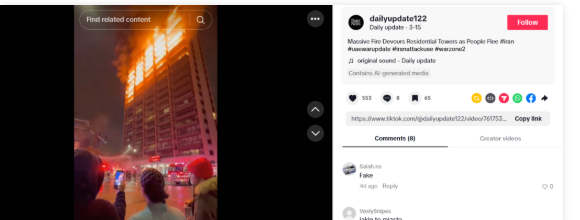
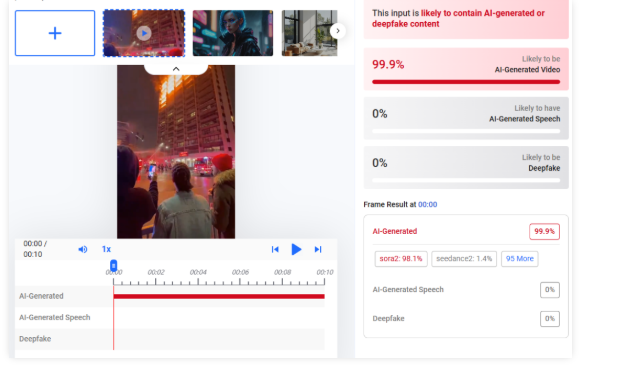
The video on this account was clearly labelled as “AI-generated media.” The account also featured several other AI-generated videos, raising doubts about the authenticity of the viral clip. Following this, we analysed the video using the AI detection tool Hive Moderation. The results indicated that the video is nearly 100 percent AI-generated. The tool further suggested with over 98 percent probability that the clip may have been created using OpenAI’s Sora or a similar AI video generation model.
Conclusion:
The viral claim that Iran attacked Apple and Microsoft headquarters in Israel is false. The video circulating online is AI-generated and has no connection to the ongoing conflict in West Asia.

Related Blogs

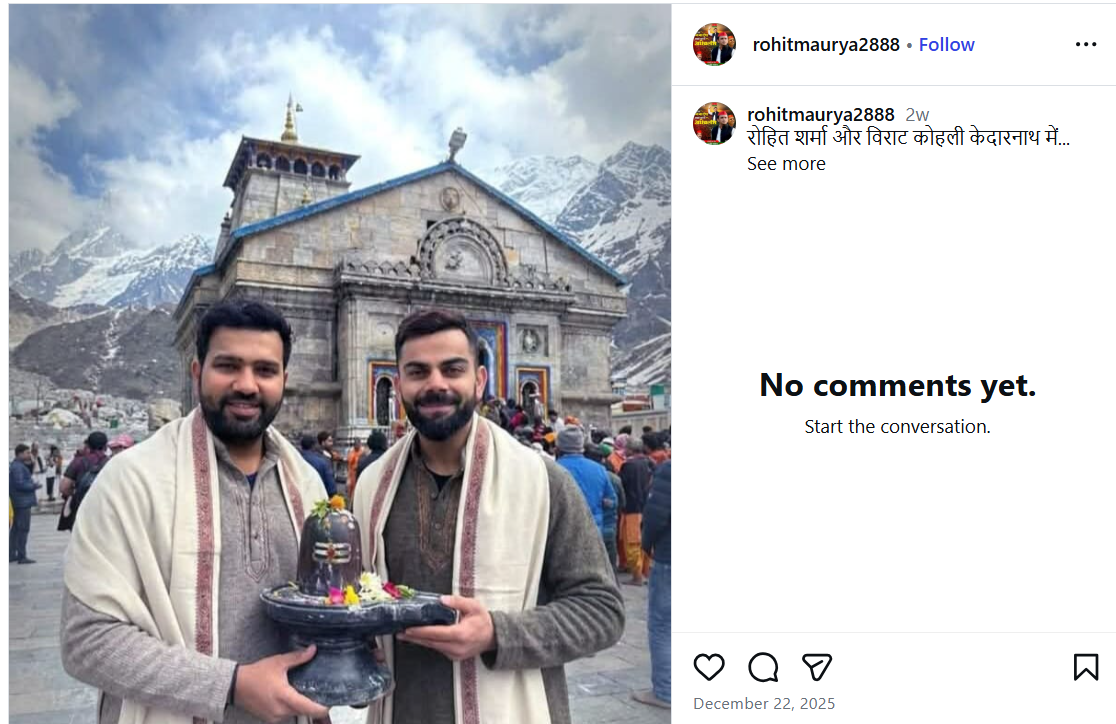
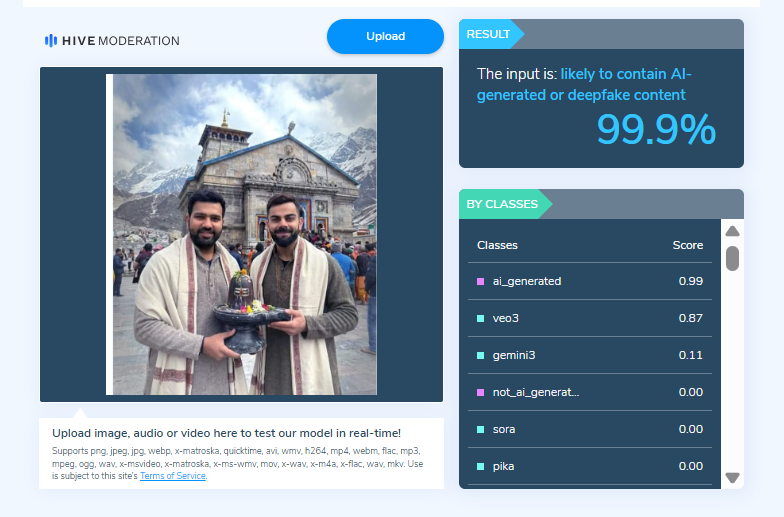
A photo featuring Indian cricketers Virat Kohli and Rohit Sharma is being widely shared on social media. In the image, both players are seen holding a Shivling, with the Kedarnath temple visible in the background. Users sharing the image claim that Virat Kohli and Rohit Sharma recently visited Kedarnath.
However, CyberPeace Foundation’s investigation found the claim to be false. Our verification established that the viral image is not real but has been created using Artificial Intelligence (AI) and is being circulated with a misleading narrative.
The Claim
An Instagram user shared the viral image on December 22, 2025, with the caption stating that Rohit Sharma and Virat Kohli are in Kedarnath. The post has since been widely reshared by other users, who assumed the image to be authentic. Link, archive link, screenshot:
Fact Check
On closely examining the viral image, the Desk noticed visual inconsistencies suggesting that it may be AI-generated. To verify this, the image was scanned using the AI detection tool HIVE Moderation. According to the results, the image was found to be 99 per cent AI-generated.
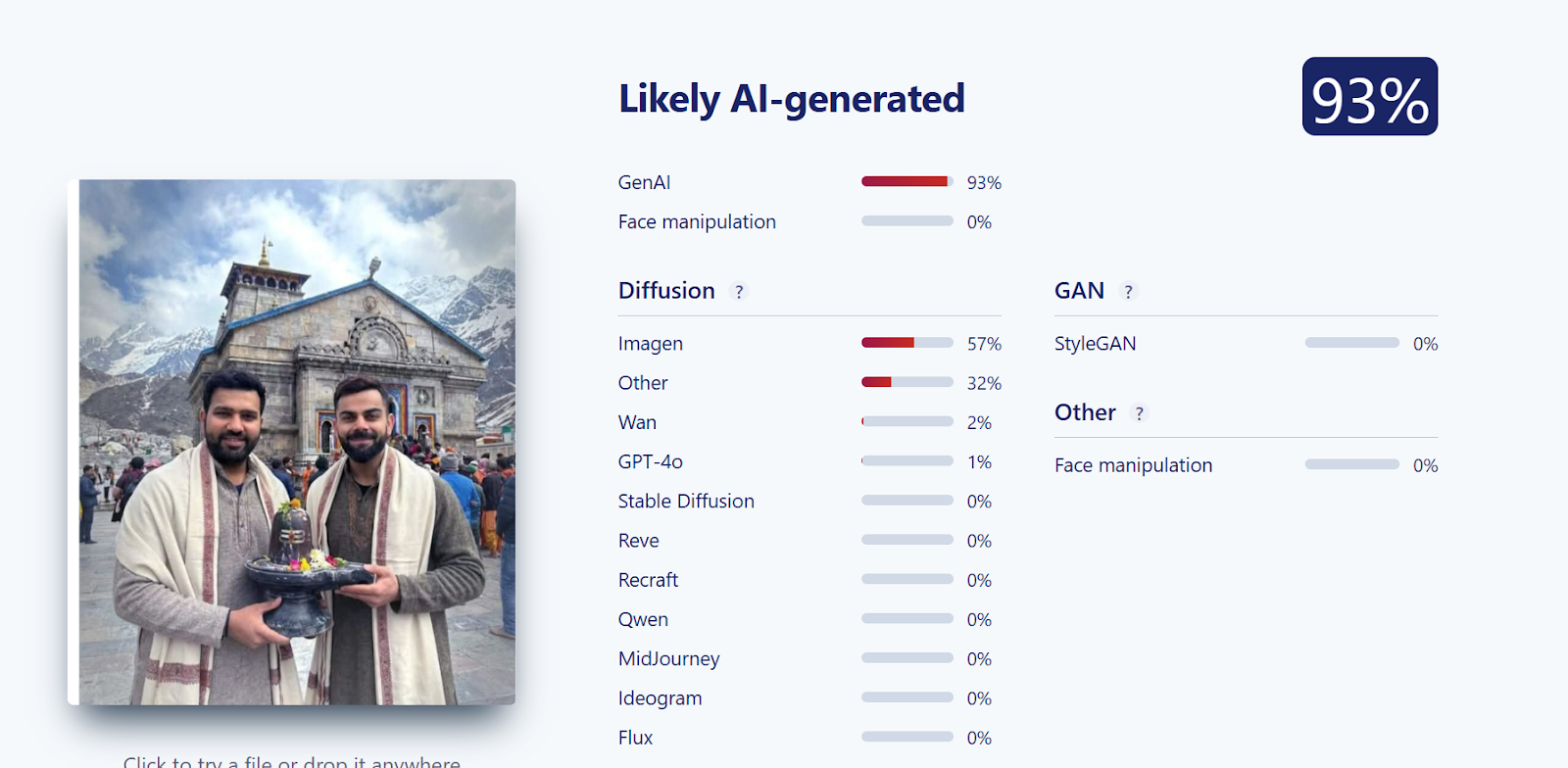
Further verification was conducted using another AI detection tool, Sightengine. The analysis revealed that the image was 93 per cent likely to be AI-generated, reinforcing the findings from the previous tool.
Conclusion
CyberPeace Foundation’s research confirms that the viral image claiming Virat Kohli and Rohit Sharma visited Kedarnath is fabricated. The image has been generated using AI technology and is being falsely shared on social media as a real photograph.
.webp)
Introduction
The spread of misinformation online has become a significant concern, with far-reaching social, political, economic and personal implications. The degree of vulnerability to misinformation differs from person to person, dependent on psychological elements such as personality traits, familial background and digital literacy combined with contextual factors like information source, repetition, emotional content and topic. How to reduce misinformation susceptibility in real-world environments where misinformation is regularly consumed on social media remains an open question. Inoculation theory has been proposed as a way to reduce susceptibility to misinformation by informing people about how they might be misinformed. Psychological inoculation campaigns on social media are effective at improving misinformation resilience at scale.
Prebunking has gained prominence as a means to preemptively build resilience against anticipated exposure to misinformation. This approach, grounded in Inoculation Theory, allows people to analyse and avoid manipulation without prior knowledge of specific misleading content by helping them build generalised resilience. We may draw a parallel here with broad spectrum antibiotics that can be used to fight infections and protect the body against symptoms before one is able to identify the particular pathogen at play.
Inoculation Theory and Prebunking
Inoculation theory is a promising approach to combat misinformation in the digital age. It involves exposing individuals to weakened forms of misinformation before encountering the actual false information. This helps develop resistance and critical thinking skills to identify and counter deceptive content.
Inoculation theory has been established as a robust framework for countering unwanted persuasion and can be applied within the modern context of online misinformation:
- Preemptive Inoculation: Preemptive inoculation entails exposing people to weaker kinds of misinformation before they encounter genuine erroneous information. Individuals can build resistance and critical thinking abilities by being exposed to typical misinformation methods and strategies.
- Technique/logic based Inoculation: Individuals can educate themselves about typical manipulative strategies used in online misinformation, which could be emotionally manipulative language, conspiratorial reasoning, trolling and logical fallacies. Learning to recognise these tactics as indicators of misinformation is an important first step to being able to recognise and reject the same. Through logical reasoning, individuals can recognize such tactics for what they are: attempts to distort the facts or spread misleading information. Individuals who are equipped with the capacity to discern weak arguments and misleading methods may properly evaluate the reliability and validity of information they encounter on the Internet.
- Educational Campaigns: Educational initiatives that increase awareness about misinformation, its consequences, and the tactics used to manipulate information can be useful inoculation tools. These programmes equip individuals with the knowledge and resources they need to distinguish between reputable and fraudulent sources, allowing them to navigate the online information landscape more successfully.
- Interactive Games and Simulations: Online games and simulations, such as ‘Bad News,’ have been created as interactive aids to protect people from misinformation methods. These games immerse users in a virtual world where they may learn about the creation and spread of misinformation, increasing their awareness and critical thinking abilities.
- Joint Efforts: Combining inoculation tactics with other anti-misinformation initiatives, such as accuracy primes, building resilience on social media platforms, and media literacy programmes, can improve the overall efficacy of our attempts to combat misinformation. Expert organisations and people can build a stronger defence against the spread of misleading information by using many actions at the same time.
CyberPeace Policy Recommendations for Tech/Social Media Platforms
Implementation of the Inoculation Theory on social media platforms can be seen as an effective strategy point for building resilience among users and combating misinformation. Tech/social media platforms can develop interactive and engaging content in the form of educational prebunking videos, short animations, infographics, tip sheets, and misinformation simulations. These techniques can be deployed through online games, collaborations with influencers and trusted sources that help design and deploy targeted campaigns whilst also educating netizens about the usefulness of Inoculation Theory so that they can practice critical thinking.
The approach will inspire self-monitoring amongst netizens so that people consume information mindfully. It is a powerful tool in the battle against misinformation because it not only seeks to prevent harm before it occurs, but also actively empowers the target audience. In other words, Inoculation Theory helps build people up, and takes them on a journey of transformation from ‘potential victim’ to ‘warrior’ in the battle against misinformation. Through awareness-building, this approach makes people more aware of their own vulnerabilities and attempts to exploit them so that they can be on the lookout while they read, watch, share and believe the content they receive online.
Widespread adoption of Inoculation Theory may well inspire systemic and technological change that goes beyond individual empowerment: these interventions on social media platforms can be utilized to advance digital tools and algorithms so that such interventions and their impact are amplified. Additionally, social media platforms can explore personalized inoculation strategies, and customized inoculation approaches for different audiences so as to be able to better serve more people. One such elegant solution for social media platforms can be to develop a dedicated prebunking strategy that identifies and targets specific themes and topics that could be potential vectors for misinformation and disinformation. This will come in handy, especially during sensitive and special times such as the ongoing elections where tools and strategies for ‘Election Prebunks’ could be transformational.
Conclusion
Applying Inoculation Theory in the modern context of misinformation can be an effective method of establishing resilience against misinformation, help in developing critical thinking and empower individuals to discern fact from fiction in the digital information landscape. The need of the hour is to prioritize extensive awareness campaigns that encourage critical thinking, educate people about manipulation tactics, and pre-emptively counter false narratives associated with information. Inoculation strategies can help people to build mental amour or mental defenses against malicious content and malintent that they may encounter in the future by learning about it in advance. As they say, forewarned is forearmed.
References
- https://www.science.org/doi/10.1126/sciadv.abo6254
- https://stratcomcoe.org/publications/download/Inoculation-theory-and-Misinformation-FINAL-digital-ISBN-ebbe8.pdf
Executive Summary
A video is being widely shared on social media showing a delivery boy risking his life by jumping in front of a speeding truck to save a small child. The dramatic footage has drawn widespread praise, with many users calling the delivery worker a "real hero," "Superman," and even "an angel." Several social media users have claimed that the incident took place in Mumbai, alleging that the delivery boy's quick thinking prevented a fatal accident. CyberPeace Research Wing ’s research found the viral claim to be false. Our research revealed that the video is not real but AI-generated, and is being circulated with a misleading claim.
Claim
An X (formerly Twitter) user shared the viral video on July 12, 2026, with the caption: "This cannot be called a human, but an angel. Such an incredible feat by a delivery boy from Mumbai is hard to believe. At first glance, it seemed like he had sacrificed his life to save the child, but in the next moment, he saved not only himself but also the child's life. Watch this incredible video."
https://x.com/virjust18/status/2076270467569320072

Fact Check
To verify the viral claim, we conducted a keyword search on Google. However, we found no credible media reports or authentic sources confirming that such an incident had occurred in Mumbai or anywhere else. During the research, we found the same video uploaded on the Instagram account 'ai_nature_of_beauty_01' on July 12, 2026. Although the post's caption did not provide any details about the incident, a review of the account revealed that it regularly uploads AI-generated videos featuring fictional and digitally created scenarios. This strongly indicates that the viral clip is not footage of an actual event but content created using Artificial Intelligence.
https://www.instagram.com/reels/Das5IJ9FFF5/

We further analysed the video using the AI detection tool Hive Moderation, which indicated a 96.1% probability that the footage was AI-generated. The analysis strongly suggests that the video was created using artificial intelligence rather than recorded in the real world.

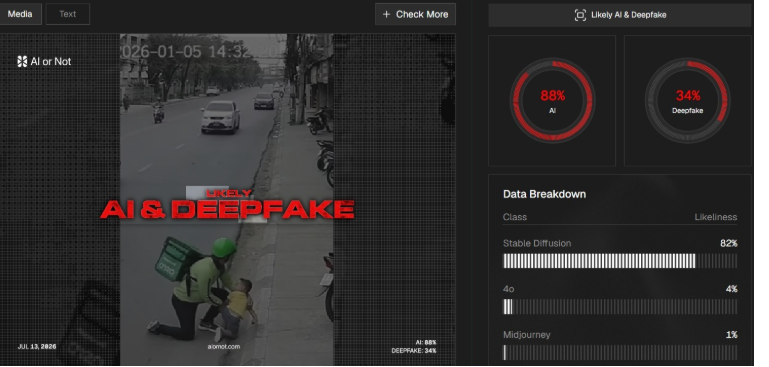
For additional verification, we also examined the video using another AI detection platform, AI or Not. The tool likewise identified the scenes in the viral clip as likely AI-generated, reinforcing our findings.
Conclusion
Our research found that the viral video does not depict a real rescue. It is AI-generated content that has been falsely circulated as footage of a delivery boy saving a child from a speeding truck in Mumbai. There is no credible evidence to support the claim that such an incident actually occurred.
