
#FactCheck: Fake AI Video Falsely Shows Rohit Sharma Seeking Support to Play Next World Cup
Executive Summary
A video of Indian cricketer Rohit Sharma is being widely shared on social media, purportedly showing him saying, “If you want me to play in the next World Cup and you are with me, then share and like this video.” However, CyberPeace Research Wing found the viral claim to be false. Our research found that the viral video is not authentic but AI-generated and is being circulated with a misleading claim.
Claim:
A Facebook user shared the viral video on September 28 with the caption, “If you want me to play in the next World Cup and you are with me, then share and like this video.” The post link, archived link and screenshot are provided below.
https://www.facebook.com/reel/27349791221308658

Fact check
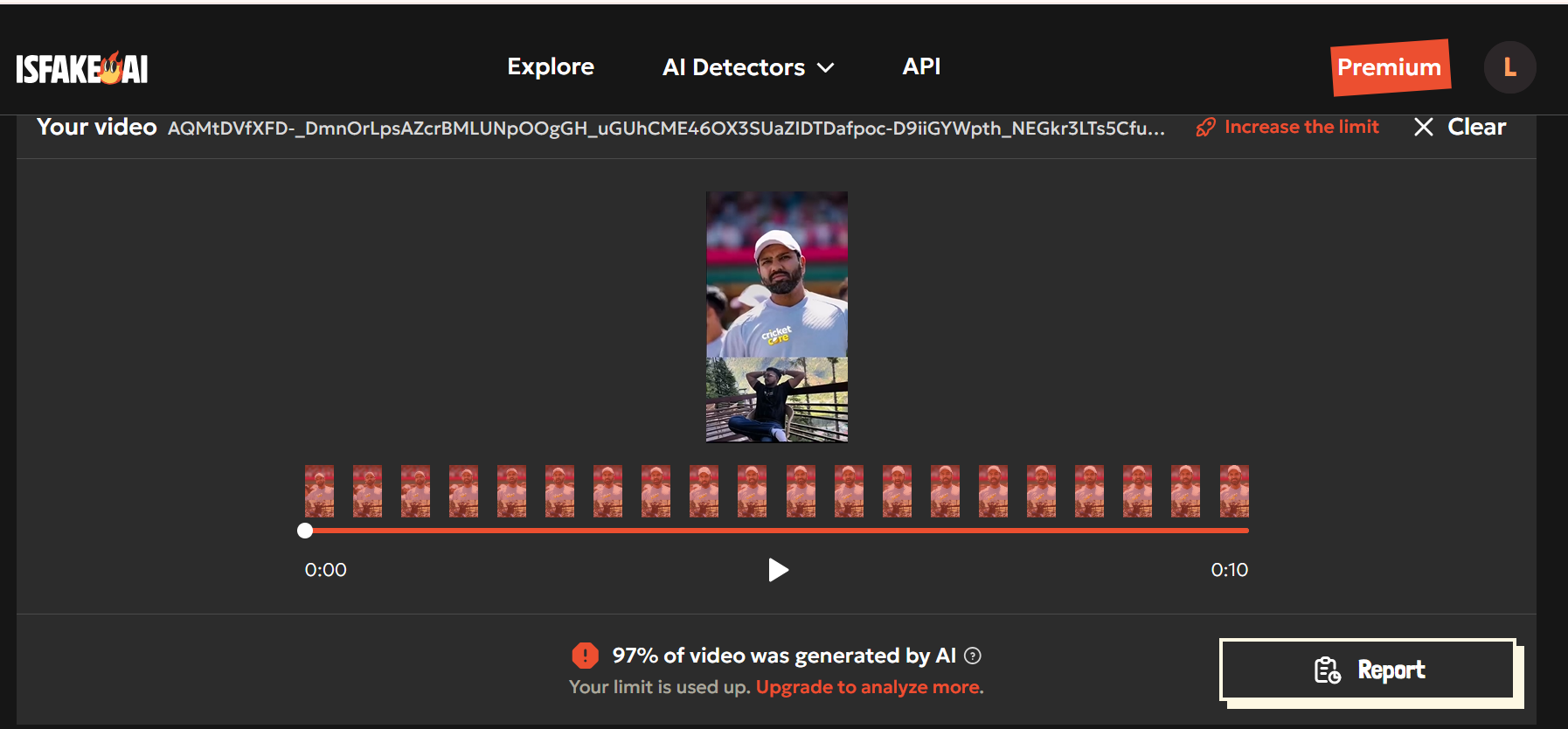
To verify the viral claim, we conducted a Google search using relevant keywords. During the search, we did not find any credible media reports corroborating the claim. As part of our research, we scanned the viral video using the AI detection tool ISFAKEAI. According to the tool’s results, the video was 97 per cent AI-generated.
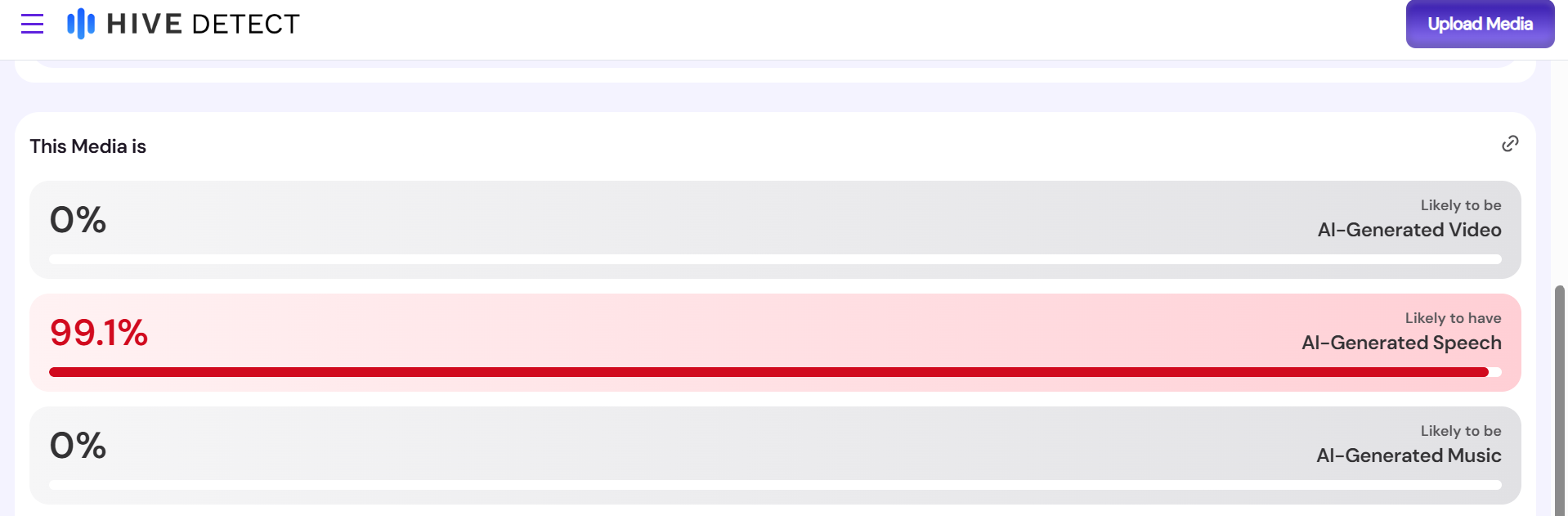
We further analysed the video using Hive Detect, which found that the speech in the viral video was 99 per cent AI-generated.
Conclusion:
Our research found that the viral video is not authentic but AI-generated. The video is being circulated on social media with a misleading claim that it shows an aeroplane being affected by the alleged ‘Arnab’ cyclone in Ahmedabad.

Related Blogs

Executive Summary
Israel’s parliament, the Knesset, recently passed a bill allowing military courts to impose the death penalty on Palestinians convicted of killing Israelis. Amid this backdrop, a video has gone viral on social media showing men in black uniforms beating detainees inside a prison, with claims linking it to alleged torture by Israeli forces. However, a research by the CyberPeace found the claim to be false. The viral video is not related to Israel or any real incident, but is actually from an Iraqi television series titled “Beit Umm Layla.”
Claim
Sharing the video, a user on X (formerly Twitter) wrote:“Live footage: IDF soldiers always torture Palestinian hostages before executing them. Please don’t let us die in silence.”

Fact Check
To verify the claim, we extracted keyframes from the viral video and conducted a reverse image search. This led us to a longer version of the clip posted on March 9 by the Iraqi channel Al-Iraqiya on its Facebook and Instagram pages.


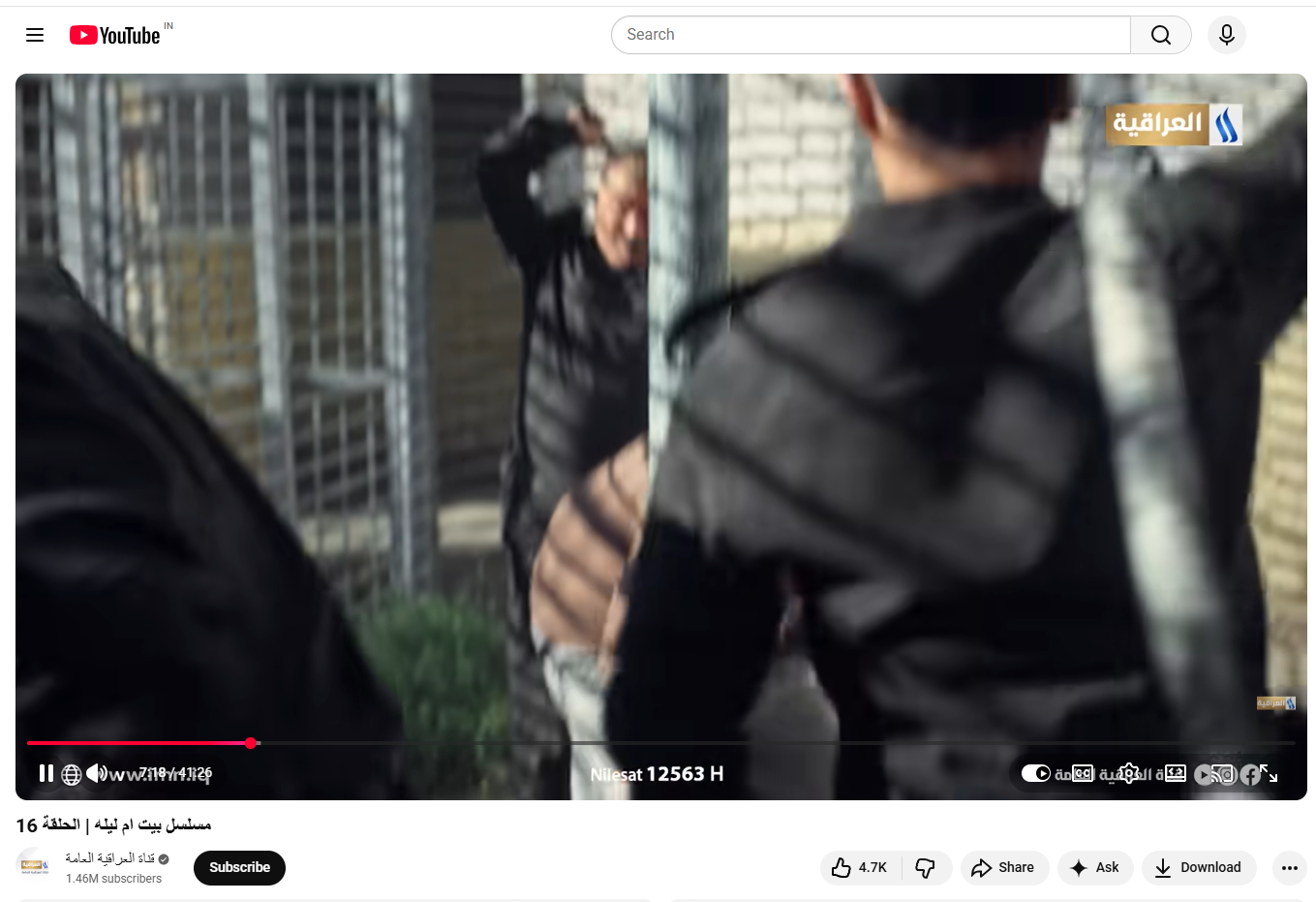
The posts clearly identified the footage as part of “Beit Umm Layla,” a popular Iraqi TV series. Further research showed that the full series is available on Al-Iraqiya’s official YouTube channel, where 25 episodes were uploaded between February 19 and March 20. The viral clip corresponds to Episode 16 of the show.
Additionally, information available on the Arabic entertainment website elCinema indicates that the series, released on February 18, is a socio-political drama focusing on prisoners and the psychological struggles faced by them and their families.
Conclusion
The viral claim is false and misleading. The video does not depict any real incident involving Israeli forces or Palestinian detainees. Instead, it is a fictional scene from an Iraqi television drama series.There is no credible evidence to support the claim that the footage shows torture by Israeli soldiers. The clip has been taken out of context and shared with a misleading narrative to provoke emotional reactions.
The global race for Artificial Intelligence is heating up, and India has become one of its most important battlegrounds. Over the past few months, tech giants like OpenAI (ChatGPT), Google (Gemini), X (Grok), Meta (Llama), and Perplexity AI have stepped up their presence in the country, not by selling their AI tools, but by offering them free or at deep discounts.
At first, it feels like a huge win for India’s digital generation. Students, professionals, and entrepreneurs today can tap into some of the world’s most powerful AI tools without paying a rupee. It feels like a digital revolution unfolding in real time. Yet, beneath this generosity lies a more complicated truth. Experts caution that this wave of “free” AI access isn’t without strings attached. This offering impacts how India handles data privacy, the fairness of competition, and the pace of the development of homegrown AI innovation that the country is focusing on.
The Market Strategy: Free Now, Pay Later
The choice of global AI companies to offer free access in India is a calculated business strategy. With one of the world’s largest and fastest-growing digital populations, India is a market no tech giant wants to miss. By giving away their AI tools for free, these firms are playing a long game:
- Securing market share early: Flooding the market with free access helps them quickly attract millions of users before Indian startups have a chance to catch up. Recent examples are Perplexity, ChatGPT Go and Gemini AI which are offering free subscriptions to Indian users.
- Gathering local data: Every interaction, every prompt, question, or language pattern, helps these models learn from larger datasets to improve their product offerings in India and the rest of the world. Nothing is free in the world - as the popular saying goes, “if something is free, means you are the product. The same goes for these AI platforms: they monetise user data by analysing chats and their behaviour to refine their model and build paid products. This creates the privacy risk as India currently lacks specific laws to govern how such data is stored, processed or used for AI training.
- Create user dependency: Once users grow accustomed to the quality and convenience of these global models, shifting to Indian alternatives, even when they become paid, will be difficult. This approach mirrors the “freemium” model used in other tech sectors, where users are first attracted through free access and later monetised through subscriptions or premium features, raising ethical concerns.
Impact on Indian Users
For most Indians, the short-term impact of free AI access feels overwhelmingly positive. Tools like ChatGPT and Gemini are breaking down barriers by democratising knowledge and making advanced technology available to everyone, from students, professionals, to small businesses. It’s changing how people learn, think and do - all without spending a single rupee.But the long-term picture isn’t quite as simple. Beneath the convenience lies a set of growing concerns:
- Data privacy risks: Many users don’t realise that their chats, prompts, or queries might be stored and used to train global AI models. Without strong data protection laws in action, sensitive Indian data could easily find its way into foreign systems.
- Overdependence on foreign technology: Once these AI tools become part of people’s daily lives, moving away from them gets harder — especially if free access later turns into paid plans or comes with restrictive conditions.
- Language and cultural bias: Most large AI models are still built mainly around English and Western data. Without enough Indian language content and cultural representation, the technology risks overlooking the very diversity that defines India
Impact on India’s AI Ecosystem
India’s Generative AI market, valued at USD $ 1.30 billion in 2024, is projected to reach 5.40 billion by 2033. Yet, this growth story may become uneven if global players dominate early.
Domestic AI startups face multiple hurdles — limited funding, high compute costs, and difficulty in accessing large, diverse datasets. The arrival of free, GPT-4-level models sharpens these challenges by raising user expectations and increasing customer acquisition costs.
As AI analyst Kashyap Kompella notes, “If users can access GPT-4-level quality at zero cost, their incentive to try local models that still need refinement will be low.” This could stifle innovation at home, resulting in a shallow domestic AI ecosystem where India consumes global technology but contributes little to its creation.
CCI’s Intervention: Guarding Fair Competition
The Competition Commission of India (CCI) has started taking note of how global AI companies are shaping India’s digital market. In a recent report, it cautioned that AI-driven pricing strategies such as offering free or heavily subsidised access could distort healthy competition and create an uneven playing field for smaller Indian developers.
The CCI’s decision to step in is both timely and necessary. Without proper oversight, such tactics could gradually push homegrown AI startups to the sidelines and allow a few foreign tech giants to gain disproportionate influence over India’s emerging AI economy.
What the Indian Government Should Do
To ensure India’s AI landscape remains competitive, inclusive, and innovation-driven, the government must adopt a balanced strategy that safeguards users while empowering local developers.
1. Promote Fair Competition
The government should mandate transparency in free access offers, including their duration, renewal terms, and data-use policies. Exclusivity deals between foreign AI firms and telecom or device companies must be closely monitored to prevent monopolistic practices.
2. Strengthen Data Protection
Under the Digital Personal Data Protection (DPDP) Act, companies should be required to obtain explicit consent from users before using data for model training. Encourage data localisation, ensuring that sensitive Indian data remains stored within India’s borders.
3. Support Domestic AI Innovation
Accelerate the implementation of the IndiaAI Mission to provide public compute infrastructure, open datasets, and research funding to local AI developers like Sarvam AI, an Indian company chosen by the government to build the country's first homegrown large language model (LLM) under IndianAI Mission.
4. Create an Open AI Ecosystem
India should develop national AI benchmarks to evaluate all models, foreign or domestic, on performance, fairness, and linguistic diversity. And at the same time, they have their own national data Centre to train their indigenous AI models.
5. Encourage Responsible Global Collaboration
Speaking at the AI Action Summit 2025, the Prime Minister highlighted that governance should go beyond managing risks and should also promote innovation for the global good. Building on this idea, India should encourage global AI companies to invest meaningfully in the country’s ecosystem through research labs, data centres, and AI education programmes. Such collaborations will ensure that these partnerships not only expand markets but also create value, jobs and knowledge within India.
Conclusion
The surge of free AI access across India represents a defining moment in the nation’s digital journey. On one hand, it’s empowering millions of people and accelerating AI awareness like never before. On the other hand, it poses serious challenges from over-reliance on foreign platforms to potential risks around data privacy and the slow growth of local innovation. India’s real test will be finding the right balance between access and autonomy, allowing global AI leaders to innovate and operate here, but within a framework that protects the interests of Indian users, startups, and data ecosystems. With strong and timely action under the Digital Personal Data Protection (DPDP) Act, the IndiaAI Mission, and the Competition Commission of India’s (CCI) active oversight, India can make sure this AI revolution isn’t just something that happens to the country, but for it.
References
- https://www.moneycontrol.com/artificial-intelligence/cci-study-flags-steep-barriers-for-indian-ai-startups-calls-for-open-data-and-compute-access-to-level-playing-field-article-13600606.html#
- https://www.imarcgroup.com/india-generative-ai-market
- https://www.mea.gov.in/Speeches-Statements.htm?dtl/39020/Opening_Address_by_Prime_Minister_Shri_Narendra_Modi_at_the_AI_Action_Summit_Paris_February_11_2025
- https://m.economictimes.com/tech/artificial-intelligence/nasscom-planning-local-benchmarks-for-indic-ai-models/articleshow/124218208.cms
- https://indianexpress.com/article/business/centre-selects-start-up-sarvam-to-build-country-first-homegrown-ai-model-9967243/#
Executive Summary
A video featuring former Union Education Minister Dharmendra Pradhan is being widely circulated on social media, claiming that he made controversial remarks against Prime Minister Narendra Modi, Rajnath Singh, and the Ambani-Adani families. Several social media users are sharing the video as genuine. CyberPeace Research Wing’s research found the viral claim to be false. The research revealed that former Union Education Minister Dharmendra Pradhan had shared a video on his official X (formerly Twitter) account on June 18, 2026. The same video has been manipulated by adding AI-generated audio and is being circulated on social media with a false claim. The viral video is not authentic; it has been digitally altered by inserting AI-generated audio.
Claim:
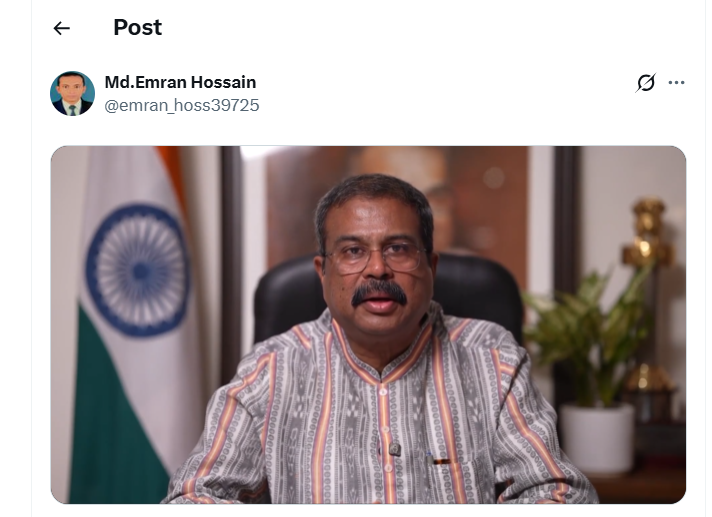
A user on social media platform X (formerly Twitter) shared the viral video claiming that former Union Education Minister Dharmendra Pradhan had released the video while addressing Prime Minister Narendra Modi. In the AI-generated audio added to the video, Pradhan is allegedly heard making statements about his resignation, alleged question paper leaks, and accusing political leaders and business families.
The post’s link, archive link and screenshot are provided below:
https://x.com/emran_hoss39725/status/2081046882676261126
Fact Check:
To verify the viral claim, the Desk conducted a keyword search on Google. However, no credible news report or official statement was found confirming that Dharmendra Pradhan had made such remarks against Prime Minister Narendra Modi, Rajnath Singh, or the Ambani-Adani families. During further research, the Desk examined Dharmendra Pradhan’s official X account. The Desk found a video posted by him on June 18, 2026.
A comparison between the viral video and the original video showed that the visuals in both clips were identical. However, the audio and statements in the viral video did not match the original video. In the original video, Dharmendra Pradhan did not make any remarks related to Prime Minister Narendra Modi, Rajnath Singh, the Ambani-Adani families, or alleged question paper leaks. Instead, he spoke about Odisha’s traditional ‘Sheetal Shashti’ festival, its cultural and spiritual significance, and encouraged people to participate in the ‘Ek Ped Maa Ke Naam’ campaign.
He also extended greetings on the occasion of Sheetal Shashti and highlighted the cultural heritage of Odisha and Sambalpur.
https://x.com/dpradhanbjp/status/2067481087140614619?s=20

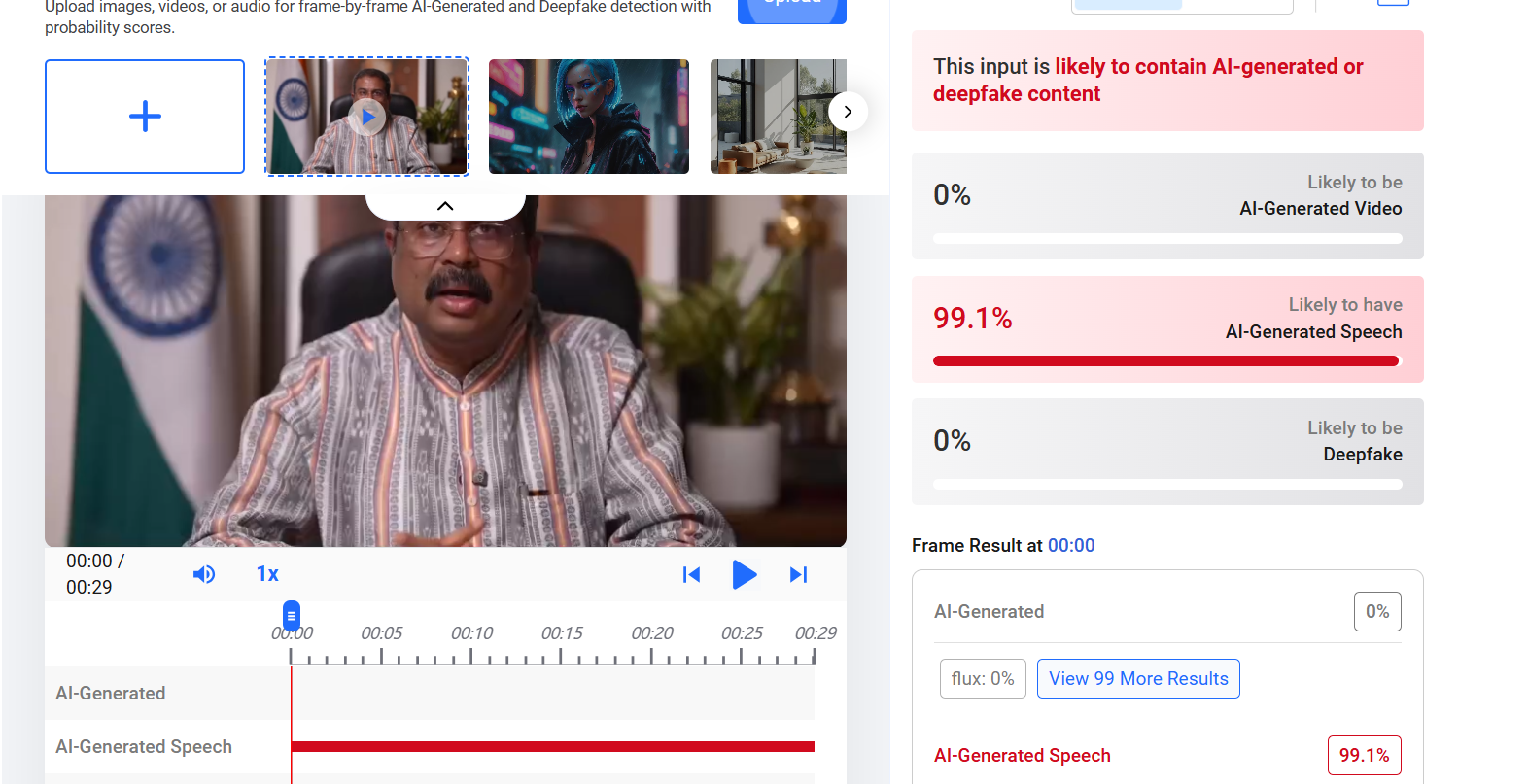
Further analysis of the viral video’s audio was conducted using the AI detection tool HIVE Moderation. The analysis indicated that the speech used in the viral video had a 99.1 per cent probability of being AI-generated.
Conclusion:
The research established that former Union Education Minister Dharmendra Pradhan did not make any statement against Prime Minister Narendra Modi, Rajnath Singh, the Ambani-Adani families, or related to question paper leaks. The viral video has been created by adding AI-generated audio to an original video shared by Dharmendra Pradhan on June 18, 2026. The manipulated video is being circulated on social media with a false and misleading claim.
