
#FactCheck: Edited video falsely shows Akshay Kumar commenting on ‘Declassified: Operation Sindoor’ documentary
Executive Summary
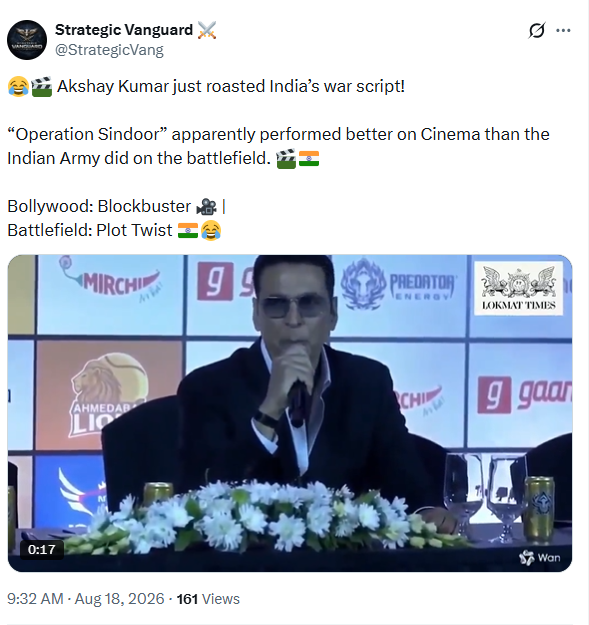
A video of Bollywood actor Akshay Kumar is being widely shared on social media with the claim that he commented on the documentary series “Declassified: Operation Sindoor,” which is based on the military operations carried out by the Indian armed forces against Pakistan following the Pahalgam terror attack in April 2025. In the viral clip, Kumar purportedly says that the documentary is performing very well, while the Indian Army's actual performance during Operation Sindoor was “nothing special.” The Research Wing of CyberPeace found that the viral video has been manipulated. Kumar did not make any such remarks about the documentary or the Indian Army.
Claim
A post on X allegedly shows Akshay Kumar saying that the recently released documentary “Declassified: Operation Sindoor” is doing well, while the Indian Army's actual performance during the operation was “nothing special.”
https://x.com/StrategicVang/status/2089563446597636212?s=20
Fact Check
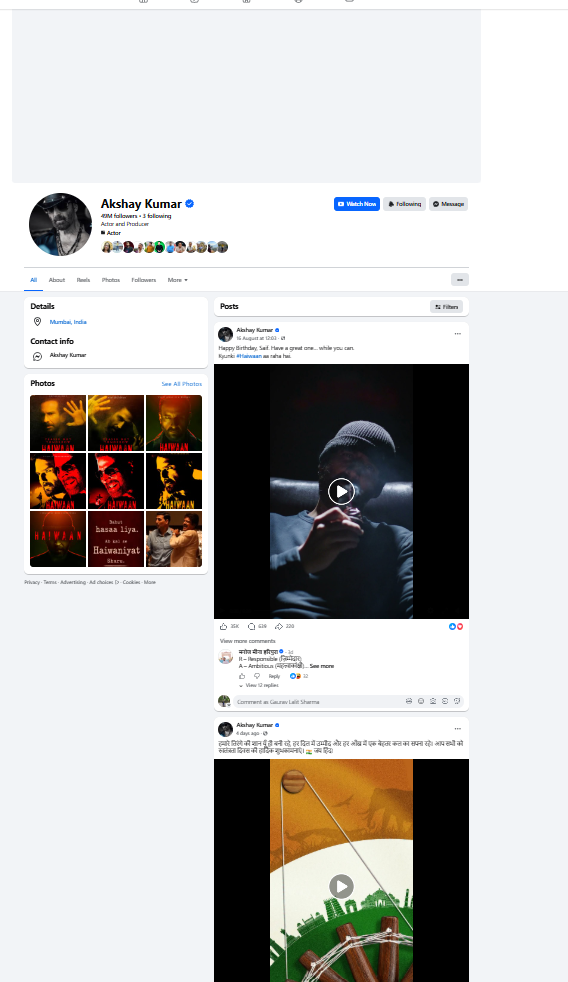
To verify the claim, we conducted a Google search using keywords such as “Akshay Kumar,” “Operation Sindoor” and “documentary.” The search did not yield any credible media report confirming that Kumar had made the alleged remarks. We also checked Kumar’s official social media accounts but found no post or video in which he commented on “Declassified: Operation Sindoor” or criticised the Indian Army’s battlefield performance.
https://www.facebook.com/akshaykumarofficial/
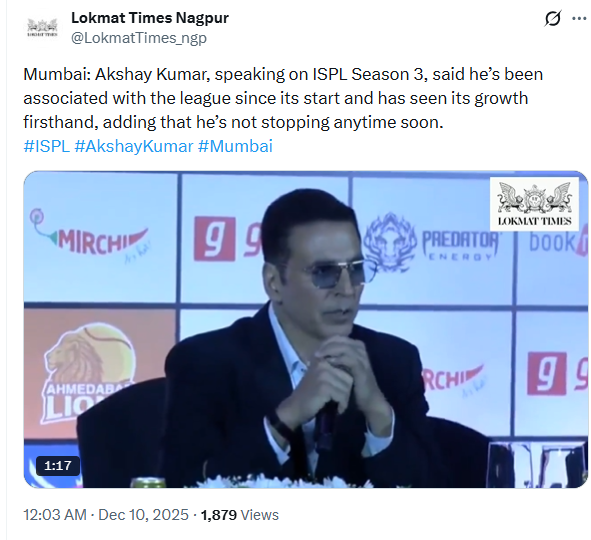
We then conducted a reverse image search of key frames from the viral video. This led us to an X post by Lokmat Times Nagpur, which carries the same visuals seen in the viral clip. The post was published on December 10, 2025, and its watermark is also visible in the viral footage. This establishes that the original footage was available well before the documentary’s release. In the original video, Kumar can be seen speaking about the Indian Street Premier League, and not the “Declassified: Operation Sindoor” documentary or the Indian Army.
https://x.com/LokmatTimes_ngp/status/1998460903415595252
We further analysed the viral video using multiple AI-detection tools. Hive Moderation indicated a high probability of AI-generated/deepfake content
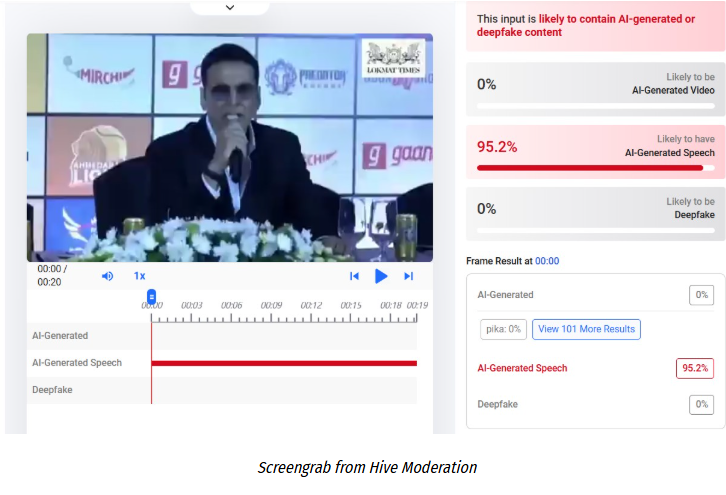
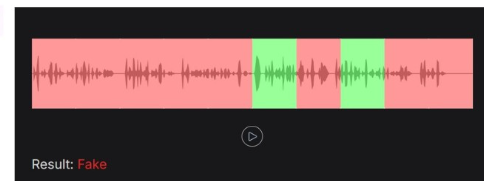
Another detector classified Kumar’s voice as likely deepfake, while Resemble AI also flagged the audio as fake.
Conclusion
The viral video has been digitally manipulated to make it appear as though Akshay Kumar commented on the “Declassified: Operation Sindoor” documentary and criticised the Indian Army’s performance during Operation Sindoor. The original footage predates the documentary and shows Kumar speaking about the Indian Street Premier League. The viral claim is false.

Related Blogs
.webp)
The 2020s mark the emergence of deepfakes in general media discourse. The rise in deepfake technology is defined by a very simple yet concerning fact: it is now possible to create perfect imitations of anyone using AI tools that can create audio in any person's voice and generate realistic images and videos of almost anyone doing pretty much anything. The proliferation of deepfake content in the media poses great challenges to the functioning of democracies. especially as such materials can deprive the public of the accurate information it needs to make informed decisions in elections. Deepfakes are created using AI, which combines different technologies to produce synthetic content.
Understanding Deepfakes
Deepfakes are synthetically generated content created using artificial intelligence (AI). This technology works on an advanced algorithm that creates hyper-realistic videos by using a person’s face, voice or likeness utilising techniques such as machine learning. The utilisation and progression of deepfake technology holds vast potential, both benign and malicious.
An example is when the NGO Malaria No More which had used deepfake technology in 2019 to sync David Beckham’s lip movements with different voices in nine languages, amplified its anti-malaria message.
Deepfakes have a dark side too. They have been used to spread false information, manipulate public opinion, and damage reputations. They can harm mental health and have significant social impacts. The ease of creating deepfakes makes it difficult to verify media authenticity, eroding trust in journalism and creating confusion about what is true and what is not. Their potential to cause harm has made it necessary to consider legal and regulatory approaches.
India’s Legal Landscape Surrounding Deepfakes
India presently lacks a specific law dealing with deepfakes, but the existing legal provisions offer some safeguards against mischief caused.
- Deepfakes created with the intent of spreading misinformation or damaging someone’s reputation can be prosecuted under the Bharatiya Nyaya Sanhita of 2023. It deals with the consequences of such acts under Section 356, governing defamation law.
- The Information Technology Act of 2000, the primary law that regulates Indian cyberspace. Any unauthorised disclosure of personal information which is used to create deepfakes for harassment or voyeurism is a violation of the act.
- The unauthorised use of a person's likeness in a deepfake can become a violation of their intellectual property rights and lead to copyright infringement.
- India’s privacy law, the Digital Personal Data Protection Act, regulates and limits the misuse of personal data. It has the potential to address deepfakes by ensuring that individuals’ likenesses are not used without their consent in digital contexts.
India, at present, needs legislation that can specifically address the challenges deepfakes pose. The proposed legislation, aptly titled, ‘the Digital India Act’ aims to tackle various digital issues, including the misuse of deepfake technology and the spread of misinformation. Additionally, states like Maharashtra have proposed laws targeting deepfakes used for defamation or fraud, highlighting growing concerns about their impact on the digital landscape.
Policy Approaches to Regulation of Deepfakes
- Criminalising and penalising the making, creation and distribution of harmful deepfakes as illegal will act as a deterrent.
- There should be a process that mandates the disclosures for synthetic media. This would be to inform viewers that the content has been created using AI.
- Encouraging tech companies to implement stricter policies on deepfake content moderation can enhance accountability and reduce harmful misinformation.
- The public’s understanding of deepfakes should be promoted. Especially, via awareness campaigns that will empower citizens to critically evaluate digital content and make informed decisions.
Deepfake, Global Overview
There has been an increase in the momentum to regulate deepfakes globally. In October 2023, US President Biden signed an executive order on AI risks instructing the US Commerce Department to form labelling standards for AI-generated content. California and Texas have passed laws against the dangerous distribution of deepfake images that affect electoral contexts and Virginia has targeted a law on the non-consensual distribution of deepfake pornography.
China promulgated regulations requiring explicit marking of doctored content. The European Union has tightened its Code of Practice on Disinformation by requiring social media to flag deepfakes, otherwise they risk facing hefty fines and proposed transparency mandates under the EU AI Act. These measures highlight a global recognition of the risks that deepfakes pose and the need for a robust regulatory framework.
Conclusion
With deepfakes being a significant source of risk to trust and democratic processes, a multi-pronged approach to regulation is in order. From enshrining measures against deepfake technology in specific laws and penalising the same, mandating transparency and enabling public awareness, the legislators have a challenge ahead of them. National and international efforts have highlighted the urgent need for a comprehensive framework to enable measures to curb the misuse and also promote responsible innovation. Cooperation during these trying times will be important to shield truth and integrity in the digital age.
References
- https://digitalcommons.usf.edu/cgi/viewcontent.cgi?article=2245&context=jss
- https://www.thehindu.com/news/national/regulating-deepfakes-generative-ai-in-india-explained/article67591640.ece
- https://www.brennancenter.org/our-work/research-reports/regulating-ai-deepfakes-and-synthetic-media-political-arena
- https://www.responsible.ai/a-look-at-global-deepfake-regulation-approaches/
- https://thesecretariat.in/article/wake-up-call-for-law-making-on-deepfakes-and-misinformation
Executive Summary:
A purported media release allegedly issued in the name of the International Cricket Council (ICC) is being widely circulated on social media. The release claims that the ICC has decided to impose a one-year ban on Pakistan cricket. CyberPeace’s research found this claim to be false.The research revealed that the media release circulating on social media is fake, and no such letter or official statement has been issued by the ICC.
Claim:
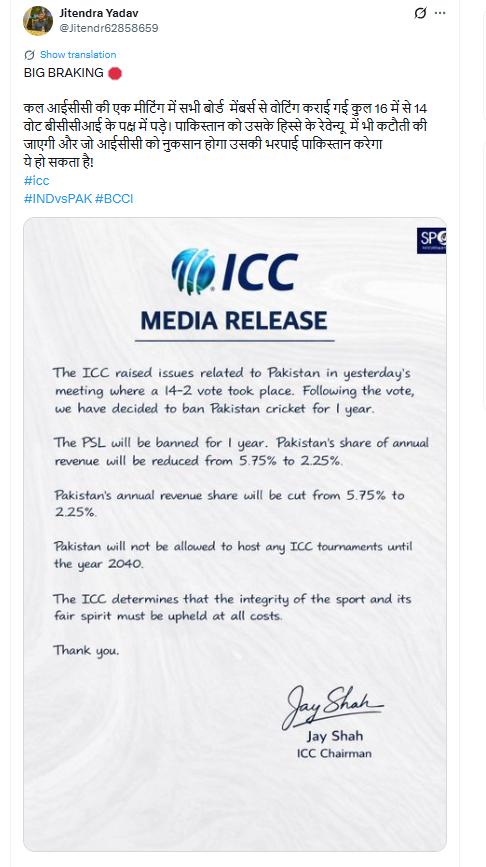
On social media platform X (formerly Twitter), a user shared the viral letter on February 3, 2026, claiming that an ICC meeting was held in which board members voted on issues related to Pakistan. The post alleged that 14 out of 16 votes were cast in favour of the BCCI. The user further claimed that Pakistan’s share of ICC revenue would be reduced and that Pakistan might be asked to compensate for losses incurred by the ICC.
The viral letter, written in English, stated that matters related to Pakistan were discussed in an ICC meeting and that a 14–2 majority vote led to the decision to impose a one-year ban on Pakistan cricket. It further claimed that the Pakistan Super League (PSL) would be suspended for one year, Pakistan’s annual revenue share would be reduced from 5.75 percent to 2.25 percent, and Pakistan would not be allowed to host any ICC tournaments until 2040. The letter also claimed that these decisions were taken to safeguard the integrity and spirit of the game. Links to the viral post, archive link, and screenshots can be seen below.
Fact Check:
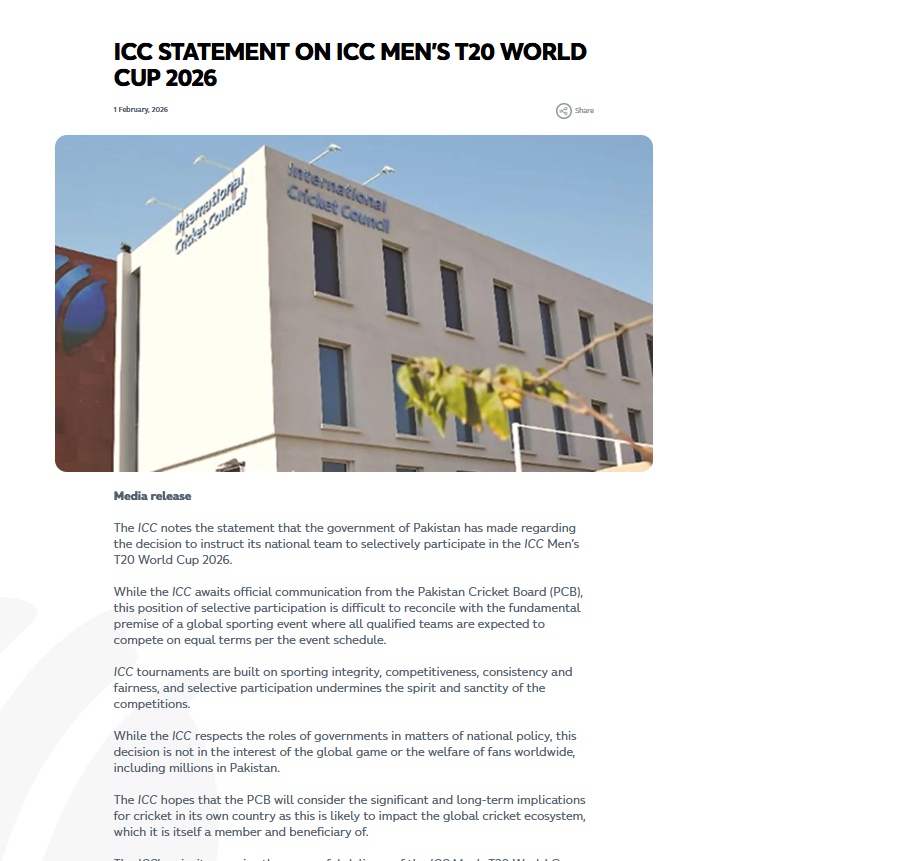
To verify the viral claim, CyberPeace conducted a Google search using relevant keywords. However, no credible or reliable media reports supporting the claim were found. In the next step of the research , an official press release uploaded on DD Sports’ Facebook page on February 2, 2026, was found. The press release responded to Pakistan’s decision not to play against India in a Group A match. The DD Sports statement said that the Pakistan Cricket Board should consider the long-term and serious implications of such a decision, as it could impact the global cricket ecosystem—of which Pakistan is itself a member and beneficiary.
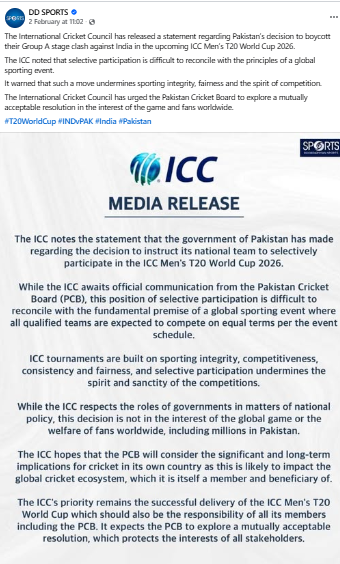
Notably, the official press release made no mention of any ban on Pakistan cricket, reduction in revenue share, suspension of the PSL, or restrictions on hosting ICC tournaments, contrary to the claims made in the viral letter. Further, the same official statement was found published on the ICC’s website on February 1, 2026. This release also did not mention any decision related to banning Pakistan cricket or barring the country from hosting ICC tournaments for the next 40 years.
Conclusion
CyberPeace concludes that the media release circulating on social media is fake. The ICC has not issued any official letter or statement announcing a one-year ban on Pakistan cricket, revenue cuts, or restrictions on hosting ICC tournaments.
Executive Summary
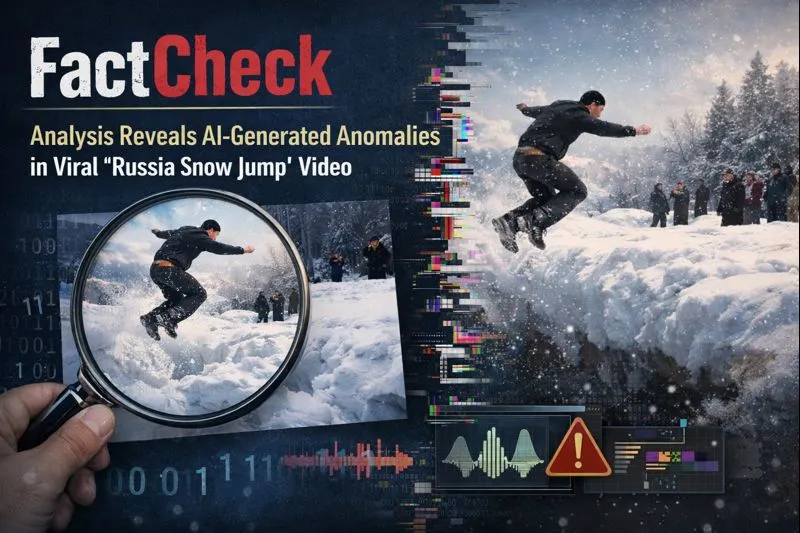
A dramatic video showing several people jumping from the upper floors of a building into what appears to be thick snow has been circulating on social media, with users claiming that it captures a real incident in Russia during heavy snowfall. In the footage, individuals can be seen leaping one after another from a multi-storey structure onto a snow-covered surface below, eliciting reactions ranging from amusement to concern. The claim accompanying the video suggests that it depicts a reckless real-life episode in a snow-hit region of Russia.
A thorough analysis by CyberPeace confirmed that the video is not a real-world recording but an AI-generated creation. The footage exhibits multiple signs of synthetic media, including unnatural human movements, inconsistent physics, blurred or distorted edges, and a glossy, computer-rendered appearance. In some frames, a partial watermark from an AI video generation tool is visible. Further verification using the Hive Moderation AI-detection platform indicated that 98.7% of the video is AI-generated, confirming that the clip is entirely digitally created and does not depict any actual incident in Russia.
Claim:
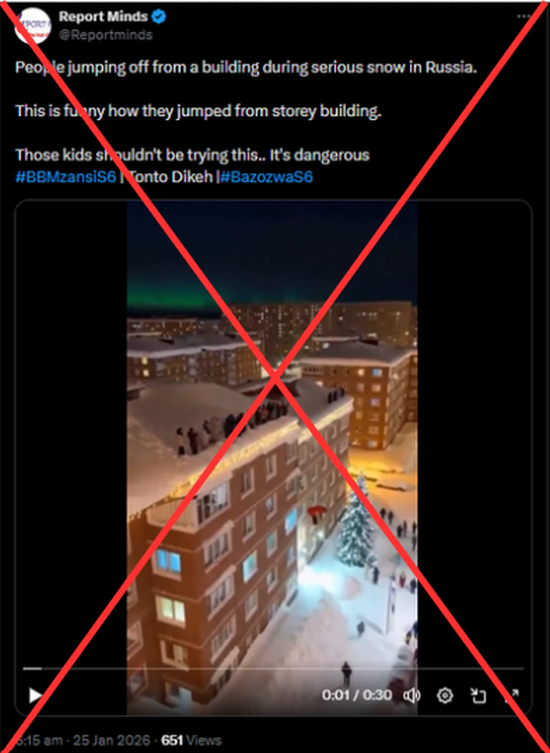
The video was shared on social media by an X (formerly Twitter) user ‘Report Minds’ on January 25, claiming it showed a real-life event in Russia. The post caption read: "People jumping off from a building during serious snow in Russia. This is funny, how they jumped from a storey building. Those kids shouldn't be trying this. It's dangerous." Here is the link to the post, and below is a screenshot.
Fact Check:
The Desk used the InVid tool to extract keyframes from the viral video and conducted a reverse image search, which revealed multiple instances of the same video shared by other users with similar claims. Upon close visual examination, several anomalies were observed, including unnatural human movements, blurred and distorted sections, a glossy, digitally-rendered appearance, and a partially concealed logo of the AI video generation tool ‘Sora AI’ visible in certain frames. Screenshots highlighting these inconsistencies were captured during the research .
- https://x.com/DailyLoud/status/2015107152772297086?s=20
- https://x.com/75secondes/status/2015134928745164848?s=20
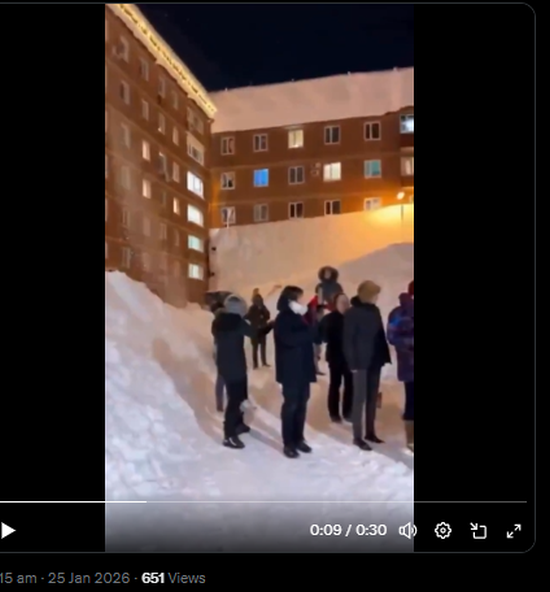
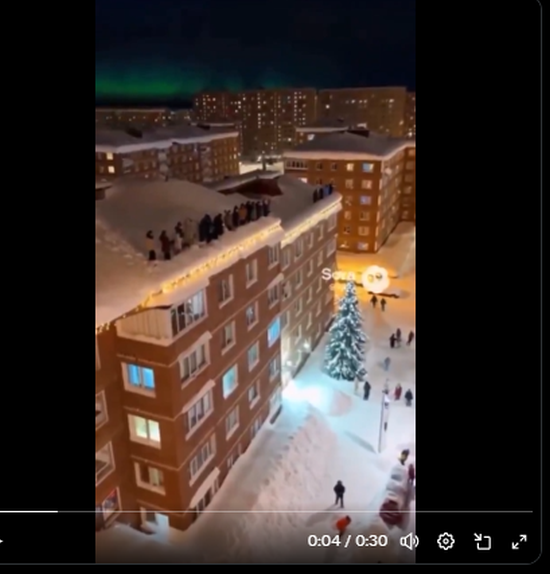
The video was analyzed on Hive Moderation, an AI-detection platform, which confirmed that 98.7% of the content is AI-generated.

The viral video showing people jumping off a building into snow, claimed to depict a real incident in Russia, is entirely AI-generated. Social media users who shared it presented the digitally created footage as if it were real, making the claim false and misleading.
