
#FactCheck -Social Media Claim of ICC’s One-Year Ban on Pakistan Cricket Is Misleading
Executive Summary:
A purported media release allegedly issued in the name of the International Cricket Council (ICC) is being widely circulated on social media. The release claims that the ICC has decided to impose a one-year ban on Pakistan cricket. CyberPeace’s research found this claim to be false.The research revealed that the media release circulating on social media is fake, and no such letter or official statement has been issued by the ICC.
Claim:
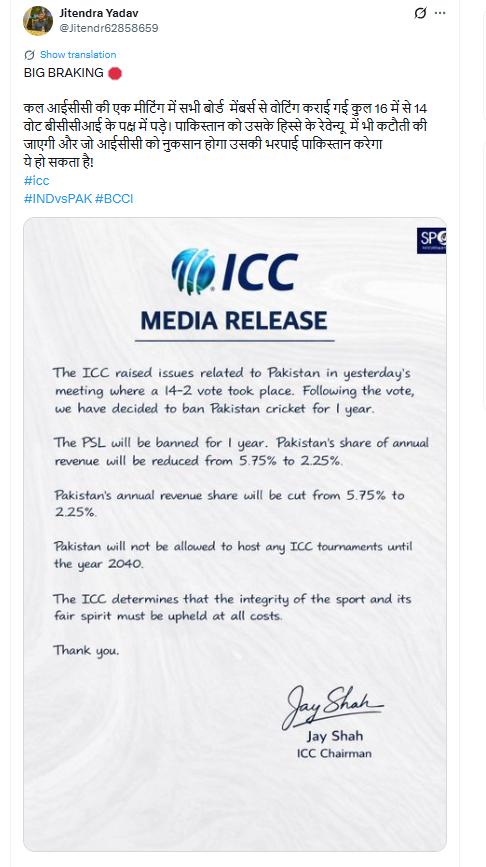
On social media platform X (formerly Twitter), a user shared the viral letter on February 3, 2026, claiming that an ICC meeting was held in which board members voted on issues related to Pakistan. The post alleged that 14 out of 16 votes were cast in favour of the BCCI. The user further claimed that Pakistan’s share of ICC revenue would be reduced and that Pakistan might be asked to compensate for losses incurred by the ICC.
The viral letter, written in English, stated that matters related to Pakistan were discussed in an ICC meeting and that a 14–2 majority vote led to the decision to impose a one-year ban on Pakistan cricket. It further claimed that the Pakistan Super League (PSL) would be suspended for one year, Pakistan’s annual revenue share would be reduced from 5.75 percent to 2.25 percent, and Pakistan would not be allowed to host any ICC tournaments until 2040. The letter also claimed that these decisions were taken to safeguard the integrity and spirit of the game. Links to the viral post, archive link, and screenshots can be seen below.
Fact Check:
To verify the viral claim, CyberPeace conducted a Google search using relevant keywords. However, no credible or reliable media reports supporting the claim were found. In the next step of the research , an official press release uploaded on DD Sports’ Facebook page on February 2, 2026, was found. The press release responded to Pakistan’s decision not to play against India in a Group A match. The DD Sports statement said that the Pakistan Cricket Board should consider the long-term and serious implications of such a decision, as it could impact the global cricket ecosystem—of which Pakistan is itself a member and beneficiary.
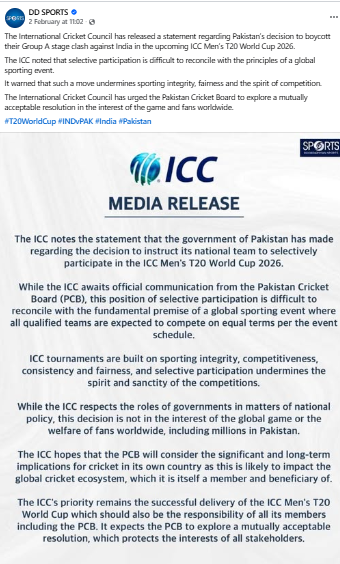
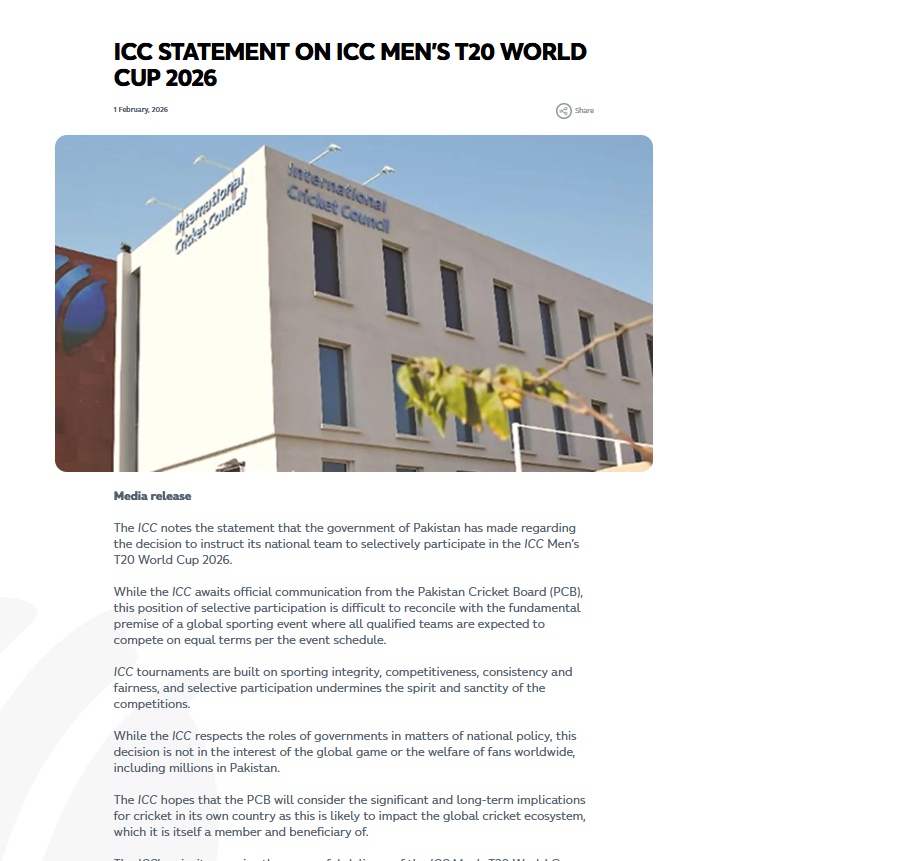
Notably, the official press release made no mention of any ban on Pakistan cricket, reduction in revenue share, suspension of the PSL, or restrictions on hosting ICC tournaments, contrary to the claims made in the viral letter. Further, the same official statement was found published on the ICC’s website on February 1, 2026. This release also did not mention any decision related to banning Pakistan cricket or barring the country from hosting ICC tournaments for the next 40 years.
Conclusion
CyberPeace concludes that the media release circulating on social media is fake. The ICC has not issued any official letter or statement announcing a one-year ban on Pakistan cricket, revenue cuts, or restrictions on hosting ICC tournaments.

Related Blogs

Introduction
A bill requiring social media companies, providers of encrypted communications, and other online services to report drug activity on their platforms to the U.S. The Drug Enforcement Administration (DEA) advanced to the Senate floor, alarming privacy advocates who claim the legislation transforms businesses into de facto drug enforcement agents and exposes many of them to liability for providing end-to-end encryption.
Why is there a requirement for online companies to report drug activity?
The reason behind the bill is that there was a Kansas teenager died after unknowingly taking a fentanyl-laced pill he purchased on Snapchat. The bill requires social media companies and other web communication providers to provide the DEA with users’ names and other information when the companies have “actual knowledge” that illicit drugs are being distributed on their platforms.
There is an urgent need to look into this matter as platforms like Snapchat and Instagram are the constant applications that netizens use. If these kinds of apps promote the selling of drugs, then it will result in major drug-selling vehicles and become drug-selling platforms.
Threat to end to end encryption
End-to-end encryption has long been criticised by law enforcement for creating a “lawless space” that criminals, terrorists, and other bad actors can exploit for their illicit purposes. End- to end encryption is important for privacy, but it has been criticised as criminals also use it for bad purposes that result in cyber fraud and cybercrimes.
Cases of drug peddling on social media platforms
It is very easy to get drugs on social media, just like calling an Uber. It is that simple to get the drugs. The survey discovered that access to illegal drugs is “staggering” on social media applications, which has contributed to the rising number of fentanyl overdoses, which has resulted in suicide, gun violence, and accidents.
According to another survey, drug dealers use slang, emoticons, QR codes, and disappearing messages to reach customers while avoiding content monitoring measures on social networking platforms. Drug dealers are frequently active on numerous social media platforms, advertising their products on Instagram while providing their WhatApps or Snapchat names for queries, making it difficult for law officials to crack down on the transactions.
There is a need for social media platforms to report these kinds of drug-selling activity on specific platforms to the Drug enforcement administration. The bill requires online companies to report drug cases going on websites, such as the above-mentioned Snapchat case. There are so many other cases where drug dealers sell the drug through Instagram, Snapchat etc. Usually, if Instagram blocks one account, they create another account for the drug selling. Just by only blocking the account does not help to stop drug trafficking on social media platforms.
Will this put the privacy of users at risk?
It is important to report the cybercrime activities of selling drugs on social media platforms. The companies will only detect the activity regarding the drugs which are being sold through social media platforms which are able to detect bad actors and cyber criminals. The detection will be on the particular activities on the applications where it is happening because the social media platforms lack regulations to govern them, and their convenience becomes the major vehicle for the drugs sale.
Conclusion
Social media companies are required to report these kinds of activities happening on their platforms immediately to the Drugs enforcement Administration so that the DEA will take the required steps instead of just blocking the account. Because just blocking does not stop these drug markets from happening online. There must be proper reporting for that. And there is a need for social media regulations. Social media platforms mostly influence people.
Executive Summary
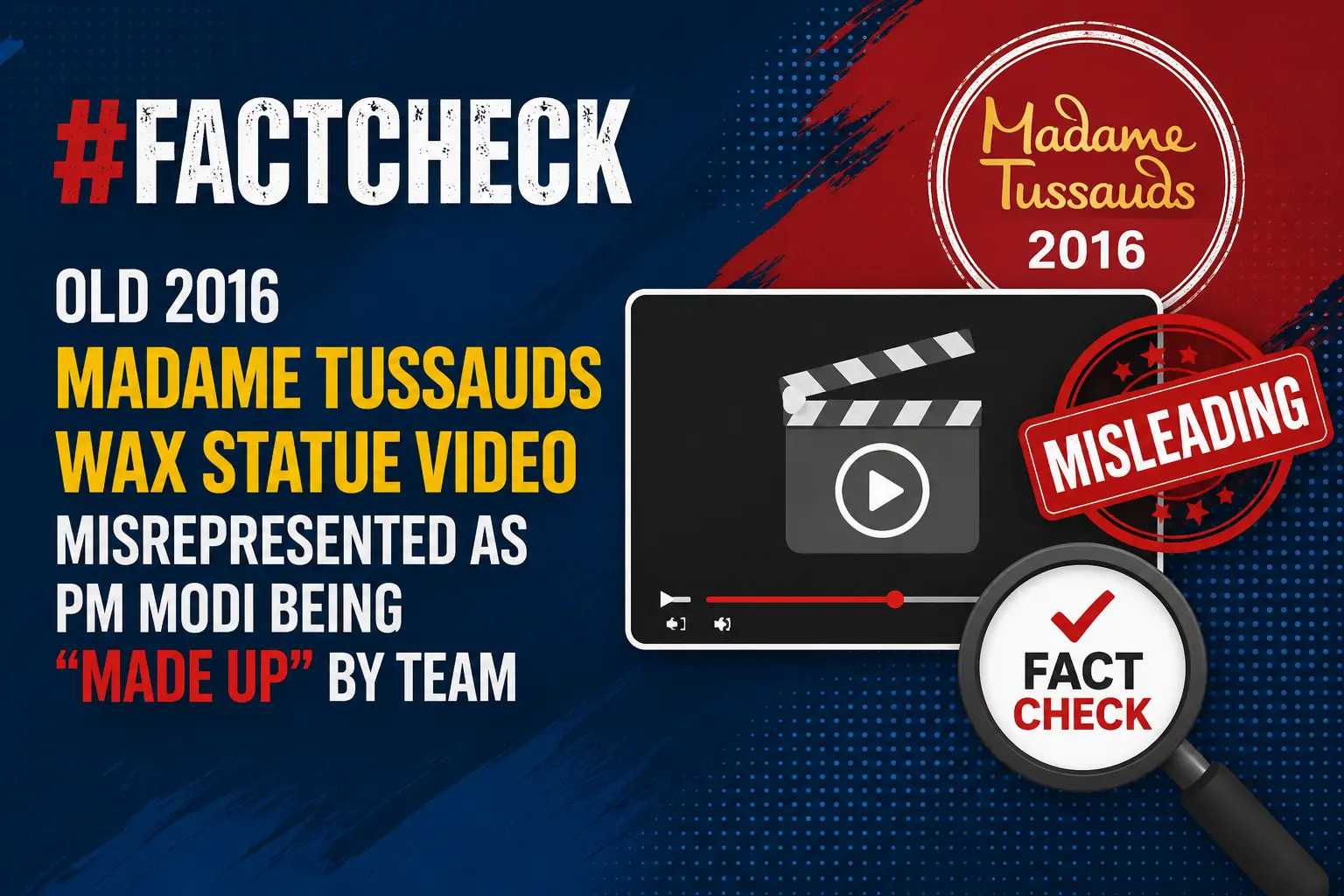
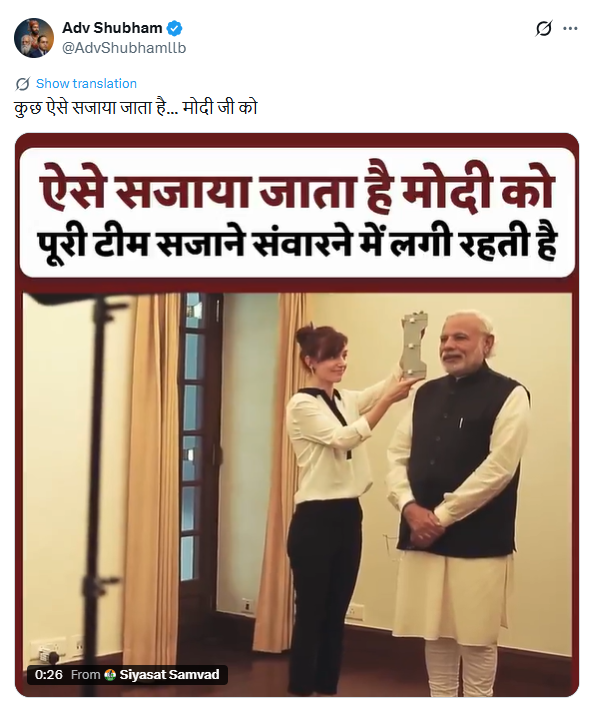
A video of Prime Minister Narendra Modi is being widely shared on social media with the claim that he is being “made up” or styled by a team, with users attempting to mock him using the footage. The clip is being circulated with misleading captions suggesting it shows the Prime Minister undergoing makeup and grooming by a dedicated team. CyberPeace Foundation Research Wing, in its research, found that the viral claim is false. In fact, the viral video is not recent, but from 2016. At that time, a statue of PM Modi was to be installed at Madame Tussauds Museum. A team of artists and experts visited the Prime Minister's residence to take measurements for the statue. This misleading claim has been circulating on social media for several years. We have previously fact-checked this claim and exposed the truth.
Claim
An X user named “Adv Shubham” shared the viral video on May 27, 2026, with the caption:“This is how Modi Ji is styled…”The post also claims that the Prime Minister is regularly “made up” by a team.
- https://x.com/AdvShubhamllb/status/2059682034289946746
- https://perma.cc/FVM9-PQBP
Fact Check
The viral video is not recent. It dates back to 2016 and is related to a completely different context. During the investigation, we found the same footage on the official YouTube channel of Madame Tussauds London, uploaded on March 16, 2016.

According to the video details, it shows the process of taking measurements for a wax statue of Prime Minister Narendra Modi for installation at Madame Tussauds. A team of artists and experts had visited the Prime Minister’s residence in Delhi for this purpose.
Conclusion
The viral claim that Prime Minister Narendra Modi is being “made up” by a team is false. The footage is from 2016 and shows a measurement session conducted for his wax statue at Madame Tussauds Museum.
The Digital Personal Data Protection (DPDP) Act, 2023, operationalises data privacy largely through a consent management framework. It aims to give data principles, ie, individuals, control over their personal data by giving them the power to track, change, and withdraw their consent from its processing. However, in practice, consent management is often not straightforward. For example, people may be frequently bombarded with requests, which can lead to fatigue and eventual overlooking of consent requests. This article discusses the way consent management is handled by the DPDP Act, and looks at how India can design the system to genuinely empower users while holding organisations accountable.
Consent Management in the DPDP Act
According to the DPDP Act, consent must be unambiguous, free, specific, and informed. It must also be easy for people to revoke their consent (DPO India, 2023). To this end, the Act creates Consent Managers- registered middlemen- who serve as a link between users and data custodians.
The purpose of consent managers is to streamline and centralise the consent procedure. Users can view, grant, update, or revoke consent across various platforms using the dashboards they offer. They hope to improve transparency and lessen the strain on people to keep track of permissions across different services by standardising the way consent is presented (IAPP, 2024).
The Act draws inspiration from international frameworks such as the GDPR (General Data Protection Regulation), mandating that Indian users be provided with a single platform to manage permissions rather than having to deal with dispersed consent prompts from every service.
The Challenges
Despite the mandate for an interoperable platform for consent management, several key challenges emerge. There is a lack of clarity on how consent management will be operationalised. This creates challenges of accountability and implementation. Thus, :
- If the interface is poorly designed, users could be bombarded with content permissions from apps/platforms/ services that are not fully compliant with the platform.
- If consent notices are vague, frequent, lengthy, or complex, users may continue to grant permissions without meaningful engagement.
- It leaves scope for data fiduciaries to use dark patterns to coerce customers into granting consent through poor UI/UX design.
- The lack of clear, standardised interoperability protocols across sectors could lead to a fragmented system, undermining the goal of a single, easy-to-use platform.
- Consent fatigue could easily appear in India's digital ecosystem, where apps, e-commerce websites, and government services all ask for permissions from over 950 million internet subscribers. Experiences from GDPR countries show that users who are repeatedly prompted eventually become banner blind, which causes them to ignore notices entirely.
- Low levels of literacy (including digital literacy) and unequal access to digital devices among women and marginalised communities create complexities in the substantive coverage of privacy rights.
- Placing the burden of verification of legal guardianship for children and persons with disabilities (PwDs) on data fiduciaries might be ineffective, as SMEs may lack the resources to undertake this activity. This could create new forms of vulnerability for the two groups.
Legal experts claim that this results in what they refer to as a legal fiction, wherein consent is treated as valid by the law despite the fact that it does not represent true understanding or choice (Lawvs, 2023). Additionally, research indicates that users hardly ever read privacy policies in their entirety. People are very likely to tick boxes without fully understanding what they are agreeing to. By drastically limiting user control, this has a bearing on the privacy rights of Indian citizens and residents. (IJLLR, 2023).
Impacts of Weak Consent Management:
According to the Indian Journal of Law and Technology, in an era of asymmetry and information overload, privacy cannot be sufficiently protected by relying only on consent (IJLT, 2023). Almost every individual will be impacted by inadequate consent management.
- For Users: True autonomy is replaced by the appearance of control. Individuals may unintentionally disclose private information, which undermines confidence in digital services.
- For Businesses: Compliance could become a mere formality. Further, if acquired consent is found to be manipulated or invalid, it creates space for legal risks and reputational damage.
- For Regulators: It becomes difficult to oversee a system where consent is frequently disregarded or misinterpreted. When consent is merely formal, the law's promise to protect personal information is undermined.
Way Forward
- Layered and Simplified Notices: Simple language and layers of visual cues should be used in consent requests. Important details like the type of data being gathered, its intended use, and its duration should be made clear up front. Additional explanations are available for users who would like more information. This method enhances comprehension and lessens cognitive overload (Lawvs, 2023).
- Effective Dashboards: Dashboards from consent managers should be user-friendly, cross-platform, and multilingual. Management is made simple by features like alerts, one-click withdrawal or modification, and summaries of active permissions. The system is more predictable and dependable when all services use the same format, which also reduces confusion (IAPP, 2024).
- Dynamic and Contextual Consent: Instead of appearing as generic pop-ups, consent requests should show up when they are pertinent to a user's actions. Users can make well-informed decisions without feeling overburdened by subtle cues, such as emphasising risks when sensitive data is requested (IJLLR, 2023).
- Accountability of Consent Managers: Organisations that offer consent management services must be accountable and independent, through clear certification, auditing, and specific legal accountability frameworks. Even when formal consent is given, strong trustee accountability guarantees that data is not misused (IJLT, 2023).
- Complementary Protections Beyond Consent: Consent continues to be crucial, but some high-risk data processing might call for extra protections. These may consist of increased responsibilities for fiduciaries or proportionality checks. These steps improve people's general protection and lessen the need for frequent consent requests (IJLLR, 2023).
Conclusion
The core of the DPDP Act is to empower users to have control over their data through measures such as consent management. But requesting consent is insufficient; the system must make it simple for people to manage, monitor, and change it. Effectively designed, managed, and executed consent management has the potential to revolutionise user experience and trust in India's digital ecosystem if it is implemented carefully.To make consent management genuinely meaningful, it is imperative to standardise procedures, hold fiduciaries accountable, simplify interfaces, and investigate supplementary protections.
References
Building Trust with Technology: Consent Management Under India’s DPDP Act, 2023
Consent Fatigue and Data Protection Laws: Is ‘Informed Consent’ a Legal Fiction
Beyond Consent: Enhancing India's Digital Personal Data Protection Framework
Top 10 operational impacts of India’s DPDPA – Consent management
