#FactCheck : Edited video falsely claims Dr. Vikas Divyakirti targeted Narendra Modi
Executive Summary
A video circulating on social media shows Dr. Vikas Divyakirti speaking during a podcast, where he is heard saying, “Those who cannot even memorise and speak four sentences are considered the greatest in India.” Several users are sharing the clip claiming that the remark was aimed at Narendra Modi. However, a research by CyberPeace found the claim to be misleading. The research revealed that the viral clip has been edited and shared out of context. In the original video, Divyakirti made the remarks in reference to film stars, not the Prime Minister.
Claim
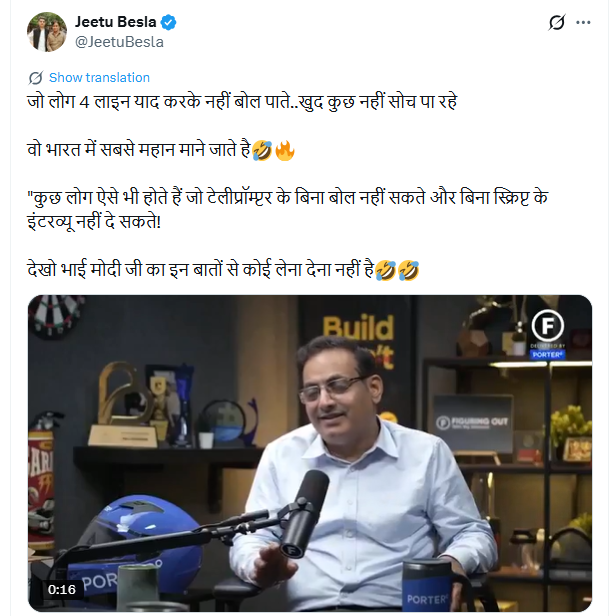
On Facebook, a user shared the viral clip with an English caption alleging that Divyakirti criticised Modi, saying he cannot speak without a teleprompter or scripted interviews and has built a false image of greatness.

Similarly, another user shared the video on X, suggesting that people who cannot speak without a teleprompter are still considered great in India, indirectly linking the remark to Modi.
Fact Check
To verify the claim, we extracted keyframes from the viral video and conducted a reverse image search using Google Lens. This led us to the original video uploaded on the official YouTube channel of Raj Shamani.

At around the 3:55 mark, the same clip can be seen. During the conversation, Shamani asks whether building a larger-than-life perception actually benefits an individual. Responding to this, Dr. Vikas Divyakirti explains that film stars often have an exaggerated public image. He notes that many of the dialogues they are praised for are not written by them, but by others, and some even rely on teleprompters while speaking. He further adds that there are individuals who cannot even memorise and deliver four sentences or think independently, yet are regarded as great in India. He also mentions that many social media personalities use teleprompters, but audiences remain unaware and assume they possess exceptional knowledge.
Conclusion
The viral claim is misleading. The video has been edited and shared out of context. Dr. Vikas Divyakirti was referring to film stars and social media personalities, not Narendra Modi.
Related Blogs

Introduction
Microsoft has unveiled its ambitious roadmap for developing a quantum supercomputer with AI features, acknowledging the transformative power of quantum computing in solving complex societal challenges. Quantum computing has the potential to revolutionise AI by enhancing its capabilities and enabling breakthroughs in different fields. Microsoft’s groundbreaking announcement of its plans to develop a quantum supercomputer, its potential applications, and the implications for the future of artificial intelligence (AI). However, there is a need for regulation in the realms of quantum computing and AI and significant policies and considerations associated with these transformative technologies. This technological advancement will help in the successful development and deployment of quantum computing, along with the potential benefits and challenges associated with its implementation.
What isQuantum computing?
Quantum computing is an emerging field of computer science and technology that utilises principles from quantum mechanics to perform complex calculations and solve certain types of problems more efficiently than classical computers. While classical computers store and process information using bits, quantum computers use quantum bits or qubits.
Interconnected Future
Quantum computing promises to significantly expand AI’s capabilities beyond its current limitations. Integrating these two technologies could lead to profound advancements in various sectors, including healthcare, finance, and cybersecurity. Quantum computing and artificial intelligence (AI) are two rapidly evolving fields that have the potential to revolutionise technology and reshape various industries. This section explores the interdependence of quantum computing and AI, highlighting how integrating these two technologies could lead to profound advancements across sectors such as healthcare, finance, and cybersecurity.
- Enhancing AI Capabilities:
Quantum computing holds the promise of significantly expanding the capabilities of AI systems. Traditional computers, based on classical physics and binary logic, need help solving complex problems due to the exponential growth of computational requirements. Quantum computing, on the other hand, leverages the principles of quantum mechanics to perform computations on quantum bits or qubits, which can exist in multiple states simultaneously. This inherent parallelism and superposition property of qubits could potentially accelerate AI algorithms and enable more efficient processing of vast amounts of data.
- Solving Complex Problems:
The integration of quantum computing and AI has the potential to tackle complex problems that are currently beyond the reach of classical computing methods. Quantum machine learning algorithms, for example, could leverage quantum superposition and entanglement to analyse and classify large datasets more effectively. This could have significant applications in healthcare, where AI-powered quantum systems could aid in drug discovery, disease diagnosis, and personalised medicine by processing vast amounts of genomic and clinical data.
- Advancements in Finance and Optimisation:
The financial sector can benefit significantly from integrating quantum computing and AI. Quantum algorithms can be employed to optimise portfolios, improve risk analysis models, and enhance trading strategies. By harnessing the power of quantum machine learning, financial institutions can make more accurate predictions and informed decisions, leading to increased efficiency and reduced risks.
- Strengthening Cybersecurity:
Quantum computing can also play a pivotal role in bolstering cybersecurity defences. Quantum techniques can be employed to develop new cryptographic protocols that are resistant to quantum attacks. In conjunction with quantum computing, AI can further enhance cybersecurity by analysing massive amounts of network traffic and identifying potential vulnerabilities or anomalies in real time, enabling proactive threat mitigation.
- Quantum-Inspired AI:
Beyond the direct integration of quantum computing and AI, quantum-inspired algorithms are also being explored. These algorithms, designed to run on classical computers, draw inspiration from quantum principles and can improve performance in specific AI tasks. Quantum-inspired optimisation algorithms, for instance, can help solve complex optimisation problems more efficiently, enabling better resource allocation, supply chain management, and scheduling in various industries.
How Quantum Computing and AI Should be Regulated-
As quantum computing and artificial intelligence (AI) continues to advance, questions arise regarding the need for regulations to govern these technologies. There is debate surrounding the regulation of quantum computing and AI, considering the potential risks, ethical implications, and the balance between innovation and societal protection.
- Assessing Potential Risks: Quantum computing and AI bring unprecedented capabilities that can significantly impact various aspects of society. However, they also pose potential risks, such as unintended consequences, privacy breaches, and algorithmic biases. Regulation can help identify and mitigate these risks, ensuring these technologies’ responsible development and deployment.
- Ethical Implications: AI and quantum computing raise ethical concerns related to privacy, bias, accountability, and the impact on human autonomy. For AI, issues such as algorithmic fairness, transparency, and decision-making accountability must be addressed. Quantum computing, with its potential to break current encryption methods, requires regulatory measures to protect sensitive information. Ethical guidelines and regulations can provide a framework to address these concerns and promote responsible innovation.
- Balancing Innovation and Regulation: Regulating quantum computing and AI involves balancing fostering innovation and protecting society’s interests. Excessive regulation could stifle technological advancements, hinder research, and impede economic growth. On the other hand, a lack of regulation may lead to the proliferation of unsafe or unethical applications. A thoughtful and adaptive regulatory approach is necessary, considering the dynamic nature of these technologies and allowing for iterative improvements based on evolving understanding and risks.
- International Collaboration: Given the global nature of quantum computing and AI, international collaboration in regulation is essential. Harmonising regulatory frameworks can avoid fragmented approaches, ensure consistency, and facilitate ethical and responsible practices across borders. Collaborative efforts can also address data privacy, security, and cross-border data flow challenges, enabling a more unified and cooperative approach towards regulation.
- Regulatory Strategies: Regulatory strategies for quantum computing and AI should adopt a multidisciplinary approach involving stakeholders from academia, industry, policymakers, and the public. Key considerations include:
- Risk-based Approach: Regulations should focus on high-risk applications while allowing low-risk experimentation and development space.
- Transparency and Explainability: AI systems should be transparent and explainable to enable accountability and address concerns about bias, discrimination, and decision-making processes.
- Privacy Protection: Regulations should safeguard individual privacy rights, especially in quantum computing, where current encryption methods may be vulnerable.
- Testing and Certification: Establishing standards for the testing and certification of AI systems can ensure their reliability, safety, and adherence to ethical principles.
- Continuous Monitoring and Adaptation: Regulatory frameworks should be dynamic, regularly reviewed, and adapted to keep pace with the evolving landscape of quantum computing and AI.
Conclusion:
Integrating quantum computing and AI holds immense potential for advancing technology across diverse domains. Quantum computing can enhance the capabilities of AI systems, enabling the solution of complex problems, accelerating data processing, and revolutionising industries such as healthcare, finance, and cybersecurity. As research and development in these fields progress, collaborative efforts among researchers, industry experts, and policymakers will be crucial in harnessing the synergies between quantum computing and AI to drive innovation and shape a transformative future.The regulation of quantum computing and AI is a complex and ongoing discussion. Striking the right balance between fostering innovation, protecting societal interests, and addressing ethical concerns is crucial. A collaborative, multidisciplinary approach to regulation, considering international cooperation, risk assessment, transparency, privacy protection, and continuous monitoring, is necessary to ensure these transformative technologies' responsible development and deployment.

Introduction
Misinformation in India has emerged as a significant societal challenge, wielding a potent influence on public perception, political discourse, and social dynamics. A potential number of first-time voters across India identified fake news as a real problem in the nation. With the widespread adoption of digital platforms, false narratives, manipulated content, and fake news have found fertile ground to spread unchecked information and news.
In the backdrop of India being the largest market of WhatsApp users, who forward more content on chats than anywhere else, the practice of fact-checking forwarded information continues to remain low. The heavy reliance on print media, television, unreliable news channels and primarily, social media platforms acts as a catalyst since studies reveal that most Indians trust any content forwarded by family and friends. It is noted that out of all risks, misinformation and disinformation ranked the highest in India, coming before infectious diseases, illicit economic activity, inequality and labour shortages. World Economic Forum analysts, in connection with their 2024 Global Risk Report, note that “misinformation and disinformation in electoral processes could seriously destabilise the real and perceived legitimacy of newly elected governments, risking political unrest, violence and terrorism and long-term erosion of democratic processes.”
The Supreme Court of India on Misinformation
The Supreme Court of India, through various judgements, has noted the impact of misinformation on democratic processes within the country, especially during elections and voting. In 1995, while adjudicating a matter pertaining to keeping the broadcasting media under the control of the public, it noted that democracy becomes a farce when the medium of information is monopolized either by partisan central authority or by private individuals or oligarchic organizations.
In 2003, the Court stated that “Right to participate by casting a vote at the time of election would be meaningless unless the voters are well informed about all sides of the issue in respect of which they are called upon to express their views by casting their votes. Disinformation, misinformation, non-information all equally create an uninformed citizenry which would finally make democracy a mobocracy and a farce.” It noted that elections would be a useless procedure if voters remained unaware of the antecedents of the candidates contesting elections. Thus, a necessary aspect of a voter’s duty to cast intelligent and rational votes is being well-informed. Such information forms one facet of the fundamental right under Article 19 (1)(a) pertaining to freedom of speech and expression. Quoting James Madison, it stated that a citizen’s right to know the true facts about their country’s administration is one of the pillars of a democratic State.
On a similar note, the Supreme Court, while discussing the disclosure of information by an election candidate, gave weightage to the High Court of Bombay‘s opinion on the matter, which opined that non-disclosure of information resulted in misinformation and disinformation, thereby influencing voters to take uninformed decisions. It stated that a voter had the elementary right to know the full particulars of a candidate who is to represent him in Parliament/Assemblies.
While misinformation was discussed primarily in relation to elections, the effects of misinformation in other sectors have also been discussed from time to time. In particular, The court highlighted the World Health Organisation’s observation in 2021 while discussing the spread of COVID-19, noting that the pandemic was not only an epidemic but also an “infodemic” due to the overabundance of information on the internet, which was riddled with misinformation and disinformation. While condemning governments’ direct or indirect threats of prosecution to citizens, it noted that various citizens who relied on the internet to provide help in securing medical facilities and oxygen tanks were being targeted by alleging that the information posted by them was false and was posted to create panic, defame the administration or damage national image. It instructed authorities to cease such threats and prevent clampdown on information sharing.
More recently, in Facebook v. Delhi Legislative Assembly [(2022) 3 SCC 529], the apex court, while upholding the summons issued to Facebook by the Delhi Legislative Assembly in the aftermath of the 2020 Delhi Riots, noted that while social media enables equal and open dialogue between citizens and policymakers, it is also a tool in the where extremist views are peddled into mainstream media, thereby spreading misinformation. It noted Facebook’s role in the Mynmar, where misinformation and posts that Facebook employees missed fueled offline violence. Since Facebook is one of the most popular social media applications, the platform itself acts as a power center by hosting various opinions and voices on its forum. This directly impacts the governance of States, and some form of liability must be attached to the platform. The Supreme Court objected to Facebook taking contrary stands in various jurisdictions; while in the US, it projected itself as a publisher, which enabled it to maintain control over the material disseminated from its platform, while in India, “it has chosen to identify itself purely as a social media platform, despite its similar functions and services in the two countries.”
Conclusion
The pervasive issue of misinformation in India is a multifaceted challenge with profound implications for democratic processes, public awareness, and social harmony. The alarming statistics of fake news recognition among first-time voters, coupled with a lack of awareness regarding fact-checking organizations, underscore the urgency of addressing this issue. The Supreme Court of India has consistently recognized the detrimental impact of misinformation, particularly in elections. The judiciary has stressed the pivotal role of an informed citizenry in upholding the essence of democracy. It has emphasized the right to access accurate information as a fundamental aspect of freedom of speech and expression. As India grapples with the challenges of misinformation, the intersection of technology, media literacy and legal frameworks will be crucial in mitigating the adverse effects and fostering a more resilient and informed society.
References
- https://thewire.in/media/survey-finds-false-information-risk-highest-in-india
- https://www.statista.com/topics/5846/fake-news-in-india/#topicOverview
- https://www.weforum.org/publications/global-risks-report-2024/digest/
- https://main.sci.gov.in/supremecourt/2020/20428/20428_2020_37_1501_28386_Judgement_08-Jul-2021.pdf
- Secretary, Ministry of Information & Broadcasting, Govt, of India and Others v. Cricket Association of Bengal and Another [(1995) 2 SCC 161]
- People’s Union for Civil Liberties (PUCL) v. Union of India [(2003) 4 SCC 399]
- Kisan Shankar Kathore v. Arun Dattatray Sawant and Others [(2014) 14 SCC 162]
- Distribution of Essential Supplies & Services During Pandemic, In re [(2021) 18 SCC 201]
- Facebook v. Delhi Legislative Assembly [(2022) 3 SCC 529]
.png)
Introduction
The fast-paced development of technology and the wider use of social media platforms have led to the rapid dissemination of misinformation with characteristics such as diffusion, fast propagation speed, wide influence, and deep impact through these platforms. Social Media Algorithms and their decisions are often perceived as a black box introduction that makes it impossible for users to understand and recognise how the decision-making process works.
Social media algorithms may unintentionally promote false narratives that garner more interactions, further reinforcing the misinformation cycle and making it harder to control its spread within vast, interconnected networks. Algorithms judge the content based on the metrics, which is user engagement. It is the prerequisite for algorithms to serve you the best. Hence, algorithms or search engines enlist relevant items you are more likely to enjoy. This process, initially, was created to cut the clutter and provide you with the best information. However, sometimes it results in unknowingly widespread misinformation due to the viral nature of information and user interactions.
Analysing the Algorithmic Architecture of Misinformation
Social media algorithms, designed to maximize user engagement, can inadvertently promote misinformation due to their tendency to trigger strong emotions, creating echo chambers and filter bubbles. These algorithms prioritize content based on user behaviour, leading to the promotion of emotionally charged misinformation. Additionally, the algorithms prioritize content that has the potential to go viral, which can lead to the spread of false or misleading content faster than corrections or factual content.
Additionally, popular content is amplified by platforms, which spreads it faster by presenting it to more users. Limited fact-checking efforts are particularly difficult since, by the time they are reported or corrected, erroneous claims may have gained widespread acceptance due to delayed responses. Social media algorithms find it difficult to distinguish between real people and organized networks of troll farms or bots that propagate false information. This creates a vicious loop where users are constantly exposed to inaccurate or misleading material, which strengthens their convictions and disseminates erroneous information through networks.
Though algorithms, primarily, aim to enhance user engagement by curating content that aligns with the user's previous behaviour and preferences. Sometimes this process leads to "echo chambers," where individuals are exposed mainly to information that reaffirms their beliefs which existed prior, effectively silencing dissenting voices and opposing viewpoints. This curated experience reduces exposure to diverse opinions and amplifies biased and polarising content, making it arduous for users to discern credible information from misinformation. Algorithms feed into a feedback loop that continuously gathers data from users' activities across digital platforms, including websites, social media, and apps. This data is analysed to optimise user experiences, making platforms more attractive. While this process drives innovation and improves user satisfaction from a business standpoint, it also poses a danger in the context of misinformation. The repetitive reinforcement of user preferences leads to the entrenchment of false beliefs, as users are less likely to encounter fact-checks or corrective information.
Moreover, social networks and their sheer size and complexity today exacerbate the issue. With billions of users participating in online spaces, misinformation spreads rapidly, and attempting to contain it—such as by inspecting messages or URLs for false information—can be computationally challenging and inefficient. The extensive amount of content that is shared daily means that misinformation can be propagated far quicker than it can get fact-checked or debunked.
Understanding how algorithms influence user behaviour is important to tackling misinformation. The personalisation of content, feedback loops, the complexity of network structures, and the role of superspreaders all work together to create a challenging environment where misinformation thrives. Hence, highlighting the importance of countering misinformation through robust measures.
The Role of Regulations in Curbing Algorithmic Misinformation
The EU's Digital Services Act (DSA) applicable in the EU is one of the regulations that aims to increase the responsibilities of tech companies and ensure that their algorithms do not promote harmful content. These regulatory frameworks play an important role they can be used to establish mechanisms for users to appeal against the algorithmic decisions and ensure that these systems do not disproportionately suppress legitimate voices. Independent oversight and periodic audits can ensure that algorithms are not biased or used maliciously. Self-regulation and Platform regulation are the first steps that can be taken to regulate misinformation. By fostering a more transparent and accountable ecosystem, regulations help mitigate the negative effects of algorithmic misinformation, thereby protecting the integrity of information that is shared online. In the Indian context, the Intermediary Guidelines, 2023, Rule 3(1)(b)(v) explicitly prohibits the dissemination of misinformation on digital platforms. The ‘Intermediaries’ are obliged to ensure reasonable efforts to prevent users from hosting, displaying, uploading, modifying, publishing, transmitting, storing, updating, or sharing any information related to the 11 listed user harms or prohibited content. This rule aims to ensure platforms identify and swiftly remove misinformation, and false or misleading content.
Cyberpeace Outlook
Understanding how algorithms prioritise content will enable users to critically evaluate the information they encounter and recognise potential biases. Such cognitive defenses can empower individuals to question the sources of the information and report misleading content effectively. In the future of algorithms in information moderation, platforms should evolve toward more transparent, user-driven systems where algorithms are optimised not just for engagement but for accuracy and fairness. Incorporating advanced AI moderation tools, coupled with human oversight can improve the detection and reduction of harmful and misleading content. Collaboration between regulatory bodies, tech companies, and users will help shape the algorithms landscape to promote a healthier, more informed digital environment.
References:
- https://www.advancedsciencenews.com/misformation-spreads-like-a-nuclear-reaction-on-the-internet/
- https://www.niemanlab.org/2024/09/want-to-fight-misinformation-teach-people-how-algorithms-work/
- Press Release: Press Information Bureau (pib.gov.in)