
#FactCheck - Digitally Manipulated Video Misrepresents Surinder Choudhary’s Remarks on PM Modi
Executive Summary
A video circulating on social media claims that Jammu and Kashmir Deputy Chief Minister Surinder Choudhary described Prime Minister Narendra Modi as an agent of Pakistan’s Inter-Services Intelligence (ISI). In the viral clip, Choudhary is allegedly heard accusing the Prime Minister of pushing Kashmir towards Pakistan and claiming that even pro-India Kashmiris are disillusioned with Modi’s policies.
However, research by the CyberPeace research wing has found that the video is digitally manipulated. While the visuals are genuine and taken from a real media interaction, the audio has been fabricated and falsely overlaid to misattribute inflammatory remarks to the Deputy Chief Minister.
Claim
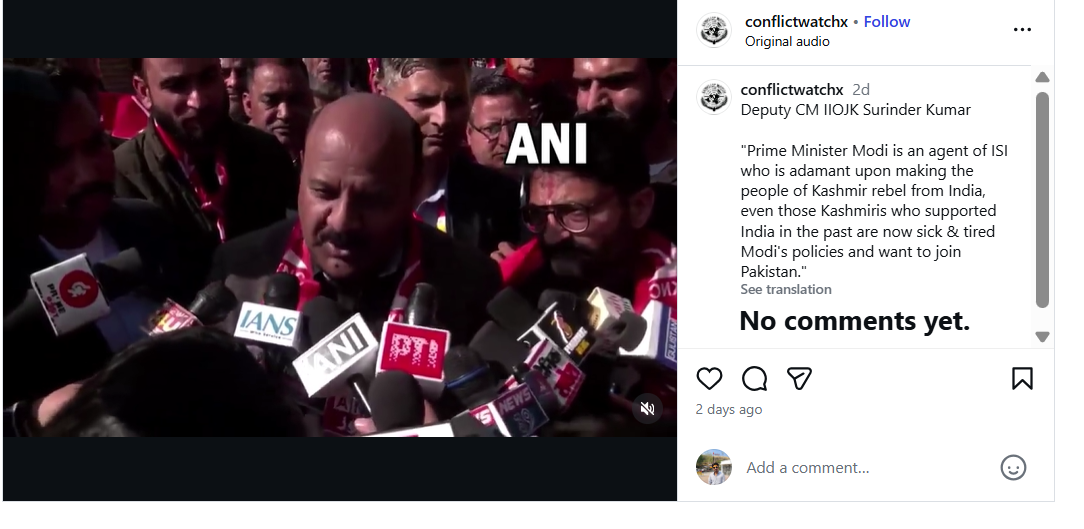
An Instagram account named Conflict Watch shared the video on January 20, claiming that J&K Deputy Chief Minister Surinder Choudhary had called Prime Minister Modi an ISI agent. The video purportedly quoted Choudhary as saying that Modi was elected with Pakistan’s support and that Kashmir would soon become part of Pakistan due to his policies.
Here is the link and archive link to the post, along with a screenshot.
Fact Check:
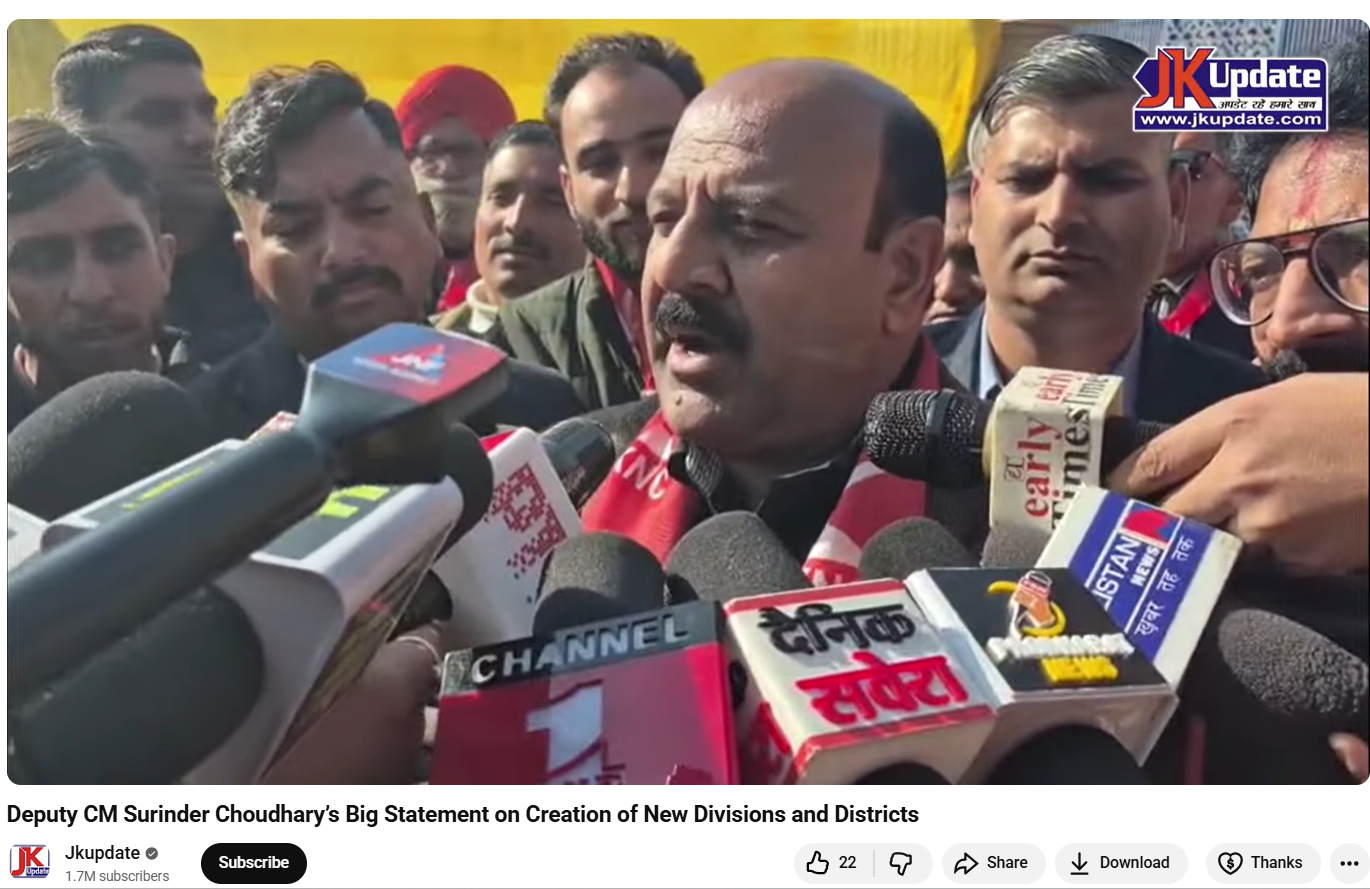
To verify the claim, the Desk conducted a Google Lens search, which led to a video uploaded on January 20, 2026, on the official YouTube channel of Jammu and Kashmir–based news outlet JKUpdate. The footage was an extended version of the viral clip and featured identical visuals. The original video showed Surinder Choudhary addressing the media on the sidelines of the inaugural two-day JKNC Convention of Block Presidents and Secretaries in the Jammu province. A review of the full media interaction revealed that Choudhary did not make any statements calling Prime Minister Modi an ISI agent or suggesting that Kashmir should join Pakistan.
Instead, in the original footage, Choudhary was seen criticising former Jammu and Kashmir Chief Minister and PDP leader Mehbooba Mufti for supporting the BJP during the bifurcation of Jammu and Kashmir and Ladakh into two Union Territories. He also spoke about the challenges faced by the region after the abrogation of Article 370 and demanded the restoration of full statehood for Jammu and Kashmir. During the interaction, Choudhary said that anyone attempting to divide Jammu and Kashmir at the state or regional level was effectively following Pakistan’s agenda and Jinnah’s two-nation theory. He added that such individuals could not be considered patriots.
Here is the link to the video, along with a screenshot.
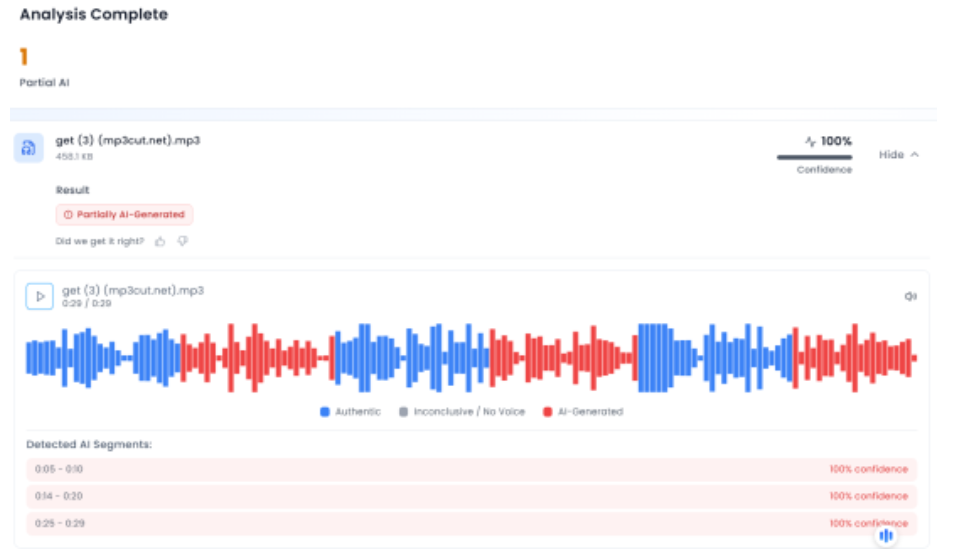
In the next phase of the research , the Desk extracted the audio from the viral clip and analysed it using the AI-based audio detection tool Aurigin. The analysis indicated that the voice in the viral video was partially AI-generated, further confirming that the clip had been tampered with.
Below is a screenshot of the result.
Conclusion
Multiple social media users shared a video claiming it showed Jammu and Kashmir Deputy Chief Minister Surinder Choudhary calling Prime Minister Narendra Modi an agent of the ISI. However, the CyberPeace found that the viral video was digitally manipulated. While the visuals were taken from a genuine media interaction with the leader, a fabricated audio track was overlaid to attribute the statements to him falsely.

Related Blogs

Introduction
In the new age of technologies the internet and social media continue to witness a surge in deepfake videos a technological phenomenon that blurs the line between reality and fiction. The string of deepfake videos of Bollywood actors and other famous personalities has raised serious concerns. While Prime Minister Narendra Modi spoke against the risks of artificial intelligence at the G20 Virtual Summit. The central government has recently announced that it will soon set up dedicated regulations to tackle this Menace. This will include holding social media platforms and creators responsible for their actions against the rules and regulations. Very often most people shy away from initiating a legal process or taking action while being victims of misuse of fast-paced tech but the government has announced its big support to the victims and promised to stand by complaints against deepfake videos especially this includes helping individuals to report the incidents and any violations by platforms.
Social media platforms to realign their policies as per the Indian laws
The Ministry of Electronics and Information Technology (MeitY) announced on 24th November 2023 that it will be giving social media platforms seven days time period to align their terms of service and other policies with Indian laws and regulations in order to address the issue of hosting of deepfakes on these platforms. All platforms must align and transform their terms of use with their users to be consistent with the 12 areas that are prohibited under rule 3(1)(b) of the Information Technology (IT) Rules, 2021.
The platforms will ensure harmonization and alignment of their terms & policies so that every user on every platform is aware that when they use a platform the platform intends to be a safe and trusted platform and the platform will not tolerate these 12 types of content or information that have been prohibited under the IT Act and the IT rules. The government approach is to collectively advocate for responsible and safe use of the Internet. The government has taken a proactive step in partnership with these social media platforms to ensure an era where such platforms will be a lot more responsible and a lot more responsive to the expectations under the law and more compliant.
Officer to be appointed under rule 7
As Deepfake Videos continue to surface on social media, the Government has geared up to curb such content online. Mr. Rajeev Chandrasekhar Minister of State, (Meity), stated that the government will soon appoint an officer to take appropriate action against deepfake videos. This statement came after the government meeting with industry stakeholders and important players held on 24 Nov 2023. He added that Meity and the government of India will nominate an officer under rule 7 (IT rules 2021) and will ensure full compliance expectations from all the platforms. An officer appointed under Rule 7, will be entrusted with building a mechanism where users can put in their complaints regarding deepfakes and MeitY may also assist such aggrieved users with filing FIRs in such cases. Mr. Rajeev Chandrasekhar, Minister of State, (Meity) also added that we will also be creating a platform where it will be very easy for netizens to bring to the attention of the government of India and notices of allegations or reports of violation of law by the platforms and the rule 7 officer will take that digital platform information and respond accordingly.
The Information Technology (Intermediary Guidelines and Digital Media Ethics Code) Rules, 2021 (updated as on 6.4.2023)
Rule 3(1)(b) states that intermediaries shall inform its rules and regulations, privacy policy and user agreement to the user and shall make reasonable efforts to ‘restrict’ the users from hosting, displaying, uploading, modifying, publishing, transmitting, store, update or sharing any information that is prohibited under this rule which also includes deepfake, misinformation, CSAM(Child sexual abusive material) etc. As per rule 3(2)(b) Intermediaries shall remove or disable access within 24 hours of receipt of complaints of contents that expose the private areas of individuals, show such individuals in full or partial nudity or in a sexual act or is in the nature of impersonation including morphed images etc.
Ongoing Efforts Ahead of Crucial Meeting with Tech Giants
Ahead of the government meeting with online platforms such as Google, Facebook, and YouTube on Friday, 24th November 2023, Mr. Rajeev Chandrasekhar Minister of State, (Meity) added that way back from October 2022 the government of India had been alerting them to the threat of misinformation and deepfakes which are part of misinformation. He further added that the current IT rules under the IT Act provide for adequate compliance requirements on their part to deal with deepfake.
Deepfake Misinformation
Misinformation powered by AI becoming an even more potent force to disrupt and to mislead and to create chaos and confusion at a scale and of a type that is deeply detrimental. Deepfakes in a very simple basic way is misinformation which is powered by or enhanced by AI. Video-based deepfake misinformation is more dangerous since it has a greater reach as video consumption today is the preferred choice by users on the internet.
Way forward
The Honorable Prime Minister has raised the issue that deep fakes are deeply disruptive they can create divisions and all kinds of disruptions in communities, in families and therefore misuse of deepfake technology is a very clear present danger to the safe and trusted internet.
The Government is on its way to draft a dedicated legislation dedicated to tackling deepfakes.
Even as we speak to a future regulation and a future law which is certainly required given that our IT Act is 23 years old. However current IT rules provide for compliance requirements by the platforms on misinformation patently false information and deepfakes. Followed by the recent government advisory on misinformation and deepfake.
Conclusion
Prime Minister alerting of the dangers of deepfakes online. The government is now in the process of starting to look very seriously into this issue and also issued guidelines for intermediaries and in a finite period of time it is hoped that the threat of deep fakes would actually no longer exist in in our system. The government made it clear that apart from people spreading deepfake videos, the platforms making them spread and not taking action will also be liable they are currently liable and will be even more so in future after new rules and regulations are brought in.
References:
- https://www.moneycontrol.com/news/technology/deepfakes-meity-gives-social-media-platforms-7-day-ultimatum-to-align-their-policies-to-indian-laws-and-regulations-11805521.html
- https://www.azbpartners.com/bank/amendments-to-the-information-technology-intermediary-guidelines-and-digital-media-ethics-code-rules-2021/#:~:text=Prior%20to%20the%20amendment%2C%20under%20Rule%203(1)
- https://www.drishtiias.com/daily-updates/daily-news-analysis/amendments-to-the-it-rules-2021
- https://youtu.be/zmI2ml1d_Es?feature=shared
- https://pib.gov.in/PressReleaseIframePage.aspx?PRID=1975445

Introduction
Snapchat's Snap Map redefined location sharing with an ultra-personalised feature that allows users to track where they and their friends are, discover hotspots, and even explore events worldwide. In November 2024, Snapchat introduced a new addition to its Family Center, aiming to bolster teen safety. This update enables parents to request and share live locations with their teens, set alerts for specific locations, and monitor who their child shares their location with.
While designed with keeping safety in mind, such tracking tools raise significant privacy concerns. Misusing these features could expose teens to potential harm, amplifying the debate around safeguarding children’s online privacy. This blog delves into the privacy and safety challenges Snap Map poses under existing data protection laws, highlighting critical gaps and potential risks.
Understanding Snapmap: How It Works and Why It’s Controversial
Snap Map, built on technology from Snap's acquisition of social mapping startup Zenly, revolutionises real-time location sharing by letting users track friends, send messages, and explore the world through an interactive map. With over 350 million active users by Q4 2023, and India leading with 202.51 million Snapchat users, Snap Map has become a global phenomenon.
This opt-in feature allows users to customise their location-sharing settings, offering modes like "Ghost Mode" for privacy, sharing with all friends, or selectively with specific contacts. However, location updates occur only when the app is in use, adding a layer of complexity to privacy management.
While empowering users to connect and share, Snap Map’s location-sharing capabilities raise serious concerns. Unintentional sharing or misuse of this tool could expose users—especially teens—to risks like stalking or predatory behaviour. As Snap Map becomes increasingly popular, ensuring its safe use and addressing its potential for harm remains a critical challenge for users and regulators.
The Policy Vacuum: Protecting Children’s Data Privacy
Given the potential misuse of location-sharing features, evaluating the existing regulatory frameworks for protecting children's geolocation privacy is important. Geolocation features remain under-regulated in many jurisdictions, creating opportunities for misuse, such as stalking or unauthorised surveillance. Presently, multiple international and national jurisdictions are in the process of creating and implementing privacy laws. The most notable examples are the COPPA in the US, GDPR in the EU and the DPDP Act which have made considerable progress in privacy for children and their online safety. COPPA and GDPR prioritise children’s online safety through strict data protections, consent requirements, and limits on profiling. India’s DPDP Act, 2023, prohibits behavioral tracking and targeted ads for children, enhancing privacy. However, it lacks safeguards against geolocation tracking, leaving a critical gap in protecting children from risks posed by location-based features.
Balancing Innovation and Privacy: The Role of Social Media Platforms
Privacy is an essential element that needs to be safeguarded and this is specifically important for children as they are vulnerable to harm they cannot always foresee. Social media companies must uphold their responsibility to create platforms that do not become a breeding ground for offences against children. Some of the challenges that platforms face in implementing a safe online environment are robust parental control and consent mechanisms to ensure parents are informed about their children’s online presence and options to opt out of services that they feel are not safe for their children. Platforms need to maintain a level of privacy that allows users to know what data is collected by the platform, sharing and retention data policies.
Policy Recommendations: Addressing the Gaps
Some of the recommendations for addressing the gaps in the safety of minors are as follows:
- Enhancing privacy and safety for minors by taking measures such as mandatory geolocation restrictions for underage users.
- Integrating clear consent guidelines for data protection for users.
- Collaboration between stakeholders such as government, social media platforms, and civil society is necessary to create awareness about location-sharing risks among parents and children.
Conclusion
Safeguarding privacy, especially of children, with the introduction of real-time geolocation tools like Snap Map, is critical. While these features offer safety benefits, they also present the danger of misuse, potentially harming vulnerable teens. Policymakers must urgently update data protection laws and incorporate child-specific safeguards, particularly around geolocation tracking. Strengthening regulations and enhancing parental controls are essential to protect young users. However, this must be done without stifling technological innovation. A balanced approach is needed, where safety is prioritised, but innovation can still thrive. Through collaboration between governments, social media platforms, and civil society, we can create a digital environment that ensures safety and progress.
References
- https://indianexpress.com/article/technology/tech-news-technology/snapchat-family-center-real-time-location-sharing-travel-notifications-9669270/
- https://economictimes.indiatimes.com/tech/technology/snapchat-unveils-location-sharing-features-to-safeguard-teen-users/articleshow/115297065.cms?from=mdr
- https://www.thehindu.com/sci-tech/technology/snapchat-adds-more-location-safety-features-for-teens/article68871301.ece
- https://www.moneycontrol.com/technology/snapchat-expands-parental-control-with-location-tracking-to-make-it-easier-for-parents-to-track-their-kids-article-12868336.html
- https://www.statista.com/statistics/545967/snapchat-app-dau/

Introduction
Words come easily, but not necessarily the consequences that follow. Imagine a 15-year-old child on the internet hoping that the world will be nice to him and help him gain confidence, but instead, someone chooses to be mean on the internet, or the child becomes the victim of a new kind of cyberbullying, i.e., online trolling. The consequences of trolling can have serious repercussions, including eating disorders, substance abuse, conduct issues, body dysmorphia, negative self-esteem, and, in tragic cases, self-harm and suicide attempts in vulnerable individuals. The effects of online trolling can include anxiety, depression, and social isolation. This is one example, and hate speech and online abuse can touch anyone, regardless of age, background, or status. The damage may take different forms, but its impact is far-reaching. In today’s digital age, hate speech spreads rapidly through online platforms, often amplified by AI algorithms.
As we celebrate today, i.e., 18th June, the International Day for Countering Hate Speech, if we have ever been mean to someone on the internet, we pledge never to repeat that kind of behaviour, and if we have been the victim, we will stand against the perpetrator and report it.
This year, the theme for the International Day for Countering Hate Speech is “Hate Speech and Artificial Intelligence Nexus: Building coalitions to reclaim inclusive and secure environments free of hatred. UN Secretary-General Antonio Guterres, in his statement, said, “Today, as this year’s theme reminds us, hate speech travels faster and farther than ever, amplified by Artificial Intelligence. Biased algorithms and digital platforms are spreading toxic content and creating new spaces for harassment and abuse."
Coded Convictions: How AI Reflects and Reinforces Ideologies
Algorithms have swiftly taken the place of feelings; they tamper with your taste, and they do so with a lighter foot, invisibly. They are becoming an important component of social media user interaction and content distribution. While these tools are designed to improve user experience, they frequently inadvertently spread divisive ideologies and push extremist propaganda. This amplification can strengthen the power of extremist organisations, spread misinformation, and deepen societal tensions. This phenomenon, known as “algorithmic radicalisation,” demonstrates how social media companies may utilise a discriminating content selection approach to entice people down ideological rabbit holes and shape their ideas. AI-driven algorithms often prioritise engagement over ethics, enabling divisive and toxic content to trend and placing vulnerable groups, especially youth and minorities, at risk. The UN’s Strategy and Plan of Action on Hate Speech, launched on June 18, 2019, recognises that while AI holds promise for early detection and prevention of harmful speech, it also demands stringent human rights safeguards. Without regulation, these tools can themselves become purveyors of bias and exclusion.
India’s Constitutional Resolve and Civilizational Ethos against Hate
India has always taken pride in being inclusive and united rather than divided. As far as hate speech is concerned, India's stand is no different. The United Nations, India believes in the same values as its international counterpart. Although India has won many battles against hate speech, the war is not over and is now more prominent than ever due to the advancement in communication technologies. In India, while the right to freedom of speech and expression is protected under Article 19(1)(a), its exercise is limited subject to reasonable restrictions under Article 19(2). Landmark rulings such as Ramji Lal Modi v. State of U.P. and Amish Devgan v. UOI have clarified that speech can be curbed if it incites violence or undermines public order. Section 69A of the IT Act, 2000, empowers the government to block content, and these principles are also reflected in Section 196 of the BNS, 2023 (153A IPC) and Section 299 of the BNS, 2023 (295A IPC). Platforms are also required to track down the creators of harmful content and remove it within a reasonable hour and fulfil their due diligence requirements under IT rules.
While there is no denying that India needs to be well-equipped and prepared normatively to tackle hate propaganda and divisive forces. India’s rich culture and history, rooted in philosophies of Vasudhaiva Kutumbakam (the world is one family) and pluralistic traditions, have long stood as a beacon of tolerance and coexistence. By revisiting these civilizational values, we can resist divisive forces and renew our collective journey toward harmony and peaceful living.
CyberPeace Message
The ultimate goal is to create internet and social media platforms that are better, safer and more harmonious for each individual, irrespective of his/her/their social and cultural background. CyberPeace stands resolute on promoting digital media literacy, cyber resilience, and consistently pushing for greater accountability for social media platforms.
References
- https://www.un.org/en/observances/countering-hate-speech
- https://www.artemishospitals.com/blog/the-impact-of-trolling-on-teen-mental-health
- https://www.orfonline.org/expert-speak/from-clicks-to-chaos-how-social-media-algorithms-amplify-extremism
- https://www.techpolicy.press/indias-courts-must-hold-social-media-platforms-accountable-for-hate-speech/
