
#FactCheck - Viral Image of Broken Mahatma Gandhi Statue Is Not from Bangladesh
An image showing a damaged statue of Mahatma Gandhi, broken into two pieces, is being widely shared on social media. The image shows Gandhi’s statue with its head separated from the body, prompting strong reactions online.
Social media users are claiming that the incident occurred in Bangladesh, alleging that Mahatma Gandhi’s statue was deliberately vandalised there. The image is being described as a recent incident and is being circulated across platforms with provocative and inflammatory captions.
Cyber Peace Foundation’s research and verification found that the claim being shared online is misleading. Our rsearch revealed that the viral image is not from Bangladesh. The image is actually from Chakulia in Uttar Dinajpur district of West Bengal, India
Claim:
Social media users claim that Mahatma Gandhi’s statue was vandalised in Bangladesh, and that the viral image shows a recent incident from the country.One Facebook user shared the video on 19 January 2026, making derogatory remarks and falsely linking the incident to Bangladesh. The post has since been widely shared on social media platforms. (Archived links and screenshots are available.)

Fact Check:
Our research revealed that the viral image is not from Bangladesh. The image is actually from Chakulia in Uttar Dinajpur district of West Bengal, India. To verify the claim, we conducted a reverse image search using Google Lens on key frames from the viral video. This led us to a report published by ABP Live Bangla on 16 January 2026, which featured the same visuals. Link and screenshot
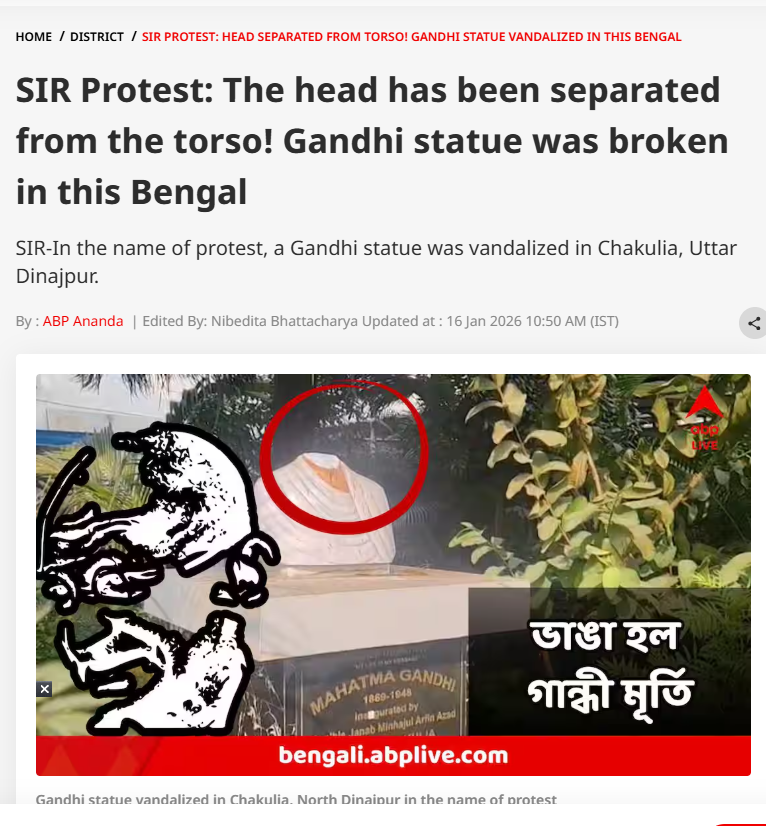
According to ABP Live Bangla, the statue of Mahatma Gandhi was damaged during a protest in Chakulia. The statue’s head was found separated from the body. While a portion of the broken statue remained at the site on Thursday night, it was reported missing by Friday morning. The report further stated that extensive damage was observed at BDO Office No. 2 in Golpokhar. Gandhi’s statue, located at the entrance of the administrative building, was found broken, and ashes were discovered near the premises. Government staff were seen clearing scattered debris from the site.
The incident reportedly occurred during a SIR (Special Intensive Revision) hearing at the BDO office, which was disrupted due to vandalism. In connection with the violence and damage to government property, 21 people have been arrested so far. In the next stage of verification, we found the same footage in a 16 January 2026 report by local Bengali news channel K TV, which also showed clear visuals of the damaged Mahatma Gandhi statue. Link and screenshot.

Conclusion:
The viral image of Mahatma Gandhi’s broken statue does not depict an incident from Bangladesh. The image is from Chakulia in West Bengal’s Uttar Dinajpur district, where the statue was damaged during a protest.

Related Blogs

In the digital era of the present day, a nation’s strength no longer gets measured only by the number of missiles or aircraft it has in its inventory. Rather, it also calls for defending the digital borders. Major infrastructures like power grids and dams are increasingly being targeted by cyberattacks in the global security environment that modern militaries operate in. When communication channels are vulnerable to an information breach, cybersecurity becomes a crucial component of national defence.
Why is cybersecurity a crucial national security concern in the modern era?
The technologies and procedures that shield digital devices, networks, and systems from unwanted access or attacks are referred to as cybersecurity. Cyberattacks are silent in the context of national security, in contrast to conventional warfare. They are swift and are also capable of causing a massive disruption without even a single case of physical infiltration. However, hostile states, terrorist organisations, or criminal networks may be able to steal any classified information or disrupt military infrastructure due to a cybersecurity breach in a military network.
To fully comprehend the significance of cybersecurity, let's examine the various approaches, such as:
- Protecting critical infrastructures- Today's nations rely heavily on digital networks to run vital services like banking, transportation, electricity, water supply, and healthcare. Therefore, a cyberattack on these systems could cause problems across the country and interfere with our daily activities. Therefore, it is also seen that the military forces of a nation closely work in synergy with other government agencies and private organizations to create a strong ecosystem of security in this sector.
- Safeguarding military operations in the present age- The armed forces heavily rely on digital tools for communication, mission planning, surveillance, and coordination. In case the cyber intruders get access to those systems, then a lot of major operational hurdles can come up in the form of breach of mission details, disruption of channels, and compromise of the confidentiality of military operations. These are certain conditions that make cybersecurity an important aspect for protecting the physical bases and the security architectures.
- Preventing cyber warfare- With the evolution of the geopolitical landscape, state and non-state actors are now resorting to cyberattacks to gather intelligence, disrupt security networks, and influence political outcomes. Still, strong cybersecurity can help nations to ensure, detect, defend, and respond to threats in an effective manner.
- Securing government databases- The government databases are known for storing sensitive information about the citizens, military assets, diplomatic data, and vital information related to major national infrastructures. If these get compromised, then it can weaken the strategic position of the nation and put the national security of the nation at a grave risk. Therefore, it becomes necessary to protect government data as a priority.
How can countries improve their cybersecurity defences?
Countries all over the world are developing their cyber capabilities using a variety of tactics to protect against the increasing number of cyber threats. A few of these can be interpreted as;
- Creating cyber defence units- The majority of contemporary armed forces have created specialised cyber domains devoted to threat identification. Their responsibilities have been centred on keeping an eye on those dangers, stopping intrusions, and reacting quickly to cyberattacks.
- Public-Private Partnerships- To safeguard vital industries like energy grids, financial networks, and communication systems, the government collaborates with private businesses and technology suppliers. Additionally, these collaborations foster innovation to improve the overall defence against cyberattacks.
- Establishing international collaborations- Cyber threats do not respect our borders. As a result, which countries are increasing their share of intelligence, best practices, and defensive strategies with their allies? Groups like NATO have conducted a joint cyber defence exercise to prepare for dealing with a digital future.
However, these collaborations can help to develop a united front against cybercrime.
Core Pillars of the modern military cyber defence
The modern defence strategies have been built upon several key designated pillars that are designed to prevent, detect, and respond to cyber threats, which can be mentioned as;
- Cyberspace as an operational domain- Militaries have now begun to treat cyberspace like the land, air, sea, and space as domains where wars can both begin and also end. Developing some dedicated cyber units to conduct digital operations to defend networks and engage in a range of counter-cyber activities when required.
- Active and proactive defence- Instead of passively waiting for the attacks to happen, real-time monitoring tools are used for blocking the threats that arise. Proactive defence goes a step further by hunting for potential threats before they can reach the networks.
- • Protection of vital infrastructures- The armed forces collaborate closely with civilian organisations and agencies to secure vital infrastructures that are important to the country. Critical infrastructure is protected from cyberattacks by layered defence, which includes encryption, stringent access control, and ongoing monitoring.
- • Strengthening alliances- Countries can develop a strong and well-coordinated defence system by exchanging intelligence to carry out cooperative cyber operations.
- Fostering innovation for the development of a workforce- Cyber threats evolve at a rapid pace, which calls for the military to invest in advanced technologies like AI-driven systems, secure cloud technologies, besides ensure continuous training related to cybersecurity.
Conclusion
The modern militaries have adopted the method of protecting digital networks to defend their land and seas. Cybersecurity has become the new line of defence to protect government data and vital defence infrastructure from serious and unseen threats. The countries are building a secure, robust, and resilient digital future with the aid of solid alliances, cutting-edge technologies, knowledgeable workers, and a proactive defence strategy.
References
- https://www.ssh.com/academy/cyber-defense-strategy-dod-perspective#:~:text=Defence%20organizations%20are%20prime%20targets,SSH%20Key%20Management%20and%20Compliance
- https://www.fortinet.com/resources/cyberglossary/cyber-warfare#:~:text=Advanced%20endpoint%20security%20adds%20proactive,information%20by%20halting%20unauthorized%20transfers
- https://medium.com/@lynnfdsouza/the-impact-of-cyber-warfare-on-modern-military-strategies-c77cf6d1a788
- https://ccoe.dsci.in/blog/why-cybersecurity-is-critical-for-national-defense-protecting-countries-in-the-digital-age
Executive Summary
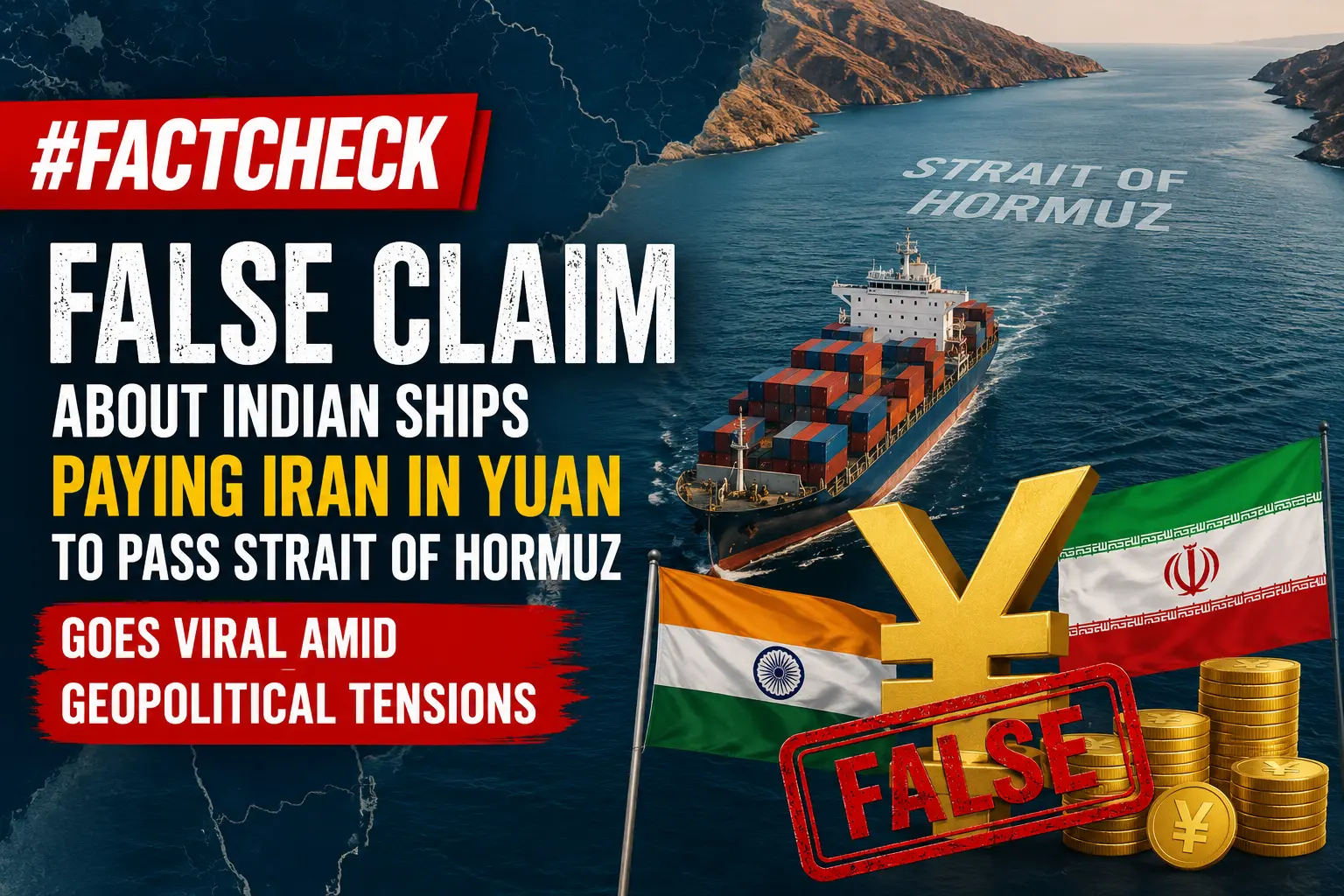
Amid the ongoing geopolitical tensions involving the US, Israel, and Iran, and reports of disruptions in the Strait of Hormuz affecting cargo ship movement and global crude oil prices, several posts on social media have made a viral claim. The posts allege that Indian cargo vessels are being allowed to pass through the Strait of Hormuz after payments to Iran were made in Chinese currency, the yuan. The claim has been widely circulated from certain social media accounts, suggesting a shift in India’s trade and payment arrangements. However, a fact-check by CyberPeace Research Wing has found the claim to be false.
Claim
A social media user “MEHF voice 2.0” shared a viral post (archived link), claiming that an Indian oil tanker secured passage through the Strait of Hormuz by making payments in Chinese yuan. The post further suggested that India had formed a new alignment with China, bypassing the US dollar system.

Fact Check
Due to US sanctions, Iran is excluded from the international banking network SWIFT, which prevents direct trade settlements in US dollars or euros. As a result, India and Iran conduct trade through a specially designed rupee–rial payment mechanism. According to a Ministry of Commerce and Industry release (based on a written reply in Parliament), India and Iran established this arrangement to facilitate bilateral trade using local currencies instead of the US dollar.

Further, information from the Indian Embassy in Tehran notes that rupee-based payments are processed through UCO Bank and Iranian banks with vostro accounts, enabling trade settlement outside sanctioned banking channels. IDBI Bank has also been part of efforts to expand rupee-based transactions with Iran.
The Ministry of External Affairs’ official fact-check handle has also debunked this claim, confirming that it is false.

Conclusion
The viral claim that Indian oil tankers are paying in Chinese yuan to pass through the Strait of Hormuz is false. India and Iran conduct trade settlements through a rupee–rial payment mechanism, not through the Chinese currency.

Introduction
The Union Minister of Information and Broadcasting Ashwini Vaishnaw addressed the Press Council of India on the occasion of National Press Day regarding emergent concerns in the digital media and technology landscape. Union Minister of Information and Broadcasting Ashwini Vaishnaw has identified four major challenges facing news media in India, including fake news, algorithmic bias, artificial intelligence, and fair compensation. He emphasized the need for greater accountability and fairness from Big Tech to combat misinformation and protect democracy. Vaishnaw argued that platforms do not verify information posted online, leading to the spread of false and misleading information. He called on online platforms and Big Tech to combat misinformation and protect democracy.
Key Concerns Highlighted by Union Minister Ashwini Vaishnaw
- Misinformation: Due to India's unique sensitivities, digital platforms should adopt country-specific responsibilities and metrics. The Minister also questioned the safe harbour principle, which shields platforms from liability for user-generated content.
- Algorithmic Biases: The prioritisation of viral content, which is often divisive, by social media algorithms can have serious implications on societal peace.
- Impact of AI on intellectual Property: The training of AI on pre-existing datasets presents the ethical challenge of robbing original creators of their rights to their intellectual property
- Fair compensation: Traditional news media is increasingly facing financial strain since news consumption is shifting rapidly to social media platforms, creating uneven compensation dynamics.
Cyberpeace Insights
- Misinformation: Marked by routine upheavals and moral panics, Indian society is vulnerable to the severe impacts of fake news, including mob violence, political propaganda, health misinformation and more. Inspired by the EU's Digital Services Act, 2022, and other related legislation that addresses hate speech and misinformation, the Indian Minister has called for revisiting the safe harbour protection under Section 79 of the IT Act, 2000. However, any legislation on misinformation must strike a balance between protecting the fundamental rights to freedom of speech, and privacy while safeguarding citizens from its harmful effects.
- Algorithmic Biases: Social media algorithms are designed to boost user engagement since this increases advertisement revenue. This leads to the creation of filter bubbles- exposure to personalized information online and echo chambers interaction with other users with the same opinions that align with their worldview. These phenomena induce radicalization of views, increase intolerance fuel polarization in public discourse, and trigger the spread of more misinformation. Tackling this requires algorithmic design changes such as disincentivizing sensationalism, content labelling, funding fact-checking networks, etc. to improve transparency.
- Impact of AI on Intellectual Property: AI models are trained on data that may contain copyrighted material. It can lead to a loss of revenue for primary content creators, while tech companies owning AI models may financially benefit disproportionately by re-rendering their original works. Large-scale uptake of AI models will significantly impact fields such as advertising, journalism, entertainment, etc by disrupting their market. Managing this requires a push for Ethical AI regulations and the protection of original content creators.
Conclusion: Charting a Balanced Path
The socio-cultural and economic fabric of the Indian subcontinent is not only distinct from the rest of the world but has cross-cutting internal diversities, too. Its digital landscape stands at a crossroads as rapid global technological advancements present increasing opportunities and challenges. In light of growing incidents of misinformation on social media platforms, it is also crucial that regulators consider framing rules that encourage and mandate content verification mechanisms for online platforms, incentivizing them to adopt advanced AI-driven fact-checking tools and other relevant measures. Additionally, establishing public-private partnerships to monitor misinformation trends is crucial to rapidly debunking viral falsehoods. However ethical concerns and user privacy should be taken into consideration while taking such steps. Addressing misinformation requires a collaborative approach that balances platform accountability, technological innovation, and the protection of democratic values.
Sources
- https://www.indiatoday.in/india/story/news-media-4-challenges-ashwini-vaishnaw-national-press-day-speech-big-tech-fake-news-algorithm-ai-2634737-2024-11-17
- https://ec.europa.eu/commission/presscorner/detail/en/ip_24_881
- https://www.legaldive.com/news/digital-services-act-dsa-eu-misinformation-law-propaganda-compliance-facebook-gdpr/691657/
- https://www.fondationdescartes.org/en/2020/07/filter-bubbles-and-echo-chambers/
- https://www.google.com/searchq=News+Media+Bargaining+Code&oq=News+Media+Bargaining+Code&gs_lcrp=EgZjaHJvbWUyBggAEEUYOTIHCAEQABiABDIHCAIQABiABDIHCAMQABiABDIHCAQQABiABDIHCAUQABiABDIICAYQABgWGB4yCAgHEAAYFhgeMggICBAAGBYYHjIICAkQABgWGB7SAQcyMjVqMGo3qAIIsAIB&sourceid=chrome&ie=UTF-8
