
#FactCheck-Claim that a Chinese helicopter reached the site of a glacier collapse in Nepal is false; video is from Alaska
Executive Summary
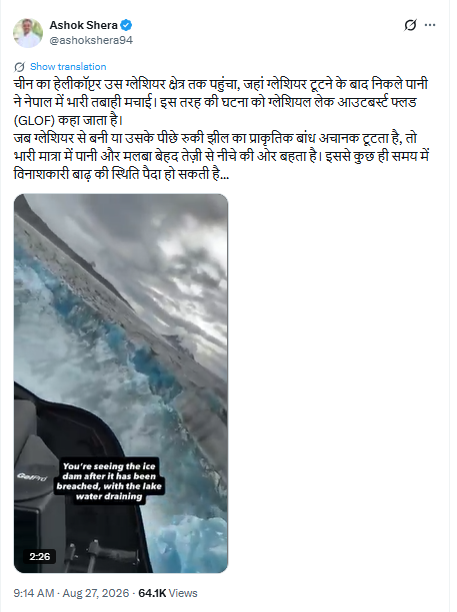
A video purportedly showing a glacier breaking apart while being filmed from a helicopter is being shared on social media with the claim that a Chinese helicopter has reached the site where a glacier broke apart, triggering floods in Nepal. A research by the Research Wing of the CyberPeace found that the video is actually from Alaska, USA. It was uploaded on Instagram and YouTube by an American pilot, Leigh Kotes, before the recent floods in Nepal, and is unrelated to the incident.
Claim
The video is being shared on X with a caption claiming: “A Chinese helicopter reached the glacier region where water released after the glacier broke apart caused massive destruction in Nepal. Such an event is known as a Glacial Lake Outburst Flood (GLOF).”
https://x.com/ashokshera94/status/2092820484811538681
Fact Check
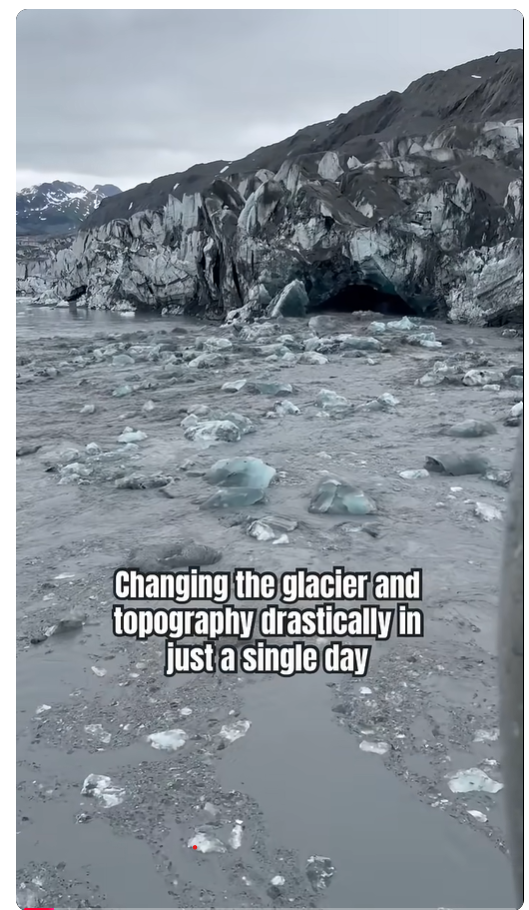
To verify the viral video claiming that a Chinese helicopter reached the site of the glacier break after the floods in Nepal, we conducted a reverse image search using keyframes from the clip. During the search, we found a video featuring the same visuals uploaded on a YouTube account named “Heli Pilot Leigh” on January 16, 2025. The location mentioned with the video identified it as Alaska, USA.
https://www.youtube.com/shorts/floh1LkZT7o
We also found several videos featuring scenes similar to those in the viral video on Ligh Kotes’ YouTube account. Among them, a nearly two-minute-long video uploaded on January 16, 2025, also contains visuals similar to those seen in the viral clip. Recorded from a helicopter, the video shows Ligh extending her mobile phone outside the helicopter to capture footage of water rushing out at high speed following the breaking of a glacier. https://www.youtube.com/watch?v=5vQP5HlyMMY
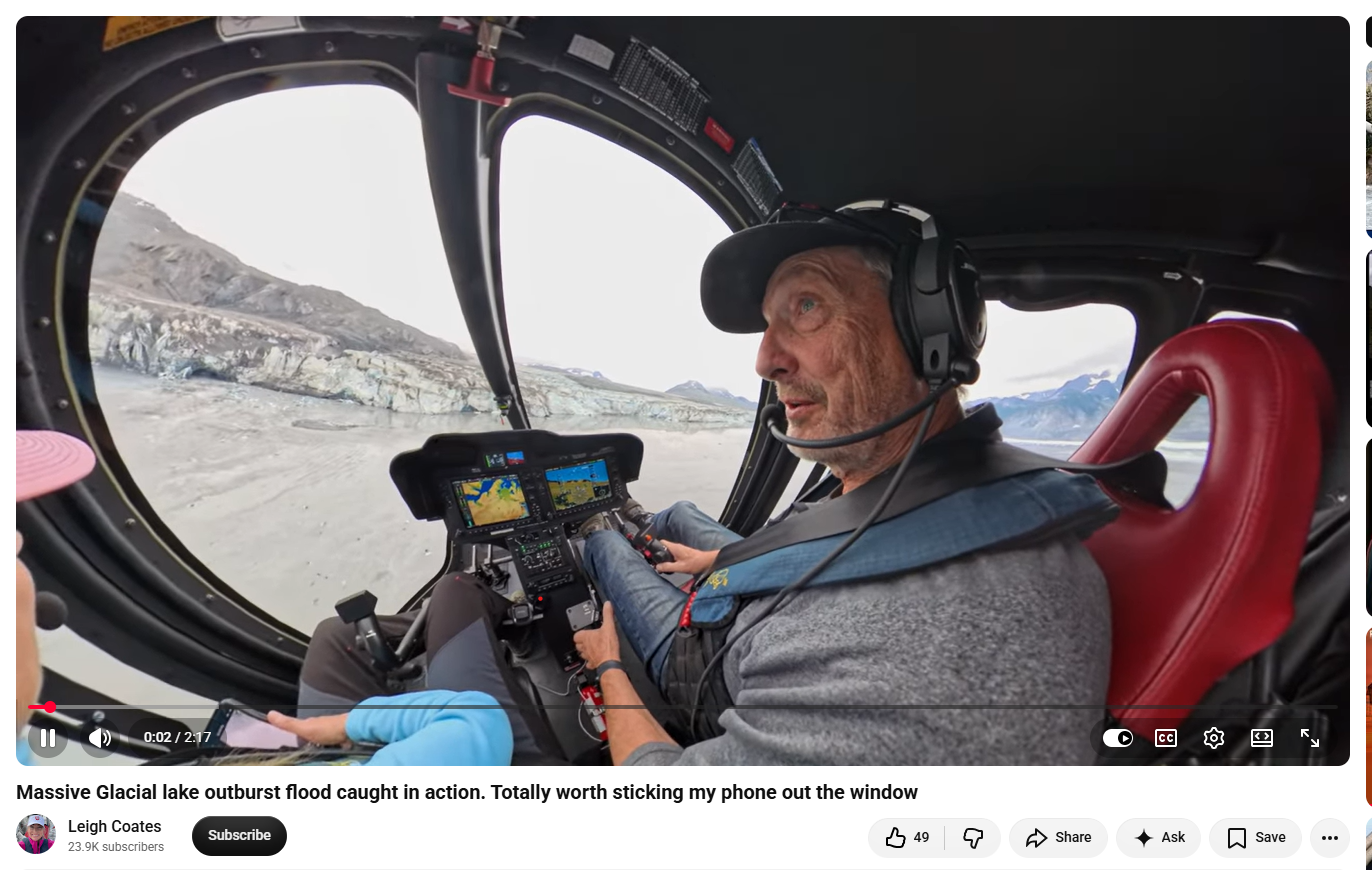
Additionally, our research found that the Columbia Glacier featured in Ligh’s video is located near Valdez, Alaska.
https://www.alaska.org/detail/columbia-glacier

Conclusion
The evidence gathered during our research makes it clear that the viral video, which is being shared with the claim that a Chinese helicopter reached the site of a glacier collapse following floods in Nepal, is actually from the Columbia Glacier in Alaska, USA. The video was recorded by an American pilot, Ligh Kotes.

Related Blogs
Executive Summary
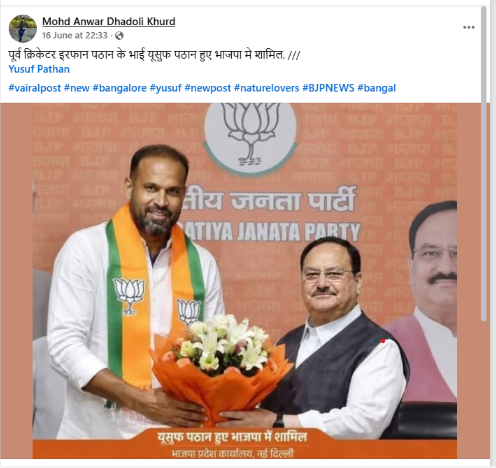
Amid political developments following the 2026 West Bengal Assembly elections, a photo is being widely circulated on social media claiming that former cricketer and Baharampur MP Yusuf Pathan has joined the Bharatiya Janata Party (BJP). The viral image shows Pathan wearing a BJP scarf and standing alongside Union Health Minister JP Nadda. CyberPeace Research Wing research found the claim to be false. The image in circulation is AI-generated and does not depict any real event.
Claim:
A Facebook user ‘Mohd Anwar Dhadoli Khurd’ shared the viral image on June 16, 2026, claiming that Yusuf Pathan has joined the BJP. The post has since been widely shared across platforms.
Post link: https://www.facebook.com/mohd.anwar.dhadoli.khurd/posts/pfbid02WAo4uXhhM1qEVTMbxTjKpTHkoeAbfEztwkX6tWLWpN8WBzNavgtJgKV8JoBGULSul
Archive link: https://perma.cc/4A3H-YTPL
Fact Check:
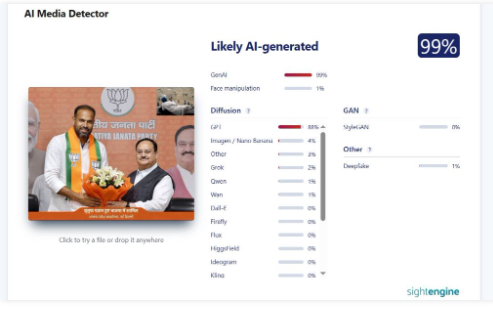
A reverse image search of the viral photo did not yield any credible news reports or authentic sources linking the image to any such political development. No related information was found on Yusuf Pathan’s official social media accounts either, raising suspicion about the authenticity of the image. The image was then analysed using AI detection tools. Sightengine reported a 99% probability of the image being AI-generated.
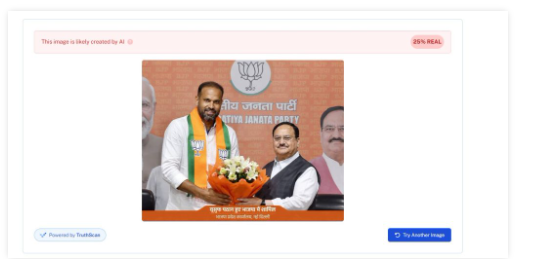
Additionally, analysis using “Undetectable.ai” also indicated a high likelihood of AI manipulation.
Conclusion:
The research confirms that the viral image claiming Yusuf Pathan’s entry into the BJP is AI-generated and does not reflect any real-world event.

Introduction
India's Computer Emergency Response Team (CERT-In) has unfurled its banner of digital hygiene, heralding the initiative 'Cyber Swachhta Pakhwada,' a clarion call to the nation's citizens to fortify their devices against the insidious botnet scourge. The government's Cyber Swachhta Kendra (CSK)—a Botnet Cleaning and Malware Analysis Centre—stands as a bulwark in this ongoing struggle. It is a digital fortress, conceived under the aegis of the National Cyber Security Policy, with a singular vision: to engender a secure cyber ecosystem within India's borders. The CSK's mandate is clear and compelling—to detect botnet infections within the subcontinent and to notify, enable cleaning, and secure systems of end users to stymie further infections.
What are Bots?
Bots are automated rogue software programs crafted with malevolent intent, lurking in the shadows of the internet. They are the harbingers of harm, capable of data theft, disseminating malware, and orchestrating cyberattacks, among other digital depredations.
A botnet infection is like a parasitic infestation within the electronic sinews of our devices—smartphones, computers, tablets—transforming them into unwitting soldiers in a hacker's malevolent legion. Once ensnared within the botnet's web, these devices become conduits for a plethora of malicious activities: the dissemination of spam, the obstruction of communications, and the pilfering of sensitive information such as banking details and personal credentials.
How, then, does one's device fall prey to such a fate? The vectors are manifold: an infected email attachment opened in a moment of incaution, a malicious link clicked in haste, a file downloaded from the murky depths of an untrusted source, or the use of an unsecured public Wi-Fi network. Each action can be the key that unlocks the door to digital perdition.
In an era where malware attacks and scams proliferate like a plague, the security of our personal devices has ascended to a paramount concern. To address this exigency and to aid individuals in the fortification of their smartphones, the Department of Telecommunications(DoT) has unfurled a suite of free bot removal tools. The government's outreach extends into the ether, dispatching SMS notifications to the populace and disseminating awareness of these digital prophylactics.
Stay Cyber Safe
To protect your device from botnet infections and malware, the Government of India, through CERT-In, recommends downloading the 'Free Bot Removal Tool' at csk.gov.in.' This SMS is not merely a reminder but a beacon guiding users to a safe harbor in the tumultuous seas of cyberspace.
Cyber Swachhta Kendra
The Cyber Swachhta Kendra portal emerges as an oasis in the desert of digital threats, offering free malware detection tools to the vigilant netizen. This portal, also known as the Botnet Cleaning and Malware Analysis Centre, operates in concert with Internet Service Providers (ISPs) and antivirus companies, under the stewardship ofCERT-In. It is a repository of knowledge and tools, a digital armoury where users can arm themselves against the specters of botnet infection.
To extricate your device from the clutches of a botnet or to purge the bots and malware that may lurk within, one must embark on a journey to the CSK website. There, under the 'Security Tools' tab, lies the arsenal of antivirus companies, each offering their own bot removal tool. For Windows users, the choice includes stalwarts such as eScan Antivirus, K7 Security, and Quick Heal. Android users, meanwhile, can venture to the Google Play Store and seek out the 'eScan CERT-IN Bot Removal ' tool or 'M-Kavach2,' a digital shield forged by C-DAC Hyderabad.
Once the chosen app is ensconced within your device, it will commence its silent vigil, scanning the digital sinews for any trace of malware, excising any infections with surgical precision. But the CSK portal's offerings extend beyond mere bot removal tools; it also proffers other security applications such as 'USB Pratirodh' and 'AppSamvid.' These tools are not mere utilities but sentinels standing guard over the sanctity of our digital lives.
USB Pratirodh
'USB Pratirodh' is a desktop guardian, regulating the ingress and egress of removable storage media. It demands authentication with each new connection, scanning for malware, encrypting data, and allowing changes to read/write permissions. 'AppSamvid,' on the other hand, is a gatekeeper for Windows users, permitting only trusted executables and Java files to run, safeguarding the system from the myriad threats that lurk in the digital shadows.
Conclusion
In this odyssey through the digital safety frontier, the Cyber Swachhta Kendra stands as a testament to the power of collective vigilance. It is a reminder that in the vast, interconnected web of the internet, the security of one is the security of all. As we navigate the dark corners of the internet, let us equip ourselves with knowledge and tools, and may our devices remain steadfast sentinels in the ceaseless battle against the unseen adversaries of the digital age.
References
- https://timesofindia.indiatimes.com/gadgets-news/five-government-provided-botnet-and-malware-cleaning-tools/articleshow/107951686.cms
- https://indianexpress.com/article/technology/tech-news-technology/cyber-swachhta-kendra-free-botnet-detection-removal-tools-digital-india-8650425/

Executive Summary
Employees’ organisations of public sector banks had recently announced a nationwide strike, with one of their key demands being a five-day work week, including holidays on all Saturdays. Against this backdrop, a claim is being circulated on social media that the bank unions’ demand has been accepted and that all public sector banks will now remain closed every Saturday.
However, CyberPeace Research found that the claim that banks will observe holidays on all Saturdays is false. Neither the government nor bank employees’ unions have made any official announcement regarding the implementation of a five-day work week or holidays on all Saturdays.
Claim:
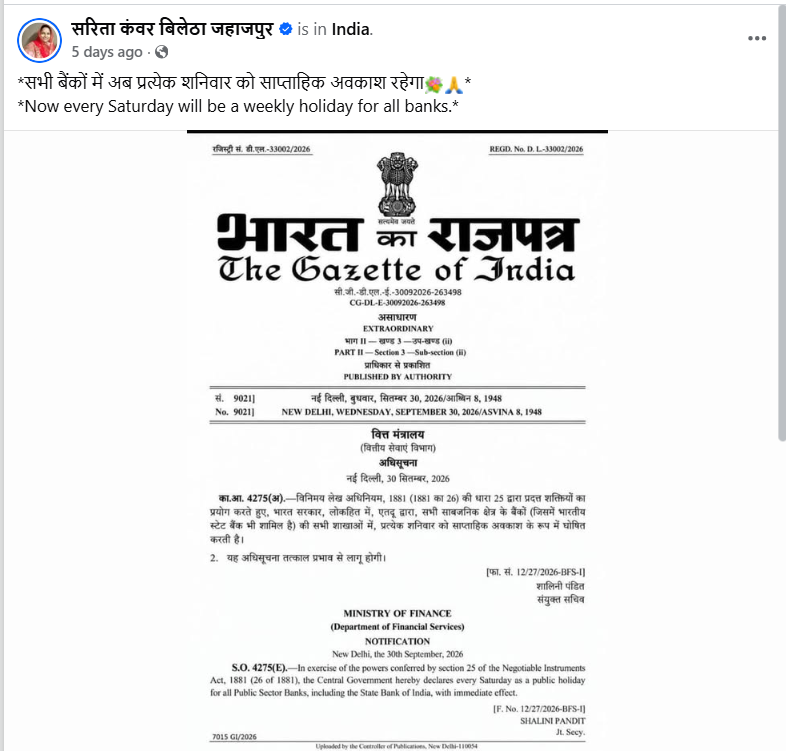
A user on the social media platform Facebook shared what was purportedly an Indian Gazette document, claiming that all banks will now observe a weekly holiday on every Saturday.
https://www.facebook.com/photo/?fbid=122234792282534138&set=a.122114627672534138
Fact Check
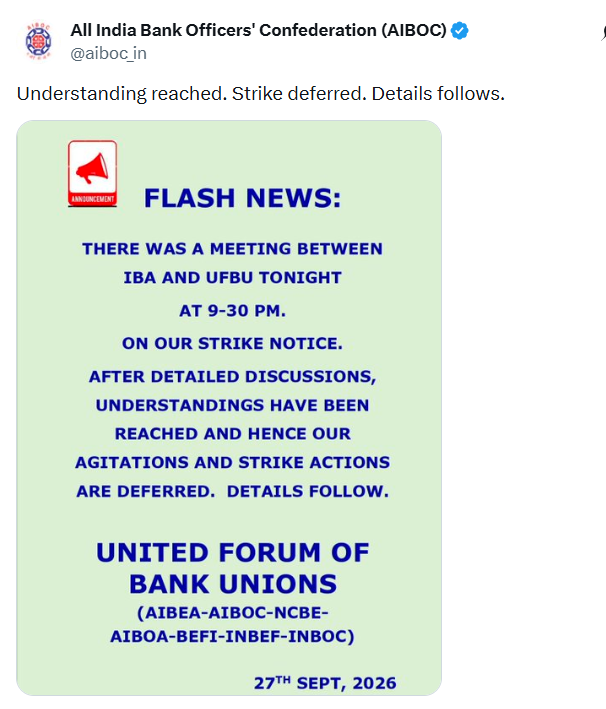
We reviewed all the announcements issued by the organisations that had called for the bank strike. None of these organisations issued any statement confirming that their demands had been accepted. We found a statement from the All India Bank Officers’ Confederation (AIBOC), in which the organisation stated in an X post that the strike scheduled for September 28–30, 2026, had been postponed following discussions. However, the organisation did not state anywhere that the demand for holidays on all Saturdays had been accepted.
https://x.com/aiboc_in/status/2104262645507612777?s=20
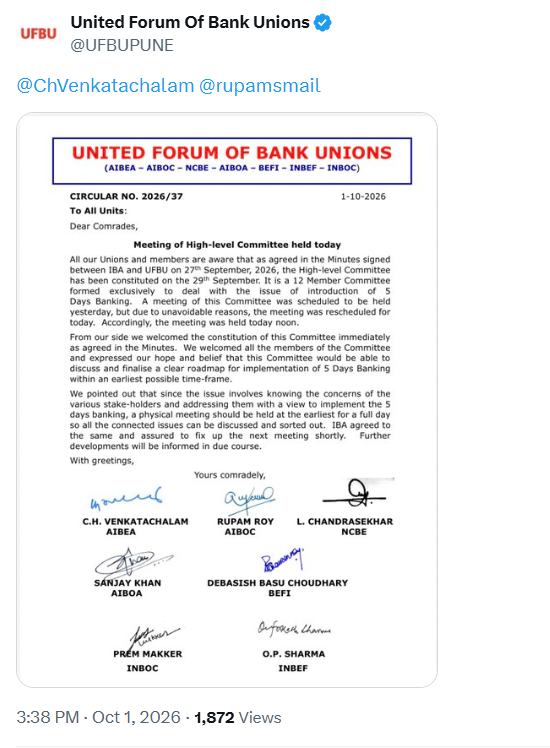
The United Forum of Bank Unions (UFBU), a joint platform of seven bank employees’ unions, issued a statement on October 1, making it clear that there has been no confirmation so far that the unions’ demands have been accepted. The statement said that a five-member committee has been constituted to consider the demand for holidays on all Saturdays, and the committee will soon prepare a roadmap for taking the matter forward.
https://x.com/UFBUPUNE/status/2105600756795707456
Conclusion:
The claim circulating on social media that all public sector banks will remain closed every Saturday from now on is false. CyberPeace Research found that neither the government nor bank employees’ unions have made any official announcement regarding the declaration of holidays on all Saturdays. Therefore, the claim being circulated on social media is misleading.
