
#FactCheck - Viral Video Misrepresented as Reaction to Pakistan’s Defeat in T20 World Cup
Executive Summary
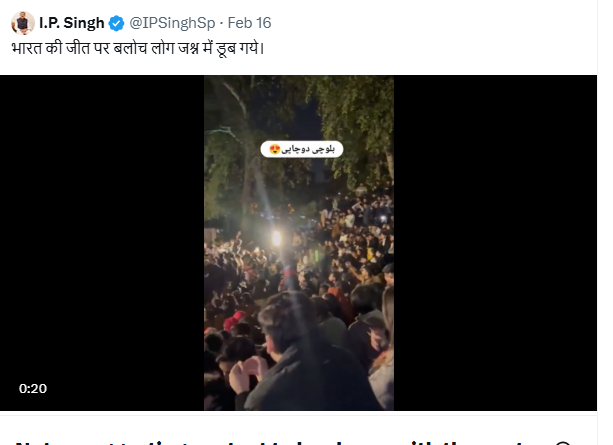
A video is being widely shared on social media with the claim that Baloch people celebrated by dancing after Pakistan’s crushing defeat to India in the T20 World Cup. However, research by the CyberPeace found the claim to be misleading. The video is actually from a Lohri celebration held on January 23 at Government College University in Lahore, and is unrelated to any cricket match. India defeated Pakistan by 61 runs in the T20 World Cup 2026 match held in Colombo last Sunday. India scored 175 runs for the loss of seven wickets in 20 overs, while Pakistan were bowled out for 114 runs in 18 overs.
Claim
The 30-second video was shared on X with the caption, “Baloch people celebrate India’s victory.” The footage shows a group of men dressed in traditional attire dancing around a fire, while a large crowd gathers around and applauds.
Fact Check
To verify the authenticity of the viral claim, key frames from the video were extracted and subjected to reverse image search. The search led to an Instagram post uploaded on January 26, 2026, by an account associated with Government College University Lahore. The caption described the performance as a Balochistan cultural dance held at the university’s amphitheatre.

Further research also uncovered another video of the same event, recorded from a different angle and uploaded on January 24, 2026, on Instagram. The caption again confirmed that the event took place at Government College University Lahore.

Conclusion
The evidence confirms that the viral video does not show Baloch people celebrating Pakistan’s defeat in the T20 World Cup. Instead, it depicts a cultural dance performance during a Lohri celebration at Government College University Lahore, and has been shared with a misleading claim.

Related Blogs

Introduction:
Welcome to the third edition of our blog on digital forensics series. In our previous blog we discussed the difference between copying, cloning, and imaging in the context of Digital Forensics, and found out why imaging is a better process. Today we will discuss the process of evidence collection in Digital Forensics. The whole process starts with making sure the evidence collection team has all necessary tools required for the task.
Investigating Tools and Equipment:
Below are some mentioned tools that the team should carry with them for a successful evidence collection:
- Anti-static bags
- Faraday bags
- Toolkit having screwdrivers(nonmagnetic), scissors, pins, cutters, forceps, clips etc.
- Rubber gloves
- Incident response toolkit (Software)
- Converter/Adapter: USB, SATA, IDE, SCSI
- Imaging software
- Volatile data collection tools (FTK Imager, Magnet Forensics RAM Capture)
- Pens, permanent markers
- Storage containers
- Batteries
- Video cameras
- Note/sketch pads
- Blank storage media
- Write-Blocker device
- Labels
- Crime scene security tapes
- Camera
What sources of Data are necessary for Digital Evidence?
- Hard-Drive (Desktop, Laptop, External, Server)
- Flash Drive
- SD Cards
- Floppy Disks
- Optical Media (CD, DVD)
- CCTV/DVR
- Internal Storage of Mobile Device
- GPS (Mobile/Car)
- Call Site Track (Towers)
- RAM

Evidence Collection
The investigators encounter two primary types of evidence during the course of gathering evidence: non-electronic and electronic evidence.
The following approaches could be used to gather non-electronic evidence:
- In the course of looking into electronic crimes, recovering non-electronic evidence can be extremely important. Be cautious to make sure that this kind of evidence is retrieved and kept safe. Items that may be relevant to a later review of electronic evidence include passwords, papers or printouts, calendars, literature, hardware and software manuals, text or graphical computer printouts, and photos. These items should be secured and kept for further examination.
- They are frequently found close to the computer or other related hardware. Locating, securing, and preserving all evidence is required by departmental procedures.
Three scenarios arise for the collection of digital evidence from computers:
Situation 1: The desktop is visible, and the monitor is on.
- Take a picture of the screen and note the data that is visible.
- Utilize tools for memory capturing to gather volatile data.
- Look for virtual disks. If so, gather mounted data's logical copies.
- Give each port and connection a label.
- Take a picture of them.
- Turn off network access to stop remote access.
- Cut off the power or turn it off.
- Locate and disconnect the hard drive by opening the CPU chassis.
- Take all evidence and place it in anti-magnetic (Faraday) bags.
- Deliver the evidence to the forensic lab.
- Keep the chain of custody intact.
Situation 2: The monitor is turned on, but it either has a blank screen (sleep mode) or an image for the screensaver.
- Make a small mouse movement (without pressing buttons). The work product should appear on the screen, or it should ask for a password.
- If moving the mouse does not result in a change to the screen, stop using the mouse and stop all keystrokes.
- Take a picture of the screen and note the data that is visible.
- Use memory capturing tools to gather volatile data (always use a write blocker to prevent manipulation during data collection).
- Proceed further in accordance with Situation 1.
Situation 3: The Monitor Is Off
- Write down the "off" status.
- After turning on the monitor, check to see if its status matches that of situations 1 or 2 above, and then take the appropriate action.
- Using a phone modem, cable, confirm that you are connected to the outside world. Try to find the phone number if there is a connection to the phone.
- To protect evidence, take out the floppy disks that might be there, package each disk separately, and label the evidence. Put in a blank floppy disk or a seizure disk, if one is available. Avoid touching the CD drive or taking out CDs.
- Cover the power connector and every drive slot with tape.
- Note the serial number, make, and model.
- Take a picture of the computer's connections and make a diagram with the relevant cables.
- To enable precise reassembly at a later date, label all connectors and cable ends, including connections to peripheral devices. Put "unused" on any connection ports that are not in use. Recognize docking stations for laptop computers in an attempt to locate additional storage media.
- All evidence should be seized and placed in anti-magnetic (Faraday) bags.
- All evidence should be seized and placed in anti-magnetic (Faraday) bags.
- Put a tag or label on every bag.
- Deliver the evidence to the forensic lab.
- Keep the chain of custody intact.
Following the effective gathering of data, the following steps in the process are crucial: data packaging, data transportation, and data storage.
The following are the steps involved in data packaging, transportation, and storage:
Packaging:
- Label every computer system that is gathered so that it can be put back together exactly as it was found
When gathering evidence at a scene of crime,
- Before packing, make sure that every piece of evidence has been appropriately labeled and documented.
- Latent or trace evidence requires particular attention, and steps should be taken to preserve it.
- Use paper or antistatic plastic bags for packing magnetic media to prevent static electricity. Do not use materials like regular plastic bags (instead use faraday bags) that can cause static electricity.
- Be careful not to bend, fold, computer media like tapes, or CD-ROM.
- Make sure that the labels on every container used to store evidence are correct.
Transporting
- Make sure devices are not packed in containers and are safely fastened inside the car to avoid shock and excessive vibrations. Computers could be positioned on the floor of the car,and monitors could be mounted on the seat with the screen down .
When transporting evidence—
- Any electronic evidence should be kept away from magnetic sources. Radiation transmitters, speaker magnets, and heated seats are a few examples of items that can contaminate electronic evidence.
- Avoid leaving electronic evidence in your car for longer than necessary. Electronic devices can be harmed by extremes in temperature, humidity.
- Maintain the integrity of the chain of custody while transporting any evidence.
Storing
- Evidence should be kept safe and away from extremes in humidity and temperature. Keep it away from dust, moisture, magnetic devices, and other dangerous impurities. Be advised that extended storage may cause important evidence—like dates, times, and system configurations—to disappear. Because batteries have a finite lifespan, data loss may occur if they malfunction. Whenever the battery operated device needs immediate attention, it should be informed to the relevant authority (eg., the chief of laboratory, the forensic examiner, and the custodian of the evidence).
CONCLUSION:
Thus, securing the crime scene to packaging, transportation and storage of data are the important steps in the process of collecting digital evidence in forensic investigations. Keeping the authenticity during the process along with their provenance is critical during this phase. It is also important to ensure the admissibility of evidence in legal proceedings. This systematic approach is essential for effectively investigating and prosecuting digital crimes.
Introduction
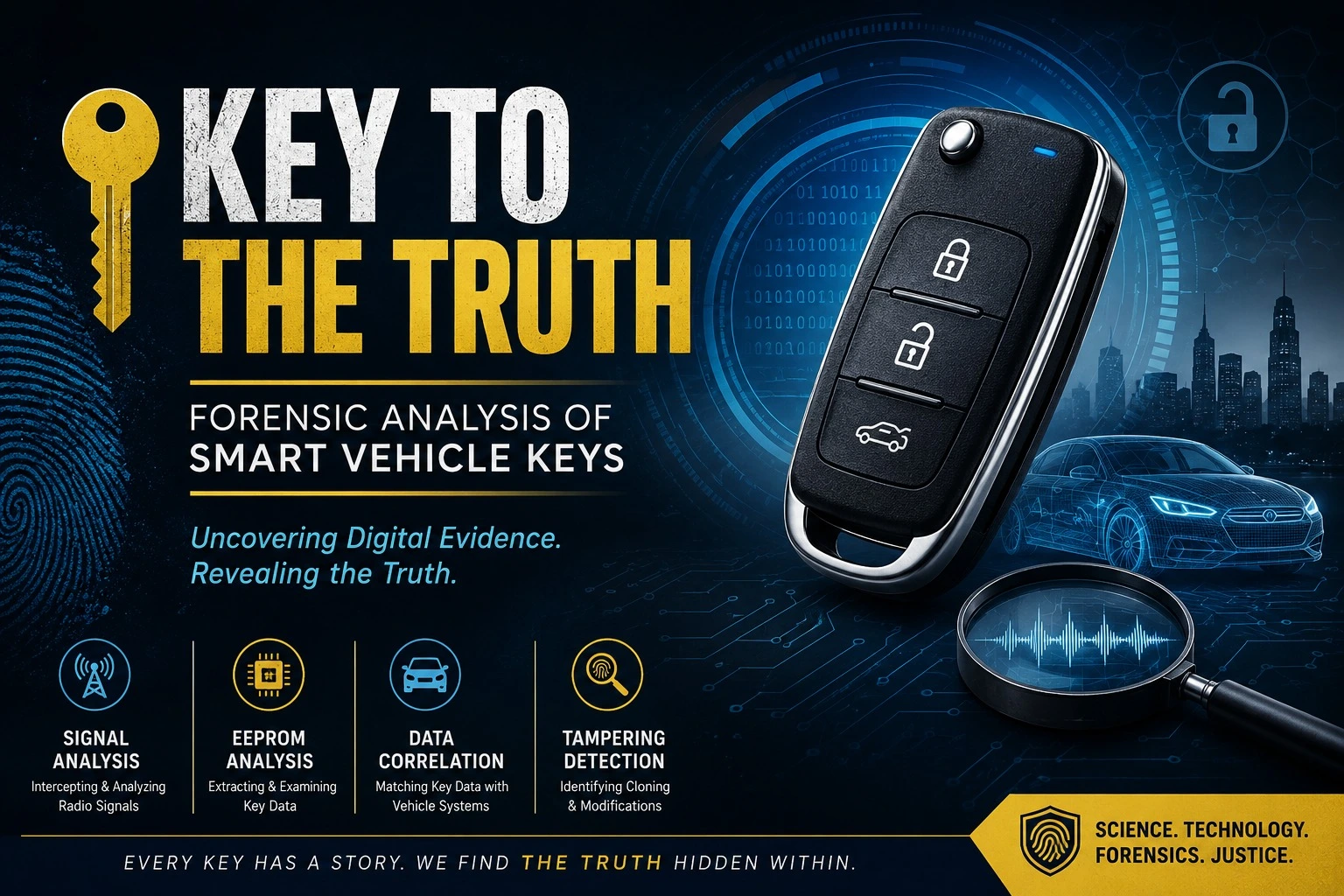
With the modernization of automobiles, so have the methods employed by criminals who seek to commit thefts. The old method of smashing a car window or bypassing an engine lock is no longer prevalent. Modern car thieves employ cloning techniques for keys and digital signals, and sophisticated methods to commit crimes without any traces left behind. In an era where intelligence is crucial, the forensic examination of car keys has become an indispensable tool for investigations, providing clues buried within ordinary car keys.
The Need for Car Key Forensics Today
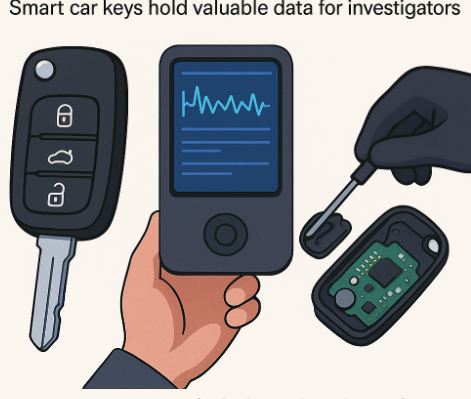
Daily, thousands of cars worth millions are being hacked or stolen around the globe. The shocking thing is that most of these hacks do not have any sign of breakage or forced entry. It is because the thieves use vulnerabilities in the wireless key systems to unlock the vehicles without leaving any trace behind. Therefore, car-key forensics has now become more important than ever before.
Forensic Value of Smart Key
The smart key is not just comprised of locking and unlocking features for vehicles. Actually, it operates as a miniature computer within the key itself. Information such as pairing records, frequency of use, or the last instance that the key was used to unlock something could be contained in smart keys, thus offering evidence of any criminal activity conducted using these items.
Patterns of Vehicle Theft
Through the examination of the chip in a key, one will be able to establish whether the key was legally programmed or had been tampered with by some other means. Such forensics become more important when trying to detect and monitor any car theft rings, which employ cloning machines or software.
Confirming Ownership and Authenticity
In cases involving insurance claims or fraud, smart key data can help confirm whether the person making a claim actually owned or used the car during the incident. It’s digital proof that goes beyond what paperwork or statements can show.
Strengthening Legal Cases
When brought to court, data doesn’t lie. A properly handled forensic examination of a car key can provide hard evidence — the kind that holds up under questioning and supports or disproves claims with complete accuracy. In many cases, this small device becomes the most reliable witness in the investigation.
A Real-Life Example
Consider the following scenario: An expensive SUV is stolen from a parking lot secured with security surveillance. No one is captured on camera and there is no sign of forced entry. After days of investigation, the police end up arresting a suspect with a smart key.
During forensic analysis of the smart key, it is revealed that:
- The transponder has an ID number which can be matched against the immobilizer installed in the vehicle.
- The rolling code counter has been incremented in such a way that the date corresponds with the report of theft of the vehicle.
- The extracted information helps match the pair timestamp of the key with the particular make and model of the vehicle.
All this from a single piece of evidence – the smart key.
Inside a Smart Key: Where the Data Lives
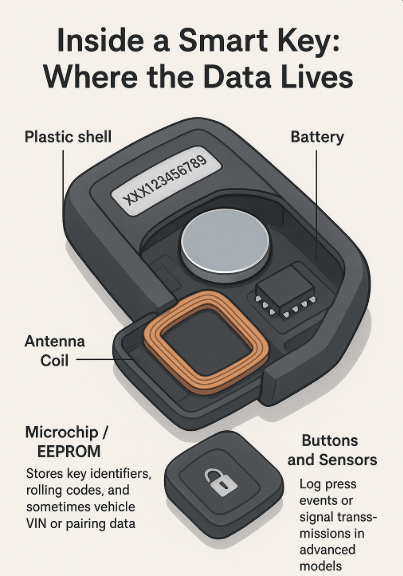
An average smart key is not only a remote but also a multi-level set of data carriers:
- Plastic Shell– could include serial numbers and information on the manufacture.
- Battery – helps calculate the time of using the key or detect any modifications.
- Antenna Coil – sends encrypted information to the immobilizer of a car. Draw the picture of this element.
- Microchip / EEPROM – holds key identification code, rolling code, VIN number, and/or other information of the vehicle.
- Buttons / sensors – could record any pressing or transmission actions in some cases.
All the little devices above, once properly studied via forensics software, provide valuable information.
How the Investigator Uncovers the Truth
In relation to investigating the true story about a vehicle, it is no different than handling other forms of digital evidence, as forensic analysts treat the car key in the same way. It is nothing more than an encrypted device in your hands, and using special techniques, they are able to reveal the information contained within the device.
Some of the methods used by modern forensic laboratories include:
1. Intercepting Radio Signals
Any intelligent key transmits radio signals to communicate with a car. Specialists employ advanced antennas and radio frequency (RF) analysers to catch and analyse them. This way, it is possible to understand the interaction between the key and the car – how often was it used, what kind of authentication procedure takes place, and if the signal matches the car’s one or has been forged somehow.
2. Checking Out the Key’s Brain (Analysis of EEPROM)
There is always a special chip on the key that is responsible for its activity. The chip contains an important memory module (EEPROM – Electrically Erasable Programmable Read-Only Memory), which holds various data, including key IDs and rolling codes. It can be carefully retrieved via advanced tools. Thus, it is possible to determine whether somebody tried to tamper with the key.
3. The Correlation between the Key and Car’s Information
The information stored inside the key will not be used separately since investigators will correlate the key's data with that of the vehicle itself (ECU and immobilizer). If the two kinds of information coincide, the investigation may conclude that the key belongs to the vehicle. Otherwise, this may mean either cloning or tampering.
4. Identifying the Tampering and Cloning Evidence
As was mentioned above, thieves sometimes resort to using unlawful programming devices for duplicating smart car keys. In order to detect possible cloning, experts examine the key using various diagnostic devices to find out whether the keys were modified by changing the encryption code, frequencies, and hardware itself.
At the end of the process, some kind of miracle occurs because of the following: all actions committed with this particular key become documented, recorded inside the device itself. Even if someone tries to hide anything or remove any information concerning this particular incident, there will always remain some data.
Car Key Forensics in the Future
The evolution of cars to connect with other devices and adopt self-driving technologies requires new investigative methods to be used for vehicle-related crimes. Advanced car keys or smartphone apps that replace physical keys will likely incorporate biometric authentication, cloud integration, or blockchain records of key activity in the near future.
Such improvements will pose several threats and offer many benefits:
- Artificial intelligence tools can determine if the car key is cloned based on its behaviour pattern.
- Blockchain validation ensures all key-related activities are recorded and cannot be altered.
- Cyber-forensic protocols will become increasingly necessary for investigating criminal activity related to vehicles.
Car key forensics technology will not only allow solving crimes but may become instrumental in crime prevention.
Conclusion
A car key in this era is more than just an unlocking mechanism; it is a miniature data storage facility, which can yield information about the user, intentions, and access rights. The more cars become technologically advanced, the more the examination of smart keys becomes necessary as part of correlating physical evidence with digital investigation. It clearly indicates how small objects such as keys can play pivotal roles in cracking cases.

Recognizing As the Ministry of Electronic and Information Technology (MeitY) continues to invite proposals from academicians, institutions, and industry experts to develop frameworks and tools for AI-related issues through the IndiaAI Mission, it has also funded two AI projects that will deal with matters related to deepfakes as per a status report submitted on 21st November 2024. The Delhi court also ordered the nomination of the members of a nine-member Committee constituted by the MeitY on 20th November 2024 (to address deepfake issues) and asked for a report within three months.
Funded AI projects :
The two projects funded by MeitY are:
- Fake Speech Detection Using Deep Learning Framework- The project was initiated in December 2021 and focuses on detecting fake speech by creating a web interface for detection software this also includes investing in creating a speech verification software platform that is specifically designed for testing fake speech detection systems. It is set to end in December 2024.
- Design and Development of Software for Detecting Deepfake Videos and Images- This project was funded by MeitY from January 2022 to March 2024. It also involved the Centre for Development of Advanced Computing (C-DAC), Kolkata and Hyderabad as they have developed a prototype tool capable of detecting deepfakes. Named FakeCheck, it is designed as a desktop application and a web portal aiming to detect deepfakes without the use of the internet. Reports suggest that it is currently undergoing the testing phase and awaiting feedback.
Apart from these projects, MeitY has released their expression of interest for proposals in four other areas which include:
- Tools that detect AI-generated content along with traceable markers,
- Tools that develop an ethical AI framework for AI systems to be transparent and respect human values,
- An AI risk management and assessment tool that analyses threats and precarious situations of AI-specific risks in public AI use cases and;
- Tools that can assess the resilience of AI in stressful situations such as cyberattacks, national disasters, operational failures, etc.
CyberPeace Outlook
Deepfakes pose significant challenges to critical sectors in India, such as healthcare and education, where manipulated content can lead to crimes like digital impersonation, misinformation, and fraud. The rapid advancement of AI, with developments (regarding regulation) that can’t keep pace, continues to fuel such threats. Recognising these risks, MeitY’s IndiaAI mission, promoting investments and encouraging educational institutions to undertake AI projects that strengthen the country's digital infrastructure comes in as a guiding light. A part of the mission focuses on developing indigenous solutions, including tools for assessment and regulation, to address AI-related threats effectively. While India is making strides in this direction, the global AI landscape is evolving rapidly, with many nations advancing regulations to mitigate AI-driven challenges. Consistent steps, including inviting proposals and funding projects provide the much-needed impetus for the mission to be realized.
References
- https://economictimes.indiatimes.com/tech/technology/meity-dot-at-work-on-projects-for-fair-ai-development/articleshow/115777713.cms?from=mdr
- https://www.hindustantimes.com/india-news/meity-seeks-tools-to-detect-deepfakes-label-ai-generated-content-101734410291642.html
- https://www.msn.com/en-in/news/India/meity-funds-two-ai-projects-to-detect-fake-media-forms-committee-on-deepfakes/ar-AA1vMAlJ
- https://indiaai.gov.in/
