
#FactCheck: AI-Generated Video Falsely Shows Dilapidated Air India Aircraft Landing in London With Chickens and Luggage
Executive Summary
A video is being shared on social media showing a dilapidated Air India aircraft landing in London. Luggage can be seen strapped to the roof of the aircraft, while live chickens are visible inside. The video is being circulated as footage of a real incident involving an Air India flight. CyberPeace Research found that the viral video is not real but AI-generated and is being shared with a misleading claim.
Claim:
The video shows a dilapidated Air India aircraft landing in London, with luggage strapped to its roof and live chickens inside.
https://x.com/globolclipzone_/status/2126560641120878629?a=3bZq8e2xcJyFrFFi3Pk&s=20

Fact Check
To investigate the viral claim, we first conducted a Google search using relevant keywords. However, we did not find any credible media reports confirming the incident shown in the viral video.
Moreover, under standard aviation rules and practices, carrying luggage strapped to the exterior of a commercial aircraft is virtually impossible. The video also contains several visual inconsistencies that suggest it may be AI-generated.
As part of our further research, we scanned the viral video using the AI detection tool AI Video Detector. According to the results, the video has a 77 per cent probability of being AI-generated.
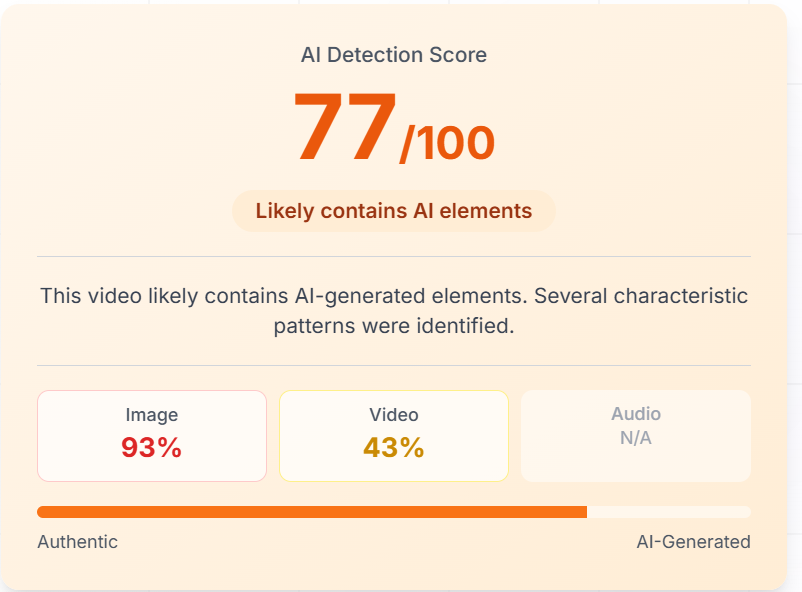
We then analysed the viral video using another AI detection tool, ‘Bit Mind’. The tool's analysis indicated an 84 per cent probability that the video was AI-generated.

Conclusion:
Our research found that the viral video is AI-generated and does not depict a real Air India flight landing in London. The AI detection tools AI Video Detector and Bit Mind indicated a 77 per cent and 84 per cent probability of AI generation, respectively. Additionally, the video contains several visual inconsistencies, and no credible media reports were found to substantiate the incident. The video is therefore being circulated on social media with a misleading claim.

Related Blogs

Introduction
Cybersecurity remains a crucial component in the modern digital era, considering the growing threat landscape caused by our increased reliance on technology and the internet. The Karnataka Government introduced a new ‘Cyber Security Policy 2024’ to address increasing cybercrimes and enhance protection measures for the State's digital infrastructure through awareness, skill development, public-private collaborations, and technology integration. Officials stated that the policy highlights various important aspects including raising awareness and providing education, developing skills, supporting the industry and start-ups, as well as forming partnerships and collaborations for enhancing capacity.
Key Highlights
- The policy consists of two components. The initial segment emphasizes creating a robust cyber security environment involving various sectors such as the public, academia, industry, start-ups, and government. The second aspect of the policy aims to enhance the cybersecurity status of the State's IT resources. Although the initial section will be accessible to the public, the second portion will be restricted to the state's IT teams and departments for their IT implementation.
- The Department of Electronics, IT, BT and S&T, the Department of Personnel and Administrative Reforms (e-Governance),and the Home Department, in collaboration with stakeholders from government and private sectors, have collectively formulated this policy. The Indian Institute of Science, the main institute for the state's K-tech Centre of Excellence for Cyber Security (CySecK), also examined the policy.
- The Department of Electronics, IT, BT and S&T, the Department of Personnel and Administrative Reforms (e-Governance),and the Home Department, in collaboration with stakeholders from government and private sectors, have collectively formulated this policy. The Indian Institute of Science, the main institute for the state's K-tech Centre of Excellence for Cyber Security (CySecK), also examined the policy.
- Approximately ₹103.87 crore will be spent over five years to implement the policy, which would be fulfilled from the budget allocated to the Department of Information Technology and Biotechnology and Science & Technology. A total of ₹23.74 crore would be allocated for offering incentives and concessions.
- The policy focuses on key pillars of building awareness and skills, promoting research and innovation, promoting industry and start-ups, partnerships and collaborations for capacity building.
- Karnataka-based undergraduate and postgraduate interns will receive a monthly stipend of INR 10,000- Rs15,000 fora maximum duration of three months under the internship program. The goal is to support 600 interns at the undergraduate level and 120 interns at the post-graduate level within the policy timeframe.
- Karnataka-based start-ups collaborating with academic institutes can receive matching grants of up to 50% of the total R&D cost for cybersecurity projects, or a maximum of ₹50 lakh.
- Reimbursement will be provided for expenses up to a maximum of INR 1 Lakh for start-ups registered with Karnataka Start-up Cell who engage CERT-In empanelled service providers from Karnataka for cyber security audit.
- The Karnataka government has partnered with Meta to raise awareness on cyber security. By reaching out to educational institutions, schools and colleges, it is piloted to provide training to 1 lakh teachers and educate 1 million children on online safety.
CyberPeace Policy Wing Outlook
The Cyber Security Policy, 2024 launched by the Karnataka government is a testament to the state government's commitment to strengthening the cyber security posture and establishing cyber resilience. By promoting and supporting research and development projects, supporting startups, and providing skill training internships, and capacity building at a larger scale, the policy will serve asa positive step in countering the growing cyber threats and establishing a peaceful digital environment for all. The partnership and collaboration with tech companies will be instrumental in implementing the capacity-building initiatives aimed at building cognitive and skill defenses while navigating the digital world. The policy will inspire other state governments in their policy initiatives for building safe and secure cyber-infrastructure in the states by implementing strategies tailored to the specific needs and demands of each state in building safe digital infrastructure and environment.
References:
- https://www.hindustantimes.com/cities/bengaluru-news/karnataka-govt-launches-new-cyber-security-policy-amid-frequent-scams-101722598078117.html
- https://ciso.economictimes.indiatimes.com/amp/news/grc/karnataka-govt-launches-new-cyber-security-policy/112214121
- https://cybermithra.in/2024/08/09/karnataka-cyber-security-policy/

Introduction
The Indian Computer Emergency Response Team, CERT-In, is the national statutory agency that responds to Cybersecurity Incidents under the Ministry of Electronics and Information Technology (MeitY) of the Government of India. CERT-In and Information Sharing and Analysis Center (ISAC) have joined hands to develop a focused pool of Cybersecurity Leaders through the National Cyber Security Scholar Program (NCSSP). This National Cyber Security Scholar Program is to create a pool of credible and ethical cybersecurity leaders in the country who prioritise national cyber security in their professional endeavours. This program allows both organisations to jointly issue joint certifications for Cohort 6 of the National Cyber Security Scholar Program (NCSSP). This certification is provided to cybersecurity professionals who complete one of the world’s leading cybersecurity management programs.
About the Program
The National Cybersecurity Scholar (NCSS) is a comprehensive 18-week, 160-hour Instructor-led program for emerging cybersecurity leaders. The ISAC will conduct the program with CERT-IN and KDEM as knowledge partners. This Cyber Security Scholar program aims to provide an extraordinary opportunity, for scholars, to gain hands-on experience in real-world scenarios through activities such as war games. It will allow scholars to acquaint themselves with roles such as that of stakeholders, including attackers, Security Operations Centre (SOC) teams, Forensicators, Chief Information Security Officers (CISOs), and CEOs, and engage in tabletop exercises that simulate a cyber crisis. This program would allow scholars to understand how responses to cyber crises impact the financial performance of an organisation, including, stock prices and sales. It offers a treasure trove of insights into the economic impact of cybersecurity decisions and the importance of proactive risk management.
The program invites applications from various scholars including Mid to senior-level leaders, diplomats and diplomatic corps officers, mid to senior-level government officials involved in homeland and cybersecurity operations, experienced executives from Managed Security Services Providers (MSSPs), faculty members who specialise in new and emerging technologies, cybersecurity professionals in CII sectors and post-doctoral or research scholars in cybersecurity.
CyberPeace Outlook
The National Cyber Security Scholar Program subsumes several key dimensions working towards building a resilient cybersecurity ecosystem for India.
- The program focuses on skill development and enhancing scholars’ knowledge in domains of network security, ethical hacking, cyber forensics, incident response, malware analysis, and threat intelligence.
- The partnership between CERT-In and ISAC, government and Industry entities, ensures that scholars are exposed to different policy-level frameworks and technical expertise, offering a unique blend of perspectives that cater to the country's national security goals and industry best practices.
- The scholar program encourages the development of new methodologies, tools, and frameworks that could be instrumental in tackling future cyber challenges and advancing India's position as a global leader in cybersecurity research and development. Research and innovation in cybersecurity are critical to the program.
- It plays a significant role in providing opportunities for career development by further providing networking platforms with professionals, researchers, and thought leaders in the cybersecurity field, giving them exposure to internships, job placements, and further academic pursuits.
This program aims to support upskilling India’s broader cyber defence strategy through the creation of highly skilled professionals. The scholars are expected to contribute actively to national cybersecurity efforts, whether through roles in government, private sector, or academia, helping to create a more secure and resilient cyberspace. The National Cyber Security Scholar Program is a major advancement in strengthening cybersecurity resilience in India. In a digital world where cyber threats crossing boundaries, such programs are essential for maintaining our national security and economic stability.
References
- https://theprint.in/ani-press-releases/cert-in-and-isac-collaborate-to-develop-focussed-pool-of-cybersecurity-leaders-through-the-national-cyber-security-scholar-program-ncssp/2318021/
- https://isacfoundation.org/national-cyber-security-scholar/
- https://cyberversefoundation.org/national-cyber-security-scholar/

Introduction
Cyber financial offences in India have experienced an alarming surge both in terms of frequency and complexity. Be it phishing attacks or organised fraud syndicates, the nation has been facing a spurt in online financial threats, which leave the victims at their mercy because of procedural lags on the part of law enforcement agencies. To counter this, the Government of India has stepped up measures to create a Cyber-Secure Bharat, focusing on speedy resolution, accountability, and digital empowerment. A key move in this direction is the introduction of the e-Zero FIR initiative, brought forth by the Ministry of Home Affairs (MHA) with Union Home Minister Amit Shah at the helm. This newly developed digital-first system is expected to revolutionise the way cyber financial crimes, particularly those that result in high monetary losses, are handled and investigated.
What Is the e-Zero FIR Initiative?
The e-Zero FIR program is a technology-based platform that enables the automated registration of Zero FIRs for value cyber financial crimes. Led by the Indian Cybercrime Coordination Centre (I4C), Ministry of Home Affairs, the programme is now piloted in Delhi and aims to fill a pressing lacuna: the time lag involved in transitioning cybercrime complaints to First Information Reports (FIRs).
Complaints of financial frauds worth more than ₹10 lakh, reported through the National Cybercrime Reporting Portal (NCRP) or helpline number 1930, will be automatically turned into e-Zero FIRs under this scheme. Such electronic FIRs are directed to the e-Crime Police Station in Delhi, regardless of jurisdiction, and then relayed to the corresponding territorial cybercrime unit. Complainants can visit the cybercrime Police Station within 3 days and get the Zero FIR converted into a regular FIR.
Key Features of the Initiative
- Pilot Implementation in Delhi
Launched as a pilot project in Delhi, it will later serve as the first use case for the national rollout. The success of the pilot will determine its implementation in other states and Union Territories.
- Seamless Digital Integration
The project provides strong back-end integration between:
- NCRP (National Cybercrime Reporting Portal)
- e-FIR System (Delhi Police)
- CCTNS (Crime and Criminal Tracking Network & Systems – NCRB)
This integrated model enables complaints to pass smoothly between platforms and agencies.
- Zero FIR Auto-Registration and Routing
Now, for complaints lodged through 1930 or the National Cyber Crime Reporting Portal related to financial losses exceeding the threshold of ₹10 lakh, the system will automatically register a Zero FIR to the e-Crime Police Station of Delhi and then route it to the concerned territorial cybercrime police station, triggering immediate case processing.
- Victim-Centric Conversion Mechanism
Complainants are given 3 days from the time of filing to physically report to the police station and transform the e-Zero FIR into a conventional regular FIR under Section 173 (1) and 1(ii) of the newly enacted Bhartiya Nagrik Suraksha Sanhita (BNSS). This ensures legal redress is quicker and easier.
Impact and Significance: The CyberPeace View
The e-Zero FIR system is a significant change in India's cybercrime enforcement, offering quicker response times and improved recovery opportunities. Cyber fraud reported within the "golden hour" can boost recovery levels of financial fraud. The system also eliminates jurisdictional barriers and procedural bottlenecks, making it more victim-friendly. Union Home Minister Amit Shah emphasised the initiative's alignment with Prime Minister Narendra Modi's vision of a digitally resilient India. The system is a scalable national model of tech-based policing supported by organised digital workflows. The initiative allows for real-time analysis of fraud graphs and detection of fraud syndicates through identification and device-based clustering. This is a step towards more automated, context-aware cyber policing, focusing on AI, identity graphs, and velocity to prevent crimes. The system is a step towards a next-generation cyber law enforcement strategy, focusing on AI, identity graphs, and velocity.
Conclusion
The roll-out of the e-Zero FIR program is a turning point in India's battle against cybercrime. By marrying automation with inter-agency coordination and easy-to-use mechanisms, the government has eradicated one of the major stumbling blocks for victims, the delay in taking legal action. Though its pilot phase targets high-value financial frauds in Delhi, its potential for having a countrywide impact is vast. With digital transactions on the upswing and frauds getting more cunning, efforts like these are the key to making a safe, responsive, and victim-centric cyber environment. CyberPeace commends and welcomes this important move towards establishing a Cyber-Secure Bharat, wherein all citizens can make digital transactions with confidence.
References
- https://www.pib.gov.in/PressReleasePage.aspx?PRID=2129715
- https://www.mha.gov.in/en
- https://cybercrime.gov.in/
- https://www.ncrb.gov.in/
- https://economictimes.indiatimes.com/wealth/save/new-e-zero-fir-govt-launches-pilot-for-swift-action-against-cybercrimes-how-it-can-help-you/articleshow/121314437.cms?from=mdr
