
Karnataka Government Launched the Cyber Security Policy, 2024
Introduction
Cybersecurity remains a crucial component in the modern digital era, considering the growing threat landscape caused by our increased reliance on technology and the internet. The Karnataka Government introduced a new ‘Cyber Security Policy 2024’ to address increasing cybercrimes and enhance protection measures for the State's digital infrastructure through awareness, skill development, public-private collaborations, and technology integration. Officials stated that the policy highlights various important aspects including raising awareness and providing education, developing skills, supporting the industry and start-ups, as well as forming partnerships and collaborations for enhancing capacity.
Key Highlights
- The policy consists of two components. The initial segment emphasizes creating a robust cyber security environment involving various sectors such as the public, academia, industry, start-ups, and government. The second aspect of the policy aims to enhance the cybersecurity status of the State's IT resources. Although the initial section will be accessible to the public, the second portion will be restricted to the state's IT teams and departments for their IT implementation.
- The Department of Electronics, IT, BT and S&T, the Department of Personnel and Administrative Reforms (e-Governance),and the Home Department, in collaboration with stakeholders from government and private sectors, have collectively formulated this policy. The Indian Institute of Science, the main institute for the state's K-tech Centre of Excellence for Cyber Security (CySecK), also examined the policy.
- The Department of Electronics, IT, BT and S&T, the Department of Personnel and Administrative Reforms (e-Governance),and the Home Department, in collaboration with stakeholders from government and private sectors, have collectively formulated this policy. The Indian Institute of Science, the main institute for the state's K-tech Centre of Excellence for Cyber Security (CySecK), also examined the policy.
- Approximately ₹103.87 crore will be spent over five years to implement the policy, which would be fulfilled from the budget allocated to the Department of Information Technology and Biotechnology and Science & Technology. A total of ₹23.74 crore would be allocated for offering incentives and concessions.
- The policy focuses on key pillars of building awareness and skills, promoting research and innovation, promoting industry and start-ups, partnerships and collaborations for capacity building.
- Karnataka-based undergraduate and postgraduate interns will receive a monthly stipend of INR 10,000- Rs15,000 fora maximum duration of three months under the internship program. The goal is to support 600 interns at the undergraduate level and 120 interns at the post-graduate level within the policy timeframe.
- Karnataka-based start-ups collaborating with academic institutes can receive matching grants of up to 50% of the total R&D cost for cybersecurity projects, or a maximum of ₹50 lakh.
- Reimbursement will be provided for expenses up to a maximum of INR 1 Lakh for start-ups registered with Karnataka Start-up Cell who engage CERT-In empanelled service providers from Karnataka for cyber security audit.
- The Karnataka government has partnered with Meta to raise awareness on cyber security. By reaching out to educational institutions, schools and colleges, it is piloted to provide training to 1 lakh teachers and educate 1 million children on online safety.
CyberPeace Policy Wing Outlook
The Cyber Security Policy, 2024 launched by the Karnataka government is a testament to the state government's commitment to strengthening the cyber security posture and establishing cyber resilience. By promoting and supporting research and development projects, supporting startups, and providing skill training internships, and capacity building at a larger scale, the policy will serve asa positive step in countering the growing cyber threats and establishing a peaceful digital environment for all. The partnership and collaboration with tech companies will be instrumental in implementing the capacity-building initiatives aimed at building cognitive and skill defenses while navigating the digital world. The policy will inspire other state governments in their policy initiatives for building safe and secure cyber-infrastructure in the states by implementing strategies tailored to the specific needs and demands of each state in building safe digital infrastructure and environment.
References:
- https://www.hindustantimes.com/cities/bengaluru-news/karnataka-govt-launches-new-cyber-security-policy-amid-frequent-scams-101722598078117.html
- https://ciso.economictimes.indiatimes.com/amp/news/grc/karnataka-govt-launches-new-cyber-security-policy/112214121
- https://cybermithra.in/2024/08/09/karnataka-cyber-security-policy/

Related Blogs

Executive Summary:
A video went viral on social media claiming to show a bridge collapsing in Bihar. The video prompted panic and discussions across various social media platforms. However, an exhaustive inquiry determined this was not real video but AI-generated content engineered to look like a real bridge collapse. This is a clear case of misinformation being harvested to create panic and ambiguity.

Claim:
The viral video shows a real bridge collapse in Bihar, indicating possible infrastructure failure or a recent incident in the state.
Fact Check:
Upon examination of the viral video, various visual anomalies were highlighted, such as unnatural movements, disappearing people, and unusual debris behavior which suggested the footage was generated artificially. We used Hive AI Detector for AI detection, and it confirmed this, labelling the content as 99.9% AI. It is also noted that there is the absence of realism with the environment and some abrupt animation like effects that would not typically occur in actual footage.
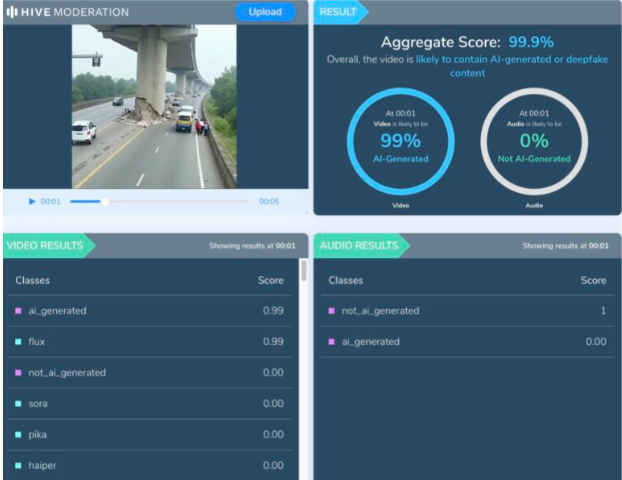
No valid news outlet or government agency reported a recent bridge collapse in Bihar. All these factors clearly verify that the video is made up and not real, designed to mislead viewers into thinking it was a real-life disaster, utilizing artificial intelligence.
Conclusion:
The viral video is a fake and confirmed to be AI-generated. It falsely claims to show a bridge collapsing in Bihar. This kind of video fosters misinformation and illustrates a growing concern about using AI-generated videos to mislead viewers.
Claim: A recent viral video captures a real-time bridge failure incident in Bihar.
Claimed On: Social Media
Fact Check: False and Misleading
.webp)
Introduction
Privacy has become a concern for netizens and social media companies have access to a user’s data and the ability to use the said data as they see fit. Meta’s business model, where they rely heavily on collecting and processing user data to deliver targeted advertising, has been under scrutiny. The conflict between Meta and the EU traces back to the enactment of GDPR in 2018. Meta is facing numerous fines for not following through with the regulation and mainly failing to obtain explicit consent for data processing under Chapter 2, Article 7 of the GDPR. ePrivacy Regulation, which focuses on digital communication and digital data privacy, is the next step in the EU’s arsenal to protect user privacy and will target the cookie policies and tracking tech crucial to Meta's ad-targeting mechanism. Meta’s core revenue stream is sourced from targeted advertising which requires vast amounts of data for the creation of a personalised experience and is scrutinised by the EU.
Pay for Privacy Model and its Implications with Critical Analysis
Meta came up with a solution to deal with the privacy issue - ‘Pay or Consent,’ a model that allows users to opt out of data-driven advertising by paying a subscription fee. The platform would offer users a choice between free, ad-supported services and a paid privacy-enhanced experience which aligns with the GDPR and potentially reduces regulatory pressure on Meta.
Meta presently needs to assess the economic feasibility of this model and come up with answers for how much a user would be willing to pay for the privacy offered and shift Meta’s monetisation from ad-driven profits to subscription revenues. This would have a direct impact on Meta’s advertisers who use Meta as a platform for detailed user data for targeted advertising, and would potentially decrease ad revenue and innovate other monetisation strategies.
For the users, increased privacy and greater control of data aligning with global privacy concerns would be a potential outcome. While users will undoubtedly appreciate the option to avoid tracking, the suggestion does beg the question that the need to pay might become a barrier. This could possibly divide users between cost-conscious and privacy-conscious segments. Setting up a reasonable price point is necessary for widespread adoption of the model.
For the regulators and the industry, a new precedent would be set in the tech industry and could influence other companies’ approaches to data privacy. Regulators might welcome this move and encourage further innovation in privacy-respecting business models.
The affordability and fairness of the ‘pay or consent’ model could create digital inequality if privacy comes at a digital cost or even more so as a luxury. The subscription model would also need clarifications as to what data would be collected and how it would be used for non-advertising purposes. In terms of market competition, competitors might use and capitalise on Meta’s subscription model by offering free services with privacy guarantees which could further pressure Meta to refine its offerings to stay competitive. According to the EU, the model needs to provide a third way for users who have ads but are a result of non-personalisation advertising.
Meta has further expressed a willingness to explore various models to address regulatory concerns and enhance user privacy. Their recent actions in the form of pilot programs for testing the pay-for-privacy model is one example. Meta is actively engaging with EU regulators to find mutually acceptable solutions and to demonstrate its commitment to compliance while advocating for business models that sustain innovation. Meta executives have emphasised the importance of user choice and transparency in their future business strategies.
Future Impact Outlook
- The Meta-EU tussle over privacy is a manifestation of broader debates about data protection and business models in the digital age.
- The EU's stance on Meta’s ‘pay or consent’ model and any new regulatory measures will shape the future landscape of digital privacy, leading to other jurisdictions taking cues and potentially leading to global shifts in privacy regulations.
- Meta may need to iterate on its approach based on consumer preferences and concerns. Competitors and tech giants will closely monitor Meta’s strategies, possibly adopting similar models or innovating new solutions. And the overall approach to privacy could evolve to prioritise user control and transparency.
Conclusion
Consent is the cornerstone in matters of privacy and sidestepping it violates the rights of users. The manner in which tech companies foster a culture of consent is of paramount importance in today's digital landscape. As the exploration by Meta in the ‘pay or consent’ model takes place, it faces both opportunities and challenges in balancing user privacy with business sustainability. This situation serves as a critical test case for the tech industry, highlighting the need for innovative solutions that respect privacy while fostering growth with the specificity of dealing with data protection laws worldwide, starting with India’s Digital Personal Data Protection Act, of 2023.
Reference:
- https://ciso.economictimes.indiatimes.com/news/grc/eu-tells-meta-to-address-consumer-fears-over-pay-for-privacy/111946106
- https://www.wired.com/story/metas-pay-for-privacy-model-is-illegal-says-eu/
- https://edri.org/our-work/privacy-is-not-for-sale-meta-must-stop-charging-for-peoples-right-to-privacy/
- https://fortune.com/2024/04/17/meta-pay-for-privacy-rejected-edpb-eu-gdpr-schrems/

Executive Summary
A video is going viral on social media showing police personnel allegedly dragging an elderly woman. The video is being shared with the claim that it was filmed in Manipur and shows the Indian Army committing atrocities against women. The CyberPeace Research Wing found that the viral video is not from Manipur. It was recorded during protests against the Ken-Betwa Link Project in Chhatarpur, Madhya Pradesh, and is being circulated with a misleading claim.
Claim:
A video shared on social media claims that the Indian Army is committing atrocities against local people, particularly women, in Manipur. The post further alleges that R&AW chief Parag Jain is allowing Manipur to burn and that people will never forget the alleged brutality.
https://x.com/i/status/2084180049285005687

Factcheck
To verify the claim, our team extracted keyframes from the viral video and conducted a reverse image search using Google Lens. During the search, we found the same video uploaded on the Facebook page of Public Vani News on July 31. The accompanying description stated: “Police action against an elderly tribal woman is shameful. During protests against the Ken-Betwa Link Project in Chhatarpur, a video showing police removing an elderly tribal woman has gone viral. Protesters claim they were holding a Jal Satyagraha, hunger strike and Chita Andolan while demanding fair compensation and protection of their land, forests and homes.”
The post and screenshot are provided below:
https://www.facebook.com/reel/1031078973033873

In the next step of the research, we found the same video on an Instagram channel named policemedianews, where it was shared without the misleading Manipur-related claim. The post link and screenshot are provided below
https://www.instagram.com/reels/DbfALvaT4mH/

Conclusion:
The research found that the viral claim is misleading. The video is not from Manipur and does not show Indian Army personnel targeting women there. The footage is from protests against the Ken-Betwa Link Project in Chhatarpur, Madhya Pradesh, where police were seen removing an elderly tribal woman during the demonstration. The video is being shared on social media with a false context.
