
#FactCheck:AI-Generated Audio Added to Real Sheikh Hasina Video to Spread False ‘United Bengal’ Claim
Executive Summary
A video clip carrying the logo of news channel Republic is being shared on social media. In the video, former Bangladesh Prime Minister Sheikh Hasina is allegedly heard saying, "If these radical Muslim terrorists do not back off from imposing terror-based governance over Bangladesh, our goal will be to finish them by any means. I will request Prime Minister Narendra Modi to make Bangla a single province by combining East and West Bengal. We will bring back a secular democracy, which I will lead in the future to restore Bangla to its secular roots." The CyberPeace Research Wing found that the visuals in the viral video are genuine, but the audio has been altered using artificial intelligence (AI) and is being circulated with a false claim.
Claim:
A Facebook user shared the video claiming that Sheikh Hasina proposed merging East and West Bengal to create a single province during her recent address. The link to the post, archive link, and screenshot are provided below.
https://www.facebook.com/reel/1567119714918951

FactCheck
During the research, several key frames from the viral video were extracted and a reverse image search was conducted using Google Lens. The search led us to the original video of Sheikh Hasina’s interaction available on the official social media accounts of Republic News. The link to the post and screenshot are provided below.
https://x.com/republic/status/2084999748755554323?ref_src=twsrc%5Etfw

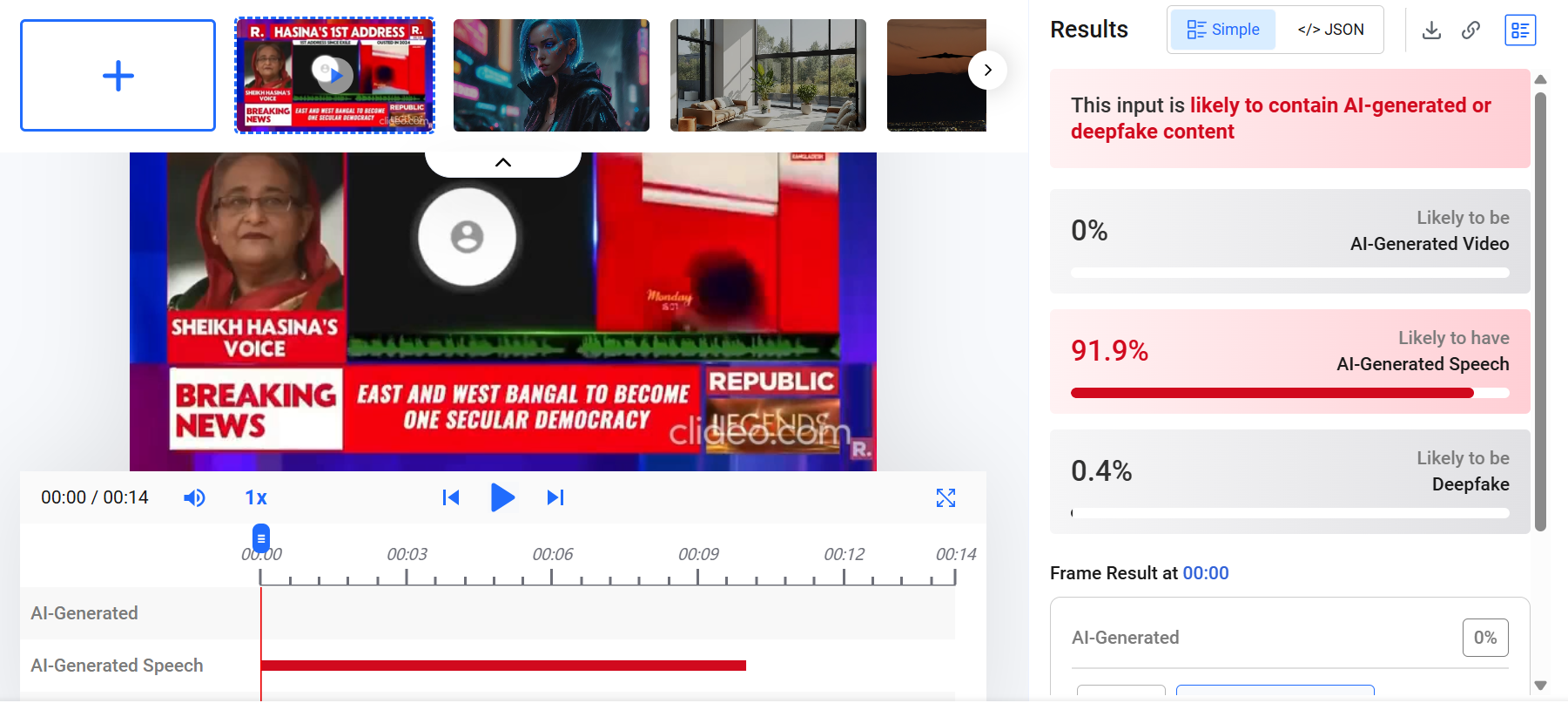
Republic shared the original video on its official X account on August 5, 2026. A comparison between the viral clip and the original footage revealed that the alleged statement about merging East and West Bengal into a single province does not appear anywhere in the authentic video. In the original video, Sheikh Hasina can be heard discussing the responsibilities of law enforcement agencies during periods of unrest. The controversial audio added to the viral clip is not part of the original recording. Further analysis of the viral video’s audio raised suspicion that it was AI-generated. The video was scanned using the AI detection tool Hive Moderation, which indicated a 91 per cent probability that the speech used in the viral video was AI-generated.
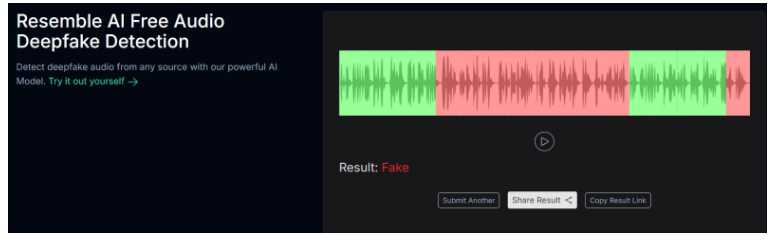
In the next step of the research, the viral audio was analysed using the Resemble AI tool. The results indicated that the audio was likely manipulated, suggesting that it had been altered using artificial intelligence (AI).
Conclusion:
The research found that the visuals used in the viral video are genuine, but the audio has been modified using AI and is being shared with a false claim. The claim that Sheikh Hasina spoke about merging East and West Bengal into a single province is false.

Related Blogs

Brief Overview of the EU AI Act
The EU AI Act, Regulation (EU) 2024/1689, was officially published in the EU Official Journal on 12 July 2024. This landmark legislation on Artificial Intelligence (AI) will come into force just 20 days after publication, setting harmonized rules across the EU. It amends key regulations and directives to ensure a robust framework for AI technologies. The AI Act, a set of EU rules governing AI, has been in development for two years and now, the EU AI Act enters into force across all 27 EU Member States on 1 August 2024, with certain future deadlines tied up and the enforcement of the majority of its provisions will commence on 2 August 2026. The law prohibits certain uses of AI tools, including those that threaten citizens' rights, such as biometric categorization, untargeted scraping of faces, and systems that try to read emotions are banned in the workplace and schools, as are social scoring systems. It also prohibits the use of predictive policing tools in some instances. The law takes a phased approach to implementing the EU's AI rulebook, meaning there are various deadlines between now and then as different legal provisions will start to apply.
The framework puts different obligations on AI developers, depending on use cases and perceived risk. The bulk of AI uses will not be regulated as they are considered low-risk, but a small number of potential AI use cases are banned under the law. High-risk use cases, such as biometric uses of AI or AI used in law enforcement, employment, education, and critical infrastructure, are allowed under the law but developers of such apps face obligations in areas like data quality and anti-bias considerations. A third risk tier also applies some lighter transparency requirements for makers of tools like AI chatbots.
In case of failure to comply with the Act, the companies in the EU providing, distributing, importing, and using AI systems and GPAI models, are subject to fines of up to EUR 35 million or seven per cent of the total worldwide annual turnover, whichever is higher.
Key highlights of EU AI Act Provisions
- The AI Act classifies AI according to its risk. It prohibits Unacceptable risks such as social scoring systems and manipulative AI. The regulation mostly addresses high-risk AI systems.
- Limited-risk AI systems are subject to lighter transparency obligations and according to the act, the developers and deployers must ensure that the end-users are aware that the interaction they are having is with AI such as Chatbots and Deepfakes. The AI Act allows the free use of minimal-risk AI. This includes the majority of AI applications currently available in the EU single market like AI-enabled video games, and spam filters, but with the advancement of Gen AI changes with regards to this might be done. The majority of obligations fall on providers (developers) of high-risk AI systems that intend to place on the market or put into service high-risk AI systems in the EU, regardless of whether they are based in the EU or a third country. And also, a third-country provider where the high-risk AI system’s output is used in the EU.
- Users are natural or legal persons who deploy an AI system in a professional capacity, not affected end-users. Users (deployers) of high-risk AI systems have some obligations, though less than providers (developers). This applies to users located in the EU, and third-country users where the AI system’s output is used in the EU.
- General purpose AI or GPAI model providers must provide technical documentation, and instructions for use, comply with the Copyright Directive, and publish a summary of the content used for training. Free and open license GPAI model providers only need to comply with copyright and publish the training data summary, unless they present a systemic risk. All providers of GPAI models that present a systemic risk – open or closed – must also conduct model evaluations, and adversarial testing, and track and report serious incidents and ensure cybersecurity protections.
- The Codes of Practice will account for international approaches. It will cover but not necessarily be limited to the obligations, particularly the relevant information to include in technical documentation for authorities and downstream providers, identification of the type and nature of systemic risks and their sources, and the modalities of risk management accounting for specific challenges in addressing risks due to the way they may emerge and materialize throughout the value chain. The AI Office may invite GPAI model providers, and relevant national competent authorities to participate in drawing up the codes, while civil society, industry, academia, downstream providers and independent experts may support the process.
Application & Timeline of Act
The EU AI Act will be fully applicable 24 months after entry into force, but some parts will be applicable sooner, for instance the ban on AI systems posing unacceptable risks will apply six months after the entry into force. The Codes of Practice will apply nine months after entry into force. Rules on general-purpose AI systems that need to comply with transparency requirements will apply 12 months after the entry into force. High-risk systems will have more time to comply with the requirements as the obligations concerning them will become applicable 36 months after the entry into force. The expected timeline for the same is:
- August 1st, 2024: The AI Act will enter into force.
- February 2025: Prohibition of certain AI systems - Chapters I (general provisions) & II (prohibited AI systems) will apply; Prohibition of certain AI systems.
- August 2025: Chapter III Section 4 (notifying authorities), Chapter V (general purpose AI models), Chapter VII (governance), Chapter XII (confidentiality and penalties), and Article 78 (confidentiality) will apply, except for Article 101 (fines for General Purpose AI providers); Requirements for new GPAI models.
- August 2026: The whole AI Act applies, except for Article 6(1) & corresponding obligations (one of the categories of high-risk AI systems);
- August 2027: Article 6(1) & corresponding obligations apply.
The AI Act sets out clear definitions for the different actors involved in AI, such as the providers, deployers, importers, distributors, and product manufacturers. This means all parties involved in the development, usage, import, distribution, or manufacturing of AI systems will be held accountable. Along with this, the AI Act also applies to providers and deployers of AI systems located outside of the EU, e.g., in Switzerland, if output produced by the system is intended to be used in the EU. The Act applies to any AI system within the EU that is on the market, in service, or in use, covering both AI providers (the companies selling AI systems) and AI deployers (the organizations using those systems).
In short, the AI Act will apply to different companies across the AI distribution chain, including providers, deployers, importers, and distributors (collectively referred to as “Operators”). The EU AI Act also has extraterritorial application and can also apply to companies not established in the EU, or providers outside the EU if they -make an AI system or GPAI model available on the EU market. Even if only the output generated by the AI system is used in the EU, the Act still applies to such providers and deployers.
CyberPeace Outlook
The EU AI Act, approved by EU lawmakers in 2024, is a landmark legislation designed to protect citizens' health, safety, and fundamental rights from potential harm caused by AI systems. The AI Act will apply to AI systems and GPAI models. The Act creates a tiered risk categorization system with various regulations and stiff penalties for noncompliance. The Act adopts a risk-based approach to AI governance, categorizing potential risks into four tiers: unacceptable, high, limited, and low. Violations of banned systems carry the highest fine: €35 million, or 7 percent of global annual revenue. It establishes transparency requirements for general-purpose AI systems. The regulation also provides specific rules for general-purpose AI (GPAI) models and lays down more stringent requirements for GPAI models with 'high-impact capabilities' that could pose a systemic risk and have a significant impact on the internal market. For high-risk AI systems, the AI Act addresses the issues of fundamental rights impact assessment and data protection impact assessment.
The EU AI Act aims to enhance trust in AI technologies by establishing clear regulatory standards governing AI. We encourage regulatory frameworks that strive to balance the desire to foster innovation with the critical need to prevent unethical practices that may cause user harm. The legislation can be seen as strengthening the EU's position as a global leader in AI innovation and developing regulatory frameworks for emerging technologies. It sets a global benchmark for regulating AI. The companies to which the act applies will need to make sure their practices align with the same. The act may inspire other nations to develop their own legislation contributing to global AI governance. The world of AI is complex and challenging, the implementation of regulatory checks, and compliance by the concerned companies, all pose a conundrum. However, in the end, balancing innovation with ethical considerations is paramount.
At the same hand, the tech sector welcomes regulatory progress but warns that overly-rigid regulations could stifle innovation. Hence flexibility and adaptability are key to effective AI governance. The journey towards robust AI regulation has begun in major countries, and it is important that we find the right balance between safety and innovation and also take into consideration the industry reactions.
References:
- https://eur-lex.europa.eu/legal-content/EN/TXT/PDF/?uri=OJ:L_202401689
- https://www.theverge.com/2024/7/12/24197058/eu-ai-act-regulations-bans-deadline
- https://techcrunch.com/2024/07/12/eus-ai-act-gets-published-in-blocs-official-journal-starting-clock-on-legal-deadlines/
- https://www.wsgr.com/en/insights/eu-ai-act-to-enter-into-force-in-august.html
- https://www.techtarget.com/searchenterpriseai/tip/Is-your-business-ready-for-the-EU-AI-Act
- https://www.simmons-simmons.com/en/publications/clyimpowh000ouxgkw1oidakk/the-eu-ai-act-a-quick-guide

In a recent ruling, a U.S. federal judge sided with Meta in a copyright lawsuit brought by a group of prominent authors who alleged that their works were illegally used to train Meta’s LLaMA language model. While this seems like a significant legal victory for the tech giant, it may not be so. Rather, this is a good case study for creators in the USA to refine their legal strategies and for policymakers worldwide to act quickly to shape the rules of engagement between AI and intellectual property.
The Case: Meta vs. Authors
In Kadrey v. Meta, the plaintiffs alleged that Meta trained its LLaMA models on pirated copies of their books, violating copyright law. However, U.S. District Judge Vince Chhabria ruled that the authors failed to prove two critical things: that their copyrighted works had been used in a way that harmed their market and that such use was not “transformative.” In fact, the judge ruled that converting text into numerical representations to train an AI was sufficiently transformative under the U.S. fair use doctrine. He also noted that the authors’ failure to demonstrate economic harm undermined their claims. Importantly, he clarified that this ruling does not mean that all AI training data usage is lawful, only that the plaintiffs didn’t make a strong enough case.
Meta even admitted that some data was sourced from pirate sites like LibGen, but the Judge still found that fair use could apply because the usage was transformative and non-exploitative.
A Tenuous Win
Chhabria’s decision emphasised that this is not a blanket endorsement of using copyrighted content in AI training. The judgment leaned heavily on the procedural weakness of the case and not necessarily on the inherent legality of Meta’s practices.
Policy experts are warning that U.S. courts are currently interpreting AI training as fair use in narrow cases, but the rulings may not set the strongest judicial precedent. The application of law could change with clearer evidence of commercial harm or a more direct use of content.
Moreover, the ruling does not address whether authors or publishers should have the right to opt out of AI model training, a concern that is gaining momentum globally.
Implications for India
The case highlights a glaring gap in India’s copyright regime: it is outdated. Since most AI companies are located in the U.S., courts have had the opportunity to examine copyright in the context of AI-generated content. India has yet to start. Recently, news agency ANI filed a case alleging copyright infringement against OpenAI for training on its copyrighted material. However, the case is only at an interim stage. The final outcome of the case will have a significant impact on the legality of these language models being able to use copyrighted material for training.
Considering that India aims to develop “state-of-the-art foundational AI models trained on Indian datasets” under the IndiaAI Mission, the lack of clear legal guidance on what constitutes fair dealing when using copyrighted material for AI training is a significant gap.
Thus, key points of consideration for policymakers include:
- Need for Fair Dealing Clarity: India’s fair-dealing provisions under the Copyright Act, 1957, are narrower than U.S. fair use. The doctrine may have to be reviewed to strike a balance between this law and the requirement of diverse datasets to develop foundational models rooted in Indian contexts. A parallel concern regarding data privacy also arises.
- Push for Opt-Out or Licensing Mechanisms: India should consider whether to introduce a framework that requires companies to license training data or provide an opt-out system for creators, especially given the volume of Indian content being scraped by global AI systems.
- Digital Public Infrastructure for AI: India’s policymakers could take this opportunity to invest in public datasets, especially in regional languages, that are both high quality and legally safe for AI training.
- Protecting Local Creators: India needs to ensure that its authors, filmmakers, educators and journalists are protected from having their work repurposed without compensation, since power asymmetries between Big Tech and local creators can lead to exploitation of the latter.
Conclusion
The ruling in Meta’s favour is just one win for the developer. The real questions about consent, compensation and creative control remain unanswered. Meanwhile, the lesson for India is urgent: it needs AI policies that balance innovation with creator rights and provide legal certainty and ethical safeguards as it accelerates its AI ecosystem. Further, as global tech firms race ahead, India must not remain a passive data source; it must set the terms of its digital future. This will help the country move a step closer to achieving its goal of building sovereign AI capacity and becoming a hub for digital innovation.
References
- https://www.theguardian.com/technology/2025/jun/26/meta-wins-ai-copyright-lawsuit-as-us-judge-rules-against-authors
- https://www.wired.com/story/meta-scores-victory-ai-copyright-case/
- https://www.cnbc.com/2025/06/25/meta-llama-ai-copyright-ruling.html
- https://www.mondaq.com/india/copyright/1348352/what-is-fair-use-of-copyright-doctrine
- https://www.pib.gov.in/PressReleasePage.aspx?PRID=2113095#:~:text=One%20of%20the%20key%20pillars,models%20trained%20on%20Indian%20datasets.
- https://www.ndtvprofit.com/law-and-policy/ani-vs-openai-delhi-high-court-seeks-responses-on-copyright-infringement-charges-against-chatgpt

Introduction
Big Tech has been pushing back against regulatory measures, particularly regarding data handling practices. X Corp (formerly Twitter) has taken a prominent stance in India. The platform has filed a petition against the Central and State governments, challenging content-blocking orders and opposing the Center’s newly launched Sahyog portal. The X Corp has furthermore labelled the Sahyog Portal as a 'censorship portal' that enables government agencies to issue blocking orders using a standardized template.
The key regulations governing the tech space in India include the IT Act of 2000, IT Rules 2021 and 2023 (which stress platform accountability and content moderation), and the DPDP Act 2023, which intersects with personal data governance. This petition by the X Corp raises concerns for digital freedom, platform accountability, and the evolving regulatory frameworks in India.
Elon Musk vs Indian Government: Key Issues at Stake
The 2021 IT Rules, particularly Rule 3(1)(d) of Part II, outline intermediaries' obligations regarding ‘Content Takedowns’. Intermediaries must remove or disable access to unlawful content within 36 hours of receiving a court order or government notification. Notably, the rules do not require government takedown requests to be explicitly in writing, raising concerns about potential misuse.
X’s petition also focuses on the Sahyog Portal, a government-run platform that allows various agencies and state police to request content removal directly. They contend that the failure to comply with such orders can expose intermediaries' officers to prosecution. This has sparked controversy, with platforms like Elon Musk’s X arguing that such provisions grant the government excessive control, potentially undermining free speech and fostering undue censorship.
The broader implications include geopolitical tensions, potential business risks for big tech companies, and significant effects on India's digital economy, user engagement, and platform governance. Balancing regulatory compliance with digital rights remains a crucial challenge in this evolving landscape.
The Global Context: Lessons from Other Jurisdictions
The ‘EU's Digital Services Act’ establishes a baseline 'notice and takedown' system. According to the Act, hosting providers, including online platforms, must enable third parties to notify them of illegal content, which they must promptly remove to retain their hosting defence. The DSA also mandates expedited removal processes for notifications from trusted flaggers, user suspension for those with frequent violations, and enhanced protections for minors. Additionally, hosting providers have to adhere to specific content removal obligations, including the elimination of terrorist content within one hour and deploying technology to detect known or new CSAM material and remove it.
In contrast to the EU, the US First Amendment protects speech from state interference but does not extend to private entities. Dominant digital platforms, however, significantly influence discourse by moderating content, shaping narratives, and controlling advertising markets. This dual role creates tension as these platforms balance free speech, platform safety, and profitability.
India has adopted a model closer to the EU's approach, emphasizing content moderation to curb misinformation, false narratives, and harmful content. Drawing from the EU's framework, India could establish third-party notification mechanisms, enforce clear content takedown guidelines, and implement detection measures for harmful content like terrorist material and CSAM within defined timelines. This would balance content regulation with platform accountability while aligning with global best practices.
Key Concerns and Policy Debates
As the issue stands, the main concerns that arise are:
- The need for transparency in government orders for takedowns, the reasons and a clear framework for why they are needed and the guidelines for doing so.
- The need for balancing digital freedom with national security and the concerns that arise out of it for tech companies. Essentially, the role platforms play in safeguarding the democratic values enshrined in the Constitution of India.
- This court ruling by the Karnataka HC will have the potential to redefine the principles upon which the intermediary guidelines function under the Indian laws.
Potential Outcomes and the Way Forward
While we wait for the Hon’ble Court’s directives and orders in response to the filed suit, while the court's decision could favour either side or lead to a negotiated resolution, the broader takeaway is the necessity of collaborative policymaking that balances governmental oversight with platform accountability. This debate underscores the pressing need for a structured and transparent regulatory framework for content moderation. Additionally, this case also highlights the importance of due process in content regulation and the need for legal clarity for tech companies operating in India. Ultimately, a consultative and principles-based approach will be key to ensuring a fair and open digital ecosystem.
References
- https://www.thehindu.com/sci-tech/technology/elon-musks-x-sues-union-government-over-alleged-censorship-and-it-act-violations/article69352961.ece
- https://www.hindustantimes.com/india-news/elon-musk-s-x-sues-union-government-over-alleged-censorship-and-it-act-violations-101742463516588.html
- https://www.financialexpress.com/life/technology-explainer-why-has-x-accused-govt-of-censorship-3788648/
- https://thelawreporters.com/elon-musk-s-x-sues-indian-government-over-alleged-censorship-and-it-act-violations
- https://www.linklaters.com/en/insights/blogs/digilinks/2023/february/the-eu-digital-services-act---a-new-era-for-online-harms-and-intermediary-liability
