
#FactCheck-AI-generated video falsely shared as real footage of Assam floods
Executive Summary
A video is being widely shared on social media showing a flood-affected area. In the video, several houses appear to be almost completely submerged in water, with only their triangular rooftops visible above the surface. Several people can be seen sitting on these rooftops, while ducks and other animals appear to be floating in the water. The video is being shared with the claim that it shows the real situation during the recent floods in Assam. CyberPeace Research Wing’s research found the claim to be misleading. The research revealed that the viral video is not from any real flood incident but was created using Artificial Intelligence (AI). Although the flood situation in Assam is real and several parts of the state have been affected, the viral video has no connection with those events. The AI-generated video is being falsely shared as an actual visual from the Assam floods.
Claim
A user on Instagram shared the viral video on July 27, 2026, claiming that Assam continues to face severe flooding, with more than seven lakh people affected. The post link, archive link and screenshot are provided below.
https://www.instagram.com/reel/DbSVmAApQf6/

FactCheck
To verify the authenticity of the viral claim, we extracted several key frames from the video and conducted a reverse image search using Google Lens. The search did not reveal any credible news report, official source, or reliable information confirming that the video showed real flood visuals from Assam. During the research, we found a report published by Aaj Tak on July 27, 2026. According to the report, the flood situation in Assam remained severe, with several deaths reported and more than 7.05 lakh people affected across nine districts of the state. The report link and screenshot are provided below.

As the video appeared suspicious, we analysed it using the AI detection tool HIVE Moderation. The tool’s analysis indicated a 98.8 percent probability that the video was AI-generated, suggesting that it was not a real recording.

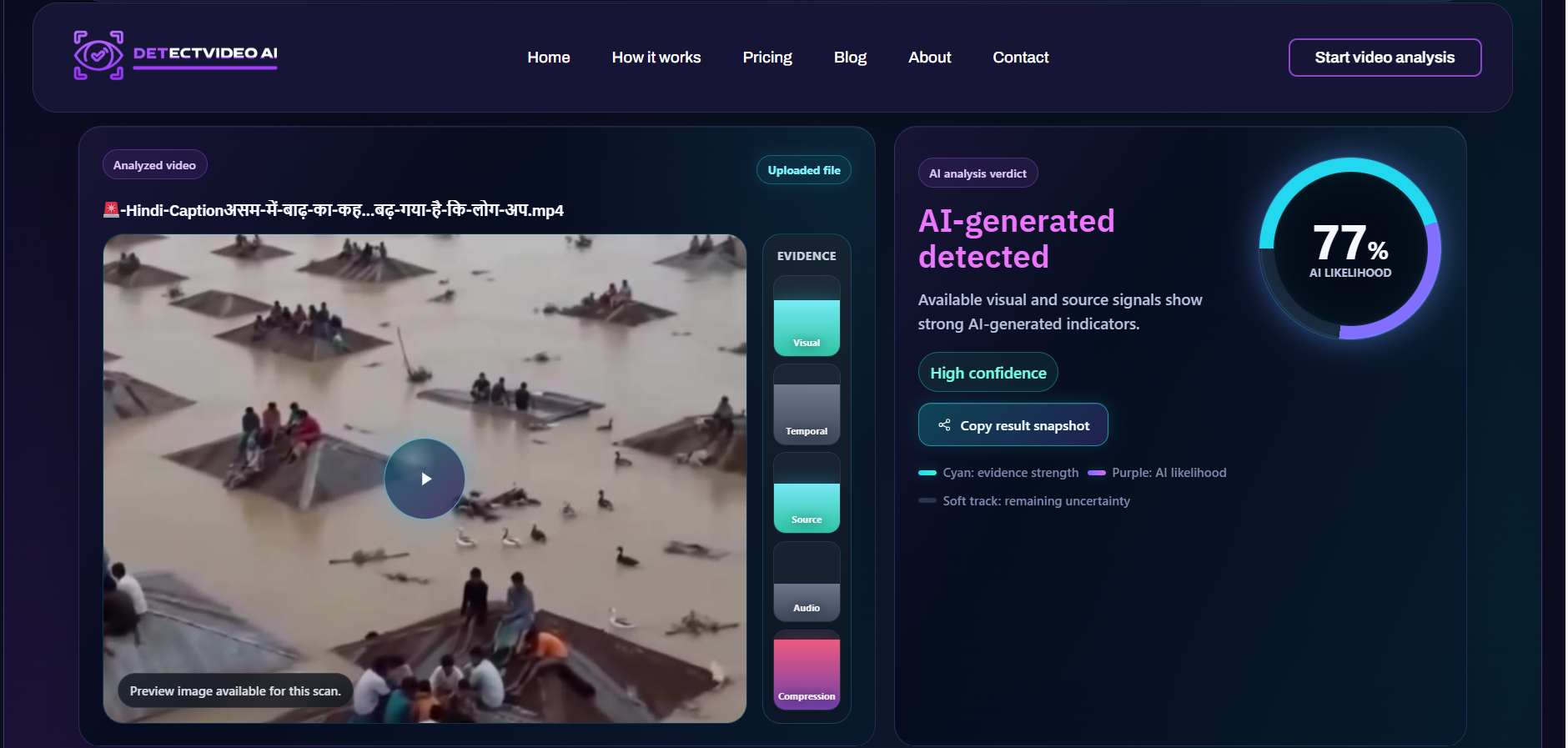
Further research was carried out using another AI detection tool, DetectVideo.AI, which found a 77 percent likelihood of the video being AI-generated.
For additional verification, we extracted key frames from the viral video and analysed them using another AI detection tool, AI or Not. The tool’s assessment indicated a 96 percent probability that the visuals were AI-generated.

Conclusion
The research established that the viral video is not from a real flood incident but was created using AI. While flooding in Assam is a real situation, this AI-generated video is unrelated to the actual floods and is being circulated on social media with a misleading claim.

Related Blogs

Executive Summary
A video is going viral on social media showing ‘injured’ security personnel being carried into ambulances. The clip is being shared with claims that a terrorist attack recently took place in Kishtwar. The video surfaced nearly a year after the terror attack in Pahalgam on April 22, 2025, adding to confusion among users online. Research by CyberPeace Research Wing found that the claim is false. The viral video is actually from a mock drill conducted in Kishtwar, not a real terror incident.
Claim
An Instagram user ‘thenewjbharat’ shared the video on April 30, 2026, claiming that a terrorist attack had taken place again in Kishtwar.
https://www.instagram.com/thenewjbharat/

Fact Check
To verify the claim, we extracted keyframes from the viral video and conducted a reverse image search using Google Lens. This led us to the same clip uploaded on April 24, 2026 by an Instagram user ‘kishtwar_breaking_news’. According to the post, the video shows a mock drill conducted by local authorities to assess emergency preparedness. Officials and rescue teams participated in the exercise.

We also found a related news video uploaded on April 23, 2026, by the YouTube channel of Daily Excelsior, which featured visuals matching the viral clip. The report confirmed that the drill was carried out to evaluate readiness for emergency situations.

Conclusion
Our research confirms that the viral video does not show a real terrorist attack. It is footage from a mock drill conducted in Kishtwar and is being falsely shared with misleading claims.

Introduction
As the world is being "Digitally Interlaced", cyber security has become a continuous wrangle. The “Gambling industry” is considered an incredibly lucrative mark for cybercriminals, principally due to the enormous quantities of cash on hand and the sensitive details it processes day to day. Cybercriminals may use susceptibilities in gambling scaffolds to achieve financial scams or launder unlawful funds. An analysis by Security Scorecard discovered that the online gambling industry was ranked third in the possibility of encountering a cyber attack, following the energy and financial services sectors. Similarly, Online gambling is a bending matter that demands meticulous contemplation by policymakers and nationals. The incredible rise of online gambling has led to a terse acclivity in unlawful activities such as online scams, fraud, etc. Also, online sports gambling has become a thriving endeavour in contemporary years as millions of people are putting stakes and gambles on their electronic devices.
The Challenges
Online gambling has thus become a widespread frolicking for numerous youngsters, with the industry tossed to be worth billions of dollars in the forthcoming decades. The prominent cyber security challenges in the gambling industry are money laundering, financial laundering, ransomware, personal information theft, data breaches, distributed Denial of Service (DDoS), system disruptions and Insider perils and employee malfeasance. Challenges of online gambling also include being properly not regulated and a lack of social interaction with near and dear ones. The spread of Internet gambling has presented many problems affecting consumer behaviour online, motivations to gamble, problem gambling, security of websites, and the righteousness and virtue of the games. The rise of online gambling among young people due to the lack of clear regulations has likewise produced an abundant backdrop for financial ruination.
Web games and betting are among the fastest-evolving areas of the Internet. Over the past several years, there has been an international flare-up in online gambling, permitting customers to play from the convenience of home, work, and public locations. Numerous offshore betting websites and apps usually permit parties to win in the start with sound returns, whereas after the user gets addicted and invests considerable sums, they either keep failing or have the website refuse to cash out the winnings. Also, the information demonstrates that online games have been employed to commit wrongdoings (Child sexual exploitive material, religious conversion, cyberbullying, fraud, betting in virtual online casinos, etc.)
India's laws and regulations surrounding online gambling are complex and constantly evolving. While the legal framework is not entirely clear, a few state in India have their own set of rules.
Recently In April 2023, the Union Ministry of Electronics and Information Technology (“MeitY”), by virtue of the rule-making powers available to the central government under the Information Technology Act, 2000 (“IT Act 2000”), implemented a new central legal framework for online gaming through amendments to the Information Technology (Intermediary Guidelines and Digital Media Ethics Code) Rules, 2021 (“IT Rules 2021”). These amendments (“Online Gaming Rules”) propose a light-touch, co-regulatory regime whereby MeitY-recognised, independent self-regulatory bodies (“SRB”) will verify whether an “online real-money game” is to be made available to the general public or not – in accordance with the baseline criteria prescribed by the Online Gaming Rules.
The Online Gaming Rules attempt to regulate online gaming platforms by treating them as an “online gaming intermediary” (“OGI”) and prescribing intermediary due diligence obligations for them under the IT Rules 2021. An OGI has been defined in the Online Gaming Rules as “any intermediary that enables the users of its computer resource to access one or more online games”. Under the Online Gaming Rules, an online game can be a “permissible online game” if (i) it is not an online real-money game, or (ii) it is an online real-money game but is “verified” by an SRB in accordance with the baseline criteria prescribed by the Online Gaming Rules and any additional criteria prescribed by the SRB itself.
Global Perspective
The global gaming industry worth over US$227 billion in 2022 is further projected to grow to US$312 billion by 2027. Several countries have set regulatory frameworks about online gaming, though these are skewed, concentrating mainly on gambling and circumventing numerous of the more typical cyber threats. The US spends about $60 billion annually on online gambling and sports betting. In Europe, gambling is an even larger moneymaker. Also, numerous countries in Europe, like the UK, have legalised gambling. Nevertheless, it is prohibited for a US based company to operate an online gambling site. Yet, sports betting online is permitted in some states.
Today, though the gaming market has been overpowered by China and the US, future growth in the sector is anticipated to come from emerging economies like India with increasing populations. The permitted status of online gambling in India is nonetheless imprecise, vamoosing space for exploitation by cyber criminals and disarray for players involved. One of the climactic points that ought to be addressed is the sudden upsurge of online games, which increases gambling. Skill-based games such as poker, rummy etc., have additionally been developed to circumvent the legal definition of gambling in India. The recent instances of the online gaming industry not being properly regulated have also come to light in India. For instance, the Enforcement Directorate (ED) is still investigating the vast Mahadev Online Betting scandal, exposing an unknown money laundering method using Unified Payment Interface (UPI) IDs. Also, the Cyber Cell in Agra has taken proactive action against copyright violations, illegal online gambling and betting activities, shutting down 27 Illegal cricket betting sites in major operations, safeguarding several lakhs of Indians with thousands of crores from being transferred to overseas shores principally China.
Consequently, though India has announced new regulations on online gaming, its contemporary policy framework cannot contend with the problems endangering this sector. The Public Gambling Act of 1867 makes it unlawful to use a public gambling house or to be seen in one. Nevertheless, the act does not explicitly cite online gambling, leading to further interpretation. The Ministry of Home Affairs (MHA) has released a further awareness campaign for offshore illegal gambling apps, notifying users to be mindful of foreign apps as they may be fraudulent and might induce monetary damage to the user. Also, state laws control gambling in India with each state having its own directive on the subject. Yet, the Supreme Court of India has maintained that skilled games are not gambling and are thus legal. Furthermore, the Information Technology (IT) Act, of 2000 does not precisely handle online gambling or games that enable gambling.
Today, developers have strived for new ways to monetise the growing popularity of online gaming, which oversaw the creation of in-game currencies that can be bought using actual money, usually through credit cards. Several nations have prohibited the usage of in-game currency and loot boxes, considering them a kind of online gambling. The in-game currency has thus caused much disagreement about becoming a state of hunting monetisation by developers, especially targeting minor or newbie players. The gambling industry, therefore, faces unique cybersecurity challenges that require a comprehensive and proactive approach to cybersecurity.
Conclusion
Presently, there are approximately 3.09 billion active video game players worldwide, and the number is expected to reach 3.32 billion by 2024 as of 2023. In the contemporary digital era, information is priceless, and encryption acts as a necessary means to safeguard it. Thus, Regulators are working to maintain the swiftness of shift in the industry, as the dearth of transparency in the law has made it challenging to implement regulations. There is also less awareness about cyber security in India due to the following grounds such as the lack of ethical hackers in the country, companies in India lacking focus on cyber security and hiring a team of ethical hackers and cyber security experts. Furthermore, there has been a lack of knowledge among the citizens as well.
It is essential to realise the conceivable social and economic consequences and take measures to handle the online gambling industry. The industry has thus been undersized in the mode of research following online crime and Internet gambling, even though it is an acute emphasis. There is also a pressing necessity to rebuild these regulations to tackle the more unbridled cyber security hazards swarming the gaming industry. Similarly, there is an urgent need for governments and policymakers around the world to start paying more attention to the gaming industry as cyber security threats continue to rise. There should be a further need to strengthen the regulatory framework, establish Self Regulatory Organizations (SROs), create ethical gaming designs and increase awareness among gamers. The Government of India should consider devising its own rating system to rate games so that players under 18 cannot access them.
Eventually, cyber security is a shared commitment, and everyone in the online gambling ecosystem must function jointly to provide a secure and safe setting for all.
References:
- https://truefort.com/gambling-industry-cybersecurity/
- https://www.orfonline.org/research/cybersecurity-threats-in-online-gaming-learnings-for-india
- https://www.hackread.com/chinese-scammers-cloned-websites-gambling-network/
- https://www.civilsdaily.com/news/cybersecurity-threats-from-online-gaming/
- https://www.linkedin.com/pulse/legal-considerations-online-gambling-india-sudden-increase-mathur/
- https://www.jsheld.com/insights/articles/the-importance-of-cybersecurity-in-the-online-sports-betting-industry
- https://www.the420.in/agra-cyber-cell-takes-down-27-illegal-betting-sites/
- https://g2g.news/gaming/ministry-of-home-affairs-releases-new-awareness-campaign-for-online-gaming-in-india/
- https://smestreet.in/technology/kaspersky-warns-of-increased-phishing-scams-and-data-breaches-in-apac-for-2024-2381601
- https://economictimes.indiatimes.com/tech/newsletters/morning-dispatch/govt-bans-mahadev-other-illegal-betting-apps-cyber-attacks-against-india-spike/articleshow/104996017.cms?from=mdr
- https://cipher.com/cybersecurity-for-gambling/
- https://www.mangalorean.com/tightening-the-reins-indian-government-blocks-over-550-illegal-betting-and-gambling-apps/
- https://cybersecurityasean.com/news-press-releases/kaspersky-predicts-rise-cyber-threats-across-apac-2024
- https://www.cnbctv18.com/technology/mahadev-betting-app-scam-ed-money-laundering-upi-celebrities-under-scanner-17815661.htm
- https://iclg.com/practice-areas/gambling-laws-and-regulations/india

India’s online gaming industry has grown at lightning speed, drawing millions of users across age groups. From casual games and e-sports to fantasy leagues and online poker, digital entertainment has become both a social and economic phenomenon. But with this growth came rising concerns of addiction, financial loss, misleading ads, and even criminal misuse of gaming platforms for illegal betting. To address these concerns, the Government of India introduced the Promotion and Regulation of Online Gaming Act and draft Rules in October 2025. While the Act represents a crucial step toward accountability and user protection, it also raises difficult questions about freedom, innovation, and investor confidence.
The Current Legal Framework
The 2025 Act, along with corresponding changes in the Information Technology and GST laws, aims to create a safer and more transparent gaming environment.
1. Ban on real-money games:
Any online game where money is involved, whether it’s entry fees, bets, or prizes, is now banned, regardless of whether it is based on skill or chance. As a result, previously permitted formats such as fantasy sports, rummy, and poker once defended as “games of skill” now fall within the category of banned activities.
2. Promotion of e-sports and social gaming
Not all gaming is banned. Casual games, e-sports, and social games that don’t involve money are fully allowed. The government is encouraging these as part of India’s growing digital economy.
3. Advertising and financial restrictions: Banks, payment gateways, and advertisers cannot facilitate or promote real-money games. Any platform offering deposits or prize pools can be blocked.
4. Central regulatory authority: The law establishes a national body to classify games, monitor compliance, and address complaints. It has the power to order the locking of violative content and websites.
Why Regulation Was Needed
The push for regulation came after a surge in online betting scams, debt-related suicides, and disputes about whether certain apps were skill-based or chance-based. State governments had taken conflicting positions, some banning, others licensing such games. Meanwhile, offshore gaming apps operated freely in India’s grey market.
The 2025 Act thus attempts to impose uniformity, protect minors, and bring moral and fiscal discipline to a rapidly expanding digital frontier. Its underlying philosophy resembles that of the Digital Personal Data Protection Act, encouraging responsible use of technology rather than an unregulated free-for-all.
Key Challenges and Gaps
(a) Clarity of Definitions
The Act bans all real-money games, ignoring the difference between skill-based games and chance-based games. This could lead to legal challenges under Article 19(1)(g), which protects the right to do business. Games like rummy or fantasy cricket, which need real skill, arguably shouldn’t be banned outright
(b) Weak Consumer and Child Protection
Although age verification and KYC are mandated, compliance at the user-end remains uncertain. India needs a Responsible Gaming Code covering:
- Spending limits and cooling-off periods;
- Self-exclusion options;
- Transparent disclosure of odds; and
- Algorithmic fairness audits.
These measures can help mitigate addiction and prevent exploitation of minors.
(c) Federal Conflicts
“Betting and gambling” fall within the State List under India’s Constitution, yet the 2025 Act seeks national uniformity. States like Tamil Nadu and Karnataka already have independent bans. Without harmonisation, legal disputes between state and central authorities could multiply. A cooperative federal framework allowing states to adopt central norms voluntarily could offer flexibility without fragmentation.
(d) Regulatory Transparency
The gaming regulator has a lot of power, like deciding which games are allowed and blocking websites. But it’s not clear who chooses its members or how people can challenge its decisions. Including court oversight, public input, and regular reporting would make the regulator fairer and more reliable.
What’s Next for India’s Online Gaming
India’s online gaming scene is at a turning point. Banning all money-based games might reduce risks, but it also slows innovation and limits opportunities. A better approach could be to license skill-based or low-risk games with proper KYC and audits, set up a Responsible Gaming Charter with input from government, industry, and civil society, and create rules for offshore platforms targeting Indian players. Player data should be protected under the Digital Personal Data Protection Act, 2023, and the law should be reviewed every few years to keep up with new tech like the metaverse, NFTs, and AI-powered games.
Conclusion
CyberPeace has already provided its detailed feedback to MEITy as on 30th October, 2025 hopes the finalised rules are released soon with the acknowledgment of the challenges discussed. The Promotion and Regulation of Online Gaming Act, 2025, marks an important turning point since this is India’s first serious attempt to bring order to a chaotic digital arena. The goal is to keep players safe, stop crime, and hold platforms accountable. But the tricky part is moving away from blanket bans. We need rules that let new ideas grow, respect people’s rights, and keep players safe. With a few smart changes and fair enforcement, India could have a gaming industry that’s safe, responsible, and ready to compete globally.
References
- https://ssrana.in/articles/indias-online-gaming-bill-2025-regulation-prohibition-and-the-future-of-digital-play/
- https://www.google.com/amp/s/m.economictimes.com/news/economy/policy/new-online-gaming-law-takes-effect-money-games-banned-from-today/amp_articleshow/124255401.cms
- https://www.google.com/amp/s/timesofindia.indiatimes.com/technology/tech-news/government-proposes-to-make-violation-of-online-money-game-rules-non-bailable-draft-rules-ban-/amp_articleshow/124277740.cms
- https://www.egf.org.in/
- https://www.pib.gov.in/PressNoteDetails.aspx?NoteId=155075&ModuleId=3
