
Your Face, Their Prompt | What Meta's Muse Image Reveals About Declining Consent Online
When your digital identity becomes raw material for someone else’s imagination, who really owns your face?
On July 7, 2026, Meta launched Muse Image, the first standalone image-generation model developed by Meta Superintelligence Labs under Alexandr Wang. Positioned as a competitor to OpenAI’s GPT Images 2.0 and Google’s Nano Banana 2, the launch highlights Meta’s growing ambitions in the generative AI race. Yet beneath the technical advancements lies a far more consequential question than what AI can create, but about who gets to decide what it creates with?
That ambition of generative AI comes with a cost, and one of Muse Image's most controversial design choices is its integration with Instagram, which allows public profiles to become creative references for AI-generated images. Users can tag public Instagram accounts in prompts and generate AI images inspired by that person’s publicly available content. Meta presents this as a new form of personalization and creativity. However, critics argue that the feature transforms years of personal photographs into a massive library of AI-ready human identities, where non-action automatically becomes permission. The concern is not just that AI can generate realistic images. The concern is that consent itself is being manipulated in a way.
The opt-out system most users never asked for
Muse Image operates through Meta AI’s integration with Instagram. A user can reference a public Instagram profile in a prompt, allowing the system to generate images influenced by that person’s existing content and likeness. Under the default arrangement, the person whose profile is being referenced may not necessarily approve the generation beforehand.
Meta does provide users with controls to restrict this functionality. The setting exists under Instagram’s “Sharing and reuse” options, where users can disable permissions related to the use of their posts and reels with Meta’s AI features. But the larger issue is the direction in which responsibility flows. Instead of requiring active permission before someone’s likeness becomes available for AI-generated content, the burden is placed on individuals to discover the feature, understand the implications, locate the setting, and disable it. In a digital environment where users already navigate endless privacy menus, cookie banners, and terms of service agreements, expecting meaningful awareness from billions of people becomes unrealistic. Consent that depends on finding the exit door is very different from consent that begins with a choice.
A guide for opting-out
One way of opting out is to have a private account. As verified, Meta does not encroach on private accounts as of now for image-generation.
But if you have a public account, here are the steps that can be followed to secure yourself from Meta’s Muse automatic consent:
On your profile, tap the menu bar which is on the top right (≡), you will enter into ‘setting and activity’, after that you will see an option of ‘sharing and refuse’ and then disable the options under it, namely- Allow people to reuse your content on Instagram and with AI features at Meta. Notably, the changes made will be only for your future content not the already existing content on your public profile.
Why “public” does not mean “available for anything”
The debate around Muse Image highlights a deeper misunderstanding at the center of modern digital platforms: the difference between visibility and reuse. When someone makes an Instagram account public, they are generally making a decision about the audience. They are allowing others to view their photos, discover their profile, or engage with their content. That decision was never traditionally understood as permission for their face, appearance, personal moments, or identity markers to become reusable components in AI-generated media. A photograph posted online has context. It represents a specific moment, purpose, relationship, or expression. Generative AI changes that equation because it separates identity from context. A person’s likeness can be extracted from its original context and placed into entirely new situations created by someone else. Muse Image does not just expand who can see your content. It expands what can be done with it. That distinction is what scales the problem for every public user on the app. The privacy implications become significantly larger because of Instagram’s global reach. With billions of users worldwide, even a small percentage of affected public accounts represents an enormous number of people. Many public profiles do not belong to celebrities, influencers, or creators who intentionally operate as public brands. They belong to students, professionals, small businesses, artists, photographers, and everyday users who simply chose visibility within a social network.
For years, platforms encouraged people to share more, build audiences, and maintain a public digital presence. Now, the meaning of that public presence is changing after the fact. The question becomes: should a decision made years ago to share photos socially automatically extend into permission for generative AI systems built years later?
There is also a catch while opting out. Changing these settings only protects your content from being used in future AI generations, it does not undo anything that has already happened. Any AI images previously created using your public profile will remain unaffected. Essentially, the opt-out works as a shield for what comes next, not a reset button for what has already been created.
A familiar pattern in the AI era
Muse Image reflects a broader pattern emerging across the technology industry. New AI capabilities are introduced at massive scale, participation becomes the default, and individual control arrives afterward through settings that many users may never find. The same debates that once surrounded targeted advertising, data collection, and algorithmic profiling are now moving into a far more personal territory, the human identity itself. Faces are not ordinary data points. Unlike a username, password, or preference setting, a person cannot simply replace their appearance once it has been widely replicated.
Technical solutions such as AI watermarking and content labels may help identify generated material, but they address authenticity after creation. They do not answer the question of whether the generation should have happened in the first place.
Innovation cannot replace consent
The technological progress behind Muse Image is significant. Better image generation, improved text rendering, and more personalized creative tools represent genuine advances in artificial intelligence. But capability alone cannot determine acceptability. The future of AI will not only depend on how realistic images become, how powerful models become, or how quickly companies can deploy new features. It will also depend on whether people feel they have meaningful control over their own digital identities. Muse Image is therefore more than another AI product launch. It represents a defining question for the next phase of the internet: Will our online presence remain something we control, or will it become something others can generate?

Related Blogs

Executive Summary:
A photo claiming that Mr. Rowan Atkinson, the famous actor who played the role of Mr. Bean, lying sick on bed is circulating on social media. However, this claim is false. The image is a digitally altered picture of Mr.Barry Balderstone from Bollington, England, who died in October 2019 from advanced Parkinson’s disease. Reverse image searches and media news reports confirm that the original photo is of Barry, not Rowan Atkinson. Furthermore, there are no reports of Atkinson being ill; he was recently seen attending the 2024 British Grand Prix. Thus, the viral claim is baseless and misleading.

Claims:
A viral photo of Rowan Atkinson aka Mr. Bean, lying on a bed in sick condition.


Fact Check:
When we received the posts, we first did some keyword search based on the claim made, but no such posts were found to support the claim made.Though, we found an interview video where it was seen Mr. Bean attending F1 Race on July 7, 2024.

Then we reverse searched the viral image and found a news report that looked similar to the viral photo of Mr. Bean, the T-Shirt seems to be similar in both the images.

The man in this photo is Barry Balderstone who was a civil engineer from Bollington, England, died in October 2019 due to advanced Parkinson’s disease. Barry received many illnesses according to the news report and his application for extensive healthcare reimbursement was rejected by the East Cheshire Clinical Commissioning Group.
Taking a cue from this, we then analyzed the image in an AI Image detection tool named, TrueMedia. The detection tool found the image to be AI manipulated. The original image is manipulated by replacing the face with Rowan Atkinson aka Mr. Bean.


Hence, it is clear that the viral claimed image of Rowan Atkinson bedridden is fake and misleading. Netizens should verify before sharing anything on the internet.
Conclusion:
Therefore, it can be summarized that the photo claiming Rowan Atkinson in a sick state is fake and has been manipulated with another man’s image. The original photo features Barry Balderstone, the man who was diagnosed with stage 4 Parkinson’s disease and subsequently died in 2019. In fact, Rowan Atkinson seemed perfectly healthy recently at the 2024 British Grand Prix. It is important for people to check on the authenticity before sharing so as to avoid the spreading of misinformation.
- Claim: A Viral photo of Rowan Atkinson aka Mr. Bean, lying on a bed in a sick condition.
- Claimed on: X, Facebook
- Fact Check: Fake & Misleading

Introduction
The mysteries of the universe have been a subject of curiosity for humans over thousands of years. To solve these unfolding mysteries of the universe, astrophysicists are always busy, and with the growing technology this seems to be achievable. Recently, with the help of Artificial Intelligence (AI), scientists have discovered the depths of the cosmos. AI has revealed the secret equation that properly “weighs” galaxy clusters. This groundbreaking discovery not only sheds light on the formation and behavior of these clusters but also marks a turning point in the investigation and discoveries of new cosmos. Scientists and AI have collaborated to uncover an astounding 430,000 galaxies strewn throughout the cosmos. The large haul includes 30,000 ring galaxies, which are considered the most unusual of all galaxy forms. The discoveries are the first outcomes of the "GALAXY CRUISE" citizen science initiative. They were given by 10,000 volunteers who sifted through data from the Subaru Telescope. After training the AI on 20,000 human-classified galaxies, scientists released it loose on 700,000 galaxies from the Subaru data.
Brief Analysis
A group of astronomers from the National Astronomical Observatory of Japan (NAOJ) have successfully applied AI to ultra-wide field-of-view images captured by the Subaru Telescope. The researchers achieved a high accuracy rate in finding and classifying spiral galaxies, with the technique being used alongside citizen science for future discoveries.
Astronomers are increasingly using AI to analyse and clean raw astronomical images for scientific research. This involves feeding photos of galaxies into neural network algorithms, which can identify patterns in real data more quickly and less prone to error than manual classification. These networks have numerous interconnected nodes and can recognise patterns, with algorithms now 98% accurate in categorising galaxies.
Another application of AI is to explore the nature of the universe, particularly dark matter and dark energy, which make up over 95% energy of the universe. The quantity and changes in these elements have significant implications for everything from galaxy arrangement.
AI is capable of analysing massive amounts of data, as training data for dark matter and energy comes from complex computer simulations. The neural network is fed these findings to learn about the changing parameters of the universe, allowing cosmologists to target the network towards actual data.
These methods are becoming increasingly important as astronomical observatories generate enormous amounts of data. High-resolution photographs of the sky will be produced from over 60 petabytes of raw data by the Vera C. AI-assisted computers are being utilized for this.
Data annotation techniques for training neural networks include simple tagging and more advanced types like image classification, which classify an image to understand it as a whole. More advanced data annotation methods, such as semantic segmentation, involve grouping an image into clusters and giving each cluster a label.
This way, AI is being used for space exploration and is becoming a crucial tool. It also enables the processing and analysis of vast amounts of data. This advanced technology is fostering the understanding of the universe. However, clear policy guidelines and ethical use of technology should be prioritized while harnessing the true potential of contemporary technology.
Policy Recommendation
- Real-Time Data Sharing and Collaboration - Effective policies and frameworks should be established to promote real-time data sharing among astronomers, AI developers and research institutes. Open access to astronomical data should be encouraged to facilitate better innovation and bolster the application of AI in space exploration.
- Ethical AI Use - Proper guidelines and a well-structured ethical framework can facilitate judicious AI use in space exploration. The framework can play a critical role in addressing AI issues pertaining to data privacy, AI Algorithm bias and transparent decision-making processes involving AI-based tech.
- Investing in Research and Development (R&D) in the AI sector - Government and corporate giants should prioritise this opportunity to capitalise on the avenue of AI R&D in the field of space tech and exploration. Such as funding initiatives focusing on developing AI algorithms coded for processing astronomical data, optimising telescope operations and detecting celestial bodies.
- Citizen Science and Public Engagement - Promotion of citizen science initiatives can allow better leverage of AI tools to involve the public in astronomical research. Prominent examples include the SETI @ Home program (Search for Extraterrestrial Intelligence), encouraging better outreach to educate and engage citizens in AI-enabled discovery programs such as the identification of exoplanets, classification of galaxies and discovery of life beyond earth through detecting anomalies in radio waves.
- Education and Training - Training programs should be implemented to educate astronomers in AI techniques and the intricacies of data science. There is a need to foster collaboration between AI experts, data scientists and astronomers to harness the full potential of AI in space exploration.
- Bolster Computing Infrastructure - Authorities should ensure proper computing infrastructure should be implemented to facilitate better application of AI in astronomy. This further calls for greater investment in high-performance computing devices and structures to process large amounts of data and AI modelling to analyze astronomical data.
Conclusion
AI has seen an expansive growth in the field of space exploration. As seen, its multifaceted use cases include discovering new galaxies and classifying celestial objects by analyzing the changing parameters of outer space. Nevertheless, to fully harness its potential, robust policy and regulatory initiatives are required to bolster real-time data sharing not just within the scientific community but also between nations. Policy considerations such as investment in research, promoting citizen scientific initiatives and ensuring education and funding for astronomers. A critical aspect is improving key computing infrastructure, which is crucial for processing the vast amount of data generated by astronomical observatories.
References
- https://mindy-support.com/news-post/astronomers-are-using-ai-to-make-discoveries/
- https://www.space.com/citizen-scientists-artificial-intelligence-galaxy-discovery
- https://www.sciencedaily.com/releases/2024/03/240325114118.htm
- https://phys.org/news/2023-03-artificial-intelligence-secret-equation-galaxy.html
- https://www.space.com/astronomy-research-ai-future

Executive Summary
A video showing people installing fencing along a border has gone viral on social media. In the clip, several individuals along with security personnel can be seen laying barbed wire fencing near a border area. The video is being shared with the claim that it shows fencing work underway on the India-Bangladesh border in West Bengal after the Bharatiya Janata Party (BJP) allegedly came to power in the state.
However, CyberPeace Research Wing investigation found the viral claim to be false. The video is not from a real incident and has been created using Artificial Intelligence (AI).
Claim
An X user named “Gopal Sanatani” shared the viral video on May 26, 2026, with the caption:“Voting in the right place keeps the country secure. Now no outsider will be able to snatch the rights of Indian citizens.”The archived link to the post is provided below.

Fact Check
To verify the authenticity of the viral claim, we extracted several key frames from the video and conducted reverse image searches using Google. However, we could not find any credible information or authentic reports related to the visuals shown in the clip. We also searched using relevant keywords on Google, but no trustworthy news reports connected to the claim were found.
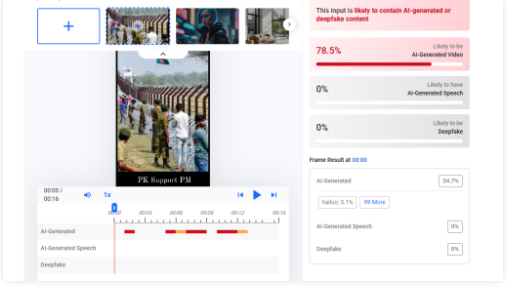
Upon closely examining the video, several visual inconsistencies became noticeable. At one point, an object resembling a piece of paper suddenly appears in a soldier’s hand and then disappears moments later. In another scene, a man installing the fencing appears to pass directly through the barbed wire and emerges unharmed, despite the sharp wires visible in the video. These irregularities raised suspicion that the clip had been artificially generated. To further investigate, we analysed the video using AI detection tools. The analysis conducted through Hive Moderation indicated a high probability — around 80 percent — that the video was AI-generated.
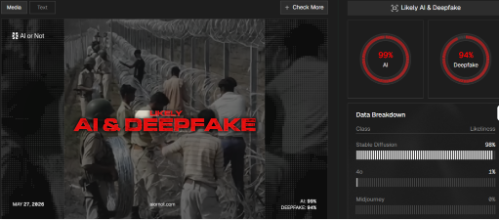
Additionally, the video was examined using another AI detection platform, “AI or Not,” which indicated nearly a 99 percent likelihood that the clip had been created using artificial intelligence.
Conclusion
Our investigation found that the viral video claiming to show fencing work along the West Bengal-Bangladesh border is fake. The footage does not depict a real incident and was generated using Artificial Intelligence (AI).

