
#FactCheck-AI-Generated Video Falsely Shared as Drone Show Honouring Cristiano Ronaldo Introduction
Executive Summary
A video is being widely circulated on social media showing thousands of drones forming an image of Cristiano Ronaldo wearing his iconic Portugal jersey over what appears to be a water body. Moments later, the drones are seen creating his famous “SIUUU” celebration pose. The video is being shared with the claim that this spectacular aerial drone show was organised as a tribute to Ronaldo.
CyberPeace Research Wing’s research found the viral claim to be false. The research revealed that the video is not a real drone display but was created using Artificial Intelligence (AI) and is being circulated with a misleading claim.
Claim
The viral video is being shared on social media with the claim that the drone show was organised in honour of Cristiano Ronaldo.
https://www.instagram.com/reel/DamaeegILpU/?igsh=NmtjOTN4cWJzenJ1

Fact Check
To verify the claim, we extracted multiple keyframes from the viral video and conducted a reverse image search using Google Lens. During the research, we did not find any credible video, news report, or reliable source confirming that such a drone show was organised for Cristiano Ronaldo.
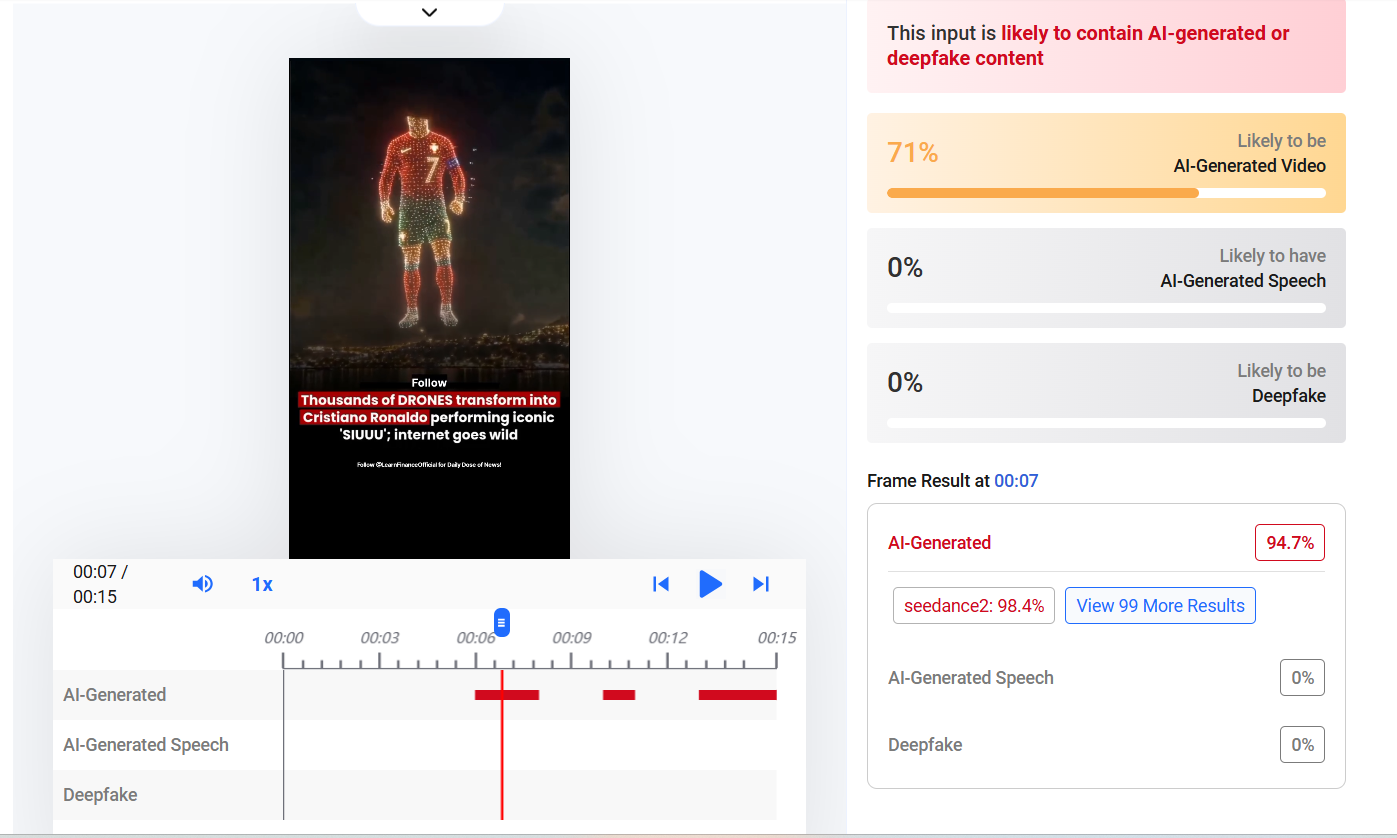
In the next stage of the research, we analysed the video using the AI detection tool Hive Moderation. The tool’s results indicated that the viral video had a 71% probability of being AI-generated.
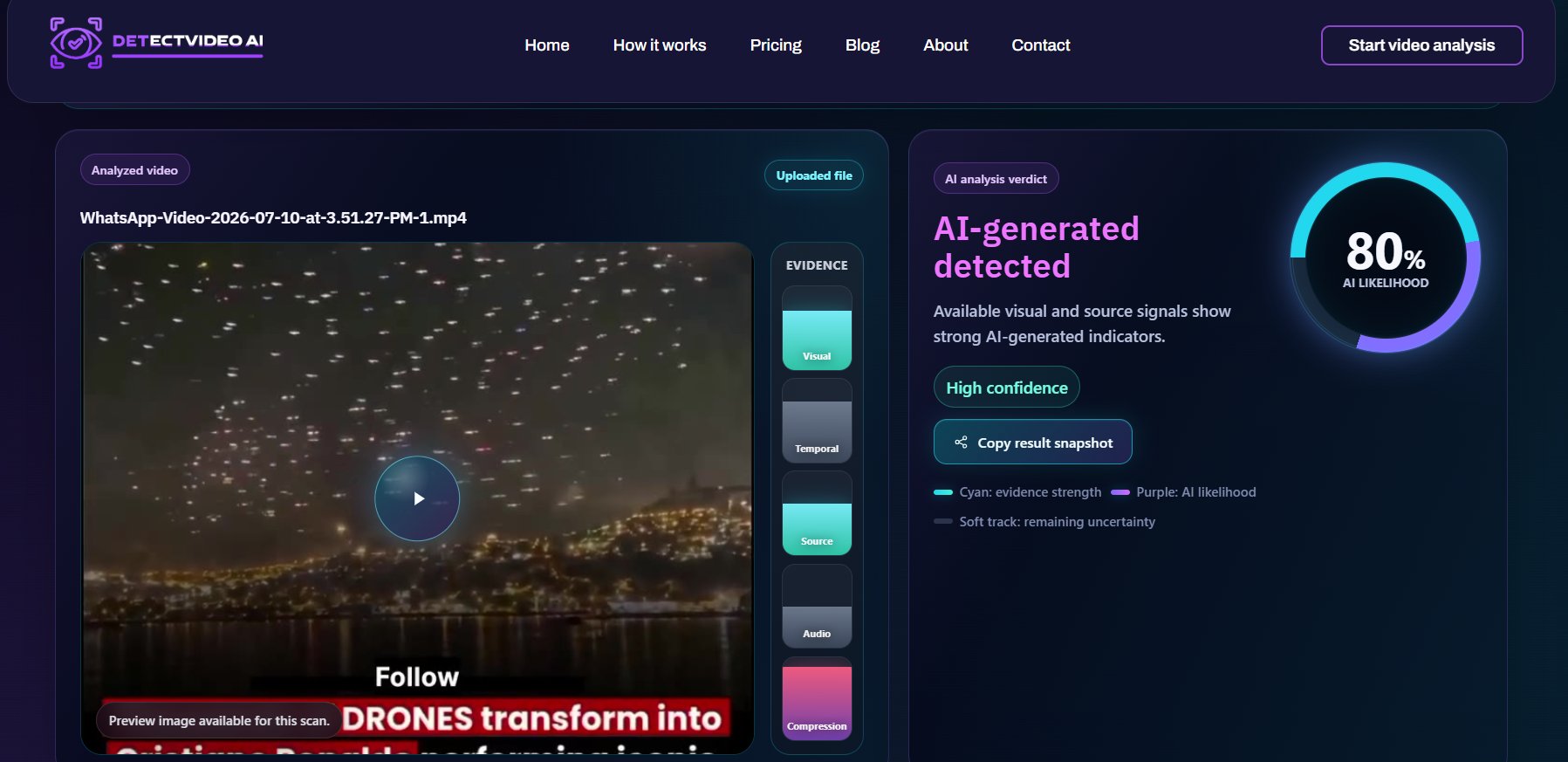
For further verification, we checked the video using another AI detection tool, DetectVideo AI. The analysis showed that the video had an 80% probability of being AI-generated.
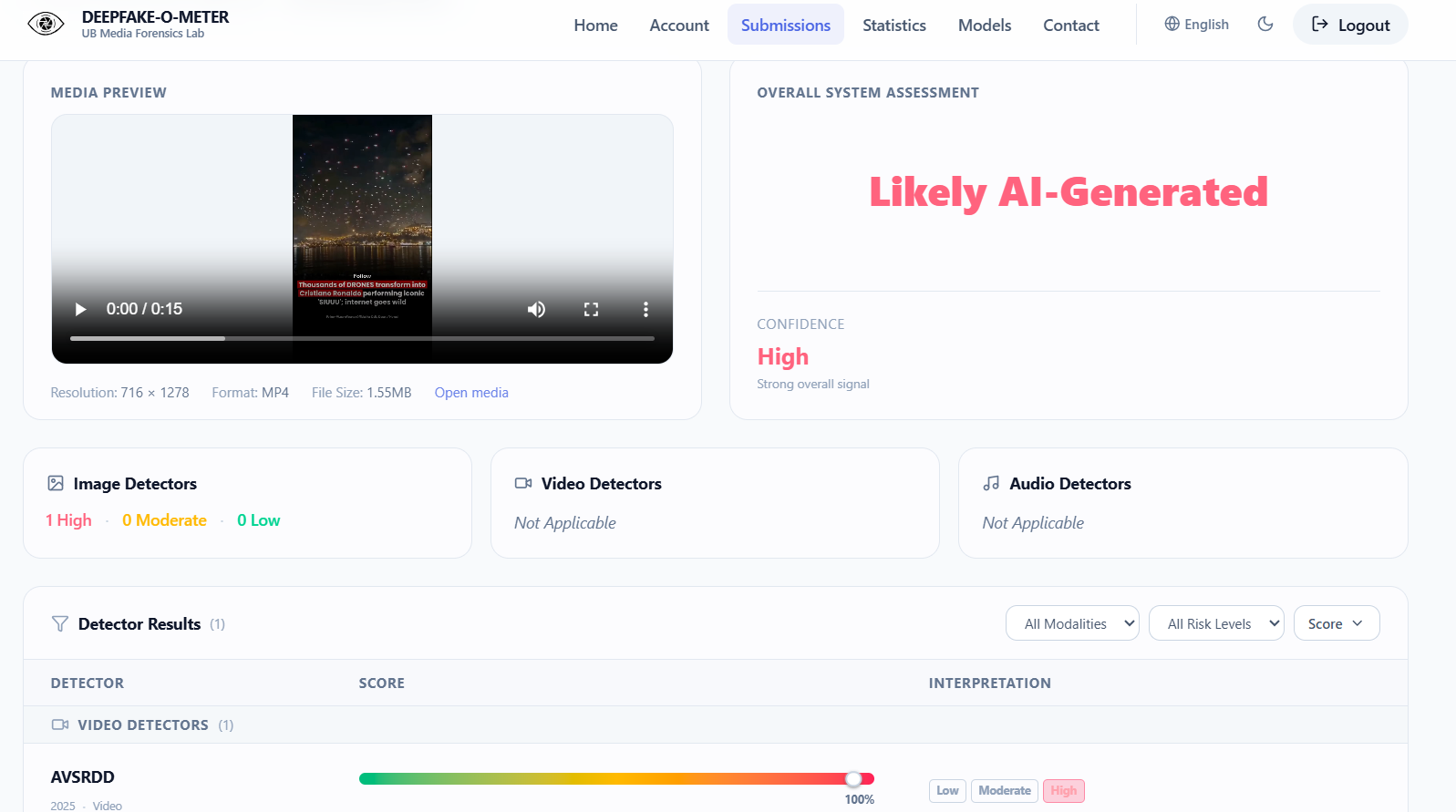
At the final stage of the research, the video was also analysed using Deepfake-O-Meter. The tool indicated an almost 100% probability that the video was AI-generated.
Conclusion
Our research found that the viral claim is false. The video does not show a real drone show organised in honour of Cristiano Ronaldo. The footage was found to be AI-generated and is being circulated on social media with a false narrative.

Related Blogs

Introduction
Election misinformation poses a major threat to democratic processes all over the world. The rampant spread of misleading information intentionally (disinformation) and unintentionally (misinformation) during the election cycle can not only create grounds for voter confusion with ramifications on election results but also incite harassment, bullying, and even physical violence. The attack on the United States Capitol Building in Washington D.C., in 2021, is a classic example of this phenomenon, where the spread of dis/misinformation snowballed into riots.
Election Dis/Misinformation
Election dis/misinformation is false or misleading information that affects/influences public understanding of voting, candidates, and election integrity. The internet, particularly social media, is the foremost source of false information during elections. It hosts fabricated news articles, posts or messages containing incorrectly-captioned pictures and videos, fabricated websites, synthetic media and memes, and distorted truths or lies. In a recent example during the 2024 US elections, fake videos using the Federal Bureau of Investigation’s (FBI) insignia alleging voter fraud in collusion with a political party and claiming the threat of terrorist attacks were circulated. According to polling data collected by Brookings, false claims influenced how voters saw candidates and shaped opinions on major issues like the economy, immigration, and crime. It also impacted how they viewed the news media’s coverage of the candidates’ campaign. The shaping of public perceptions can thus, directly influence election outcomes. It can increase polarisation, affect the quality of democratic discourse, and cause disenfranchisement. From a broader perspective, pervasive and persistent misinformation during the electoral process also has the potential to erode public trust in democratic government institutions and destabilise social order in the long run.
Challenges In Combating Dis/Misinformation
- Platform Limitations: Current content moderation practices by social media companies struggle to identify and flag misinformation effectively. To address this, further adjustments are needed, including platform design improvements, algorithm changes, enhanced content moderation, and stronger regulations.
- Speed and Spread: Due to increasingly powerful algorithms, the speed and scale at which misinformation can spread is unprecedented. In contrast, content moderation and fact-checking are reactive and are more time-consuming. Further, incendiary material, which is often the subject of fake news, tends to command higher emotional engagement and thus, spreads faster (virality).
- Geopolitical influences: Foreign actors seeking to benefit from the erosion of public trust in the USA present a challenge to the country's governance, administration and security machinery. In 2018, the federal jury indicted 11 Russian military officials for alleged computer hacking to gain access to files during the 2016 elections. Similarly, Russian involvement in the 2024 federal elections has been alleged by high-ranking officials such as White House national security spokesman John Kirby, and Attorney General Merrick Garland.
- Lack of Targeted Plan to Combat Election Dis/Misinformation: In the USA, dis/misinformation is indirectly addressed through laws on commercial advertising, fraud, defamation, etc. At the state level, some laws such as Bills AB 730, AB 2655, AB 2839, and AB 2355 in California target election dis/misinformation. The federal and state governments criminalize false claims about election procedures, but the Constitution mandates “breathing space” for protection from false statements within election speech. This makes it difficult for the government to regulate election-related falsities.
CyberPeace Recommendations
- Strengthening Election Cybersecurity Infrastructure: To build public trust in the electoral process and its institutions, security measures such as updated data protection protocols, publicized audits of election results, encryption of voter data, etc. can be taken. In 2022, the federal legislative body of the USA passed the Electoral Count Reform and Presidential Transition Improvement Act (ECRA), pushing reforms allowing only a state’s governor or designated executive official to submit official election results, preventing state legislatures from altering elector appointment rules after Election Day and making it more difficult for federal legislators to overturn election results. More investments can be made in training, scenario planning, and fact-checking for more robust mitigation of election-related malpractices online.
- Regulating Transparency on Social Media Platforms: Measures such as transparent labeling of election-related content and clear disclosure of political advertising to increase accountability can make it easier for voters to identify potential misinformation. This type of transparency is a necessary first step in the regulation of content on social media and is useful in providing disclosures, public reporting, and access to data for researchers. Regulatory support is also required in cases where popular platforms actively promote election misinformation.
- Increasing focus on ‘Prebunking’ and Debunking Information: Rather than addressing misinformation after it spreads, ‘prebunking’ should serve as the primary defence to strengthen public resilience ahead of time. On the other hand, misinformation needs to be debunked repeatedly through trusted channels. Psychological inoculation techniques against dis/misinformation can be scaled to reach millions on social media through short videos or messages.
- Focused Interventions On Contentious Themes By Social Media Platforms: As platforms prioritize user growth, the burden of verifying the accuracy of posts largely rests with users. To shoulder the responsibility of tackling false information, social media platforms can outline critical themes with large-scale impact such as anti-vax content, and either censor, ban, or tweak the recommendations algorithm to reduce exposure and weaken online echo chambers.
- Addressing Dis/Information through a Socio-Psychological Lens: Dis/misinformation and its impact on domains like health, education, economy, politics, etc. need to be understood through a psychological and sociological lens, apart from the technological one. A holistic understanding of the propagation of false information should inform digital literacy training in schools and public awareness campaigns to empower citizens to evaluate online information critically.
Conclusion
According to the World Economic Forum’s Global Risks Report 2024, the link between misleading or false information and societal unrest will be a focal point during elections in several major economies over the next two years. Democracies must employ a mixed approach of immediate tactical solutions, such as large-scale fact-checking and content labelling, and long-term evidence-backed countermeasures, such as digital literacy, to curb the spread and impact of dis/misinformation.
Sources
- https://www.cbsnews.com/news/2024-election-misinformation-fbi-fake-videos/
- https://www.brookings.edu/articles/how-disinformation-defined-the-2024-election-narrative/
- https://www.fbi.gov/wanted/cyber/russian-interference-in-2016-u-s-elections
- https://indianexpress.com/article/world/misinformation-spreads-fear-distrust-ahead-us-election-9652111/
- https://academic.oup.com/ajcl/article/70/Supplement_1/i278/6597032#377629256
- https://www.brennancenter.org/our-work/policy-solutions/how-states-can-prevent-election-subversion-2024-and-beyond
- https://www.bbc.com/news/articles/cx2dpj485nno
- https://msutoday.msu.edu/news/2022/how-misinformation-and-disinformation-influence-elections
- https://misinforeview.hks.harvard.edu/article/a-survey-of-expert-views-on-misinformation-definitions-determinants-solutions-and-future-of-the-field/
- https://reutersinstitute.politics.ox.ac.uk/sites/default/files/2023-06/Digital_News_Report_2023.pdf
- https://www.weforum.org/stories/2024/03/disinformation-trust-ecosystem-experts-curb-it/
- https://www.apa.org/topics/journalism-facts/misinformation-recommendations
- https://mythvsreality.eci.gov.in/
- https://www.brookings.edu/articles/transparency-is-essential-for-effective-social-media-regulation/
- https://www.brookings.edu/articles/how-should-social-media-platforms-combat-misinformation-and-hate-speech/

Introduction
Rapid growth in India’s Digital Economy has opened up various options for companies to utilise digital technology as part of their operations. Examples of these technologies include cloud computing; online payment systems; digitally enabled supply chains; and platforms that facilitate remote working. As small and medium enterprises(SMEs) represent a major part of India’s economy, they have quickly been able to capitalise on the benefits these technologies provide in improving their operational efficiency and developing an increased presence within the market. However, this rapid pace of digitalisation creates an exposure to a much greater breadth of cyber-security threats than ever for SMEs. Today, perhaps the greatest cyber-threat facing SMEs in India is ransomware, an increasing frequent type of cyber-attack that has been increasing on a global scale over the past few years and in response, there have been numerous initiatives by various government agencies, industry organisations, and cyber-security firms designed to educate the general public on the risks of ransomware.
What is Ransomware?
Ransomware is a type of malware, which prevents all users being able to access their file system or access their data until they pay a ransom. In a standard ransomware event an attacker will breach the company's network, and encrypt all critical files so that they are unable to be used. The attacker usually demands payment in bitcoin because it is a difficult trace and promises to provide a key to unlock the data in exchange for the payment. Attackers gain access to company networks by using social engineering techniques such as phishing email, stolen password, or exploiting an unpatched vulnerability in the software that is running on the company's network.
The Rising Threat of Ransomware
Cybercriminals have created one of the most destructive varieties of cybercrimes around the world through ransomware; while experts in the cybersecurity field project losses to global ransomware damage may reach $30 billion by 2025. There has also been a marked increase in SMEs being attacked by ransomware-based cybercriminals throughout India. NASSCOM has done research and found that many SMEs in India have experienced attempted ransomware attacks in the past few years alone. According to incident reports provided through CERT-In, there has been a noticeable increase in the number of cybercrime occurrences throughout different sectors of India’s economy since those reports began. These developments have shown an increase in the size and level of sophistication of ransomware related threats.
Why Indian SMEs Remain Vulnerable Despite Awareness
Despite increased awareness about cyber threats, there is a large number of Indian SMEs that continue to be vulnerable to ransomware. The main reason is financial limitations. Many small businesses typically have limited financial resources and those limited resources more often than not, go towards operations, including production, logistics, and marketing - cybersecurity costs are usually viewed as additional costs.
Another significant problem facing SMEs is a shortage of skilled cybersecurity professionals. Large enterprises typically have dedicated security teams responsible for protecting the enterprise, whereas SMEs will employ IT staff generally without any specific expertise in detecting/countering cyber threats. Human error are also significant contributors to these cyber incursion events. An employee can inadvertently click on an email link or download an infected attachment, or use a weak password - all of which could provide opportunities for cybercriminals to access the company's network. Phishing emails continue to be the most common approach for initiating ransomware.
Furthermore - many SMEs have implemented digital platforms, such as cloud-based applications and payment processing, without appropriately executing cybersecurity planning prior to implementation. Many of the issues that have arisen from such rapid digitisation are due to a lack of sufficient planned cybersecurity measures as part of the implementation process. This has also resulted in a situation where technological advancements such as Ransomware as a Service (RaaS) have created an even larger pool of potential perpetrators (cybercriminals) with little-to-no expertise being able to launch a widespread ransomware campaign using readily available/pre-manufactured tools.
Real-World Cyber Incidents Affecting Indian SMEs
As several examples recently demonstrate, Indian SMEs continue to experience significant cyber attack risks. Recently, a logistics firm located in Gurugram found itself locked out of nearly 4,000 shipments due to a ransomware attack, which cost them ₹12 lakhs to fix because they had poor backups and another incident in Gurugram which highlights how vulnerable many SMEs in the country continue to be to ransomware attacks. In the case of a garments company, a hacker compromised the company's server by placing ransomware on its system. The company was forced to shut down its computerised warehouse system as a result of the attack. Only after the company had lost access to its system, did it receive a ransom demand from the hacker, in the form of an email requesting payment of 15 bitcoins (approximately ₹25 lakh), in order for the hacker to restore the company's access to the system. The hacker also threatened to delete the company's financial and banking records if the ransom were not paid. Gurgaon Police's Cyber Cell received the report of the incident, and registered a first information report (FIR) against unknown hackers. The case represents an opportunity for SMEs to evaluate the risks associated with ransomware.
Bridging the Gap Between Awareness and Implementation
Although awareness campaigns can show organisations what types of cybersecurity risks they’re exposed to, these campaigns will not keep businesses from being victims of a ransomware attack by themselves.. The most critical step forward is the implementation of the principles of cybersecurity from an understanding viewpoint to that of an active action. Organisations need to go beyond being aware of the risks related to cyber and then put measures in place to mitigate those risks.
To improve cybersecurity, organisations may need to spend money on developing and maintaining systems; set up regular training for employees on handling cyber threats and implementing an incident response plan to address security incidents; back up data regularly; maintain the hardware and software used in the organisation's computer systems at least once a month (or more often if necessary); and monitor all aspects of its computer systems continuously for weaknesses or problems.
The Way Forward: Strengthening SME Cybersecurity
In order to truly address the ransomware threat, collaboration by businesses, government agencies and cyber security professionals is mandatory. One of the biggest roles in this collaboration is through governmental initiatives to enhance the overall level of awareness of digital security among SMEs (small to medium-sized enterprises). Improved SME understanding of cyber risks will be based on the availability of affordable security solutions that are specifically tailored for small businesses.
Industry partnerships as well as public-private partnerships also aid the sharing of threat intelligence to strengthen collaborative defense against all cybercriminal activity.
Conclusion
Despite Indian SMEs being aware of cyber threats, they have been unable to implement safeguards or Cyber Security plans due to limited financial resources, insufficient qualified personnel, human errors, and the rapid pace at which digital technology is being adopted without adequate Cyber Security measures. In order to respond effectively to the growing threat of Ransomware, Indian SMEs must evolve from being aware of cyber threats to proactively developing Cyber Security strategies that will allow them to prevent, prepare for, and recover from the increased cyber threat posed by the rapidly growing digitalisation of business within an increasingly globalised economy.
References
- https://www.ibm.com/think/topics/ransomware
- https://primeinfoserv.com/indias-sme-cybersecurity-crisis-real-incidents-real-lessons-2024-2025/
- https://timesofindia.indiatimes.com/city/gurgaon/ransomware-attack-on-apparel-firm-all-data-lost/articleshow/59496777.cms#
- https://ciso.economictimes.indiatimes.com/news/cybercrime-fraud/indian-businesses-face-nearly-700-ransomware-attacks-per-day-kaspersky/120471668
- https://smestreet.in/msmenews/indian-smes-remain-alarmingly-exposed-to-ransomware-threats-sophos-report-2025-9456628
- https://m.economictimes.com/news/how-to/how-can-indian-smes-combat-ransomware-attacks/articleshow/108047111.cms
Executive Summary
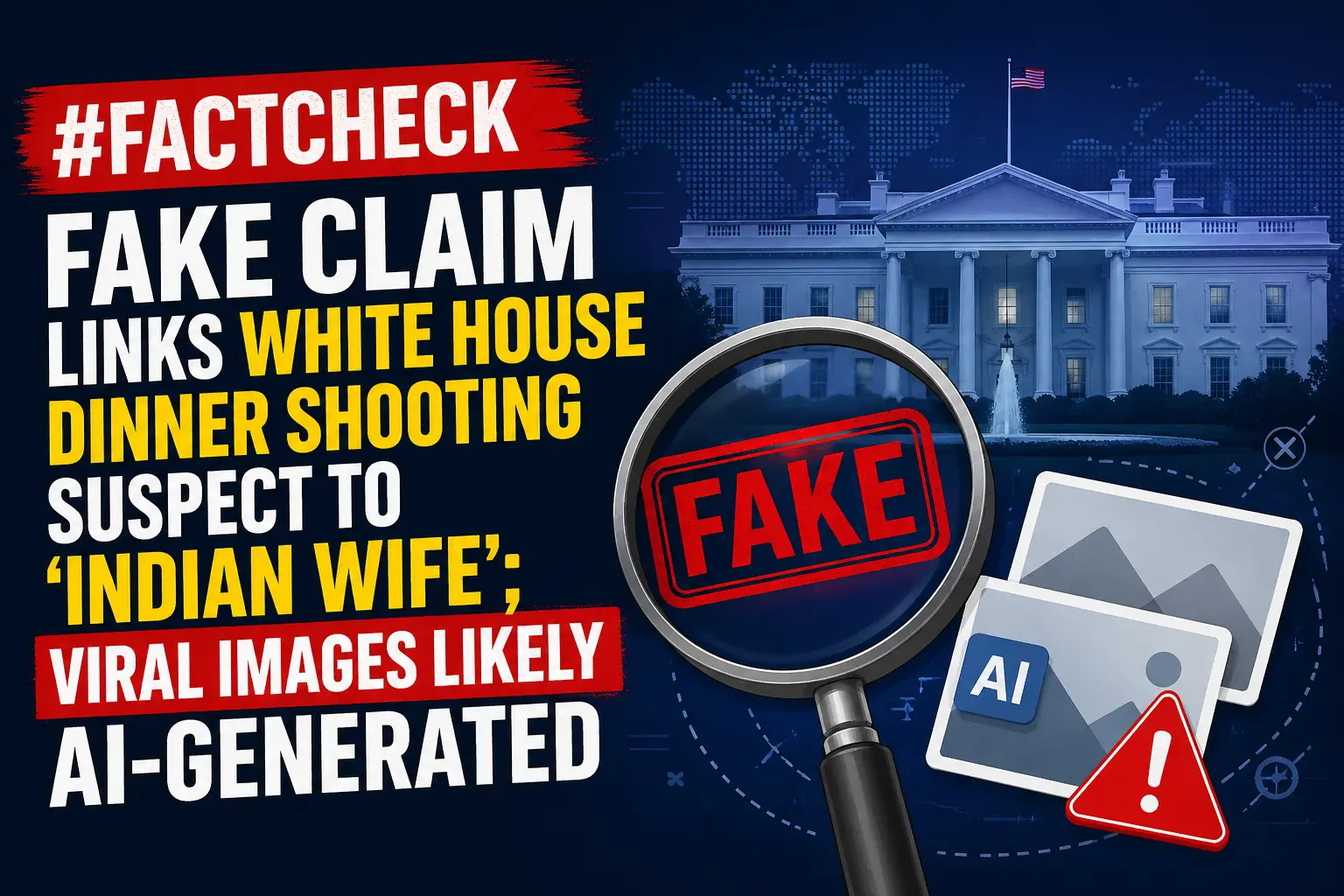
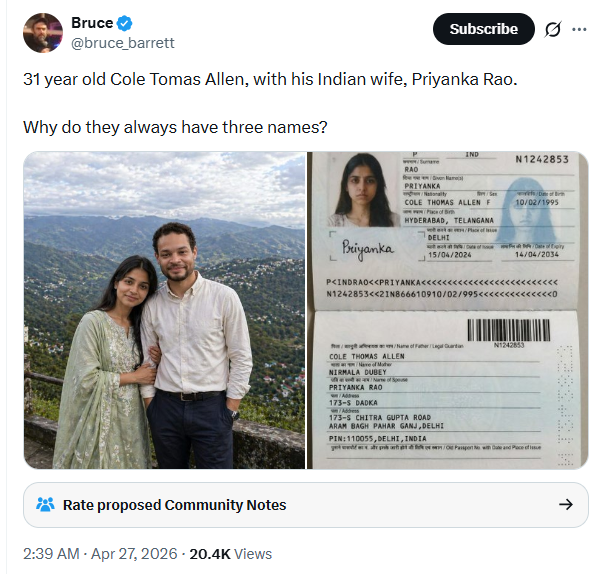
After reports identifying Cole Thomas Allen as the accused in the shooting incident at the White House Correspondents’ Association (WHCA) dinner, several Pakistani propaganda-linked social media accounts began circulating a new claim alleging that the suspect’s wife is an Indian woman named Priyanka Rao. Users shared a photo purportedly showing Cole Thomas Allen with Priyanka Rao, along with an alleged Indian passport in her name. One user posted the image with the caption: “31-year-old Cole Thomas Allen with his Indian wife Priyanka Rao. Why do they always have three names?”
However, research by the CyberPeace Research Wing found the claim to be fake. The viral passport and accompanying image appear to be AI-generated.
Claim:
Social media users claimed that Cole Thomas Allen, accused in the WHCA dinner shooting, is married to an Indian woman named Priyanka Rao.
Fact Check:
During the research, multiple inconsistencies were found in the viral passport image, strongly indicating it is fabricated. A close review of the document revealed several obvious errors commonly seen in AI-generated content. For instance, in the “Nationality” field, the name “Cole Thomas Allen” was written instead of a country name. Such a basic mistake would not appear in any genuine government-issued passport.
The Hindi text on the document was also highly inaccurate and unnatural. Examples included:
- “राष्ट्रीयता” misspelled as “राष्ट्रीयाय”
- “जन्मतिथि” replaced with meaningless text
- “जन्म स्थान” incorrectly written
- “Issue” mistranslated as unrelated wording
- “Date of Expiry” left untranslated in Hindi format
Further analysis using an AI detection tool indicated that the viral passport image had a 69 percent probability of being AI-generated.

Conclusion:
The claim that WHCA dinner shooting accused Cole Thomas Allen has an Indian wife named Priyanka Rao is fake. The viral passport and image being shared online are likely AI-generated and part of a misinformation campaign.
