
The Bank of Baroda Data Breach ~ What We Know, What We Don't, and What Comes Next
Introduction
On 27 July 2026, Bank of Baroda admitted to experiencing a cybersecurity attack, officially confirming many hours of chatter and speculation amongst Bank of Baroda customers and information security professionals. According to a statement by the bank issued through regulatory filing, the breach came about due to unauthorised access into some of its data via compromise of an employee’s email account; however, not much beyond these details was disclosed. In the meantime, allegations of a major large-scale data leak flooded into various platforms and forums of the cybersecurity world along with mainstream news outlets and, eventually, mainstream social networks. It’s now critically important for us to attempt to differentiate factual from unverified details about Bank of Baroda’s recent cybersecurity incident.
We will analyse and list what the bank has released, what our community research has discovered and also what questions are still left unanswered.
The bank's version
Bank of Baroda said the breach traced back to a single compromised employee email account, which gave an unknown party unauthorised access to "certain data". Crucially, the bank maintains that its core banking systems, that is, the infrastructure that actually moves customer money, were never touched. It says the incident was detected and contained quickly and that it is working with law enforcement and regulators while a forensic investigation continues. That's a fairly narrow admission compared with what had already surfaced on the dark web.
What the hackers claim
Days before the bank's statement, a relatively new ransomware and data-extortion group calling itself ‘TripleX’ listed Bank of Baroda on its dark web leak site, dated July 24. The group claimed to have pulled roughly 1 terabyte of data and, unusually, released the entire cache for free rather than holding it for ransom, framing the move on its leak page as punishment for the bank's weak passwords and security lapses.
Independent researcher Srikanth Lakshmanan, founder of the digital-rights group 'CashlessConsumer', examined samples of the leaked material before alerting the bank and authorities. He told India Today Tech that what he reviewed included internal branch audit files, loan appraisal documents, vigilance investigation records, audit reports tied to the bank's bob World mobile app, and customer account-opening forms.
Several outlets also reported that sample files appeared to contain Aadhaar numbers, customer photographs, and NetBanking details, alongside corporate and NRI banking records. It's worth being precise here, though: Reuters and other outlets have emphasised that the exact contents and true scale of the leak haven't been independently verified, and Bank of Baroda itself hasn't confirmed which specific data categories were exposed. Estimates of the dataset's size have also varied anywhere from around 700 gigabytes to a full terabyte, depending on the source.
A repeat offender
TripleX isn't new to targeting state-owned banks. The gang first appeared in May 2026, and only weeks before targeting Bank of Baroda, it claimed responsibility for hacking PT Bank Negara Indonesia – the largest of Indonesia's state-owned banks, which stole nearly 2 terabytes of documents, including contracts, IDs and transaction histories. Both compromises follow a familiar pattern. Identify one point of entry, extract widely, and instead of working in the background to negotiate for a ransom, publish everything for the largest damage possible.
This represents a notable break from typical ransomware attacks. Groups such as TripleX forego encryption, simply relying solely on the public pressure of (or actuality of) imminent disclosure to extort victims. It is the extortion component of "double extortion" with little incentive to pursue payment.
The regulatory clock
India's banking sector doesn't get much slack when something like this happens. The Reserve Bank of India's Cyber Security Framework for Banks requires an initial incident report within two to six hours of detection, and India's Computer Emergency Response Team (CERT-In) mandates reporting of specified incidents within six hours. Bank of Baroda has also reportedly filed a preliminary notice under a cyber-insurance programme arranged through National Insurance, offering total coverage of roughly $78 million, though it's far too early to know whether it will actually be paid out or how much will actually be paid out.
Looking ahead, India's Digital Personal Data Protection Rules are due to take effect in May 2027, which will tighten breach-notification obligations further. This incident lands right at the edge of that regulatory transition, arguably a preview of what's at stake for the next bank that gets hit.
A History of Data Security Missteps
This is not the first time banks’ technology has raised a red flag. In 2023, an investigation by The Reporters’ Collective and Al Jazeera discovered that bank employees had inserted the mobile numbers of unauthorised agents (including those belonging to staff and security guards) and other businesses into their customers' profiles to drive enrolment on the bank’s app – BoB World. Several of the bank's customers were later victims of fraud due to the unauthorised association of mobile numbers, and the bank had its own internally reported data issues that later led to the RBI mandating an audit and then prohibiting the bank from onboarding new Bob World users temporarily. Even though the two issues are not related, it serves as context; in the case of banks handling more than $300 billion in their global operations through over 8,400 domestic locations, room for security errors is marginal, and the damage, both public and regulatory, escalates from there on.
What it means for customers
For those who bank with the Bank of Baroda, the common-sense approach is checking statements for any unfamiliar transactions; beware unsolicited calls/messages referencing account details (which typically follow after identity document leaks are being used as a basis for secondary scams); and as a security precaution, change your NetBanking password and app PIN while no core systems of the bank are reported to have been breached; even so, it is advisable to apply. Because Aadhaar, if it has been really compromised, cannot be reset like a password, which is why a compromised identity document is typically of longer-term risk than a stolen password.
Conclusion
The bigger story here isn't just one bank's bad week. It's a reminder that in a system where a single compromised employee inbox can cascade into hundreds of gigabytes of exposed customer data, "our core systems weren't affected" is true and reassuring and, for anyone whose loan documents or ID numbers may now be sitting on a dark web forum, somewhat beside the point.
Sources
- Bank of Baroda confirms cyber incident after hackers claim data theft — The Record (Recorded Future News): https://therecord.media/india-bank-of-baroda-reports-cybersecurity-incident
- Bank of Baroda Data Leak: What We Know So Far — Gulf News: https://gulfnews.com/business/banking/bank-of-baroda-data-leak-what-we-know-so-far-about-alleged-cyber-breach-1.500621898
- Bank of Baroda Breach Tests Disclosure Readiness — GovInfoSecurity (ISMG): https://www.govinfosecurity.com/bank-baroda-breach-tests-disclosure-readiness-a-32335
- India's Bank of Baroda Faces Alleged 1TB Data Leak on Dark Web — Yahoo Finance / India Today Tech: https://finance.yahoo.com/technology/ai/articles/india-bank-baroda-faces-alleged-113047992.html
- Bank of Baroda Data Breach Exposes Customer Records — The Asian Banker: https://www.theasianbanker.com/updates-and-articles/india-s-bank-of-baroda-data-breach-exposes-customer-records-after-employee-email-compromise
- India's Bank of Baroda Expose Worsens: Agents Steal Money From Accounts (2023 background) — Al Jazeera: https://www.aljazeera.com/economy/2023/10/12/indias-bank-of-baroda-expose-worsens-agents-steal-money-from-accounts
- 'Immediate Containment Measures Implemented': Bank of Baroda Issues Clarity on Alleged 1TB Data Leak — Republic World: https://www.republicworld.com/business/immediate-containment-measures-implemented-bank-of-baroda-issues-clarity-on-1tb-data-leak-2026-07-27-133590

Related Blogs
Executive Summary
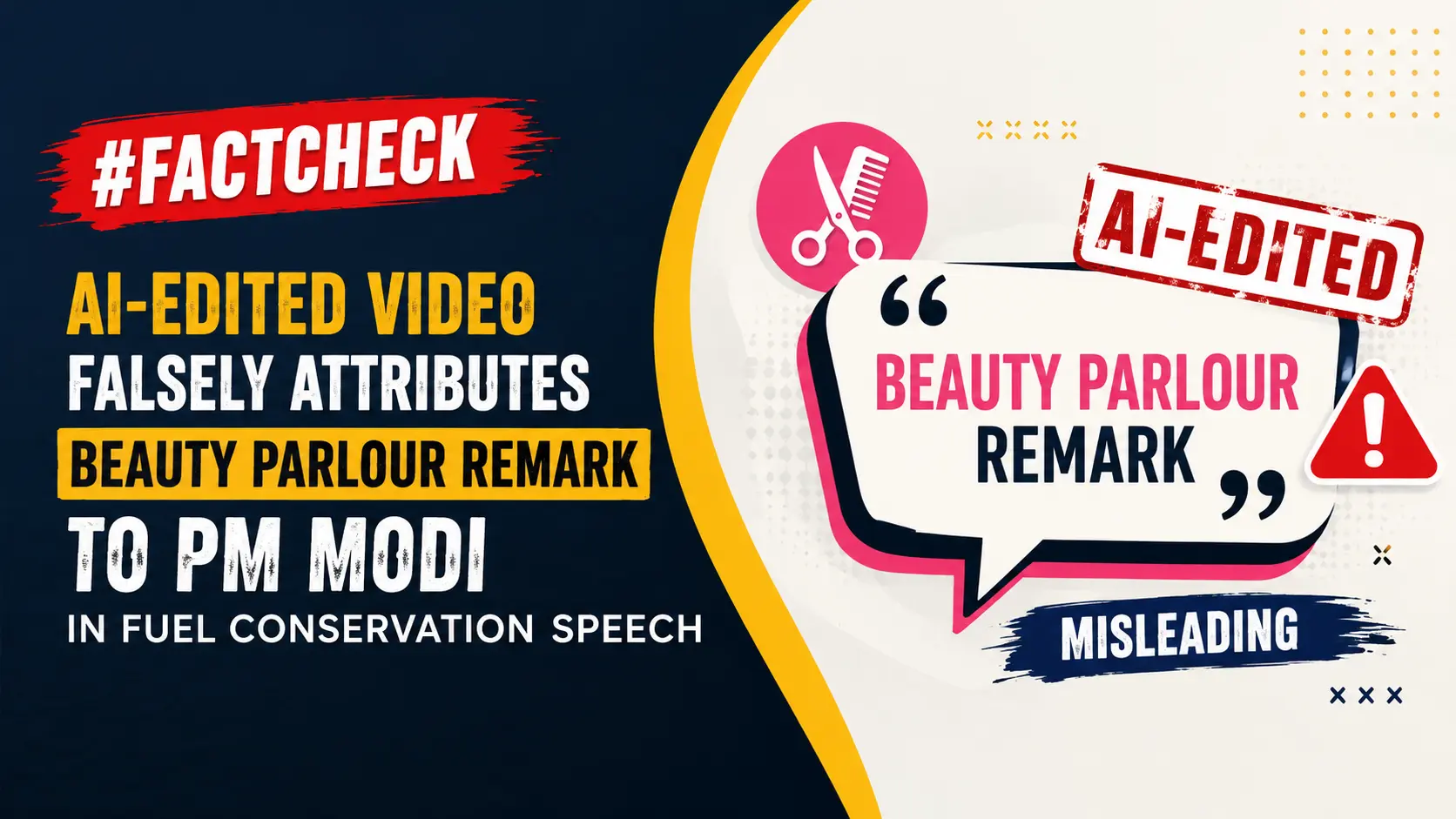
Amid ongoing tensions in West Asia, a video has been circulating on social media claiming that Prime Minister Narendra Modi urged women not to visit beauty parlours as part of an appeal related to fuel conservation. Users are widely sharing the clip as genuine. However, a fact-check by CyberPeace Research Wing has found the claim to be false. The research revealed that the original video, which discussed saving petrol, diesel and cooking gas, has been digitally edited using AI tools and shared with a misleading narrative.
Claim
An Instagram user shared the viral video on May 15, 2026, claiming that the Prime Minister advised women against visiting beauty parlours.

Fact Check
A keyword-based search on Google did not return any credible media reports supporting the viral claim. To verify the video, keyframes were extracted and run through reverse image search. The original footage was traced to the official YouTube channel of Prime Minister Narendra Modi, uploaded on May 10, 2026.
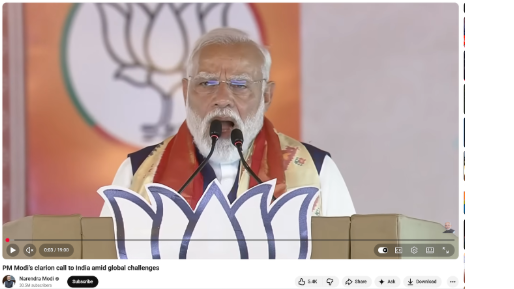
The video shows a rally held in Hyderabad, where the Prime Minister appealed to the public to save fuel by adopting work-from-home practices, promoting swadeshi goods, and refraining from purchasing gold for one year. However, nowhere in the full video is there any mention of advising women not to visit beauty parlours.
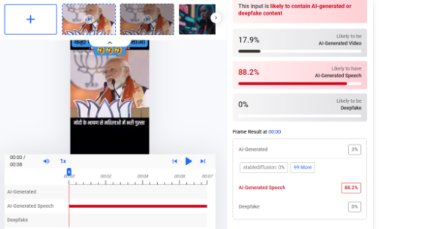
Further analysis also raised suspicion that the viral clip had been digitally altered using AI tools. The video was scanned using the HIVE Moderation AI detection tool, which indicated that it is approximately 88% likely to be AI-generated or manipulated.
Conclusion
The viral video is misleading. The original speech by Prime Minister Narendra Modi about conserving petrol, diesel and cooking gas has been edited using AI tools and circulated with a false claim targeting women visiting beauty parlours.

Introduction
In an era when misinformation spreads like wildfire across the digital landscape, the need for effective strategies to counteract these challenges has grown exponentially in a very short period. Prebunking and Debunking are two approaches for countering the growing spread of misinformation online. Prebunking empowers individuals by teaching them to discern between true and false information and acts as a protective layer that comes into play even before people encounter malicious content. Debunking is the correction of false or misleading claims after exposure, aiming to undo or reverse the effects of a particular piece of misinformation. Debunking includes methods such as fact-checking, algorithmic correction on a platform, social correction by an individual or group of online peers, or fact-checking reports by expert organisations or journalists. An integrated approach which involves both strategies can be effective in countering the rapid spread of misinformation online.
Brief Analysis of Prebunking
Prebunking is a proactive practice that seeks to rebut erroneous information before it spreads. The goal is to train people to critically analyse information and develop ‘cognitive immunity’ so that they are less likely to be misled when they do encounter misinformation.
The Prebunking approach, grounded in Inoculation theory, teaches people to recognise, analyse and avoid manipulation and misleading content so that they build resilience against the same. Inoculation theory, a social psychology framework, suggests that pre-emptively conferring psychological resistance against malicious persuasion attempts can reduce susceptibility to misinformation across cultures. As the term suggests, the MO is to help the mind in the present develop resistance to influence that it may encounter in the future. Just as medical vaccines or inoculations help the body build resistance to future infections by administering weakened doses of the harm agent, inoculation theory seeks to teach people fact from fiction through exposure to examples of weak, dichotomous arguments, manipulation tactics like emotionally charged language, case studies that draw parallels between truths and distortions, and so on. In showing people the difference, inoculation theory teaches them to be on the lookout for misinformation and manipulation even, or especially, when they least expect it.
The core difference between Prebunking and Debunking is that while the former is preventative and seeks to provide a broad-spectrum cover against misinformation, the latter is reactive and focuses on specific instances of misinformation. While Debunking is closely tied to fact-checking, Prebunking is tied to a wider range of specific interventions, some of which increase motivation to be vigilant against misinformation and others increase the ability to engage in vigilance with success.
There is much to be said in favour of the Prebunking approach because these interventions build the capacity to identify misinformation and recognise red flags However, their success in practice may vary. It might be difficult to scale up Prebunking efforts and ensure their reach to a larger audience. Sustainability is critical in ensuring that Prebunking measures maintain their impact over time. Continuous reinforcement and reminders may be required to ensure that individuals retain the skills and information they gained from the Prebunking training activities. Misinformation tactics and strategies are always evolving, so it is critical that Prebunking interventions are also flexible and agile and respond promptly to developing challenges. This may be easier said than done, but with new misinformation and cyber threats developing frequently, it is a challenge that has to be addressed for Prebunking to be a successful long-term solution.
Encouraging people to be actively cautious while interacting with information, acquire critical thinking abilities, and reject the effect of misinformation requires a significant behavioural change over a relatively short period of time. Overcoming ingrained habits and prejudices, and countering a natural reluctance to change is no mean feat. Developing a widespread culture of information literacy requires years of social conditioning and unlearning and may pose a significant challenge to the effectiveness of Prebunking interventions.
Brief Analysis of Debunking
Debunking is a technique for identifying and informing people that certain news items or information are incorrect or misleading. It seeks to lessen the impact of misinformation that has already spread. The most popular kind of Debunking occurs through collaboration between fact-checking organisations and social media businesses. Journalists or other fact-checkers discover inaccurate or misleading material, and social media platforms flag or label it. Debunking is an important strategy for curtailing the spread of misinformation and promoting accuracy in the digital information ecosystem.
Debunking interventions are crucial in combating misinformation. However, there are certain challenges associated with the same. Debunking misinformation entails critically verifying facts and promoting corrected information. However, this is difficult owing to the rising complexity of modern tools used to generate narratives that combine truth and untruth, views and facts. These advanced approaches, which include emotional spectrum elements, deepfakes, audiovisual material, and pervasive trolling, necessitate a sophisticated reaction at all levels: technological, organisational, and cultural.
Furthermore, It is impossible to debunk all misinformation at any given time, which effectively means that it is impossible to protect everyone at all times, which means that at least some innocent netizens will fall victim to manipulation despite our best efforts. Debunking is inherently reactive in nature, addressing misinformation after it has grown extensively. This reactionary method may be less successful than proactive strategies such as Prebunking from the perspective of total harm done. Misinformation producers operate swiftly and unexpectedly, making it difficult for fact-checkers to keep up with the rapid dissemination of erroneous or misleading information. Debunking may need continuous exposure to fact-check to prevent erroneous beliefs from forming, implying that a single Debunking may not be enough to rectify misinformation. Debunking requires time and resources, and it is not possible to disprove every piece of misinformation that circulates at any particular moment. This constraint may cause certain misinformation to go unchecked, perhaps leading to unexpected effects. The misinformation on social media can be quickly spread and may become viral faster than Debunking pieces or articles. This leads to a situation in which misinformation spreads like a virus, while the antidote to debunked facts struggles to catch up.
Prebunking vs Debunking: Comparative Analysis
Prebunking interventions seek to educate people to recognise and reject misinformation before they are exposed to actual manipulation. Prebunking offers tactics for critical examination, lessening the individuals' susceptibility to misinformation in a variety of contexts. On the other hand, Debunking interventions involve correcting specific false claims after they have been circulated. While Debunking can address individual instances of misinformation, its impact on reducing overall reliance on misinformation may be limited by the reactive nature of the approach.
.png)
CyberPeace Policy Recommendations for Tech/Social Media Platforms
With the rising threat of online misinformation, tech/social media platforms can adopt an integrated strategy that includes both Prebunking and Debunking initiatives to be deployed and supported on all platforms to empower users to recognise the manipulative messaging through Prebunking and be aware of the accuracy of misinformation through Debunking interventions.
- Gamified Inoculation: Tech/social media companies can encourage gamified inoculation campaigns, which is a competence-oriented approach to Prebunking misinformation. This can be effective in helping people immunise the receiver against subsequent exposures. It can empower people to build competencies to detect misinformation through gamified interventions.
- Promotion of Prebunking and Debunking Campaigns through Algorithm Mechanisms: Tech/social media platforms may promote and guarantee that algorithms prioritise the distribution of Prebunking materials to users, boosting educational content that strengthens resistance to misinformation. Platform operators should incorporate algorithms that prioritise the visibility of Debunking content in order to combat the spread of erroneous information and deliver proper corrections; this can eventually address and aid in Prebunking and Debunking methods to reach a bigger or targeted audience.
- User Empowerment to Counter Misinformation: Tech/social media platforms can design user-friendly interfaces that allow people to access Prebunking materials, quizzes, and instructional information to help them improve their critical thinking abilities. Furthermore, they can incorporate simple reporting tools for flagging misinformation, as well as links to fact-checking resources and corrections.
- Partnership with Fact-Checking/Expert Organizations: Tech/social media platforms can facilitate Prebunking and Debunking initiatives/campaigns by collaborating with fact-checking/expert organisations and promoting such initiatives at a larger scale and ultimately fighting misinformation with joint hands initiatives.
Conclusion
The threat of online misinformation is only growing with every passing day and so, deploying effective countermeasures is essential. Prebunking and Debunking are the two such interventions. To sum up: Prebunking interventions try to increase resilience to misinformation, proactively lowering susceptibility to erroneous or misleading information and addressing broader patterns of misinformation consumption, while Debunking is effective in correcting a particular piece of misinformation and having a targeted impact on belief in individual false claims. An integrated approach involving both the methods and joint initiatives by tech/social media platforms and expert organizations can ultimately help in fighting the rising tide of online misinformation and establishing a resilient online information landscape.
References
- https://mark-hurlstone.github.io/THKE.22.BJP.pdf
- https://futurefreespeech.org/wp-content/uploads/2024/01/Empowering-Audiences-Through-%E2%80%98Prebunking-Michael-Bang-Petersen-Background-Report_formatted.pdf
- https://newsreel.pte.hu/news/unprecedented_challenges_Debunking_disinformation
- https://misinforeview.hks.harvard.edu/article/global-vaccination-badnews/
.webp)
Introduction
In July 2025, the Digital Defence Report prepared by Microsoft raised an alarm that India is part of the top target countries in AI-powered nation-state cyberattacks with malicious agents automating phishing, creating convincing deepfakes, and influencing opinion with the help of generative AI (Microsoft Digital Defence Report, 2025). Most of the attention in the world has continued to be on the United States and Europe, but Asia-Pacific and especially India have become a major target in terms of AI-based cyber activities. This blog discusses the role of AI in espionage, redefining the threat environment of India, the reaction of the government, and what India can learn by looking at the example of cyber giants worldwide.
Understanding AI-Powered Cyber Espionage
Conventional cyber-espionage intends to hack systems, steal information or bring down networks. With the emergence of generative AI, these strategies have changed completely. It is now possible to automate reconnaissance, create fake voices and videos of authorities and create highly advanced phishing campaigns which can pass off as genuine even to a trained expert. According to the report made by Microsoft, AI is being used by state-sponsored groups to expand their activities and increase accuracy in victims (Microsoft Digital Defence Report, 2025). Based on SQ Magazine, almost 42 percent of state-based cyber campaigns in 2025 had AIs like adaptive malware or intelligent vulnerability scanners (SQ Magazine, 2025).
AI is altering the power dynamic of cyberspace. The tools previously needing significant technical expertise or substantial investments have become ubiquitous, and smaller countries can conduct sophisticated cyber operations as well as non-state actors. The outcome is the speeding up of the arms race with AI serving as the weapon and the armour.
India’s Exposure and Response
The weakness of the threat landscape lies in the growing online infrastructure and geopolitical location. The attack surface has expanded the magnitude of hundreds of millions of citizens with the integration of platforms like DigiLocker and CoWIN. Financial institutions, government portals and defence networks are increasingly becoming targets of cyber attacks that are more sophisticated. Faking videos of prominent figures, phishing letters with the official templates, and manipulation of the social media are currently all being a part of disinformation campaigns (Microsoft Digital Defence Report, 2025).
According to the Data Security Council of India (DSCI), the India Cyber Threat Report 2025 reported that attacks using AI are growing exponentially, particularly in the shape of malicious behaviour and social engineering (DSCI, 2025). The nodal cyber-response agency of India, CERT-In, has made several warnings regarding scams related to AI and AI-generated fake content that is aimed at stealing personal information or deceiving the population. Meanwhile, enforcement and red-teaming actions have been intensified, but the communication between central agencies and state police and the private platforms is not even. There is also an acute shortage of cybersecurity talents in India, as less than 20 percent of cyber defence jobs are occupied by qualified specialists (DSCI, 2025).
Government and Policy Evolution
The government response to AI-enabled threats is taking three forms, namely regulation, institutional enhancing, and capacity building. The Digital Personal Data Protection Act 2023 saw a major move in defining digital responsibility (Government of India, 2023). Nonetheless, threats that involve AI-specific issues like data poisoning, model manipulation, or automated disinformation remain grey areas. The following National Cybersecurity Strategy will attempt to remedy them by establishing AI-government guidelines and responsibility standards to major sectors.
At the institutional level, the efforts of such organisations as the National Critical Information Infrastructure Protection Centre (NCIIPC) and the Defence Cyber Agency are also being incorporated into their processes with the help of AI-based monitoring. There is also an emerging public-private initiative. As an example, the CyberPeace Foundation and national universities have signed a memorandum of understanding that currently facilitates the specialised training in AI-driven threat analysis and digital forensics (Times of India, August 2025). Even after these positive indications, India does not have any cohesive system of reporting cases of AI. The publication on arXiv in September 2025 underlines the importance of the fact that legal approaches to AI-failure reporting need to be developed by countries to approach AI-initiated failures in such fields as national security with accountability (arXiv, 2025).
Global Implications and Lessons for India
Major economies all over the world are increasing rapidly to integrate AI innovation with cybersecurity preparedness. The United States and United Kingdom are spending big on AI-enhanced military systems, performing machine learning in security operations hubs and organising AI-based “red team” exercises (Microsoft Digital Defence Report, 2025). Japan is testing cross-ministry threat-sharing platforms that utilise AI analytics and real-time decision-making (Microsoft Digital Defence Report, 2025).
Four lessons can be distinguished as far as India is concerned.
- To begin with, the cyber defence should shift to proactive intelligence in place of reactive investigation. It is not only possible to detect the adversary behaviour after the attacks, but to simulate them in advance using AI.
- Second, teamwork is essential. The issue of cybersecurity cannot be entrusted to government enforcement. The private sector that maintains the majority of the digital infrastructure in India must be actively involved in providing information and knowledge.
- Third, there is the issue of AI sovereignty. Building or hosting its own defensive AI tools in India will diminish dependence on foreign vendors, and minimise the possible vulnerabilities of the supply-chain.
- Lastly, the initial defence is digital literacy. The citizens should be trained on how to detect deepfakes, phishing, and other manipulated information. The importance of creating human awareness cannot be underestimated as much as technical defences (SQ Magazine, 2025).
Conclusion
AI has altered the reasoning behind cyber warfare. There are quicker attacks, more difficult to trace and scalable as never before. In the case of India, it is no longer about developing better firewalls but rather the ability to develop anticipatory intelligence to counter AI-powered threats. This requires a national policy that incorporates technology, policy and education.
India can transform its vulnerability to strength with the sustained investment, ethical AI governance, and healthy cooperation between the government and the business sector. The following step in cybersecurity does not concern who possesses more firewalls than the other but aims to learn and adjust more quickly and successfully in a world where machines already belong to the battlefield (Microsoft Digital Defence Report, 2025).
References:
- Microsoft Digital Defense Report 2025
- India Cyber Threat Report 2025, DSCI
- Lucknow based organisations to help strengthen cybercrime research training policy ecosystem
- AI Cyber Attacks Statistics 2025: How Attacks, Deepfakes & Ransomware Have Escalated, SQ Magazine
- Incorporating AI Incident Reporting into Telecommunications Law and Policy: Insights from India.
- The Digital Personal Data Protection Act, 2023
