#FactCheck-AI-Generated Video Falsely Shared as Drone Footage of Flooded Surat, Gujarat
Executive Summary
A 20-second video showing skyscrapers submerged in water is being widely circulated on social media with the claim that it depicts the flood situation in Surat, Gujarat. The video is also being used by some users to criticize the Bharatiya Janata Party (BJP) government in Gujarat and Prime Minister Narendra Modi. Many social media users are sharing the clip as authentic footage of flooding in Surat. CyberPeace Research Wing’s research found the viral claim to be false. Our research revealed that the video is AI-generated and has no connection with Surat. While it is true that heavy rainfall caused flooding in parts of Surat and nearby districts in early July 2026, the viral video does not show any real scenes from the city.
Claim
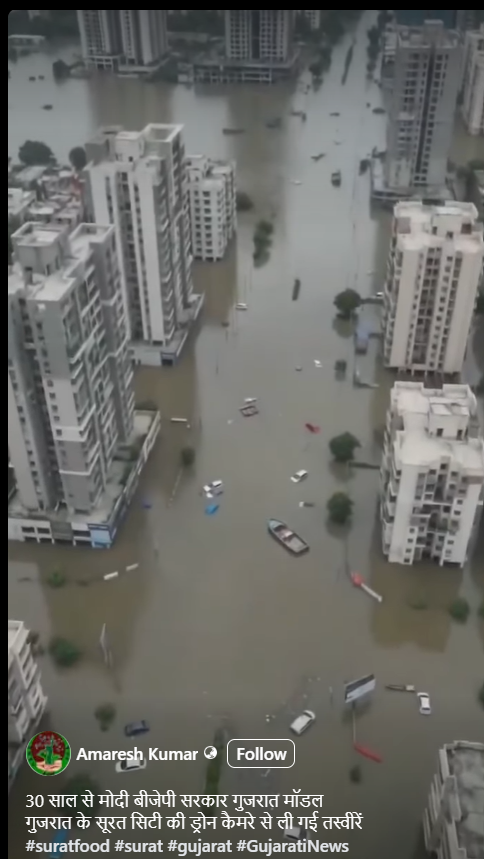
Facebook user ‘Amresh Kumar’ shared the viral video on July 16, 2026, with the caption, “Thirty years of the Modi-BJP government. Drone footage of Gujarat Model – Surat city.”
https://www.facebook.com/reel/2440459239767277
Fact Check
To verify the claim, we first conducted a keyword search using terms related to flooding in Surat during July 2026. Our search confirmed that Surat experienced heavy rainfall during the first week of July, resulting in waterlogging and disruption in several low-lying areas. According to a report published by Bhaskar.com on July 8, 2026, intense rainfall led to flooding in several parts of Surat, and a few deaths due to electrocution were also reported.
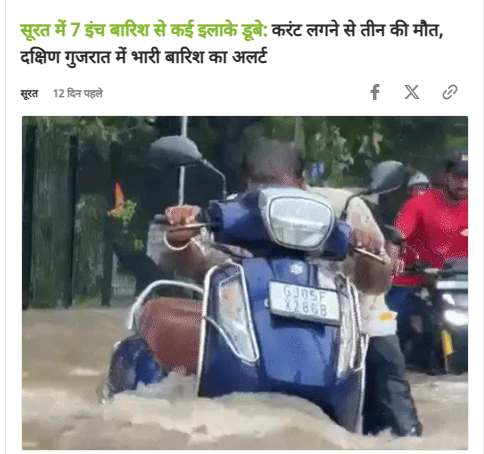
However, none of the credible reports or images from the actual flooding resembled the scenes shown in the viral video. To further investigate, we analysed the video using multiple AI detection tools.We first scanned the video using Hive Moderation, which indicated a 99.9% probability that the footage was generated using Artificial Intelligence.
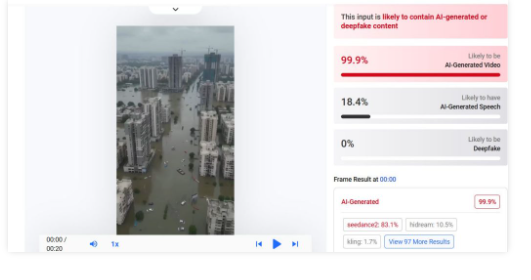
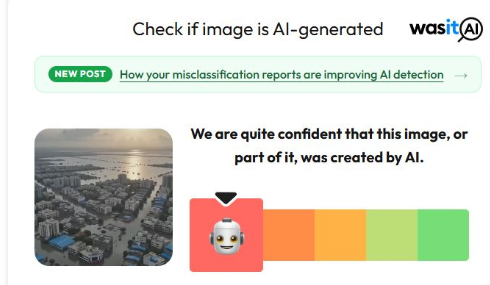
For additional verification, we examined the clip using another AI detection platform, WasItAI, which also concluded that the video had been created using AI. The analysis from multiple tools strongly suggests that the viral footage is digitally generated and does not represent a real event.
Conclusion
Our research found that the viral video being shared as drone footage of flooding in Surat is fake. Although Surat experienced heavy rainfall and flooding in early July 2026, the video circulating on social media is AI-generated and has no connection with the actual situation in the city. The clip is being falsely shared to spread misleading information.
Related Blogs

Governments in nations across the globe are consequently vying to draw in data centre investments as components of the wider AI sovereignty policies. However, recent events in Ireland make it clear that such an infrastructure is associated with significant environmental and social price tags. In geographically dense and resource-strained countries such as India, these trade-offs pose some pressing questions of whether today's AI ambitions are socially or environmentally sustainable. The data centre crisis in Ireland provides a handy reminder. It puts emphasis on the capacity of land use, water stress, energy demand, and disruption of communities to amplify quickly as digital infrastructure continues to increase at a faster rate than the regulatory and ecological capacity. These lessons should be paid close attention to as India continues to develop the IndiaAI Mission and establish itself as an AI hub in the future.
Why Data Centres Are Ecological Stress Multipliers
The data centres are sometimes referred to as clean digital infrastructure; however, in an actual sense, they are heavy industrial guardians of resources. Centres of large proportions demand an extensive amount of land, constant electricity, and a significant amount of water to cool down.
The most apparent effect is on energy consumption. Data centres are 24/7, round the clock, and need to be powered with a high-quality and stable electricity supply. By 2022, data centres had more than a quarter of the overall national electricity demand in Ireland, which created problems regarding grid stability and energy security (EirGrid, 2022). This compelled regulators to limit new connections in some of the areas. These trends also bring some similarities to certain regions of the United States, especially in Virginia, where particular data centres have led to peaks in the electricity demand in the region (U.S. Energy Information Administration, 2023).
Another primary source of pressure is the use of water. Heavy liquid coolers are very intensive systems in data centres, which tend to use the local freshwater sources. This may directly compete with residential and agricultural requirements in case of heatwaves or drought. In the western US, environmental advocates have issued notices that data centres contribute to a water deficit in other overextended basins (New York Times, 2023).
It also depends on local pollution and land use. Data centres are normally constructed on large plots close to urban or peri-urban centres, having good accessibility. This may push aside farmlands, increase property rates, and change local ecologies. The backup diesel generators, which are employed during power cuts, add to air and noise pollutants, and they thus impact the adjacent communities.
Ireland’s Experience and the Social Backlash
The low corporate taxes, cool climate, and PIC access to the EU market made Ireland a big data centre hub. The concentration of facilities around Dublin was, however, done unintentionally, leading to its rapid concentration. The population in their local communities also experienced mounting housing pressure, power competition, and underemployment because the number of long-term jobs created by a data centre is comparatively low.
The Irish government later realised that data centre expansion was causing strain on climate commitments and electricity infrastructure on a national level. The grid operators started denying new connections to data centres in sections of the country, which amounted to a kind of moratorium on further growth (TechPolicy.Press, 2024). What was initially a digital success story became a government issue, an ecology versus economic plan clash.
This experience particularly applies to smaller or densely populated countries. Countries such as Ireland and India have concentrated influences on fewer points, unlike the United States or China, which are able to spread data centres over wide areas.
India’s Emerging Data Centre Geography
India is advertising data centres as a way of advancing its digital and AI platforms. There are a number of states that have published data centre policies, such as Maharashtra, Tamil Nadu, Telangana, and Uttar Pradesh. The connectivity, financial infrastructure, and location to large user bases are making Mumbai, Chennai, Hyderabad, and Noida major hubs (MeitY, 2023).
Nevertheless, these areas are already stressed in terms of the environment. Mumbai also suffers from land shortage and flooding. There is a permanent water scarcity in Chennai. Hyderabad and Noida cannot cope with the intensity of population growth and energy demand in urban areas. Locating such large-scale data centres in these locations will pose a risk of augmenting the existing vulnerabilities instead of decentralising the benefits of development.
India, in contrast to the United States or China, does not have continental-scale low-density areas with spare water and power near demand centres. Each additional data centre in India is thus likely to have an impact on an increasing number of people per unit of infrastructure, by land acquisition, water diversion, grid pressure, or environmental externalities.
Community Impacts and Uneven Costs
The cost incurred by local communities to increase their data centre expansion is not proportionate to the benefits enjoyed. The after construction efforts to generate employment is minimal and the long term effects include strains on infrastructure. Tariffs can be increased with the growth of electric power demand. The extraction of water may have impacts on local supply. The prices of real estate may crowd out the lower-income population.
These impacts may be enhanced in India, where urban inequality is already high. The informal settlements along the industrial areas are such that they are vulnerable to pollution as well as diversion of resources. Data centres will otherwise be yet another project that creates unequal development without proper consultation with the community and other environmental protection measures.
What This Means for India’s AI Sovereignty Plans
The IndiaAI Mission of India focuses on developing local AI potential, data networks, and processing units to minimise the use of external systems ( IndiaAI Mission Document, 2024). This vision is based on data centres. Nevertheless, the concept of simple AI autonomy is made difficult by ecological limits.
An AI infrastructure that compromises water security, energy availability, or climate objectives could come under opposition and regulation backlash, as in the case of Ireland. This would delay deployment and add up to more expenses. Physical expansion is not sufficient to have true AI sovereignty. It should also take into consideration sustainability, decentralisation, and efficiency.
This brings about strategic concerns. India must invest more vigorously in energy-efficient computing, edge AI and model optimisation as opposed to scale. Is renewable energy integration viable to maintain the information centre demand? Is data centre siting to comply with long term water and land use planning, and not the short-term incentives of investment?
Towards a Sustainable Digital Infrastructure Strategy
India can still afford to learn not to repeat the errors experienced elsewhere. This will necessitate data centres being regarded as digital assets, not important infrastructures that have an environmental and social impact. Both more robust environmental impact assessments and public water and energy accounting and community involvement must become unavoidable.
From an AI policy perspective, sustainability should be seen as a pillar of sovereignty. An AI ecosystem that depends on fragile ecological foundations is not resilient. By learning from Ireland and adapting global lessons to local realities, India can pursue AI leadership without creating new environmental crises.
The future of AI will not be decided only by algorithms and talent. It will also be shaped by land, water, energy, and the communities that live alongside digital infrastructure. Ignoring those realities would make AI ambition fragile rather than sovereign.
References
- TechPolicy.Press. What Ireland’s Data Center Crisis Means for the EU’s AI Sovereignty Plans. 2024. https://techpolicy.press
- EirGrid. Electricity Demand Forecast Statement. 2022. https://www.eirgridgroup.com
- U.S. Energy Information Administration. Data Centers and Energy Demand. 2023. https://www.eia.gov
- New York Times. Data Centers Are Straining Water Supplies in the American West. 2023. https://www.nytimes.com
- Ministry of Electronics and Information Technology. India Data Centre Policy and Digital Infrastructure Initiatives. 2023. https://www.meity.gov.in
- IndiaAI Mission. Official Mission Document and Framework. 2024. https://indiaai.gov.in

Executive Summary:
A viral video circulating on social media shows a man attempting to fly using a helicopter like fan attached to his body, followed by a crash onto a parked car. The clip was widely shared with humorous captions, suggesting it depicts a real life incident. Given the unusual nature of the visuals, the video was subjected to technical verification using AI content detection tools. Analysis using the AI detection platform indicates that the video is AI generated, and not a genuine real world event.
Claim:
A viral video (archive link) claims to show a person attempting to fly using a self made helicopter fan mechanism, briefly lifting off before crashing onto a car in a public setting. The video shows a man attempting to fly by strapping a helicopter like rotating fan to himself, essentially trying to imitate a human helicopter using a DIY mechanism. For a brief moment, it appears as if the device might work, but the attempt quickly fails due to lack of control, engineering support, and safety measures. Within seconds, the man loses balance and crashes down, landing on top of a parked car. The scene highlights a mix of overconfidence, unregulated experimentation, and risk taking carried out in a public space, with bystanders watching rather than intervening. The clip is shared humorously with the caption “India is not for beginners”.

Fact Check:
To verify the authenticity of the video, it was analyzed using the Hive Moderation AI detection tool, a widely used platform for identifying synthetic and AI generated media. The tool flagged the video with a high probability of AI generation, indicating that the visuals are not captured from a real physical event. Additional indicators such as unrealistic motion physics, inconsistent human object interaction further support the conclusion that the clip was artificially generated or heavily manipulated using generative AI techniques. No credible news reports or independent eyewitness sources corroborate the occurrence of such an incident.

Conclusion:
The claim that the video shows an individual attempting and failing to fly using a helicopter like device is false. Technical analysis confirms that the video is AI generated, and it should be treated as synthetic or fictional content rather than a real life incident. This case highlights how AI generated videos, when shared without context, can mislead audiences and be mistaken for real events, reinforcing the need for verification tools and critical evaluation of viral content.
- Claim: A viral video claims to show a person attempting to fly using a self made helicopter fan mechanism, briefly lifting off before crashing onto a car in a public setting
- Claimed On: X (Formally Twitter)
- Fact Check: False and Misleading

Executive Summary:
The rise in cybercrime targeting vulnerable individuals, particularly students and their families, has reached alarming levels. Impersonation scams, where fraudsters pose as Law Enforcement Officers, have become increasingly sophisticated, exploiting fear, urgency, and social stigma. This report delves into recent incidents of ransom scams involving fake CBI officers, highlighting the execution methods, psychological impact on victims, and preventive measures. The goal is to raise public awareness and equip individuals with the knowledge needed to protect themselves from such fraudulent activities.
Introduction:
Cybercriminals are evolving their tactics, with impersonation and social engineering at the forefront. Scams involving fake law enforcement officers have become rampant, preying on the fear of legal repercussions and the desire to protect loved ones. This report examines incidents where scammers impersonated CBI officers to extort money from families of students, emphasizing the urgent need for awareness, verification, and preventive measures.
Case Study:
This case study explains how the scammers impersonate themselves for the money targeting students' families.
Targets receive calls from scammers posing as CBI officers. Mostly the families of students are targeted by the fraudsters using sophisticated impersonation and emotional manipulation tactics. In our case study, the targets received calls from unknown international numbers, falsely claiming that the students, along with their friends, were involved in a fabricated rape case. The parents get calls during school or college hours, a time when it is particularly difficult and chaotic for parents to reach their children, adding to the panic and sense of urgency. The scammers manipulate the parents by stating that, due to the students' clean records, they are not officially arrested but would face severe legal consequences unless a sum of money is paid immediately.
Although in these specific cases, the parents did not pay the money, many parents in our country fall victim to such scams, paying large sums out of fear and desperation to protect their children’s futures. The fear of legal repercussions, social stigma, and the potential damage to the students' reputations, the scammers used high-pressure tactics to force compliance.
These incidents may result in significant financial losses, emotional trauma, and a profound loss of trust in communication channels and authorities. This underscores the urgent need for awareness, verification of authority, and prompt reporting of such scams to prevent further victimisation
Modus Operandi:
- Caller ID Spoofing: The scammer used a unknown number and spoofing techniques to mimic a legitimate law enforcement authority.
- Fear Induction: The fraudster played on the family's fear of social stigma, manipulating them into compliance through emotional blackmail.
Analysis:
Our research found that the unknown international numbers used in these scams are not real but are puppet numbers often used for prank calls and fraudulent activities. This incident also raises concerns about data breaches, as the scammers accurately recited students' details, including names and their parents' information, adding a layer of credibility and increasing the pressure on the victims. These incidents result in significant financial losses, emotional trauma, and a profound loss of trust in communication channels and authorities.
Impact on Victims:
- Financial and Psychological Losses: The family may face substantial financial losses, coupled with emotional and psychological distress.
- Loss of Trust in Authorities: Such scams undermine trust in official communication and law enforcement channels.
- Exploitation of Fear and Urgency: Scammers prey on emotions such as fear, urgency, and social stigma to manipulate victims.
- Sophisticated Impersonation Techniques: Using caller ID spoofing, Virtual/Temporary numbers and impersonation of Law Enforcement Officers adds credibility to the scam.
- Lack of Verification: Victims often do not verify the caller's identity, leading to successful scams.
- Significant Psychological Impact: Beyond financial losses, these scams cause lasting emotional trauma and distrust in institutions.
Recommendations:
- Cross-Verification: Always cross-verify with official sources before acting on such claims. Always contact official numbers listed on trusted Government websites to verify any claims made by callers posing as law enforcement.
- Promote Awareness: Educational institutions should conduct regular awareness programs to help students and families recognize and respond to scams.
- Encourage Prompt Reporting: Reporting such incidents to authorities can help track scammers and prevent future cases. Encourage victims to report incidents promptly to local authorities and cybercrime units.
- Enhance Public Awareness: Continuous public awareness campaigns are essential to educate people about the risks and signs of impersonation scams.
- Educational Outreach: Schools and colleges should include Cybersecurity awareness as part of their curriculum, focusing on identifying and responding to scams.
- Parental Guidance and Support: Parents should be encouraged to discuss online safety and scam tactics with their children regularly, fostering a vigilant mindset.
Conclusion:
The rise of impersonation scams targeting students and their families is a growing concern that demands immediate attention. By raising awareness, encouraging verification of claims, and promoting proactive reporting, we can protect vulnerable individuals from falling victim to these manipulative and harmful tactics. It is high time for the authorities, educational institutions, and the public to collaborate in combating these scams and safeguarding our communities. Strengthening data protection measures and enhancing public education on the importance of verifying claims can significantly reduce the impact of these fraudulent schemes and prevent further victimisation.