
#FactCheck: AI-Generated Newspaper Clipping Falsely Claims Ayushman Cards Will Be Valid Only at Government Hospitals From December 1
Executive Summary
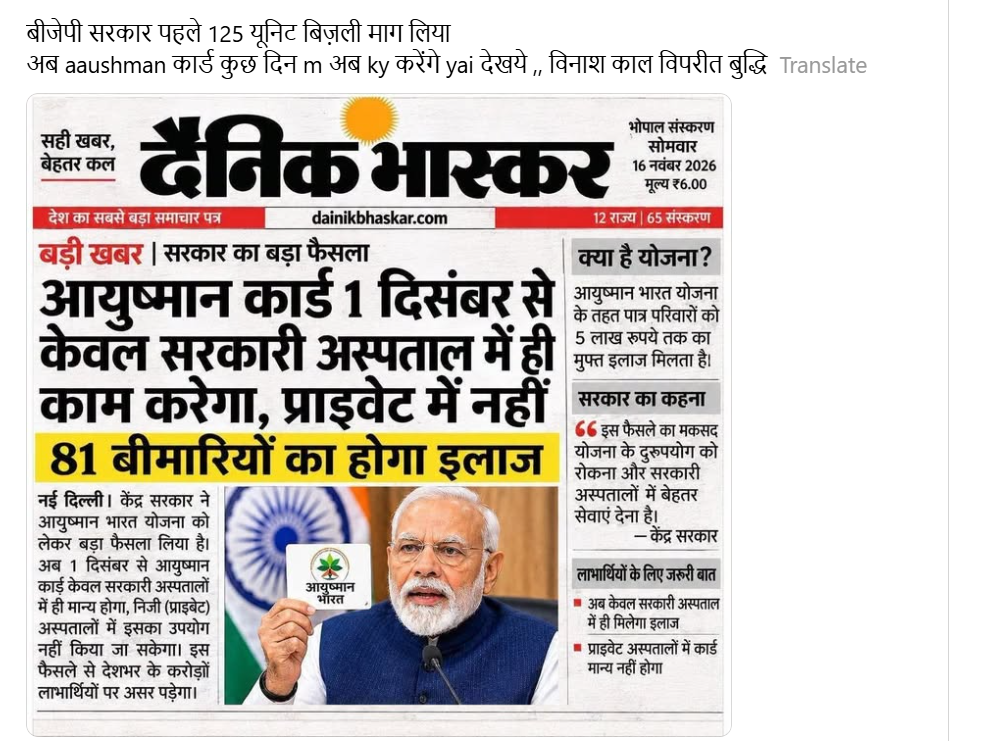
A purported newspaper clipping regarding the Central Government's Ayushman Bharat scheme is being circulated on social media. It claims that, from December 1, Ayushman cards will be valid only at government hospitals and cannot be used at private hospitals. Several users are sharing the clipping on social media, believing it to be a genuine news report. CyberPeace Research found that Dainik Bhaskar did not publish any such report. Furthermore, the Central Government has made no such announcement regarding Ayushman cards. Our research revealed that the viral newspaper clipping was created using Artificial Intelligence (AI).
Claim:
The Central Government has announced that, from December 1, Ayushman cards will be valid only at government hospitals.
https://www.threads.com/@sauravvikram15/post/Df679RljeaA
Fact-check:
Upon closely examining the viral newspaper clipping, we noticed several grammatical and spelling errors. Even common words such as ‘card’, ‘private’ and ‘crores’ were misspelled. Furthermore, a search using relevant keywords on Dainik Bhaskar's official website did not yield any report supporting the claim. These findings indicate that the viral news screenshot circulated in the name of Dainik Bhaskar was created using Artificial Intelligence (AI).
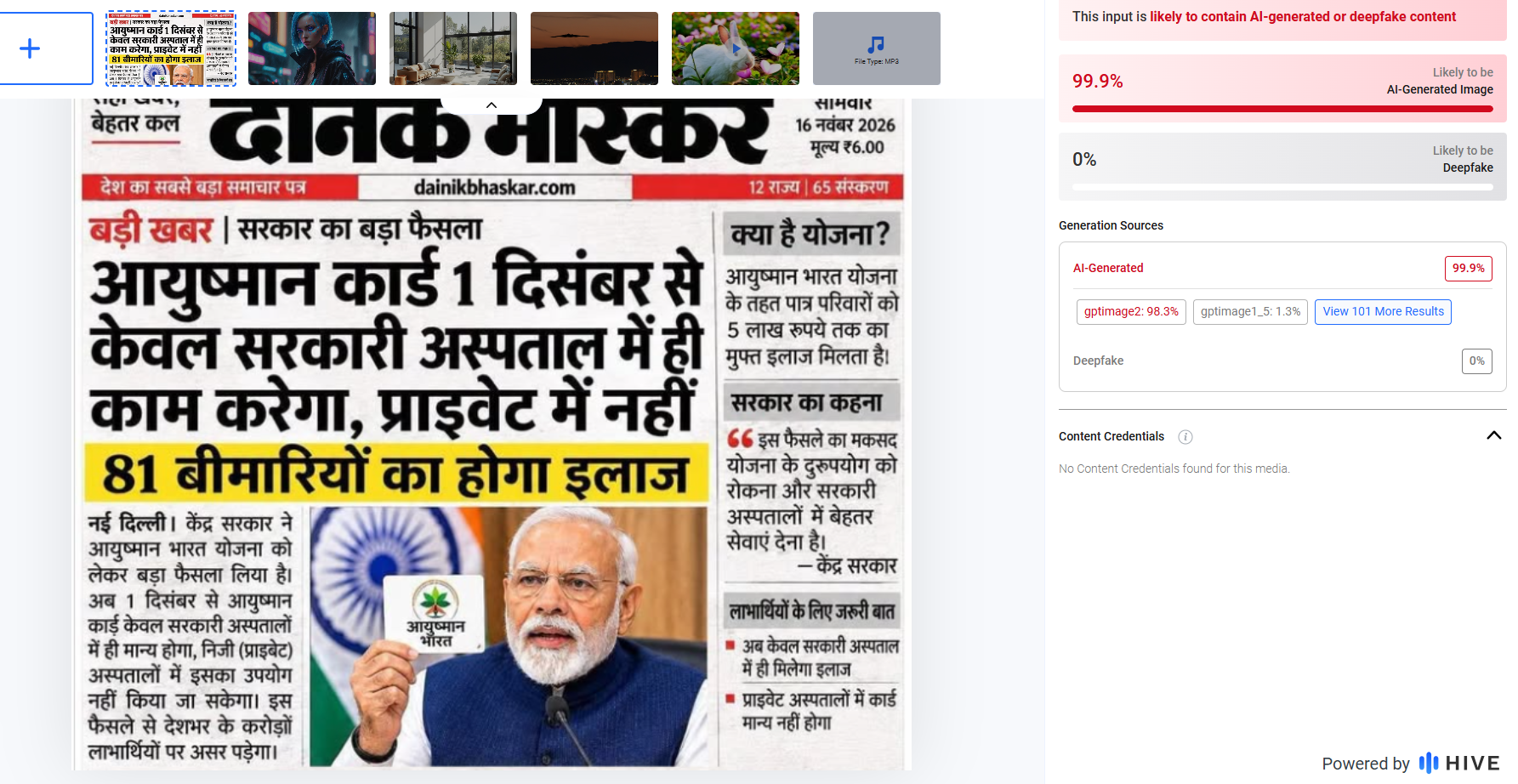
Additionally, we scanned the viral newspaper clipping using the AI detection tool 'Hive Moderation'. According to the results, there is a 99 per cent likelihood that the viral news clipping was AI-generated.
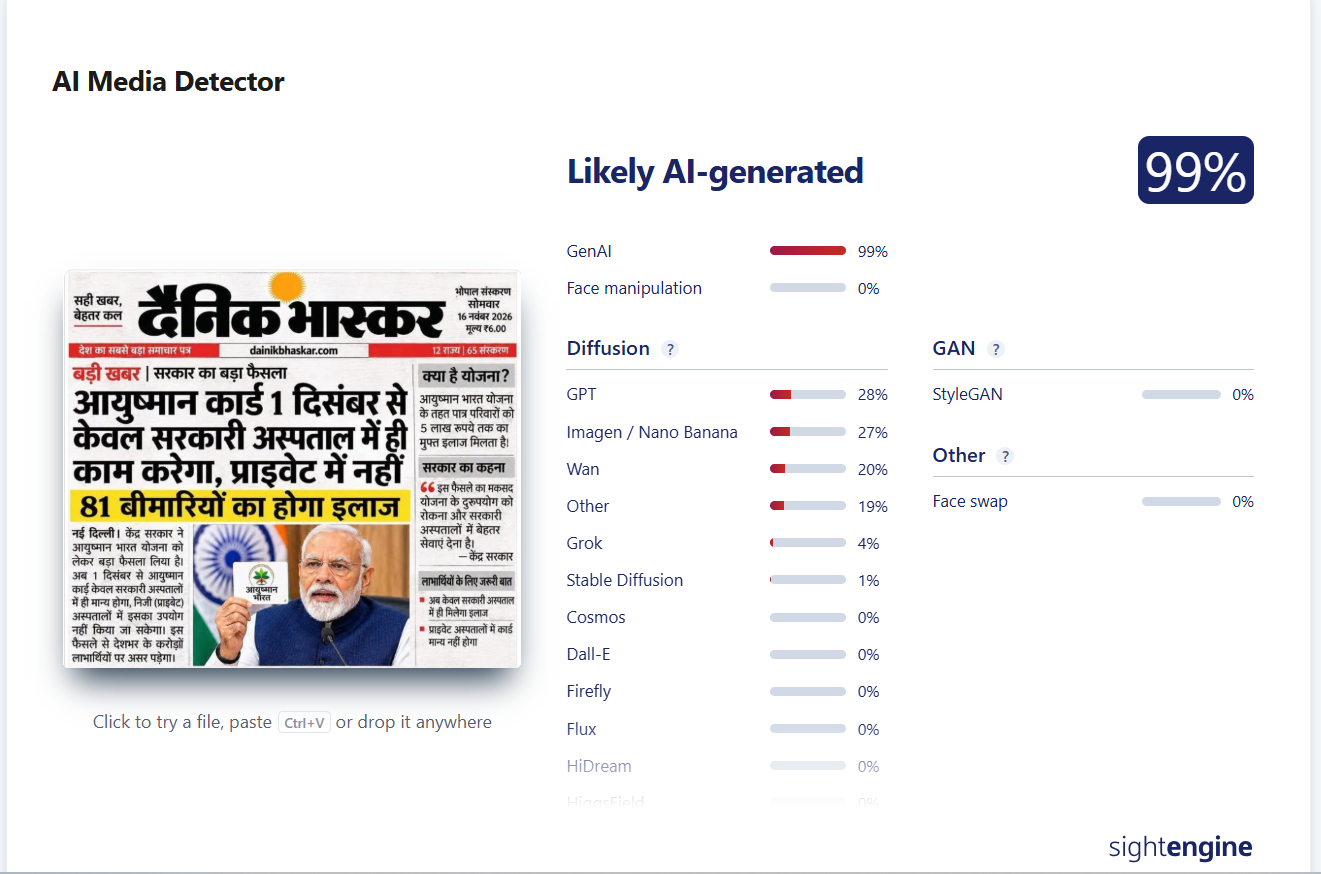
Further, we scanned the viral newspaper clipping using another AI detection tool, 'Sightengine'. According to the results, there is a 99 per cent likelihood that the viral clipping was generated using Artificial Intelligence (AI).
Conclusion:
Our research found that Dainik Bhaskar did not publish any such report. Furthermore, the Central Government has made no such announcement regarding Ayushman cards. The investigation revealed that the viral newspaper clipping was generated using Artificial Intelligence (AI).

Related Blogs

Introduction
As India moves full steam ahead towards a trillion-dollar digital economy, how user data is gathered, processed and safeguarded is under the spotlight. One of the most pervasive but least known technologies used to gather user data is the cookie. Cookies are inserted into every website and application to improve functionality, measure usage and customize content. But they also present enormous privacy threats, particularly when used without explicit user approval.
In 2023, India passed the Digital Personal Data Protection Act (DPDP) to give strong legal protection to data privacy. Though the act does not refer to cookies by name, its language leaves no doubt as to the inclusion of any technology that gathers or processes personal information and thus cookies regulation is at the centre of digital compliance in India. This blog covers what cookies are, how international legislation, such as the GDPR, has addressed them and how India's DPDP will regulate their use.
What Are Cookies and Why Do They Matter?
Cookies are simply small pieces of data that a website stores in the browser. They were originally designed to help websites remember useful information about users, such as your login session or what is in your shopping cart. Netscape initially built them in 1994 to make web surfing more efficient.
Cookies exist in various types. Session cookies are volatile and are deleted when the browser is shut down, whereas persistent cookies are stored on the device to monitor users over a period of time. First-party cookies are made by the site one is visiting, while third-party cookies are from other domains, usually utilised for advertisements or analytics. Special cookies, such as secure cookies, zombie cookies and tracking cookies, differ in intent and danger. They gather information such as IP addresses, device IDs and browsing history information associated with a person, thus making it personal data per the majority of data protection regulations.
A Brief Overview of the GDPR and Cookie Policy
The GDPR regulates how personal data can be processed in general. However, if a cookie collects personal data (like IP addresses or identifiers that can track a person), then GDPR applies as well, because it sets the rules on how that personal data may be processed, what lawful bases are required, and what rights the user has.
The ePrivacy Directive (also called the “Cookie Law”) specifically regulates how cookies and similar technologies can be used. Article 5(3) of the ePrivacy Directive says that storing or accessing information (such as cookies) on a user’s device requires prior, informed consent, unless the cookie is strictly necessary for providing the service requested by the user.
In the seminal Planet49 decision, the Court of Justice of the European Union held that pre-ticked boxes do not represent valid consent. Another prominent enforcement saw Amazon fined €35 million by France's CNIL for using tracking cookies without user consent.
Cookies and India’s Digital Personal Data Protection Act (DPDP), 2023
India's Digital Personal Data Protection Act, 2023 does not refer to cookies specifically but its provisions necessarily come into play when cookies harvest personal data like user activity, IP addresses, or device data. According to DPDP, personal data is to be processed for legitimate purposes with the individual's consent. The consent has to be free, informed, clear and unambiguous. The individuals have to be informed of what data is collected, how it will be processed.. The Act also forbids behavioural monitoring and targeted advertising in the case of children.
The Ministry of Electronics and IT released the Business Requirements Document for Consent Management Systems (BRDCMS) in June 2025. Although it is not binding by law, it provides operational advice on cookie consent. It recommends that websites use cookie banners with "Accept," "Reject," and "Customize" choices. Users must be able to withdraw or change their consent at any moment. Multi-language handling and automatic expiry of cookie preferences are also suggested to suit accessibility and privacy requirements.
The DPDP Act and the BRDCMS together create a robust user-rights model, even in the absence of a special cookie law.
What Should Indian Websites Do?
For the purposes of staying compliant, Indian websites and online platforms need to act promptly to harmonise their use of cookies with DPDP principles. This begins with a transparent and simple cookie banner providing users with an opportunity to accept or decline non-essential cookies. Consent needs to be meaningful; coercive tactics such as cookie walls must not be employed. Websites need to classify cookies (e.g., necessary, analytics and ads) and describe each category's function in plain terms under the privacy policy. Users must be given the option to modify cookie settings anytime using a Consent Management Platform (CMP). Monitoring children or their behavioural information must be strictly off-limits.
These are not only about being compliant with the law, they're about adhering to ethical data stewardship and user trust building.
What Should Users Do?
Cookies need to be understood and controlled by users to maintain online personal privacy. Begin by reading cookie notices thoroughly and declining unnecessary cookies, particularly those associated with tracking or advertising. The majority of browsers today support blocking third-party cookies altogether or deleting them periodically.
It is also recommended to check and modify privacy settings on websites and mobile applications. It is possible to minimise surveillance with the use of browser add-ons such as ad blockers or privacy extensions. Users are also recommended not to blindly accept "accept all" in cookie notices and instead choose "customise" or "reject" where not necessary for their use.
Finally, keeping abreast of data rights under Indian law, such as the right to withdraw consent or to have data deleted, will enable people to reclaim control over their online presence.
Conclusion
Cookies are a fundamental component of the modern web, but they raise significant concerns about individual privacy. India's DPDP Act, 2023, though not explicitly referring to cookies, contains an effective legal framework that regulates any data collection activity involving personal data, including those facilitated by cookies.
As India continues to make progress towards comprehensive rulemaking and regulation, companies need to implement privacy-first practices today. And so must the users, in an active role in their own digital lives. Collectively, compliance, transparency and awareness can build a more secure and ethical internet ecosystem where privacy is prioritised by design.
References
- https://prsindia.org/billtrack/digital-personal-data-protection-bill-2023
- https://gdpr-info.eu/
- https://d38ibwa0xdgwxx.cloudfront.net/create-edition/7c2e2271-6ddd-4161-a46c-c53b8609c09d.pdf
- https://oag.ca.gov/privacy/ccpa
- https://www.barandbench.com/columns/cookie-management-under-the-digital-personal-data-protection-act-2023#:~:text=The%20Business%20Requirements%20Document%20for,the%20DPDP%20Act%20and%20Rules.
- https://samistilegal.in/cookies-meaning-legal-regulations-and-implications/#
- https://secureprivacy.ai/blog/india-digital-personal-data-protection-act-dpdpa-cookie-consent-requirements
- https://law.asia/cookie-use-india/
- https://www.cookielawinfo.com/major-gdpr-fines-2020-2021/#:~:text=4.,French%20websites%20could%20refuse%20cookies.

Executive Summary
Amid rising tensions in West Asia and concerns over the safety of Indian seafarers, a video showing a vessel engulfed in flames and thick black smoke is being widely circulated on social media. The clip is being shared with the claim that it depicts a US attack on a ship carrying Indian nationals in Omani waters. CyberPeace Research Wing research found the claim to be misleading. The viral video predates the incident it is being linked to and is not related to any recent attack.
Claim:
A Facebook user shared the video alleging that the United States attacked a ship carrying Indian citizens in the maritime region near Oman. The post has been widely circulated as part of the ongoing West Asia tensions. Facebook link: https://www.facebook.com/reel/3031094270427837, https://www.facebook.com/reel/3031094270427837

Fact Check:
A reverse image search of keyframes from the viral video led to several media reports published on 2 March 2026, which carried the same visuals seen in the circulating clip. The reports indicated that the footage showed a vessel targeted amid escalating tensions in the Strait of Hormuz, following restrictions on maritime movement in the region. https://www.ndtv.com/world-news/iran-targets-6th-ship-in-hormuz-strait-video-shows-billowing-smoke-11159019

Further research also found the same visuals in a Moneycontrol report published on 2 March 2026. The report clearly established that the footage is from an earlier incident and not linked to any recent developments. https://www.moneycontrol.com/world/indian-crew-member-killed-after-drone-boat-strikes-oil-tanker-off-oman-coast-first-indian-casualty-in-us-iran-tensions-article-13848303.html

Conclusion:
The research confirms that the viral video is not related to any recent US attack on a vessel carrying Indian nationals. The footage has been online since at least March 2026 and shows an earlier incident involving the oil tanker Skylight during tensions in the Strait of Hormuz. Hence, the claim being circulated on social media is misleading.
Introduction
Meta has announced that E2EE in Instagram direct messages is ending entirely. Every day, billions of people send messages they consider private. A medical update to a family member. A photograph meant for one person. A conversation they would never have in public. For years, end-to-end encryption (E2EE) was the technology that made that privacy possible: the digital equivalent of a sealed envelope that only the sender and receiver could open. After May 8, 2026, this will change.
Understanding the Adoption Gap
Meta pointed to low user adoption as the reason for this change. Few people were using encrypted messaging on Instagram, the company said, so the feature was not worth keeping. That explanation raises some questions. Encryption was never switched on by default. Users had to find it and turn it on themselves. It was not advertised. And it was only available in certain regions to begin with, something Meta noted on its own Help Centre page. Features that require users to actively seek them out tend to get used far less than those that simply work from the start. WhatsApp demonstrates this clearly; encryption has been on by default since 2016, for every user, with no action required. Back in 2019, Mark Zuckerberg spoke publicly about building privacy into Meta’s messaging platforms as a core direction for the company. The current decision shows a different vision for the company.
The Commercial Dimension
Encrypted message content is not accessible for advertising purposes by design. In December 2025, Meta updated its privacy policy to allow interactions with its Meta AI assistant to inform personalized advertising recommendations across its platforms. With encryption removed from Instagram direct messages, the content of those conversations enters a data environment that already serves Meta’s advertising systems. Meta has not made a direct public statement connecting these two decisions, but technology analysts and privacy researchers have noted the commercial implications of making previously inaccessible message content available within that ecosystem.
What This Means for Users
From May 8, 2026, the content of Instagram direct messages will be accessible to Meta’s systems. This includes messages relating to personal matters that users may have previously sent under the assumption of encryption. A related concern is the question of data security. Unencrypted message content stored on platform servers creates a larger surface area of sensitive information that could be exposed in the event of a security breach. As platforms collect and retain greater volumes of personal data, the potential consequences of unauthorised access grow correspondingly.
But, there is an argument on the other side. Law enforcement agencies and child safety organisations have long maintained that end-to-end encryption limits their ability to detect and act on harmful content. Removing encryption does make certain forms of platform-level content moderation technically feasible where they were not before.
India’s Supreme Court: The Warning Nobody Heeded
India’s Supreme Court said it plainly when hearing the case against Meta’s 2021 WhatsApp privacy policy, which forced hundreds of millions of users to accept data sharing with Facebook or lose access entirely. Chief Justice Surya Kant called it “a decent way of committing theft of private information” and asked how ordinary people could meaningfully consent to policies written in language they cannot understand. He made it human with one line: “A poor woman selling fruits on the streets — will she understand the terms of your policy?” The court ordered Meta not to share a single word of user data until the case is resolved. When Meta’s lawyers argued that encryption protects users anyway, the bench pushed back: encryption protects message content, not the metadata surrounding it. Who you talk to, how often, at what time, from where: all of it is still harvested. The Competition Commission’s own advocate summarised the entire arrangement in four words: “We are the products.”
WhatsApp: A Question Worth Asking
Instagram, Messenger, and WhatsApp are three products inside one ecosystem, owned by Meta, serving one business model. Instagram’s encryption is already gone. Is WhatsApp next in line ?
WhatsApp has over 850 million monthly active users in India alone. People do not use it for entertainment, it is how families talk, how businesses run, how essential daily communication happens. It is infrastructure, not an app. Meta acquired it in 2014 promising no ads, no data exploitation. By 2021 that promise was already bending. By 2025 ads appeared in the Status section. Both original co-founders had long since left the company over exactly these concerns. Instagram’s encryption survived until it conflicted with revenue and regulation. WhatsApp’s encryption exists today under the same ownership, the same business model, and the same tightening global regulatory pressure. That is not a reason to panic. It is a reason to pay attention.
Conclusion
Encryption is not permanent. It is a design choice, and like any design choice, it can be undone when priorities shift. After May 8, 2026, Instagram direct messages will no longer be protected the way they once were. For most users, this change will pass unnoticed. But the data those conversations contain will now be accessible in ways it previously was not. What platforms do with user data is rarely announced loudly. Paying attention to the quiet changes matters.
References
- https://help.instagram.com/491565145294150
- https://www.theguardian.com/technology/2026/mar/18/instagram-to-remove-end-to-end-encryption-for-private-messages-in-may
- https://www.androidpolice.com/why-meta-is-getting-rid-of-e2ee/
- https://digitalpolicyalert.org/change/13307
- https://www.skadden.com/insights/publications/2025/06/take-it-down-act
- https://timesofindia.indiatimes.com/india/you-cant-play-with-right-of-privacy-of-citizens-scs-big-warning-to-whatsapp-meta-over-take-it-or-leave-it-policy/articleshow/127878524.cms#
- https://proton.me/blog/instagram-end-to-end-encryption
- https://www.forbes.com/sites/parmyolson/2018/09/26/exclusive-whatsapp-cofounder-brian-acton-gives-the-inside-story-on-deletefacebook-and-why-he-left-850-million-behind/
