
#FactCheck: AI-Generated Newspaper Clipping Falsely Attributes Statement on Nationwide Implementation of UGC Law to Amit Shah
Executive Summary
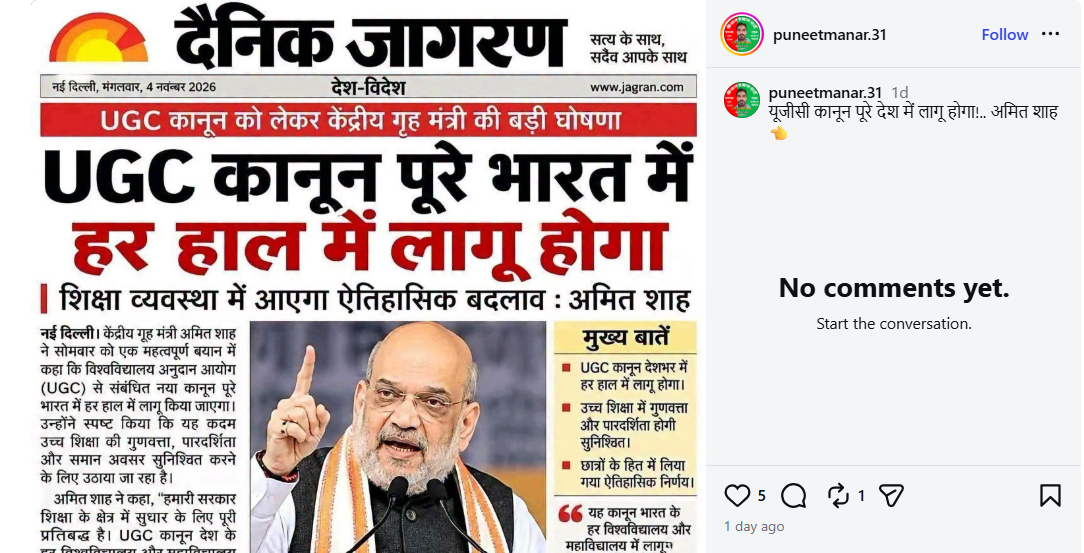
A purported newspaper clipping featuring Union Home Minister Amit Shah is being shared on social media with the claim that he said the UGC law would be implemented across the country under all circumstances. CyberPeace Research found the viral claim to be false. Our research revealed that the newspaper clipping being shared on social media is not authentic but was generated using artificial intelligence (AI).
Claim:
An Instagram user shared the purported newspaper clipping on November 17, 2026, claiming that Amit Shah had said the UGC law would be implemented across India. The post link, archive link and screenshot are provided below.
https://www.instagram.com/p/Df1Qby4iIAY/
Fact Check
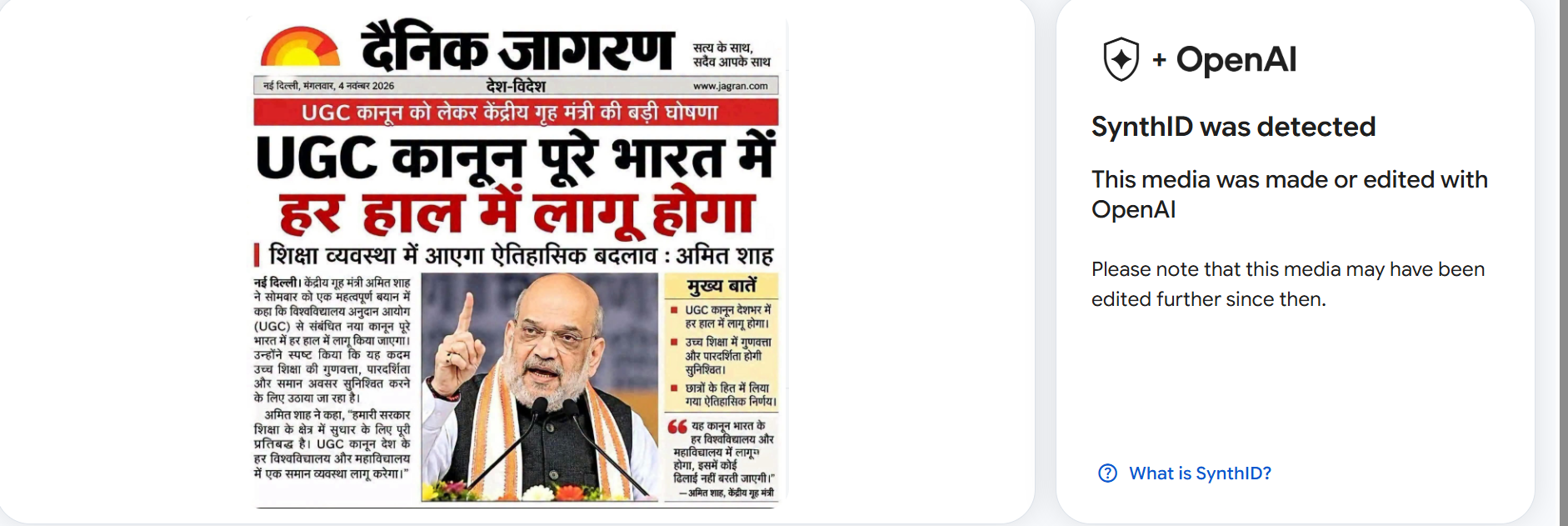
To verify the viral claim, we conducted a Google search using relevant keywords. However, we did not find any credible media reports corroborating the claim. As part of our further research, we closely examined the viral newspaper clipping and noticed several inconsistencies that raised suspicions about it being AI-generated. We then scanned the image using the AI detection tool ‘SynthID’. According to the results, the image was generated using OpenAI.
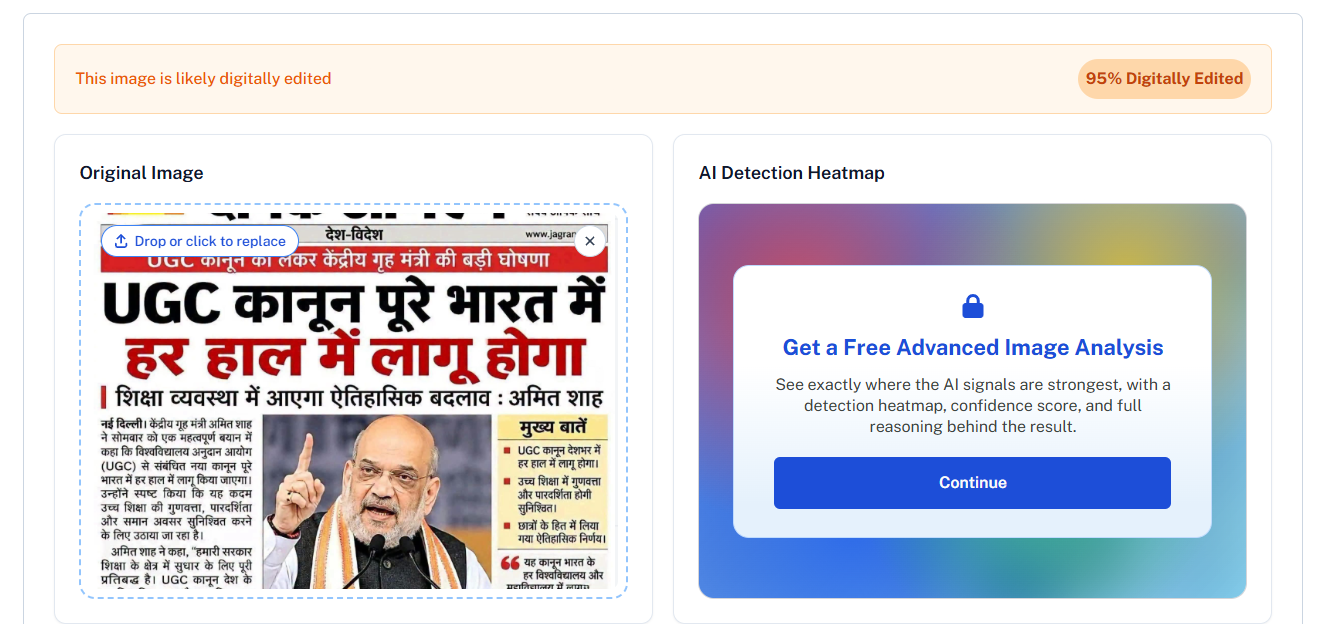
As part of our further research, we scanned the viral image using another AI detection tool, ‘Undetectable AI’. According to the results, the viral image has been digitally edited.
Conclusion
Our research found that the purported newspaper clipping being shared on social media is not authentic but was generated using artificial intelligence (AI).

Related Blogs

Executive Summary:
A widely used news on social media is that a 3D model of Chanakya, supposedly made by Magadha DS University matches with MS Dhoni. However, fact-checking reveals that it is a 3D model of MS Dhoni not Chanakya. This MS Dhoni-3D model was created by artist Ankur Khatri and Magadha DS University does not appear to exist in the World. Khatri uploaded the model on ArtStation, calling it an MS Dhoni similarity study.

Claims:
The image being shared is claimed to be a 3D rendering of the ancient philosopher Chanakya created by Magadha DS University. However, people are noticing a striking similarity to the Indian cricketer MS Dhoni in the image.


Fact Check:
After receiving the post, we ran a reverse image search on the image. We landed on a Portfolio of a freelance character model named Ankur Khatri. We found the viral image over there and he gave a headline to the work as “MS Dhoni likeness study”. We also found some other character models in his portfolio.


Subsequently, we searched for the mentioned University which was named as Magadha DS University. But found no University with the same name, instead the name is Magadh University and it is located in Bodhgaya, Bihar. We searched the internet for any model, made by Magadh University but found nothing. The next step was to conduct an analysis on the Freelance Character artist profile, where we found that he has a dedicated Instagram channel where he posted a detailed video of his creative process that resulted in the MS Dhoni character model.

We concluded that the viral image is not a reconstruction of Indian philosopher Chanakya but a reconstruction of Cricketer MS Dhoni created by an artist named Ankur Khatri, not any University named Magadha DS.
Conclusion:
The viral claim that the 3D model is a recreation of the ancient philosopher Chanakya by a university called Magadha DS University is False and Misleading. In reality, the model is a digital artwork of former Indian cricket captain MS Dhoni, created by artist Ankur Khatri. There is no evidence of a Magadha DS University existence. There is a university named Magadh University in Bodh Gaya, Bihar despite its similar name, we found no evidence in the model's creation. Therefore, the claim is debunked, and the image is confirmed to be a depiction of MS Dhoni, not Chanakya.

Introduction
India’s telecom regulator, the Telecom Regulatory Authority of India (TRAI), has directed telcos to block all unverified headers and message templates within 30 and 60 days, respectively, according to a press release. The regulator observed that telemarketers were ‘misusing’ headers and message templates of registered parties and asked telcos to reverify all registered headers & message templates on the DLT (Distributed Ledger Technology) platform. All telecom service providers (TSP) have to comply with these directions, issued under the Telecom Commercial Communication Customer Preference Regulations, 2018, within a month, TRAI said in its release. The directions were issued after TRAI held a meeting with telcos on February 17, 2023, to discuss quality of service (QoS) improvements, review of QoS standards, QoS of 5G services and unsolicited commercial communications”, as per its press release.
Why it matters?
It may be useful as it can ensure that all promotional messages are sent through registered telemarketers using only approved templates. It is no secret that the spam problem has been difficult to rein in, so the measure can restrict its proliferation and filter out telemarketers resorting to misuse.
Details about TRAI’s orders
The release said that telcos have to ensure that temporary headers are deactivated immediately after the time duration for which such headers were created. The telcos also have to ensure that there is no space to insert unwanted content in the template of a message where one can add content to be sent to people. Message recipients should not be confused, so telcos must ensure that they register no lookalike headers in the names of different senders.
Measures to check unregistered telemarketers
The release ordered telcos to bar telemarketers not registered on its DLT platform from accessing message templates and scrubbing them to deliver spam messages to recipients on the telco’s network. The telcos have been directed not to allow promotional messages to be sent by unregistered telemarketers or telemarketers using 10-digit telephone numbers. It added that telcos have to take action against erring telemarketers and share details of these telemarketers with other telcos, which will then be responsible for stopping these entities from sending commercial communications through their networks.
How big is the problem of spam?
A survey conducted by LocalCircles said that two out of every three people (66 per cent) in India get three or more spam calls daily. It added that not one person among thousands of respondents checked the box of ‘no spam’.
The platform said that it was a national survey which gathered over 56,000 responses from Indians located in 342 districts. It also found that 92 % of responders said they continue receiving spam despite opting for DND. The DND list is a feature where mobile subscriber can register their number to avoid getting unsolicited commercial communication (UCC).
Addressing the problem of spam
The regulatory body recently released a consultation paper that proposed the idea of providing the real name identity of callers to people receiving calls. The paper said that it would use a database containing each subscriber’s correct name to implement the caller name presentation (CNAP) service. The regulator wants to use details acquired by telecom service providers via customer acquisition forms (CAF).
TRAI formed a joint committee to look at the issue of phishing and cyber fraud in 2022. It included officials from the Reserve Bank of India (RBI) and the Securities and Exchange Board of India (SEBI). The telecom watchdog had laid out a plan to combat SMS and call spam using blockchain technology (DLT). It saw telecom companies and TRAI to build an encrypted and distributed database that will record user consent to be included in SMS or call send-out lists.
According to a press release, the Telecom Regulatory Authority of India (TRAI), the telecom regulator in India, has ordered carriers to block any unverified headers and message templates within 30 and 60 days, respectively.
The regulator saw that telemarketers were “misusing” registered parties’ headers and message templates. Thus, they requested that telecoms validate all of the registered headers and message templates on the DLT (Distributed Ledger Technology) platform.
According to TRAI’s statement, all telecom service providers (TSP) must adhere to these directives within one month under the 2018 Telecom Commercial Communication Consumer Preference Rules. The guidelines were released following a conference with telcos convened by TRAI on February 17, 2023, to discuss quality of service (QoS) enhancements, a review of QoS standards, the QoS of 5G services, and unsolicited commercial communications.
Why it matters?
Requiring that only registered telemarketers send promotional communications using approved templates may prove to be a beneficial safeguard. It is no secret that the spam problem has been challenging to control, so the measure can limit its spread and screen out telemarketers that employ abusive tactics.
Information on the TRAI order
According to the press release, telecoms must ensure that temporary headers are deactivated as soon as the time period they were established has passed. The telecoms must also ensure that there is no room in the message template where one can add content to be sent to recipients for unwanted content. There should be no room for uncertainty among message recipients. Thus, telecoms must ensure that no similar-looking headers are registered under the identities of various senders.
Taking action against unregistered telemarketers In accordance with the directive, telcos must prevent telemarketers who are not registered on their DLT platform from obtaining message templates and using them to send spam to subscribers on their network. Telemarketers who are not registered or who use 10-digit phone numbers cannot send promotional messages, according to instructions given to telecoms. Telcos must take action against misbehaving telemarketers, it was noted, and divulge their information to other telecoms, who would be in charge of preventing these companies from transmitting commercial messages.
How widespread is the spam issue?
According to a LocalCircles poll, three or more spam calls are received every day by two out of every three Indians (66%) on average. It further stated that not a single one of the thousands of responses clicked the “no-spam” box. According to the platform, the survey was conducted nationally and received over 56,000 responses from Indians in 342 districts. Moreover, 92 % of respondents reported that even after choosing DND, they still receive spam. A mobile subscriber can register their number on the DND list to prevent receiving unsolicited commercial communication (UCC).
consultation document recently in which it recommended the concept of providing the genuine name identify of callers to persons receiving calls. The paper indicated that it would employ a database containing each subscriber’s correct name to implement the caller name presentation (CNAP) service. The regulator wants to use information collected by telecom service providers through client acquisition forms (CAF).
Conclusion
TRAI established a joint committee to examine the problem of phishing and cyber scams in 2022. Officials from the Securities and Exchange Board of India (SEBI) and Reserve Bank of India (RBI) were present (SEBI).
The telecom watchdog had outlined a strategy for leveraging blockchain technology to combat SMS and call spam (DLT).

Executive Summary
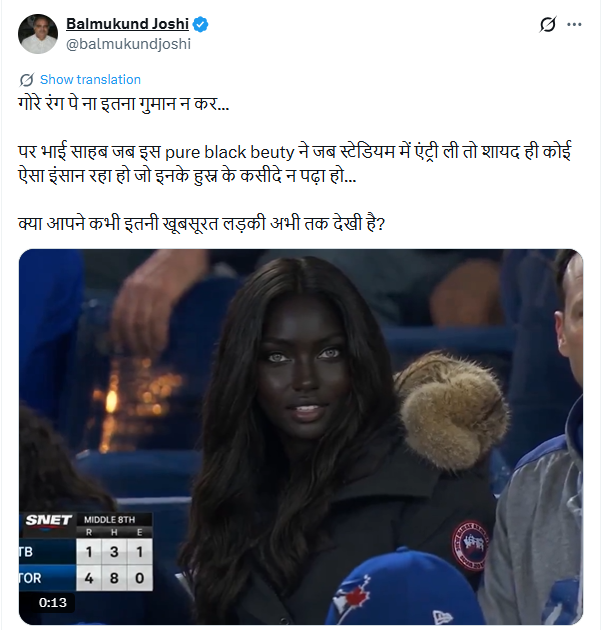
Amid ongoing FIFA World Cup 2026 festivities, a video is being widely circulated on social media platforms claiming that a female football fan became the centre of attraction during a match due to her striking beauty. The clip is being shared with the caption “Beauty in Black,” suggesting that beauty transcends colour and became the highlight of the stadium crowd. CyberPeace Research Wing research, however, found the claim to be misleading. The viral video is AI-generated and does not depict any real incident from the FIFA World Cup 2026.
Claim:
Social media user Bal Mukund Joshi shared the video on X on June 14, 2026, claiming that a beautiful woman captured everyone’s attention inside a World Cup stadium. The post has been widely circulated across platforms.
https://x.com/balmukundjoshi/status/2066033100208095452?s=20
Fact Check:
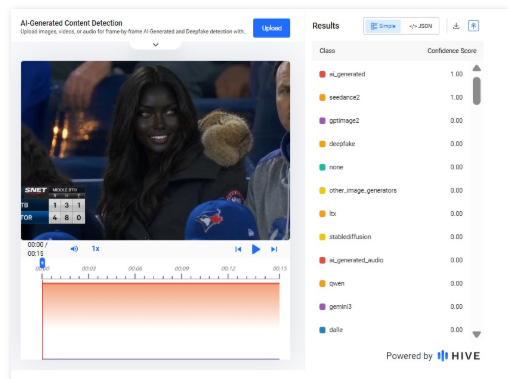
A close visual analysis of the clip revealed inconsistencies, including a mismatch in skin tone between different frames, raising suspicion of digital manipulation or AI generation. The video was further examined using multiple AI detection tools. Google’s SynthID analysis indicated no direct trace of Google AI generation, but Gemini’s assessment highlighted anomalies suggesting possible AI or heavy digital editing, particularly in facial features and skin texture. The video was then analysed using Hive Moderation, which indicated a 100% probability of the content being AI-generated.
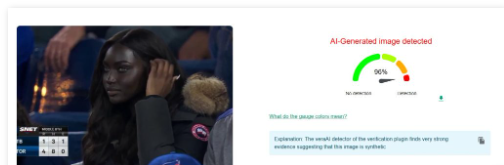
Additionally, frame-by-frame analysis using Vera AI Detector showed a high likelihood (92%) of AI-generated visuals. The research also revealed that the video originates from an Instagram-based virtual influencer account that shares AI-created content.
Conclusion:
The viral video claiming that a female fan became the centre of attention during a FIFA World Cup 2026 match is not real. The clip is AI-generated and originates from a virtual influencer account on Instagram, shared with a misleading narrative.
