
#FactCheck: AI-Generated Image Falsely Shows Indian Embassy Official Attending JAAC Protest in London
Executive Summary
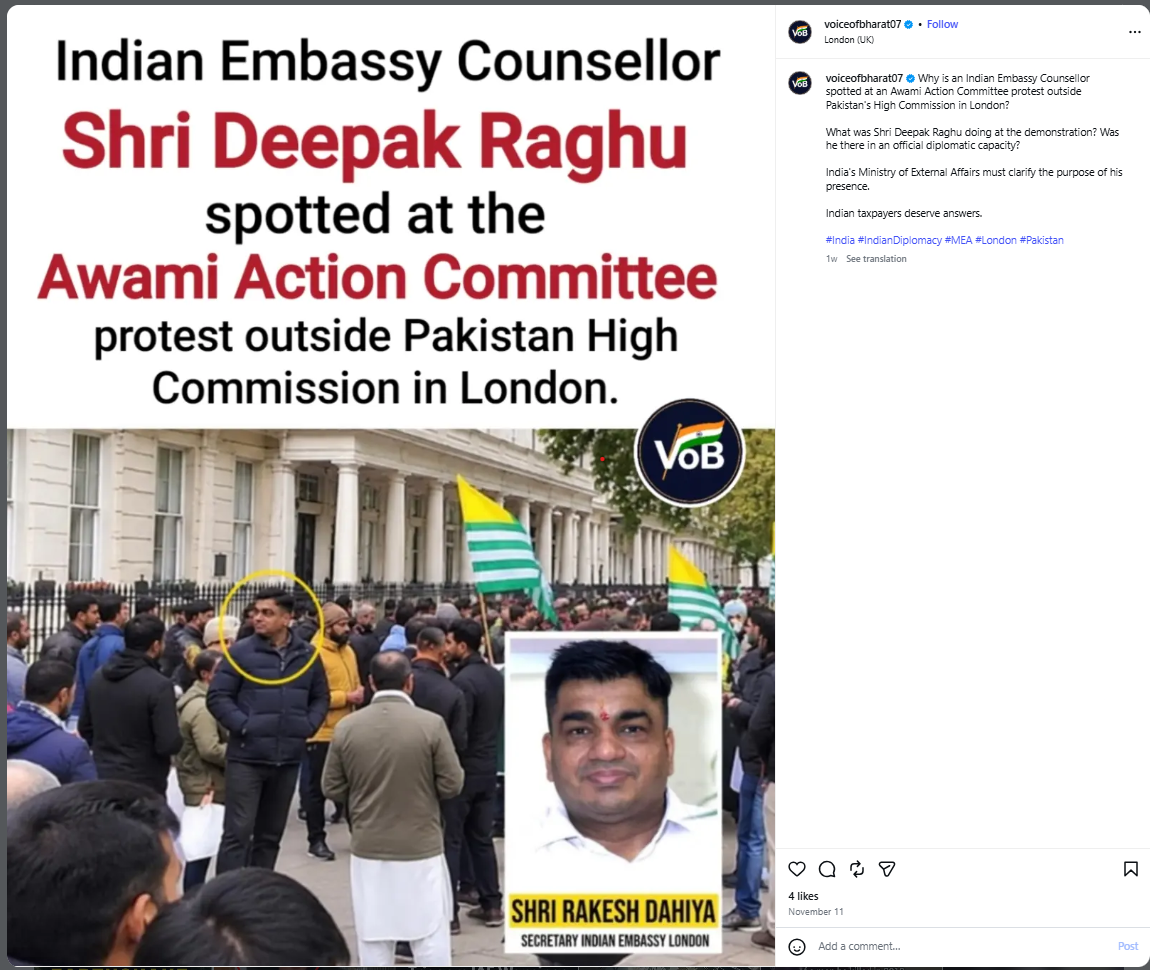
A photograph purportedly showing Deepak Raghu, a counsellor at the Indian Embassy in London, is going viral on social media. The image is being shared with the claim that he attended a protest organised by the Joint Awami Action Committee (JAAC) in London against the alleged political repression in Pakistan-occupied Kashmir (PoK). Several users are sharing the photograph, claiming it shows an actual incident. CyberPeace Research found that the viral photograph is not authentic and was generated using AI. It is being circulated with a misleading claim.
Claim:
A photograph of Rakesh Dahiya, a secretary at the Indian Embassy, is being misidentified as Raghu Deepak and shared with the claim that he attended a JAAC protest in London.
https://www.instagram.com/p/DfknTtTxrC8/
Fact Check
To verify the identity of the person in the viral photograph, we conducted a reverse image search. This led us to a Facebook account (@rakesh.dahiya.702553), where a post featuring the same person was found. According to the profile details, Rakesh Dahiya is the Director of Education at the New Delhi Municipal Council (NDMC). We also found his name listed on the NDMC's official website, along with posts featuring him on the civic body's official X account.
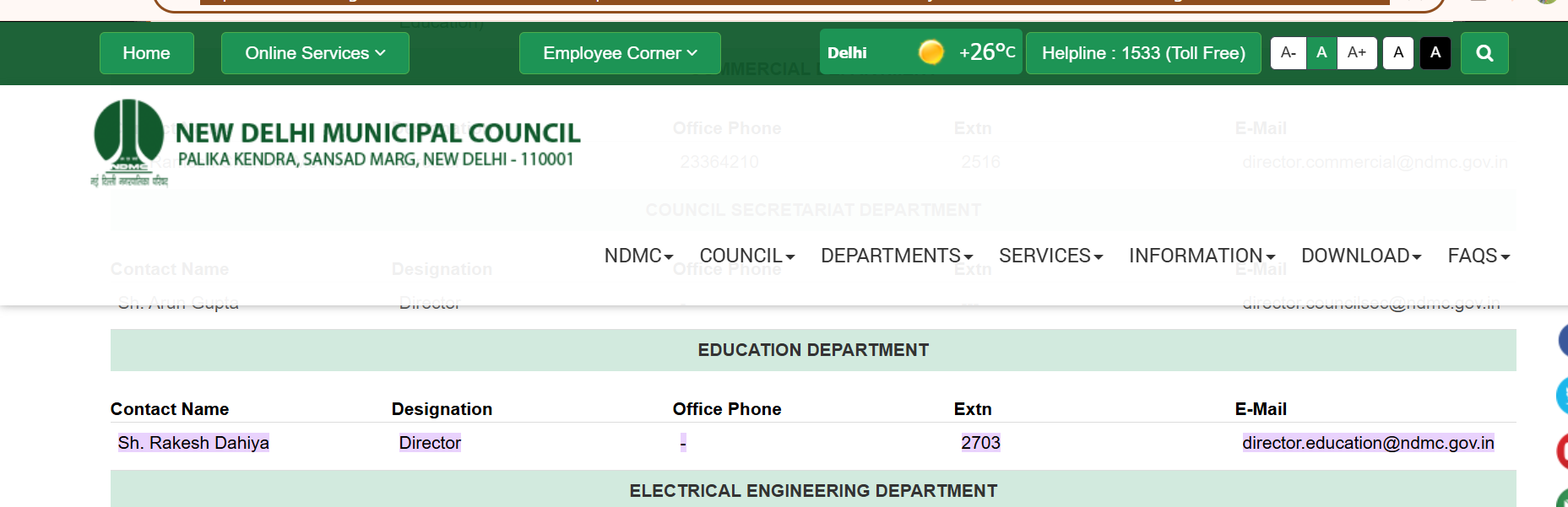
https://x.com/tweetndmc/status/2104065666798240235

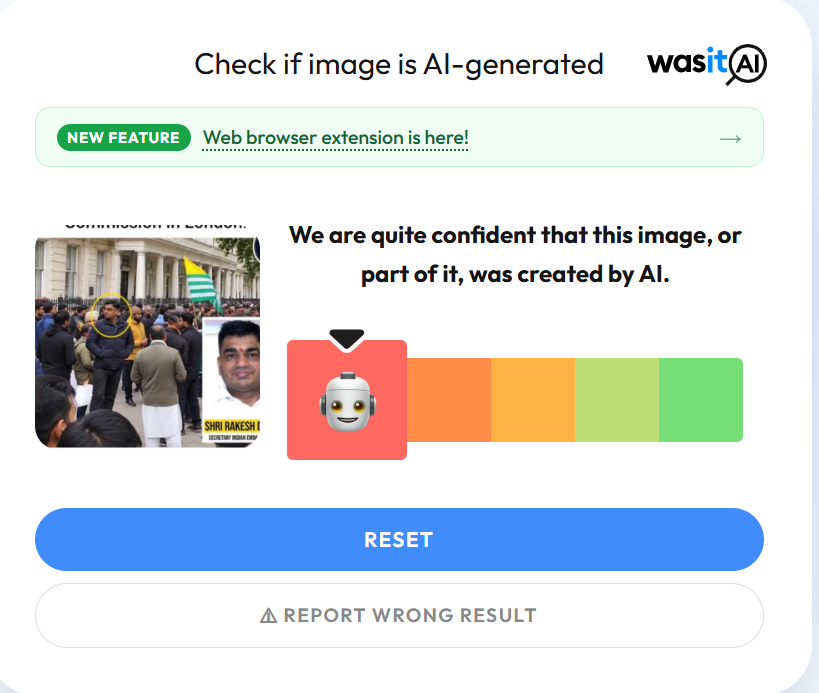
On closely examining the viral photograph, we suspected that it had been generated using AI. To verify this, we scanned the image using the AI detection tool Wasit AI. According to the tool's results, the viral photograph was generated using AI.
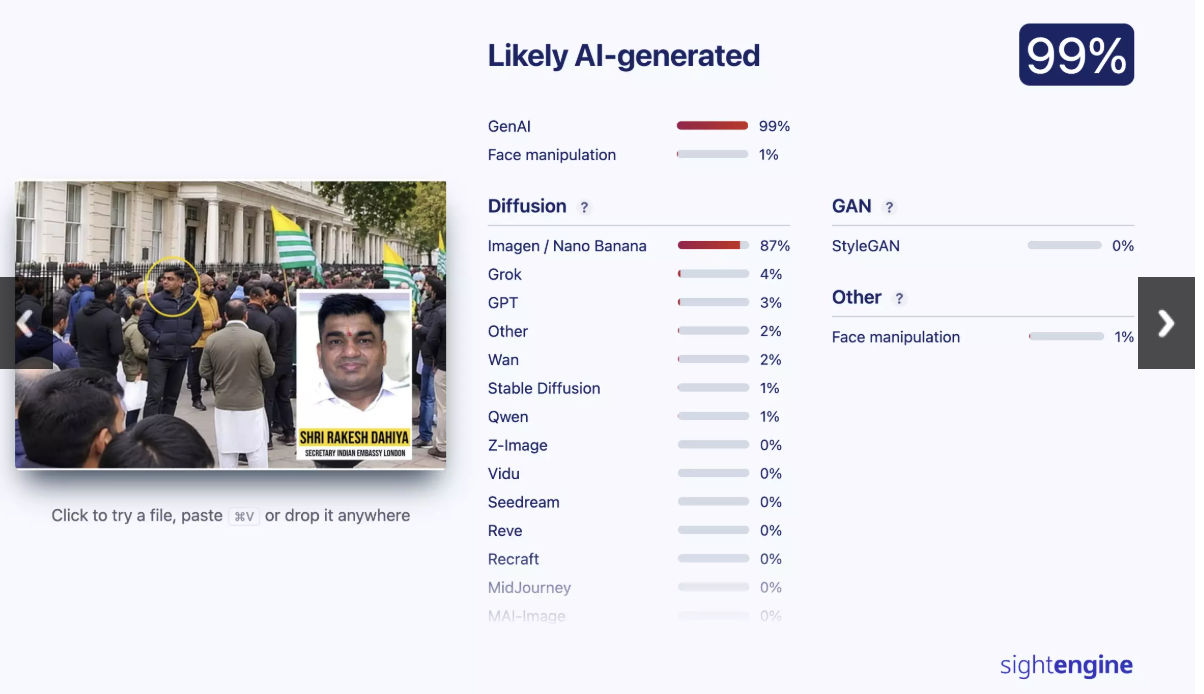
As part of our further research, we scanned the viral photograph using another AI detection tool, SIGHTENGINE. According to the tool's results, there is a 99 per cent probability that the viral photograph is AI-generated.
Conclusion:
Our research found that the viral photograph is not authentic and was generated using AI. The image has been digitally created and is being circulated on social media with the misleading claim that it shows an Indian Embassy official attending a JAAC protest in London.

Related Blogs

Introduction
Privacy has become a concern for netizens and social media companies have access to a user’s data and the ability to use the said data as they see fit. Meta’s business model, where they rely heavily on collecting and processing user data to deliver targeted advertising, has been under scrutiny. The conflict between Meta and the EU traces back to the enactment of GDPR in 2018. Meta is facing numerous fines for not following through with the regulation and mainly failing to obtain explicit consent for data processing under Chapter 2, Article 7 of the GDPR. ePrivacy Regulation, which focuses on digital communication and digital data privacy, is the next step in the EU’s arsenal to protect user privacy and will target the cookie policies and tracking tech crucial to Meta's ad-targeting mechanism. Meta’s core revenue stream is sourced from targeted advertising which requires vast amounts of data for the creation of a personalised experience and is scrutinised by the EU.
Pay for Privacy Model and its Implications with Critical Analysis
Meta came up with a solution to deal with the privacy issue - ‘Pay or Consent,’ a model that allows users to opt out of data-driven advertising by paying a subscription fee. The platform would offer users a choice between free, ad-supported services and a paid privacy-enhanced experience which aligns with the GDPR and potentially reduces regulatory pressure on Meta.
Meta presently needs to assess the economic feasibility of this model and come up with answers for how much a user would be willing to pay for the privacy offered and shift Meta’s monetisation from ad-driven profits to subscription revenues. This would have a direct impact on Meta’s advertisers who use Meta as a platform for detailed user data for targeted advertising, and would potentially decrease ad revenue and innovate other monetisation strategies.
For the users, increased privacy and greater control of data aligning with global privacy concerns would be a potential outcome. While users will undoubtedly appreciate the option to avoid tracking, the suggestion does beg the question that the need to pay might become a barrier. This could possibly divide users between cost-conscious and privacy-conscious segments. Setting up a reasonable price point is necessary for widespread adoption of the model.
For the regulators and the industry, a new precedent would be set in the tech industry and could influence other companies’ approaches to data privacy. Regulators might welcome this move and encourage further innovation in privacy-respecting business models.
The affordability and fairness of the ‘pay or consent’ model could create digital inequality if privacy comes at a digital cost or even more so as a luxury. The subscription model would also need clarifications as to what data would be collected and how it would be used for non-advertising purposes. In terms of market competition, competitors might use and capitalise on Meta’s subscription model by offering free services with privacy guarantees which could further pressure Meta to refine its offerings to stay competitive. According to the EU, the model needs to provide a third way for users who have ads but are a result of non-personalisation advertising.
Meta has further expressed a willingness to explore various models to address regulatory concerns and enhance user privacy. Their recent actions in the form of pilot programs for testing the pay-for-privacy model is one example. Meta is actively engaging with EU regulators to find mutually acceptable solutions and to demonstrate its commitment to compliance while advocating for business models that sustain innovation. Meta executives have emphasised the importance of user choice and transparency in their future business strategies.
Future Impact Outlook
- The Meta-EU tussle over privacy is a manifestation of broader debates about data protection and business models in the digital age.
- The EU's stance on Meta’s ‘pay or consent’ model and any new regulatory measures will shape the future landscape of digital privacy, leading to other jurisdictions taking cues and potentially leading to global shifts in privacy regulations.
- Meta may need to iterate on its approach based on consumer preferences and concerns. Competitors and tech giants will closely monitor Meta’s strategies, possibly adopting similar models or innovating new solutions. And the overall approach to privacy could evolve to prioritise user control and transparency.
Conclusion
Consent is the cornerstone in matters of privacy and sidestepping it violates the rights of users. The manner in which tech companies foster a culture of consent is of paramount importance in today's digital landscape. As the exploration by Meta in the ‘pay or consent’ model takes place, it faces both opportunities and challenges in balancing user privacy with business sustainability. This situation serves as a critical test case for the tech industry, highlighting the need for innovative solutions that respect privacy while fostering growth with the specificity of dealing with data protection laws worldwide, starting with India’s Digital Personal Data Protection Act, of 2023.
Reference:
- https://ciso.economictimes.indiatimes.com/news/grc/eu-tells-meta-to-address-consumer-fears-over-pay-for-privacy/111946106
- https://www.wired.com/story/metas-pay-for-privacy-model-is-illegal-says-eu/
- https://edri.org/our-work/privacy-is-not-for-sale-meta-must-stop-charging-for-peoples-right-to-privacy/
- https://fortune.com/2024/04/17/meta-pay-for-privacy-rejected-edpb-eu-gdpr-schrems/

Executive Summary:
BrazenBamboo’s DEEPDATA malware represents a new wave of advanced cyber espionage tools, exploiting a zero-day vulnerability in Fortinet FortiClient to extract VPN credentials and sensitive data through fileless malware techniques and secure C2 communications. With its modular design, DEEPDATA targets browsers, messaging apps, and password stores, while leveraging reflective DLL injection and encrypted DNS to evade detection. Cross-platform compatibility with tools like DEEPPOST and LightSpy highlights a coordinated development effort, enhancing its espionage capabilities. To mitigate such threats, organizations must enforce network segmentation, deploy advanced monitoring tools, patch vulnerabilities promptly, and implement robust endpoint protection. Vendors are urged to adopt security-by-design practices and incentivize vulnerability reporting, as vigilance and proactive planning are critical to combating this sophisticated threat landscape.
Introduction
The increased use of zero-day vulnerabilities by more complex threat actors reinforces the importance of more developed countermeasures. One of the threat actors identified is BrazenBamboo uses a zero-day vulnerability in Fortinet FortiClient for Windows through the DEEPDATA advanced malware framework. This research explores technical details about DEEPDATA, the tricks used in its operations, and its other effects.
Technical Findings
1. Vulnerability Exploitation Mechanism
The vulnerability in Fortinet’s FortiClient lies in its failure to securely handle sensitive information in memory. DEEPDATA capitalises on this flaw via a specialised plugin, which:
- Accesses the VPN client’s process memory.
- Extracts unencrypted VPN credentials from memory, bypassing typical security protections.
- Transfers credentials to a remote C2 server via encrypted communication channels.
2. Modular Architecture
DEEPDATA exhibits a highly modular design, with its core components comprising:
- Loader Module (data.dll): Decrypts and executes other payloads.
- Orchestrator Module (frame.dll): Manages the execution of multiple plugins.
- FortiClient Plugin: Specifically designed to target Fortinet’s VPN client.
Each plugin operates independently, allowing flexibility in attack strategies depending on the target system.
3. Command-and-Control (C2) Communication
DEEPDATA establishes secure channels to its C2 infrastructure using WebSocket and HTTPS protocols, enabling stealthy exfiltration of harvested data. Technical analysis of network traffic revealed:
- Dynamic IP switching for C2 servers to evade detection.
- Use of Domain Fronting, hiding C2 communication within legitimate HTTPS traffic.
- Time-based communication intervals to minimise anomalies in network behavior.
4. Advanced Credential Harvesting Techniques
Beyond VPN credentials, DEEPDATA is capable of:
- Dumping password stores from popular browsers, such as Chrome, Firefox, and Edge.
- Extracting application-level credentials from messaging apps like WhatsApp, Telegram, and Skype.
- Intercepting credentials stored in local databases used by apps like KeePass and Microsoft Outlook.
5. Persistence Mechanisms
To maintain long-term access, DEEPDATA employs sophisticated persistence techniques:
- Registry-based persistence: Modifies Windows registry keys to reload itself upon system reboot.
- DLL Hijacking: Substitutes legitimate DLLs with malicious ones to execute during normal application operations.
- Scheduled Tasks and Services: Configures scheduled tasks to periodically execute the malware, ensuring continuous operation even if detected and partially removed.
Additional Tools in BrazenBamboo’s Arsenal
1. DEEPPOST
A complementary tool used for data exfiltration, DEEPPOST facilitates the transfer of sensitive files, including system logs, captured credentials, and recorded user activities, to remote endpoints.
2. LightSpy Variants
- The Windows variant includes a lightweight installer that downloads orchestrators and plugins, expanding espionage capabilities across platforms.
- Shellcode-based execution ensures that LightSpy’s payload operates entirely in memory, minimising artifacts on the disk.
3. Cross-Platform Overlaps
BrazenBamboo’s shared codebase across DEEPDATA, DEEPPOST, and LightSpy points to a centralised development effort, possibly linked to a Digital Quartermaster framework. This shared ecosystem enhances their ability to operate efficiently across macOS, iOS, and Windows systems.
Notable Attack Techniques
1. Memory Injection and Data Extraction
Using Reflective DLL Injection, DEEPDATA injects itself into legitimate processes, avoiding detection by traditional antivirus solutions.
- Memory Scraping: Captures credentials and sensitive information in real-time.
- Volatile Data Extraction: Extracts transient data that only exists in memory during specific application states.
2. Fileless Malware Techniques
DEEPDATA leverages fileless infection methods, where its payload operates exclusively in memory, leaving minimal traces on the system. This complicates post-incident forensic investigations.
3. Network Layer Evasion
By utilising encrypted DNS queries and certificate pinning, DEEPDATA ensures that network-level defenses like intrusion detection systems (IDS) and firewalls are ineffective in blocking its communications.
Recommendations
1. For Organisations
- Apply Network Segmentation: Isolate VPN servers from critical assets.
- Enhance Monitoring Tools: Deploy behavioral analysis tools that detect anomalous processes and memory scraping activities.
- Regularly Update and Patch Software: Although Fortinet has yet to patch this vulnerability, organisations must remain vigilant and apply fixes as soon as they are released.
2. For Security Teams
- Harden Endpoint Protections: Implement tools like Memory Integrity Protection to prevent unauthorised memory access.
- Use Network Sandboxing: Monitor and analyse outgoing network traffic for unusual behaviors.
- Threat Hunting: Proactively search for indicators of compromise (IOCs) such as unauthorised DLLs (data.dll, frame.dll) or C2 communications over non-standard intervals.
3. For Vendors
- Implement Security by Design: Adopt advanced memory protection mechanisms to prevent credential leakage.
- Bug Bounty Programs: Encourage researchers to report vulnerabilities, accelerating patch development.
Conclusion
DEEPDATA is a form of cyber espionage and represents the next generation of tools that are more advanced and tunned for stealth, modularity and persistence. While Brazen Bamboo is in the process of fine-tuning its strategies, the organisations and vendors have to be more careful and be ready to respond to these tricks. The continuous updating, the ability to detect the threats and a proper plan on how to deal with incidents are crucial in combating the attacks.
References:

Executive Summary
A video is being shared on social media with the claim that a Dalit woman was raped inside the Ram Temple in Ayodhya. In the video, two women can be seen crying, while some people around them appear to be consoling them. CyberPeace Research Wing’s research found the viral claim to be false. Our research found that the viral video has been created by combining two separate clips. In the first part of the video, a woman can be seen staging a protest at Buddha Park in Haldwani and raising issues related to her in-laws. The second part shows a girl expressing her anger. Our research found that this clip has been available on the internet since December 27, 2025. Neither of the two videos is related to the alleged rape of a Dalit woman inside the Ram Temple in Ayodhya.
Claim:
A Facebook user shared the viral video on September 21, 2026, with the caption, “Dalit woman raped inside the Ram Temple.”The post link, archive link and screenshot are provided below.
https://www.facebook.com/watch/?v=1420442086956519
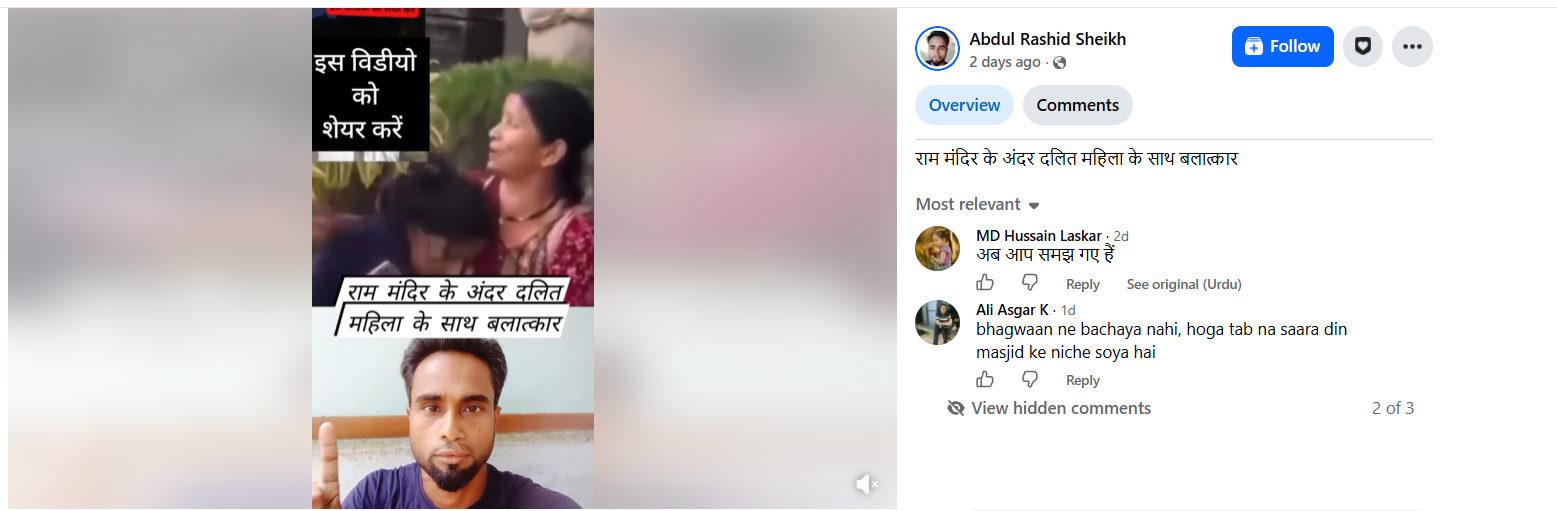
Fact Check
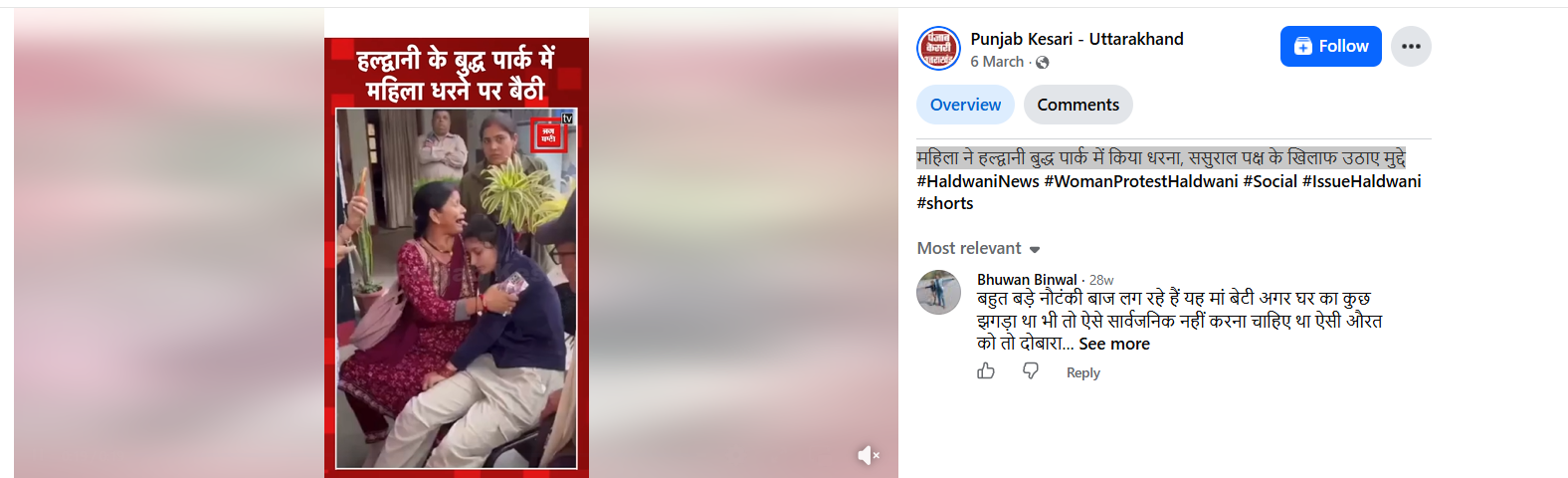
To verify the authenticity of the viral image, we conducted a Google search using relevant keywords. However, we did not find any credible media report related to the viral image during the search. To verify the claim, we conducted a reverse image search of the keyframes from the video. During the search, we found the same video on the Facebook page of Punjab Kesari - Uttarakhand, where it was published on March 6, 2026. According to the post, the woman staged a protest at Buddha Park in Haldwani and raised issues related to her in-laws. The link and screenshot of the relevant post are provided below.
https://www.facebook.com/watch/?v=897776589732940
Meanwhile, we found the second part of the viral video on LinkedIn, where the video was published on December 27, 2025.
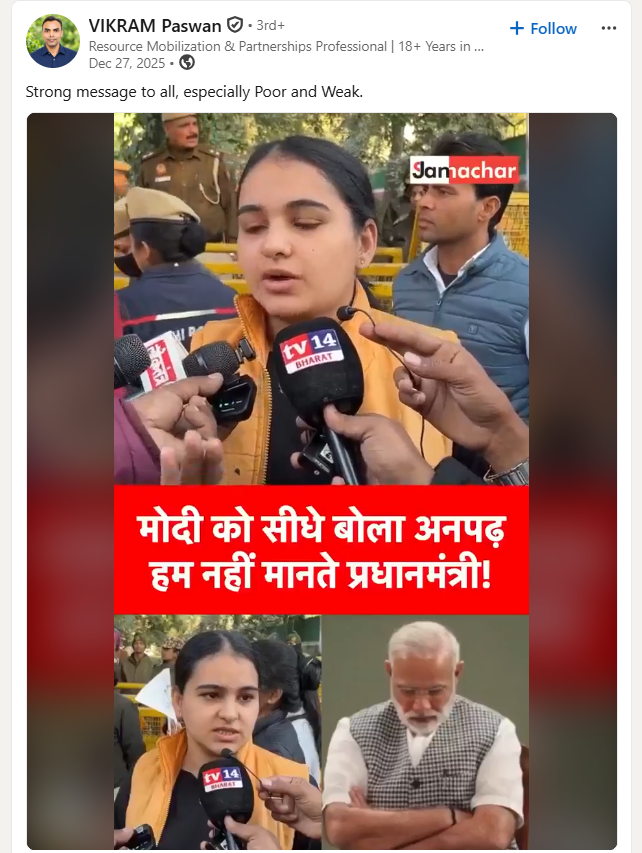
Our research makes it clear that two old and unrelated videos are being shared with a misleading claim linking them to the Ram Temple in Ayodhya. The videos have no connection with the alleged incident on the temple premises, and based on the available evidence, there is no confirmation of any such incident taking place at the Ram Temple. Our research found that the viral video was created by combining two separate clips. In the first part of the video, a woman can be seen staging a protest at Buddha Park in Haldwani and raising issues related to her in-laws. In the second part, a girl can be seen expressing her anger. Our research found that this clip has been available on the internet since December 27, 2025. Neither of the two videos is related to the alleged rape of a Dalit woman inside the Ram Temple in Ayodhya.
