
#FactCheck- Viral Video Falsely Claims Iranian Strike Destroyed Israeli Army Headquarters
Executive Summary
A video is going viral on social media showing a massive building engulfed in flames and collapsing into debris. It is being widely claimed that Iran launched a powerful attack that destroyed Israel’s army headquarters. However, research by CyberPeace reveals that this claim is misleading. The viral video is AI-generated and has no connection to any real-world event.
Claim
An X (formerly Twitter) user shared the viral video with the caption: “Iran has targeted Israel’s army headquarters. It seems Israel’s dream of becoming ‘Greater Israel’ will remain unfulfilled.”
Post link:
- https://x.com/KAMESHKUMAR96/status/2039009484069368083
Archived version:
- https://archive.ph/HKXkK
- https://x.com/KAMESHKUMAR96/status/2039009484069368083
- https://archive.ph/HKXkK

Similar videos have also been shared by other users on social media:
Fact Check
To verify the claim, we extracted keyframes from the viral video and conducted a reverse image search. During this process, we found several credible media reports confirming that Iran has carried out drone and missile attacks on Israel and the Gulf regions in recent times. However, none of these reports featured the viral video, indicating that it is not authentic footage.

- https://www.youtube.com/watch?v=fxDBX90bYng

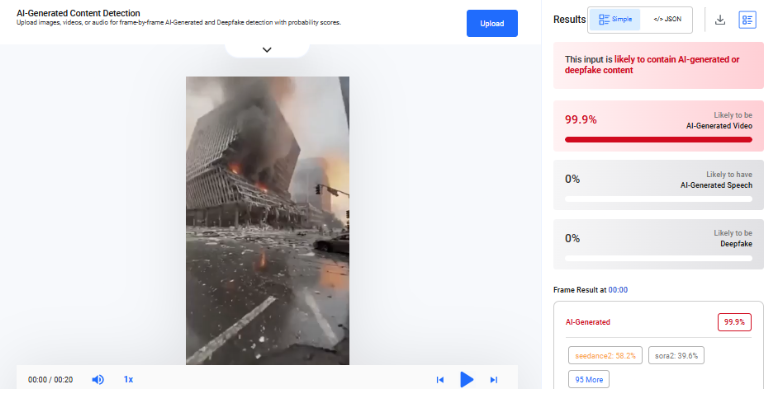
A closer examination of the video revealed multiple visual inconsistencies commonly associated with AI-generated content. For instance, a building on the left side appears to bend and collapse in a rubber-like manner—something that is physically unrealistic for structures made of concrete and steel. Additionally, the smoke and flames appear unnatural and lack realistic dynamics.
To further verify, we analyzed the video using the AI detection tool Hive Moderation, which classified it as 99.9% AI-generated.
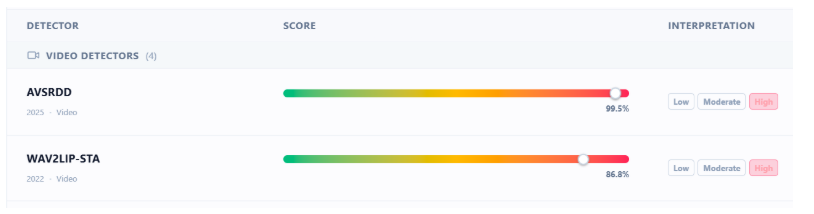
We also tested the video using the Deepfake-o-Meter platform.The AVSRDD (2025) model detected it as 99.5% AI-generated
Conclusion
Our research clearly establishes that the viral video claiming Iran destroyed Israel’s army headquarters is false and misleading. The footage does not appear in any credible news coverage of recent attacks, which strongly indicates that it is not real. Moreover, multiple AI detection tools consistently classify the video as artificially generated, with extremely high probability scores. Visual anomalies in the clip further support this finding.

Related Blogs

Introduction
The use of digital information and communication technologies for healthcare access has been on the rise in recent times. Mental health care is increasingly being provided through online platforms by remote practitioners, and even by AI-powered chatbots, which use natural language processing (NLP) and machine learning (ML) processes to simulate conversations between the platform and a user. Thus, AI chatbots can provide mental health support from the comfort of the home, at any time of the day, via a mobile phone. While this has great potential to enhance the mental health care ecosystem, such chatbots can present technical and ethical challenges as well.
Background
According to the WHO’s World Mental Health Report of 2022, every 1 in 8 people globally is estimated to be suffering from some form of mental health disorder. The need for mental health services worldwide is high but the supply of a care ecosystem is inadequate both in terms of availability and quality. In India, it is estimated that there are only 0.75 psychiatrists per 100,000 patients and only 30% of the mental health patients get help. Considering the slow thawing of social stigma regarding mental health, especially among younger demographics and support services being confined to urban Indian centres, the demand for a telehealth market is only projected to grow. This paves the way for, among other tools, AI-powered chatbots to fill the gap in providing quick, relatively inexpensive, and easy access to mental health counseling services.
Challenges
Users who seek mental health support are already vulnerable, and AI-induced oversight can exacerbate distress due to some of the following reasons:
- Inaccuracy: Apart from AI’s tendency to hallucinate data, chatbots may simply provide incorrect or harmful advice since they may be trained on data that is not representative of the specific physiological and psychological propensities of various demographics.
- Non-Contextual Learning: The efficacy of mental health counseling often relies on rapport-building between the service provider and client, relying on circumstantial and contextual factors. Machine learning models may struggle with understanding interpersonal or social cues, making their responses over-generalised.
- Reinforcement of Unhelpful Behaviors: In some cases, AI chatbots, if poorly designed, have the potential to reinforce unhealthy thought patterns. This is especially true for complex conditions such as OCD, treatment for which requires highly specific therapeutic interventions.
- False Reassurance: Relying solely on chatbots for counseling may create a partial sense of safety, thereby discouraging users from approaching professional mental health support services. This could reinforce unhelpful behaviours and exacerbate the condition.
- Sensitive Data Vulnerabilities: Health data is sensitive personal information. Chatbot service providers will need to clarify how health data is stored, processed, shared, and used. Without strong data protection and transparency standards, users are exposed to further risks to their well-being.
Way Forward
- Addressing Therapeutic Misconception: A lack of understanding of the purpose and capabilities of such chatbots, in terms of care expectations and treatments they can offer, can jeopardize user health. Platforms providing such services should be mandated to lay disclaimers about the limitations of the therapeutic relationship between the platform and its users in a manner that is easy to understand.
- Improved Algorithm Design: Training data for these models must undertake regular updates and audits to enhance their accuracy, incorporate contextual socio-cultural factors for profile analysis, and use feedback loops from customers and mental health professionals.
- Human Oversight: Models of therapy where AI chatbots are used to supplement treatment instead of replacing human intervention can be explored. Such platforms must also provide escalation mechanisms in cases where human-intervention is sought or required.
Conclusion
It is important to recognize that so far, there is no substitute for professional mental health services. Chatbots can help users gain awareness of their mental health condition and play an educational role in this regard, nudging them in the right direction, and provide assistance to both the practitioner and the client/patient. However, relying on this option to fill gaps in mental health services is not enough. Addressing this growing —and arguably already critical— global health crisis requires dedicated public funding to ensure comprehensive mental health support for all.
Sources
- https://www.who.int/news/item/17-06-2022-who-highlights-urgent-need-to-transform-mental-health-and-mental-health-care
- https://health.economictimes.indiatimes.com/news/industry/mental-healthcare-in-india-building-a-strong-ecosystem-for-a-sound-mind/105395767#:~:text=Indian%20mental%20health%20market%20is,access%20to%20better%20quality%20services.
- https://www.frontiersin.org/journals/digital-health/articles/10.3389/fdgth.2023.1278186/full

Executive Summary:
A viral online image claims to show Arvind Kejriwal, Chief Minister of Delhi, welcoming Elon Musk during his visit to India to discuss Delhi’s administrative policies. However, the CyberPeace Research Team has confirmed that the image is a deep fake, created using AI technology. The assertion that Elon Musk visited India to discuss Delhi’s administrative policies is false and misleading.


Claim
A viral image claims that Arvind Kejriwal welcomed Elon Musk during his visit to India to discuss Delhi’s administrative policies.


Fact Check:
Upon receiving the viral posts, we conducted a reverse image search using InVid Reverse Image searching tool. The search traced the image back to different unrelated sources featuring both Arvind Kejriwal and Elon Musk, but none of the sources depicted them together or involved any such event. The viral image displayed visible inconsistencies, such as lighting disparities and unnatural blending, which prompted further investigation.
Using advanced AI detection tools like TrueMedia.org and Hive AI Detection tool, we analyzed the image. The analysis confirmed with 97.5% confidence that the image was a deepfake. The tools identified “substantial evidence of manipulation,” particularly in the merging of facial features and the alignment of clothes and background, which were artificially generated.


Moreover, a review of official statements and credible reports revealed no record of Elon Musk visiting India to discuss Delhi’s administrative policies. Neither Arvind Kejriwal’s office nor Tesla or SpaceX made any announcement regarding such an event, further debunking the viral claim.
Conclusion:
The viral image claiming that Arvind Kejriwal welcomed Elon Musk during his visit to India to discuss Delhi’s administrative policies is a deep fake. Tools like Reverse Image search and AI detection confirm the image’s manipulation through AI technology. Additionally, there is no supporting evidence from any credible sources. The CyberPeace Research Team confirms the claim is false and misleading.
- Claim: Arvind Kejriwal welcomed Elon Musk to India to discuss Delhi’s administrative policies, viral on social media.
- Claimed on: Facebook and X(Formerly Twitter)
- Fact Check: False & Misleading
.webp)
Introduction
On the precipice of a new domain of existence, the metaverse emerges as a digital cosmos, an expanse where the horizon is not sky, but a limitless scope for innovation and imagination. It is a sophisticated fabric woven from the threads of social interaction, leisure, and an accelerated pace of technological progression. This new reality, a virtual landscape stretching beyond the mundane encumbrances of terrestrial life, heralds an evolutionary leap where the laws of physics yield to the boundless potential inherent in our creativity. Yet, the dawn of such a frontier does not escape the spectre of an age-old adversary—financial crime—the shadow that grows in tandem with newfound opportunity, seeping into the metaverse, where crypto-assets are no longer just an alternative but the currency du jour, dazzling beacons for both legitimate pioneers and shades of illicit intent.
The metaverse, by virtue of its design, is a canvas for the digital repaint of society—a three-dimensional realm where the lines between immersive experiences and entertainment blur, intertwining with surreal intimacy within this virtual microcosm. Donning headsets like armor against the banal, individuals become avatars; digital proxies that acquire the ability to move, speak, and perform an array of actions with an ease unattainable in the physical world. Within this alternative reality, users navigate digital topographies, with experiences ranging from shopping in pixelated arcades to collaborating in virtual offices; from witnessing concerts that defy sensory limitations to constructing abodes and palaces from mere codes and clicks—an act of creation no longer beholden to physicality but to the breadth of one's ingenuity.
The Crypto Assets
The lifeblood of this virtual economy pulsates through crypto-assets. These digital tokens represent value or rights held on distributed ledgers—a technology like blockchain, which serves as both a vault and a transparent tapestry, chronicling the pathways of each digital asset. To hop onto the carousel of this economy requires a digital wallet—a storeroom and a gateway for acquisition and trade of these virtual valuables. Cryptocurrencies, with NFTs—Non-fungible Tokens—have accelerated from obscure digital curios to precious artifacts. According to blockchain analytics firm Elliptic, an astonishing figure surpassing US$100 million in NFTs were usurped between July 2021 and July 2022. This rampant heist underlines their captivating allure for virtual certificates. Empowers do not just capture art, music, and gaming, but embody their very soul.
Yet, as the metaverse burgeons, so does the complexity and diversity of financial transgressions. From phishing to sophisticated fraud schemes, criminals craft insidious simulacrums of legitimate havens, aiming to drain the crypto-assets of the unwary. In the preceding year, a daunting figure rose to prominence—the vanishing of US$14 billion worth of crypto-assets, lost to the abyss of deception and duplicity. Hence, social engineering emerges from the shadows, a sort of digital chicanery that preys not upon weaknesses of the system, but upon the psychological vulnerabilities of its users—scammers adorned in the guise of authenticity, extracting trust and assets with Machiavellian precision.
The New Wave of Fincrimes
Extending their tentacles further, perpetrators of cybercrime exploit code vulnerabilities, engage in wash trading, obscuring the trails of money laundering, meander through sanctions evasion, and even dare to fund activities that send ripples of terror across the physical and virtual divide. The intricacies of smart contracts and the decentralized nature of these worlds, designed to be bastions of innovation, morph into paths paved for misuse and exploitation. The openness of blockchain transactions, the transparency that should act as a deterrent, becomes a paradox, a double-edged sword for the law enforcement agencies tasked with delineating the networks of faceless adversaries.
Addressing financial crime in the metaverse is Herculean labour, requiring an orchestra of efforts—harmonious, synchronised—from individual users to mammoth corporations, from astute policymakers to vigilant law enforcement bodies. Users must furnish themselves with critical awareness, fortifying their minds against the siren calls that beckon impetuous decisions, spurred by the anxiety of falling behind. Enterprises, the architects and custodians of this digital realm, are impelled to collaborate with security specialists, to probe their constructs for weak seams, and to reinforce their bulwarks against the sieges of cyber onslaughts. Policymakers venture onto the tightrope walk, balancing the impetus for innovation against the gravitas of robust safeguards—a conundrum played out on the global stage, as epitomised by the European Union's strides to forge cohesive frameworks to safeguard this new vessel of human endeavour.
The Austrian Example
Consider the case of Austria, where the tapestry of laws entwining crypto-assets spans a gamut of criminal offences, from data breaches to the complex webs of money laundering and the financing of dark enterprises. Users and corporations alike must become cartographers of local legislation, charting their ventures and vigilances within the volatile seas of the metaverse.
Upon the sands of this virtual frontier, we must not forget: that the metaverse is more than a hive of bits and bandwidth. It crystallises our collective dreams, echoes our unspoken fears, and reflects the range of our ambitions and failings. It stands as a citadel where the ever-evolving quest for progress should never stray from the compass of ethical pursuit. The cross-pollination of best practices, and the solidarity of international collaboration, are not simply tactics—they are imperatives engraved with the moral codes of stewardship, guiding us to preserve the unblemished spirit of the metaverse.
Conclusion
The clarion call of the metaverse invites us to venture into its boundless expanse, to savour its gifts of connection and innovation. Yet, on this odyssey through the pixelated constellations, we harness vigilance as our star chart, mindful of the mirage of morality that can obfuscate and lead astray. In our collective pursuit to curtail financial crime, we deploy our most formidable resource—our unity—conjuring a bastion for human ingenuity and integrity. In this, we ensure that the metaverse remains a beacon of awe, safeguarded against the shadows of transgression, and celebrated as a testament to our shared aspiration to venture beyond the realm of the possible, into the extraordinary.
References
- https://www.wolftheiss.com/insights/financial-crime-in-the-metaverse-is-real/
- https://gnet-research.org/2023/08/16/meta-terror-the-threats-and-challenges-of-the-metaverse/
- https://shuftipro.com/blog/the-rising-concern-of-financial-crimes-in-the-metaverse-aml-screening-as-a-solution/

