
#FactCheck-AI-Generated Image Falsely Shared as Chinese Soldiers Capturing Indian Troops in Arunachal Pradesh
Executive Summary
A photograph is being widely circulated on social media with the claim that it shows Chinese soldiers blindfolding and escorting three Indian soldiers after entering 60 kilometres inside Arunachal Pradesh. The image is being shared as evidence of an alleged Chinese military intrusion into Indian territory.
CyberPeace Research Wing’s research found the claim to be false. Our research revealed that the viral image is AI-generated and has no connection to any real incident in Arunachal Pradesh. The Government of India and the Indian Army have also rejected claims of Chinese forces entering Indian territory.
Claim
An Instagram user, 'star8atik', shared the viral image on July 6, 2026, with the caption:"China has occupied 60 km of land in Arunachal Pradesh."
https://www.instagram.com/reel/Dac60uVtH4j

Fact Check
To verify the claim, we first performed a reverse image search using Google Lens. However, we did not find any authentic source or credible report linking the viral image to an actual incident involving Chinese troops in Arunachal Pradesh. We also conducted keyword-based searches on Google using terms related to the alleged Chinese incursion. The search yielded no credible news reports confirming that Chinese soldiers had captured Indian troops or entered 60 kilometres inside Arunachal Pradesh. We then closely examined the image and noticed several visual inconsistencies commonly associated with AI-generated content. The facial features and body proportions of the soldiers in the background appeared distorted and unnatural. Additionally, one of the Indian soldiers was shown with what appeared to be a Chinese flag patch on his arm, but its design and placement were inconsistent and visually flawed. These anomalies raised strong suspicions that the image had been generated using artificial intelligence. To verify this, we analysed the image using the AI detection tool Hive Moderation, which indicated a 98% probability that the image was AI-generated.
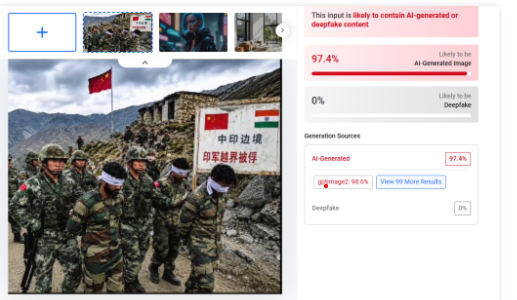
For additional verification, we also scanned the image using Undetectable AI, which found a 97% probability that the image had been digitally generated or manipulated using AI.

Conclusion
Our research found that the viral image claiming to show Chinese soldiers capturing Indian troops after entering Arunachal Pradesh is fake. The image is AI-generated and is being falsely circulated to support misleading claims of a Chinese military incursion. Furthermore, Union Minister Kiren Rijiju and the Indian Army have publicly rejected claims that Chinese forces entered Indian territory, making the viral claim baseless.

Related Blogs

The UN established its first permanent Global Mechanism for cybersecurity which will begin operations in March 2026. The policy framework for Western countries exists because their current strategies are being developed. The situation in India presents greater complexity and higher levels of interest than any other country.
The Fence That Became a Vantage Point
The United Nations cybersecurity talks have seen India actively participate since their start. India brought its proposal for an open and inclusive multilateral framework which was supported by Western states who wanted to establish universal norms and responsible state behaviour but India did not accept their geopolitical viewpoint.
India did not support the Russia-led bloc which wanted a permanent open-ended working group that would focus only on plenary meetings and the country also rejected the European Union's Program of Action. India maintained its previous stance by supporting multilateralism as a general principle while showing hesitation about backing specific power structures.
The fence now provides an advantage because it no longer serves as a point of vulnerability. India's non-alignment provides him with operational power because the body operates through decision-making which requires all members to agree.
Sovereignty First, Norms Second
The digital sovereignty framework which defines India's long-standing cybersecurity diplomatic activities serves as the country's fundamental cybersecurity diplomatic framework. New Delhi has been reluctant to endorse frameworks that could constrain how it manages its own cyberspace, whether through content regulation, surveillance architecture, or incident response. The Indian government establishes its control over internet governance through its implementation of VPN regulations and CERT-In reporting requirements and data localization discussions.
The new Global Mechanism creates a situation which India must handle because it creates an uncommon diplomatic situation. The framework's five pillars, threats, norms, international law, confidence-building measures, and capacity-building, each carry embedded assumptions that don't sit neatly with India's domestic policy posture. India supports the norm which prohibits countries from attacking each other's critical infrastructure while developing offensive cyber abilities and keeping its cyber response strategies secret.
The Capacity-Building Opening
The Indian government has a definite interest in dedicated thematic group 2 which focuses on building cybersecurity capacity. India exists in two opposing states because it operates as a developing nation which lacks basic national cybersecurity systems while also maintaining advanced cyber defense capabilities. The donor table exists as a platform which gives India both funding rights and complete rights to speak for developing nations. India should serve as a connecting force for DTG 2 by sharing its experience with CERT-In development and its sectoral frameworks for finance and telecom and its National Cyber Coordination Centre programs which train cybersecurity professionals while requesting capacity-building programs that follow demand-based needs assessment and local context understanding and which do not include the typical restrictions that accompany Western technical assistance.
India has done this before in other multilateral settings. The organization maintains its independence through its role as a credible Global South representative which it uses to speak for the Global South without aligning with any particular alliance.
The DTG 1 Question: Critical Infrastructure and Strategic Ambiguity
The DTG 1 study about ICT security challenges shows how resilience and cooperation and stability work together as different themes but creates complex challenges for India.
The 2020 Mumbai power grid incident which some researchers attribute to Chinese state-linked actors has become one of three major attacks against India's critical infrastructure together with AIIMS Delhi incidents in 2022 and ongoing cyber intrusions into defence and government networks. The international standards which govern critical infrastructure protection require actual implementation from India because the country possesses vital national assets.
India has not yet established formal processes for cyberattack attribution while its officials avoid the norm-enforcement diplomacy which Western countries practice through their coordinated attribution and sanction procedures.
India must either develop deeper transparency about its operations or create specialized operational plans which can keep its needed information undercover if it wants to participate in DTG 1 about cross-border interdependencies and incident response collaboration. India will likely engage selectively, supporting the idea of critical infrastructure norms while resisting mechanisms that operationalise accountability.
Geopolitical Triangulation
The new Global Mechanism needs countries to implement their national policies because states must stop merely restating their positions. Multilateral cybersecurity forums operate as Geopolitical triangulation platforms for India. India's security system must protect its interests against its two main cyber adversaries which include China and Pakistan-based groups.
The US and EU strategic partnership between India and these Western governments requires India to show closer ties with democratic nations through its participation in international forums. The new Global Mechanism will require India to pursue its current position by participating in capacity-building activities while developing common norms through its work on general norms language.
India will maintain its current position between Western liberal order enforcement and Russia-China sovereignty-maximalist counter-narrative through its capacity-building activities and general norms language work.
What India Should Actually Do
The document establishes core argument which states early DTG development needs to be established for proper assessment of future results which applies to Indian territory and European territory. India has the credibility and technical foundation and diplomatic ties which enable it to establish itself as an agenda-setter who takes proactive actions instead of following others. India should take the following actions to achieve its goals: lead or co-lead DTG 2 discussions which focus on the capacity requirements of the Global South while advancing DG 1 areas that protect developing nations from actual threats and establish South-South cybersecurity agreements through this system which will help them bypass Western capacity development restrictions. The Global Mechanism offers an essential multilateral platform which provides advantages to countries that take initial actions. India has the ability to make an impact because it possesses strategic advantages which will be activated through its choice between active participation and total disengagement.
References
- http://interface-eu.org/publications/the-new-united-nations-mechanism-on-cybersecurity#a-european-strategy-for-the-dtgs
- https://disarmament.unoda.org/en/our-work/emerging-challenges/developments-field-information-and-telecommunications-context
- https://www.recordedfuture.com/research/redecho-targeting-indian-power-sector
- https://www.saikrishnaassociates.com/cert-in-issues-directions-for-information-security-practices-procedure-prevention-response-and-reporting-of-cyber-incidents/

Introduction
The Chairman of Vardhman Group, Mr SP Oswal, an India-based textile manufacturer, fell victim to a cyber fraud scheme that cost him ₹7 crore. The scam unfolded on August 28 and 29, conning Mr Oswal into transferring Rs 7 crore into multiple bank accounts. As per the recent reports, the Police have managed to freeze these accounts and recover over Rs 5 crore as of now. The fraudsters convinced Mr SP Oswal that he was a suspect in a money laundering investigation and held on a “Digital Arrest”. These are sophisticated cyber frauds where cyber-criminals impersonate law enforcement officials or other authorities and target innocent individuals with manipulative tactics. The scam targets are often contacted out of the blue, on Instant messaging apps like WhatsApp and informed that their bank accounts, digital identities, or other online assets have been compromised. Criminals play into the victims' fear by threatening them with imminent arrest, legal consequences, or public humiliation if they don't cooperate with a series of urgent demands.
Posing as Officials, Fraudsters Orchestrate ₹7 Crore Scam
The investigation revealed that the fraudsters posed as members of the Central Bureau of Investigation (CBI). They had contacted Mr Oswal and claimed that his Aadhaar had been misused in a case involving fake passports and financial fraud. The imposter conducted a video call in a police uniform using a background with the CBI logo. The fraud escalated further, Mr Oswal got a fake "arrest warrant" on WhatsApp allegedly authorised by the Supreme Court. Fraudsters convinced Mr Oswal to transfer ₹7 crores to facilitate bail proceedings, claiming he was under "digital arrest". The meticulously planned scam involved fake documents, a virtual courtroom, and relentless intimidation tactics leaving Mr Oswal effectively under "digital arrest" for two days. While the police have successfully recovered over Rs 5 crore so far, this case highlights the alarming threat of digital impersonation of law enforcement authorities.
Legal Outlook on the Validity of Digital Arrests
In India, the main laws governing cyber crimes are the Information Technology Act, of 2000 and the rules made under therein, and the newly enacted Bhartiya Nyaya Sanhita, 2023. Recently enacted new criminal laws do not provide for any provision for law enforcement agencies conducting a digital arrest. The law only provides for service of the summons and the proceedings in an electronic mode. Hence, there are no provisions for conducting 'digital arrests' as per the laws of the country.
Further, It should be noted that the Indian Cyber Crime Coordination Centre (I4C), under the Ministry of Home Affairs, coordinates the activities related to combating cybercrime in the country. MHA works closely with other ministries to counter these frauds. The I4C also provides technical support to the police authorities of states/UTs for the identification and investigation of these cases.
Best Practices to Avoid Digital Arrest Scams
- To protect yourself from scams, it is crucial to verify the identity of individuals claiming to be law enforcement or government officials and use official contact channels to confirm their credentials.
- Be cautious of pressure tactics used by fraudsters, especially demands for quick payment over unverified communication platforms like WhatsApp.
- Cross-check official documents with legal advisors or relevant authorities.
- Never share sensitive personal information, such as your Aadhaar number, over phone calls, emails, or messages without verifying the request's authenticity.
- Avoid untraceable payments, such as cryptocurrency or prepaid cards, without validating the transaction's legitimacy, especially under duress.
- Stay informed on scam techniques, particularly those involving impersonation and digital threats.
- Enable Two-Factor Authentication (2FA) for sensitive online accounts to prevent misuse.
- Consult advice from legal professionals if you receive threatening communication involving digital arrest or legal actions and do not take any action on the asks of persons posing as legitimate authorities.
- In case of any cybercrime, you can file a complaint at cybercrime.gov.in or helpline number 1930. You can also seek assistance from the CyberPeace helpline at +91 9570000066.
Conclusion
The digital arrest of Vardhman Group's CEO underscores the increasing sophistication of cyber fraud schemes, which exploit fear and urgency, leading to severe financial and reputational harm. No one is immune from cybercrime, vigilance is essential at all leadership levels. While laws like the IT Act and initiatives taken by the I4C help combat cybercrime, rapidly evolving threats demand proactive safety measures. Beyond the possibility of financial loss, incidents like this jeopardise brand reputation, investor confidence, and operational stability. Be cautious of such threats and exercise due care and caution while navigating the digital landscape. Be aware of such kinds of scams and the manipulative tactics used by fraudsters to avoid them. By staying vigilant and aware we can avoid the growing scam of digital arrests.
References
- https://www.business-standard.com/companies/news/digital-arrest-and-rs-7-crore-heist-how-vardhman-group-head-was-tricked-124100100832_1.html
- https://www.hindustantimes.com/business/vardhman-group-chairman-sp-oswal-duped-of-rs-7-crore-fraudsters-posed-as-cbi-101727666912738.html
- https://www.msspalert.com/native/digital-arrests-the-new-frontier-of-cybercrime

The European Union (EU) has made trailblazing efforts regarding protection and privacy, coming up with the most comprehensive and detailed regulation called the GDPR (General Data Protection Regulation). As countries worldwide continue to grapple with setting their laws, the EU is already taking on issues with tech giants and focusing on the road ahead. Its contentious issues with Meta and the launch of Meta’s AI assistant in the EU are thus seen as a complex process, shaped by stringent data privacy regulations, ongoing debates over copyright, and ethical AI practices. This development is considered important as previously, the EU and Meta have had issues (including fines and and also received a pushback concerning its services), which broadly include data privacy regarding compliance with GDPR, antitrust law concerns- targeting ads, facebook marketplace activities and content moderation with respect to the spread of misinformation.
Privacy and Data Protection Concerns
A significant part of operating Large Language Models (LLMs) is the need to train them with a repository of data/ plausible answers from which they can source. If it doesn’t find relevant information or the request is out of its scope, programmed to answer, it shall continue to follow orders, but with a reduction in the accuracy of its response. Meta's initial plans to train its AI models using publicly available content from adult users in the EU received a setback from privacy regulators. The Irish Data Protection Commission (DPC), acting as Meta's lead privacy regulator in Europe, raised the issue and requested a delay in the rollout to assess its compliance with GDPR. It has also raised similar concerns with Grok, the AI tool of X, to assess whether the EU users’ data was lawfully processed for training it.
In response, Meta stalled the release of this feature for around a year and agreed to exclude private messages and data from users under the age of 18 and implemented an opt-out mechanism for users who do not wish their public data to be used for AI training. This approach aligns with GDPR requirements, which mandate a clear legal basis for processing personal data, such as obtaining explicit consent or demonstrating legitimate interest, along with the option of removal of consent at a later stage, as the user wishes. The version/service available at the moment is a text-based assistant which is not capable of things like image generation, but can provide services and assistance which include brainstorming, planning, and answering queries from web-based information. However, Meta has assured its users of expansion and exploration regarding the AI features in the near future as it continues to cooperate with the regulators.
Regulatory Environment and Strategic Decisions
The EU's regulatory landscape, characterised by the GDPR and the forthcoming AI Act, presents challenges for tech companies like Meta. Citing the "unpredictable nature" of EU regulations, Meta has decided not to release its multimodal Llama AI model—capable of processing text, images, audio, and video—in the EU. This decision underscores the tension between innovation and regulatory compliance, as companies navigate the complexities of deploying advanced AI technologies within strict legal frameworks.
Implications and Future Outlook
Meta's experience highlights the broader challenges faced by AI developers operating in jurisdictions with robust data protection laws. The most critical issue that remains for now is to strike a balance between leveraging user data for AI advancement while respecting individual privacy rights.. As the EU continues to refine its regulatory approach to AI, companies need to adapt their strategies to ensure compliance while fostering innovation. Stringent measures and regular assessment also keep in check the accountability of big tech companies as they make for profit as well as for the public.
Reference:
- https://thehackernews.com/2025/04/meta-resumes-eu-ai-training-using.html
- https://www.thehindu.com/sci-tech/technology/meta-to-train-ai-models-on-european-users-public-data/article69451271.ece
- https://about.fb.com/news/2025/04/making-ai-work-harder-for-europeans/
- https://www.theregister.com/2025/04/15/meta_resume_ai_training_eu_user_posts/
- https://noyb.eu/en/twitters-ai-plans-hit-9-more-gdpr-complaints
- https://www.businesstoday.in/technology/news/story/meta-ai-finally-comes-to-europe-after-a-year-long-delay-but-with-some-limitations-468809-2025-03-21
- https://www.bloomberg.com/news/articles/2025-02-13/meta-opens-facebook-marketplace-to-rivals-in-eu-antitrust-clash
- https://www.nytimes.com/2023/05/22/business/meta-facebook-eu-privacy-fine.html#:~:text=Many%20civil%20society%20groups%20and,million%20for%20a%20data%20leak.
- https://ec.europa.eu/commission/presscorner/detail/en/ip_24_5801
- https://www.thehindu.com/sci-tech/technology/european-union-accuses-facebook-owner-meta-of-breaking-digital-rules-with-paid-ad-free-option/article68358039.ece
- https://www.theregister.com/2025/04/14/ireland_investigation_into_x/
- https://www.theverge.com/2024/7/18/24201041/meta-multimodal-llama-ai-model-launch-eu-regulations?utm_source=chatgpt.com
- https://www.axios.com/2024/07/17/meta-future-multimodal-ai-models-eu?utm_source=chatgpt.com
