
#FactCheck-AI-Generated Image Collage Falsely Linked to Recent Nepal Floods
Executive Summary
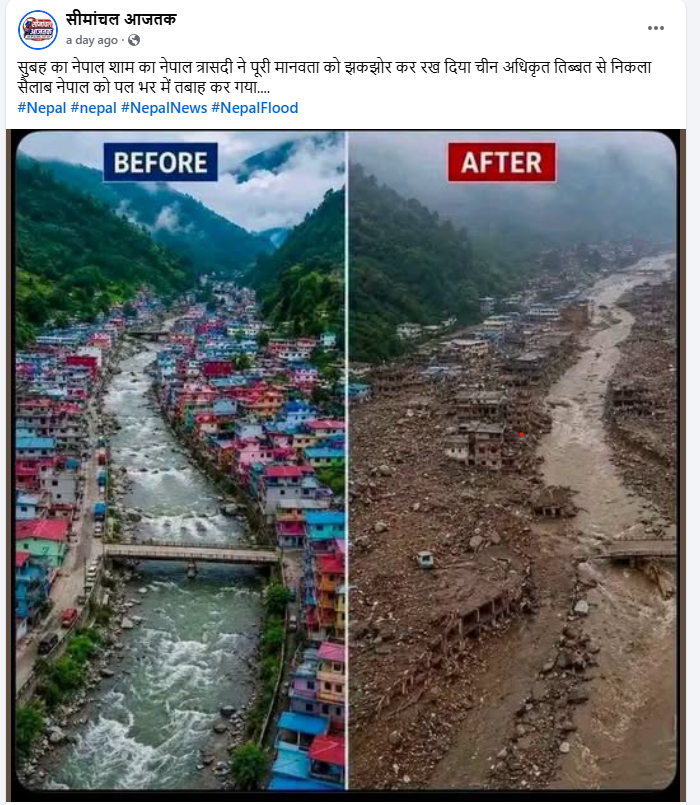
A collage made by combining two images is going viral on social media. It is being shared as being related to the recent devastating floods in Nepal. One image in the collage shows a beautiful town before the floods, while the other depicts the destruction caused by the flooding. A research done by the Research Wing of the CyberPeace found the viral claim to be false. The research revealed that the viral image collage circulating on social media is AI-generated and is being falsely shared as visuals of the recent floods in Nepal.
Claim:
A user on social media platform Facebook shared the viral collage with the caption: “Nepal in the morning, Nepal in the evening. The tragedy has shaken all of humanity. The flood originating from China-occupied Tibet devastated Nepal in an instant.”
The link to the post, its archived version, and a screenshot are provided below.
https://www.facebook.com/photo/?fbid=1630488505774559&set=a.467756888714399
Fact Check
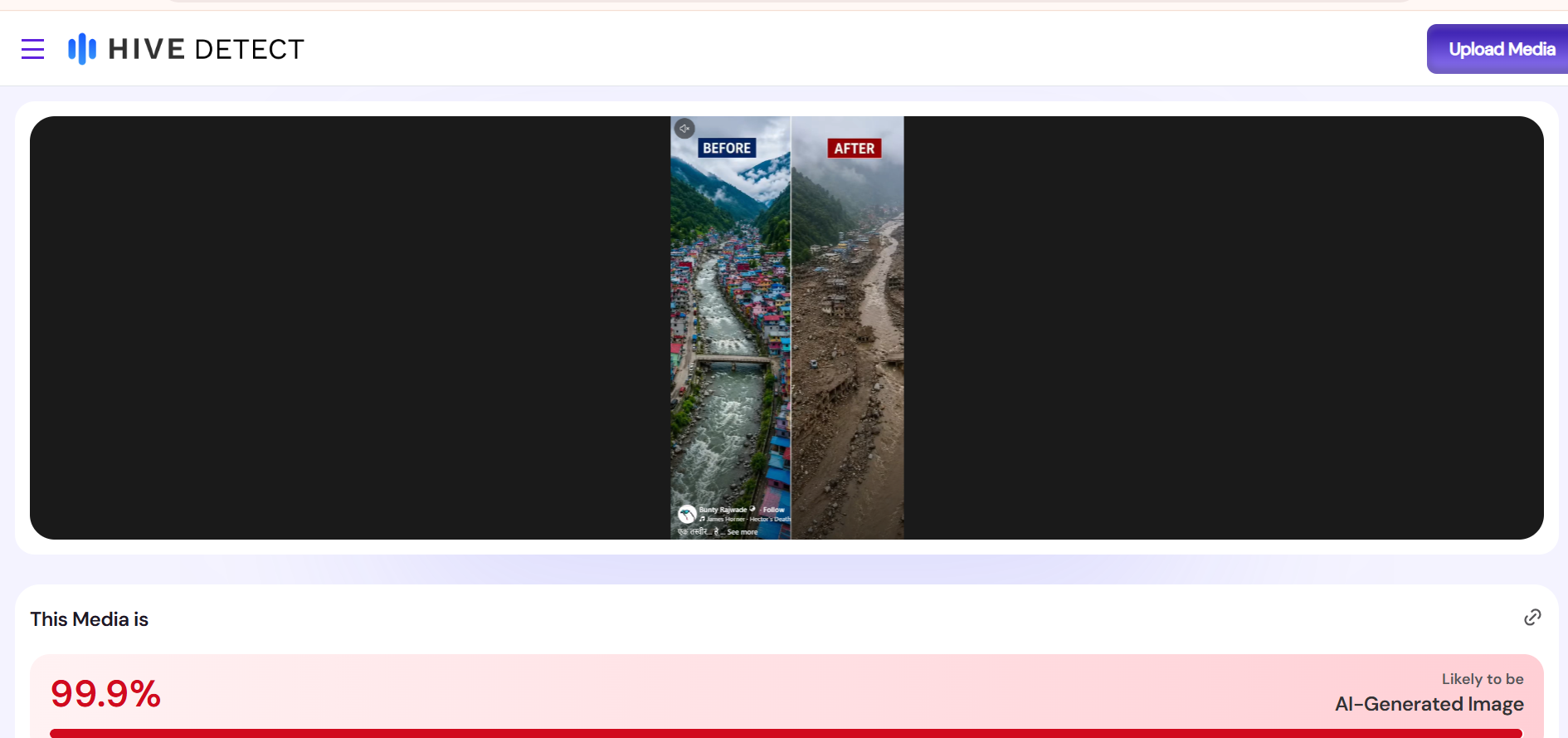
To verify the authenticity of the viral images, the desk first conducted a reverse image search. However, the search did not lead us to any credible media reports or original sources featuring these images. We then closely examined the images. The analysis revealed several anomalies in the structure of the buildings, the vehicles visible on the road, and other elements in the images, further strengthening the suspicion that they were AI-generated. We then scanned the viral image using the AI detection tool Hive Moderation. The tool’s analysis indicated a 99 percent likelihood that the image was AI-generated.
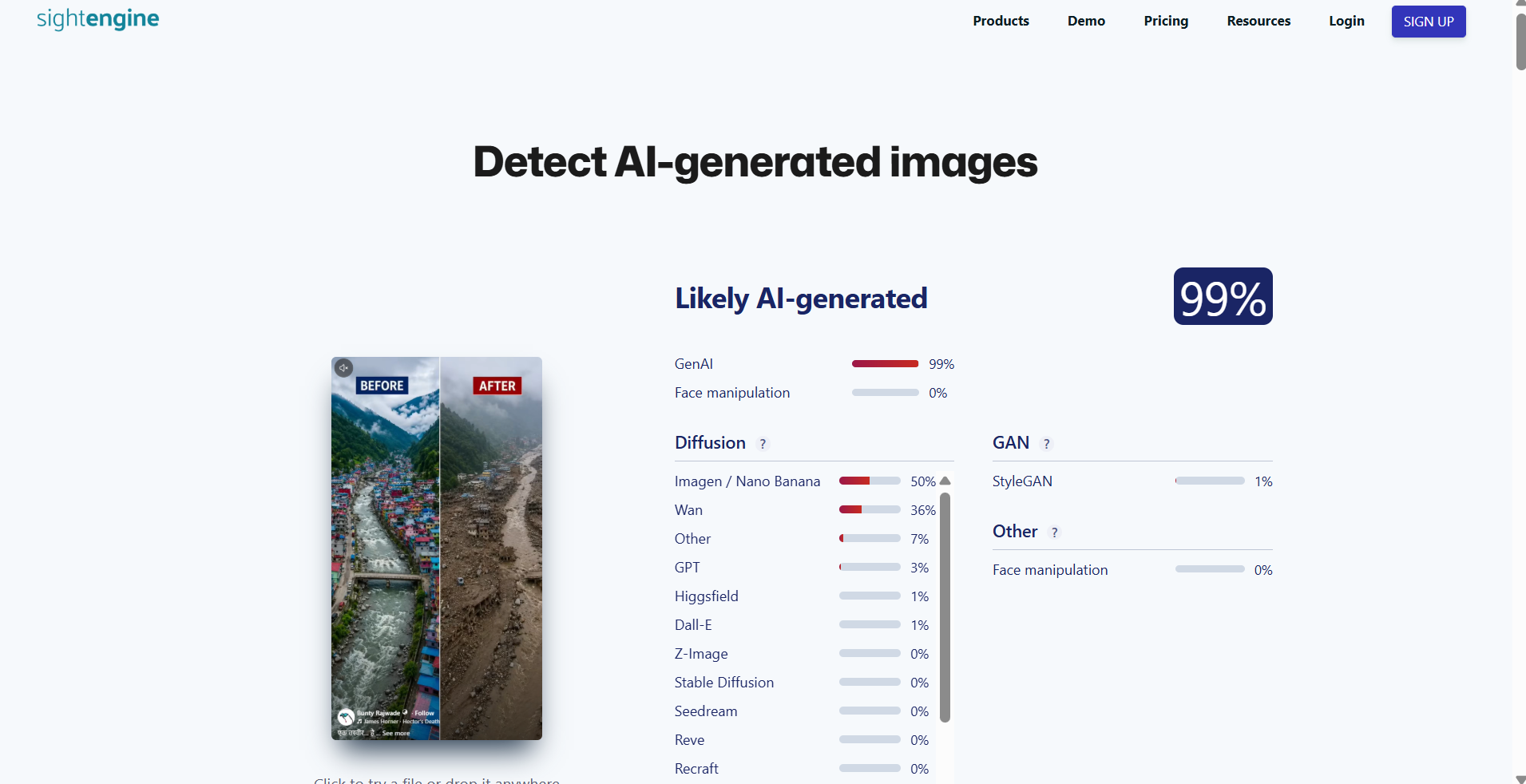
We then scanned the viral image using the AI detection tool Sightengine as well. The tool’s analysis indicated a 99 percent likelihood that the image was AI-generated.
Conclusion
Our research found that the viral collage of images being shared on social media is AI-generated and is being falsely linked to the recent floods in Nepal.

Related Blogs

Introduction
The Telecom Regulatory Authority of India (TRAI) has directed all telcos to set up detection systems based on Artificial Intelligence and Machine Learning (AI/ML) technologies in order to identify and control spam calls and text messages from unregistered telemarketers (UTMs).
The TRAI Directed telcos
The telecom regulator, TRAI, has directed all Access Providers to detect Unsolicited commercial communication (UCC)by systems, which is based on Artificial Intelligence and Machine Learning to detect, identify, and act against senders of Commercial Communication who are not registered in accordance with the provisions of the Telecom Commercial Communication Customer Preference Regulations, 2018 (TCCCPR-2018). Unregistered Telemarketers (UTMs) are entities that do not register with Access Providers and use 10-digit mobile numbers to send commercial communications via SMS or calls.
TRAI steps to curb Unsolicited commercial communication
TRAI has taken several initiatives to reduce Unsolicited Commercial Communication (UCC), which is a major source of annoyance for the public. It has resulted in fewer complaints filed against Registered Telemarketers (RTMs). Despite the TSPs’ efforts, UCC from Unregistered Telemarketers (UTMs) continues. Sometimes, these UTMs use messages with bogus URLs and phone numbers to trick clients into revealing crucial information, leading to financial loss.
To detect, identify, and prosecute all Unregistered Telemarketers (UTMs), the TRAI has mandated that Access Service Providers implement the UCC.
Detect the System with the necessary functionalities within the TRAI’s Telecom Commercial Communication Customer Preference Regulations, 2018 framework.
Access service providers have implemented such detection systems based on their applicability and practicality. However, because UTMs are constantly creating new strategies for sending unwanted communications, the present UCC detection systems provided by Access Service providers cannot detect such UCC.
TRAI also Directs Telecom Providers to Set Up Digital Platform for Customer Consent to Curb Promotional Calls and Messages.
Unregistered Telemarketers (UTMs) sometimes use messages with fake URLs and phone numbers to trick customers into revealing essential information, resulting in financial loss.
TRAI has urged businesses like banks, insurance companies, financial institutions, and others to re-verify their SMS content templates with telcos within two weeks. It also directed telecom companies to stop misusing commercial messaging templates within the next 45 days.
The telecom regulator has also instructed operators to limit the number of variables in a content template to three. However, if any business intends to utilise more than three variables in a content template for communicating with their users, this should be permitted only after examining the example message, as well as adequate justifications and justification.
In order to ensure consistency in UCC Detect System implementations, TRAI has directed all Access Providers to deploy UCC and detect systems based on artificial intelligence and Machine Learning that are capable of constantly evolving to deal with new signatures, patterns, and techniques used by UTMs.
Access Providers have also been directed to use the DLT platform to share intelligence with others. Access Providers have also been asked to ensure that such UCC Detect System detects senders that send unsolicited commercial communications in bulk and do not comply with the requirements. All Access Providers are directed to follow the instructions and provide an update on actions done within thirty days.
The move by TRAI is to curb the menacing calls as due to this, the number of scam cases is increasing, and now a new trend of scams started as recently, a Twitter user reported receiving an automated call from +91 96681 9555 with the message “This call is from Delhi Police.” It then asked her to stay in the queue since some of her documents needed to be picked up. Then he said he works as a sub-inspector at the Kirti Nagar police station in New Delhi. He then inquired whether she had recently misplaced her Aadhaar card, PAN card, or ATM card, to which she replied ‘no’. The scammer then poses as a cop and requests that she authenticate the last four digits of her card because they have found a card with her name on it. And a lot of other people tweeted about it.

Conclusion
TRAI directed the telcos to check the calls and messages from Unregistered numbers. This step of TRAI will curb the pesky calls and messages and catch the Frauds who are not registered with the regulation. Sometimes the unregistered sender sends fraudulent links, and through these fraudulent calls and messages, the sender tries to take the personal information of the customers, which results in financial losses.
Introduction
The Ministry of Electronics and Information Technology (MEITy) released the Draft Information Technology (Intermediary Guidelines and Digital Media Ethics Code) Second Amendment Rules, 2026 on March 30, 2026, inviting public comments with a response window closing on April 14. This is a limited 15-day period for public input on proposed rules that will have major constitutional impacts. The brevity and timing of this opportunity demonstrate debatable commitment to stakeholder engagement and meaningful consultation by the drafting agency.
While MEITY describes the proposed amendments as "clarificatory and procedural nature," an analysis shows they will have substantive effects. Collectively, the amended language changes significantly how online speech will be regulated in India by providing the executive with more concentrated regulatory authority, limiting the required transparency of content enforcement, mandating greater retention of data without proportionality-based safeguards, and placing excessive compliance burden on intermediaries. Each of these changes has consequences beyond just changes in process and together, these changes collectively raise substantial concerns regarding compliance with Articles 14, 19, and 21 of the Constitution of India.
The Constitutional Baseline: Shreya Singhal and the Limits of Intermediary Liability
India’s Supreme Court decision in Shreya Singhal v Union of India (2015) 5 SCC 1 provides the foundation for intermediary liability, wherein the Court read down Section 79(3)(b) of the IT Act, 2000, holding that intermediaries are required to act upon receiving actual knowledge only through a court order or a valid notification by the appropriate government authority. The Supreme Court’s decision intended to provide a constitutional protection to intermediaries from being subjected to informal, unverified executive pressure to take down content by requiring that any such order be subject to some level of legal objective credibility or threshold.
Rule 3(4) of the proposed amendments places that balance under significant strain. By requiring intermediaries to comply with advisories, directions, standard operating procedures, codes of practice, and guidelines issued by the Ministry — and tying non-compliance to the loss of safe harbour — the draft effectively lowers the constitutional threshold that Shreya Singhal was designed to maintain. Compliance obligations now potentially arise from instruments that carry no judicial sanction and no mandatory public disclosure.
Rule 3(4): Delegated Legislation or Executive Overreach
The rule-making power conferred on the Central Government under Section 87 of the IT Act is limited to carrying out the provisions of the Act. It does not authorise the creation of new substantive obligations. This principle has been consistently affirmed in Indian Express Newspapers v. Union of India (1985) 1 SCC 641 and Confederation of Ex-Servicemen Associations v. Union of India (2006) 8 SCC 399, where the Court held that delegated legislation must remain within the four corners of the parent statute.
Rule 3(4) tests those limits. It converts executive advisories into binding compliance instruments without a clear statutory foundation in either Section 79 or Section 87. Although the proposed rule requires that such instruments specify their legal basis, there is no requirement that they be published or made publicly accessible. This creates a framework in which legality risks becoming circular — instruments claimed to be lawful solely by reference to a provision that does not clearly authorise them, shielded from scrutiny by their own opacity. Justice Chandurkar’s judgment in Kunal Kamra v. Union of India identified precisely this defect in the Fact Check Unit amendment. Rule 3(4) replicates the structural problem in a broader form.
Compliance Pressure and the Logic of Over-Censorship
The practical consequence of Rule 3(4) lies not only in its legality but in how it reshapes incentive structures for platforms. An intermediary facing the permanent threat of safe harbour loss will not wait to assess the legal merit of each advisory. The rational calculation is to comply early, broadly, and without friction. Lawful content — particularly satire, political commentary, and journalism — becomes vulnerable not because it is unlawful, but because it presents regulatory risk.
This dynamic was visible on 18 March 2026, when stand-up comedian Pulkit Mani (@hunnywhoisfunny) found his satirical Instagram reel being restricted across India. The video had accumulated over 16.5 million views. Users encountered a notice citing Section 79(3)(b) of the IT Act. No reasons were publicly provided. No prior hearing was offered. The same night, several political parody and satire accounts were withheld on X.
Data Retention, Privacy, and the Proportionality Test
The amendments to Rules 3(1)(g) and 3(1)(h) extend data retention obligations by making them additional to requirements under any other law. The existing 180-day floor for retained user data — covering removed content, registration information, and associated records — becomes a minimum rather than a ceiling. No maximum is specified, and no proportionality requirement accompanies the extension.
This raises direct concerns under Article 21 as interpreted in Justice K.S. Puttaswamy v. Union of India (2017) 10 SCC 1, which held that any state intrusion into privacy must satisfy the triple test of legality, necessity, and proportionality. Undefined retention periods, with no statutory ceiling and no requirement of purpose limitation, risk failing all three. The longer user data is held, including metadata, device information, and records of removed content, the greater the exposure to surveillance, unauthorised access, and use beyond the original justification.
Circumventing Judicial Scrutiny Through Procedural Redesign
The Bombay High Court, in its August 2021 order, stayed provisions of the IT Rules’ oversight mechanism as prima facie violative of Article 19(1)(a). The Madras High Court in T.M. Krishna v. Union of India affirmed that stay, cautioning that government-controlled media oversight risked undermining press independence. Both matters remain pending before the Delhi High Court.
The amendments to Rules 8(1) and 14 restructure the same oversight machinery through a modified procedural design. By extending the Inter-Departmental Committee’s jurisdiction to cover “matters” referred by the Ministry with no requirement of a complainant, no defined subject matter, and no guaranteed prior hearing, the proposed rules effectively reconstitute what courts found constitutionally suspect. Individual users posting news and current affairs content are now brought within reach of blocking mechanisms originally designed for institutional publishers.
Conclusion
As seen above, the Draft IT Rules 2026 are unable to meet the constitutional and judicial requirements to regulate free speech. What the proposed amendments construct is a durable system in which platforms self-censor under liability pressure, data is retained without proportionate justification, and content oversight expands through procedural adjustment rather than parliamentary legislation. Regulation of the digital public sphere is both legitimate and necessary. But it must be anchored in law, not in the quiet authority of executive advisories. The law must ultimately remain anchored in constitutional values, guided by the enduring principles of justice, equity, and good conscience.
The comment period closes on 14 April 2026.
Submissions may be sent to itrules.consultation@meity.gov.in.
References
- https://www.meity.gov.in/static/uploads/2026/03/30591fc6e322dcbcc9dae84a0f02e9e7.pdf
- https://www.meity.gov.in/static/uploads/2026/03/a71a21d35c107f2e528363d3eb17646a.pdf
- https://www.meity.gov.in/static/uploads/2026/02/550681ab908f8afb135b0ad42816a1c9.pdf
- https://neopolitico.com/india/government-blocks-viral-satirical-reel-impersonating-pm-modi-raising-fresh-questions-on-free-speech-and-digital-regulation/
- https://internetfreedom.in/sound-the-alarm-iffs-first-read-on-meitys-draft-it-rules-second-amendment-2026/
Executive Summary
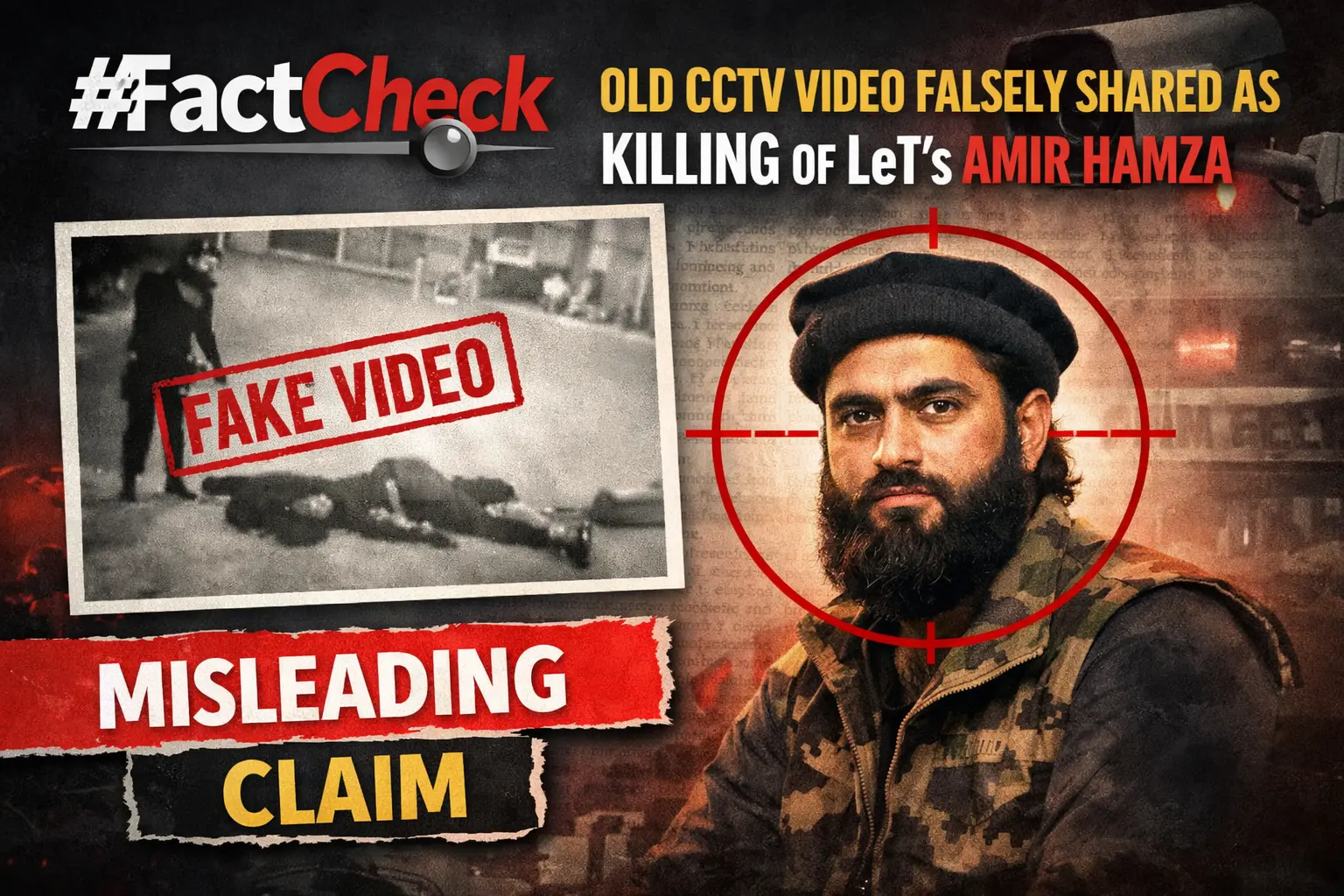
A CCTV video showing a man being shot is being widely circulated on social media with the claim that it depicts the killing of Lashkar-e-Taiba terrorist Amir Hamza in Pakistan. However, research by the CyberPeace Research Wing found that the claim is misleading. The viral video existed online even before the reported attack on Amir Hamza.
Claim
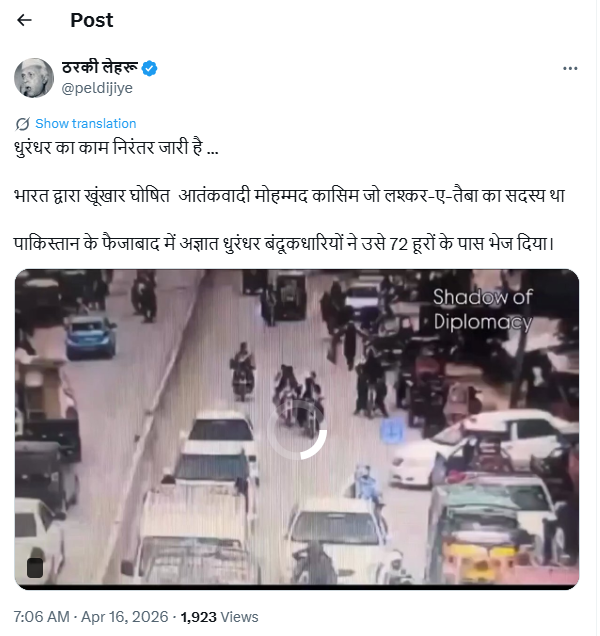
Social media users are sharing a CCTV clip claiming that Lashkar-e-Taiba terrorist Amir Hamza was shot dead in Pakistan.
Fact Check
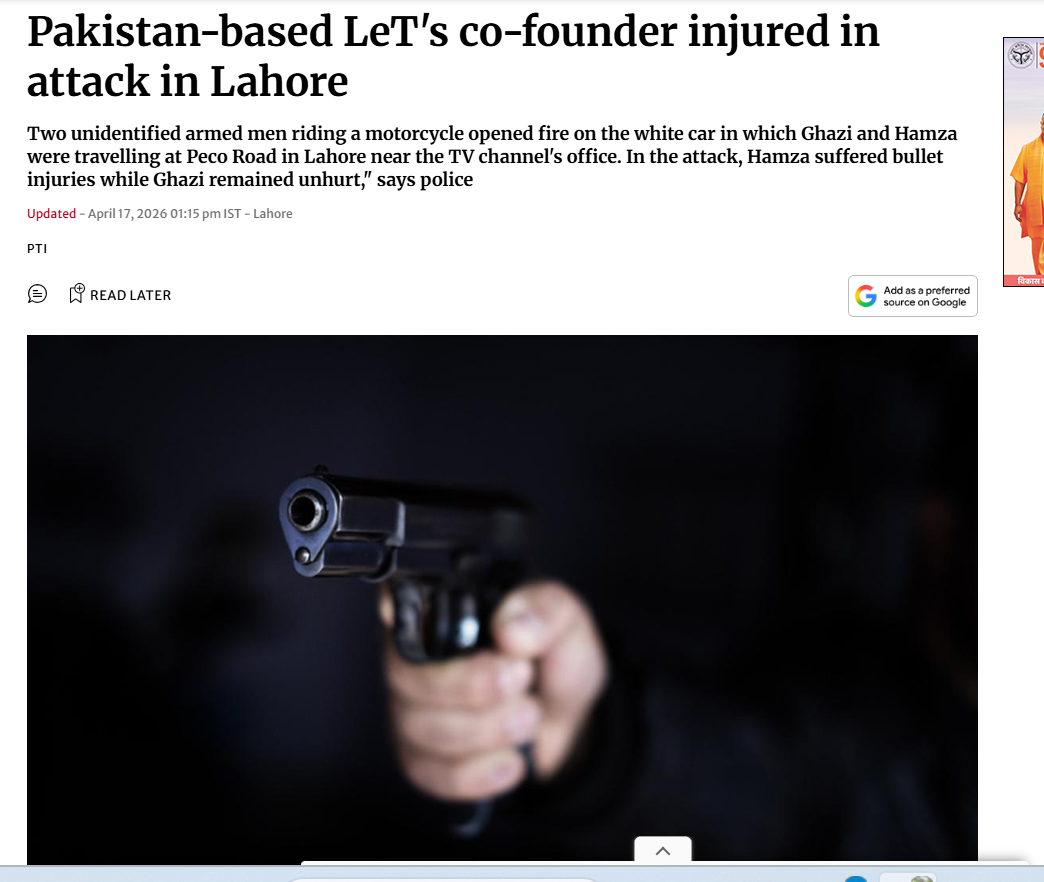
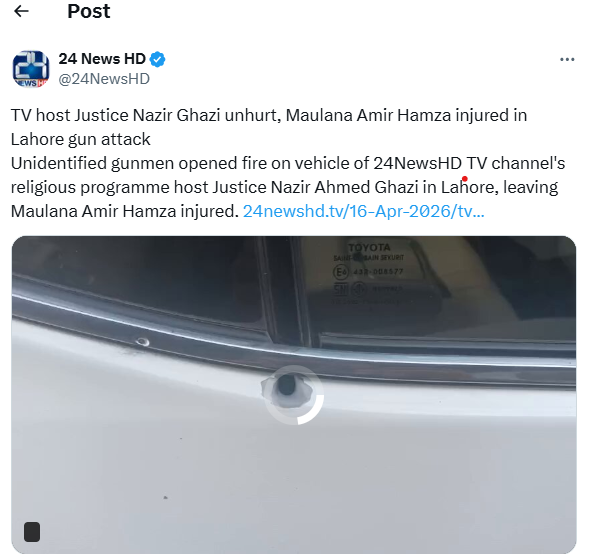
To verify the claim, we first searched relevant keywords such as “Maulana Amir Hamza firing Lahore.” This led us to a report published on April 17, 2026, by The Hindu. Citing Pakistani channel 24 News HD TV, the report stated that unidentified attackers opened fire on the car of TV host Justice Nazir Ahmed Ghazi. Amir Hamza was injured in the incident, not killed.
We also reviewed the official social media accounts of 24 News HD TV. A post on its X handle (@24NewsHD) confirmed that Justice Ghazi was safe, while Amir Hamza sustained injuries in the firing incident in Lahore.
For further verification, we extracted keyframes from the viral video and performed a reverse image search. The same clip was found uploaded on March 28, 2026, on a Pakistani Facebook page. According to the post, the CCTV footage was linked to the killing of an individual named Saifullah Malakhel.
Although we could not independently verify the exact origin of the video, our findings clearly indicate that the footage predates the recent attack on Amir Hamza and is unrelated to the incident.
Conclusion
The viral claim is false. Amir Hamza was not killed but reportedly injured in the firing incident, as per credible media reports. The CCTV video being shared in this context is old and unrelated, and has been circulated with a misleading narrative.
