
#FactCheck: AI-Generated Bond Paper Falsely Linked to CJP Founder Abhijeet Dipke
Executive Summary
Amid the ongoing protests in Delhi, an image of a bond paper is being widely shared on social media. The image is being shared with the claim that it shows the bond allegedly submitted in court by Cockroach Janata Party (CJP) founder Abhijeet Dipke for his release. The purported bond mentions that Abhijeet Dipke would not participate in any protest in the future and that he had furnished a bail bond of Rs 50,000. CyberPeace Research found that the image of the bond paper being shared in connection with Abhijeet Dipke is not genuine, but was created using AI.
Claim
Amid the ongoing protests in Delhi, an image of a bond paper is being widely shared on social media. It is being claimed that the image shows the bond allegedly submitted in court by Cockroach Janata Party (CJP) founder Abhijeet Dipke for his release. The purported bond mentions that Abhijeet Dipke would not participate in any protest in the future and that he had furnished a bail bond of Rs 50,000.
https://www.facebook.com/photo/?fbid=122133387387390171&set=a.122113963941390171
https://ghostarchive.org/archive/C8SDb

Fact Check
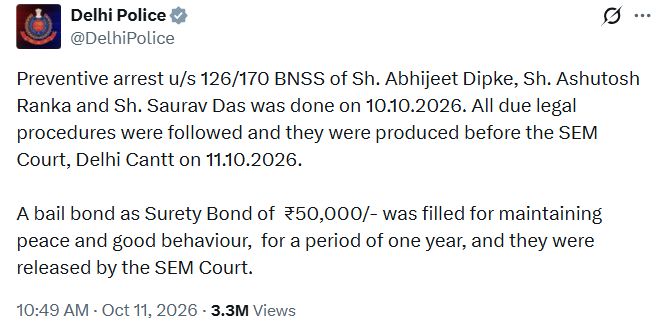
In a post shared on X, the Delhi Police stated that Abhijeet Dipke, Ashutosh Ranka and Saurav Das were taken into preventive custody on October 10, 2026, under Sections 126/170 of the Bharatiya Nagarik Suraksha Sanhita (BNSS). According to the police, all legal procedures were followed, and the three were produced before the SEM court at Delhi Cantt on October 11, 2026. In its post, the Delhi Police also stated that a bail bond (surety bond) of ₹50,000 was furnished for a period of one year to maintain peace and good behaviour.
https://x.com/DelhiPolice/status/2109151954438136069
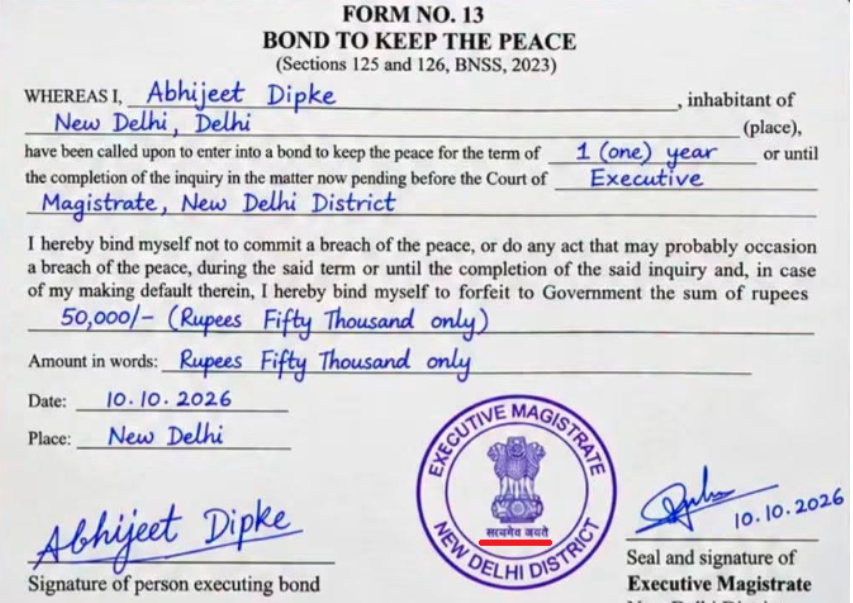
To verify the viral image of the bond paper, we examined the Delhi Police’s social media handles and searched other media reports. However, we did not find the viral image of the bond paper in any article or X post published by a credible source. We then closely examined the viral bond paper. During our analysis, we noticed a clear error. The spelling of “Satyamev Jayate” on the seal affixed to the document is incorrect. Based on this error, we suspected that the purported image of the bond paper being circulated on social media may have been created using AI.
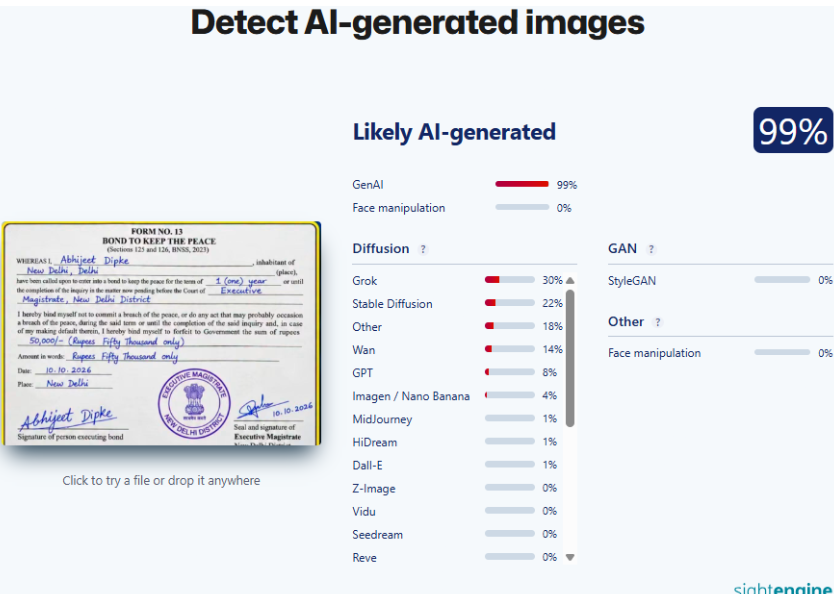
As the next step in our research, we used AI detection tools to analyse the viral image. We scanned the image using Sightengine, which indicated that the viral image is 99% likely to be AI-generated.
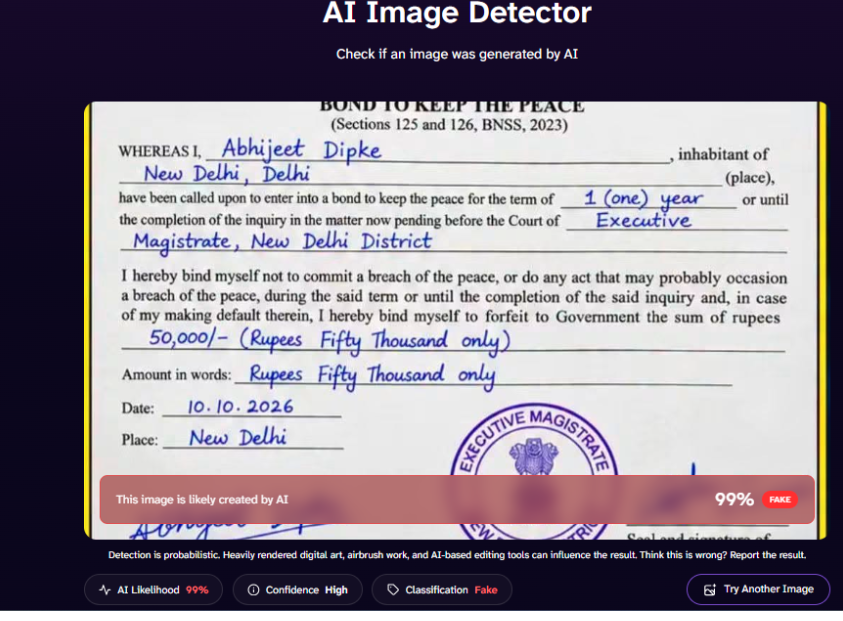
DeepAI, in its analysis, estimated a 99% likelihood that the viral bond paper was created using AI.
Conclusion
Our research found that the image of the bond paper being shared in connection with Abhijeet Dipke is not genuine but was created using AI.

Related Blogs

Executive Summary
A video is being widely shared on social media claiming to show baggage handlers in India carelessly unloading passenger luggage from an aircraft cargo hold. The clip allegedly shows a handler ignoring standard procedures and throwing bags directly onto the tarmac instead of placing them on a motorized conveyor belt. CyberPeace Research Wing research found the video to be entirely fake. The clip has been generated using artificial intelligence (AI) and is being falsely shared as a real incident from India.
Claim
An X user, I.P. Singh (@IPSinghSp), shared the video on June 25, claiming it shows baggage handlers unloading luggage from an aircraft in India. The post criticized the alleged mishandling of passenger baggage and questioned aviation authorities over poor service standards.
The accompanying post read:
“When will the DGCA and the Civil Aviation Minister finally pay attention? Despite high airfares, this is the state of passengers’ luggage. The Ministry of Civil Aviation should learn from Japan and China how luggage should be handled.” https://x.com/IPSinghSp/status/2070164107551273109?s=20 , https://archive.ph/heiHA

Fact Check
A detailed analysis of the footage revealed multiple visual inconsistencies suggesting AI generation. Notably, even after the baggage handler seen initially tossing the luggage exits via the conveyor belt, bags continue to emerge from the cargo hold and fall onto the tarmac on their own. This physically impossible sequence strongly indicates digital manipulation. To verify these findings, the video was analyzed using the AI detection tool Hive Moderation. The results indicated that a significant portion of the footage was generated using artificial intelligence.

Conclusion
Our research confirms that the viral video is entirely fake. It has been generated using AI and is being misrepresented as a real incident from India involving baggage handling at an airport.
Introduction
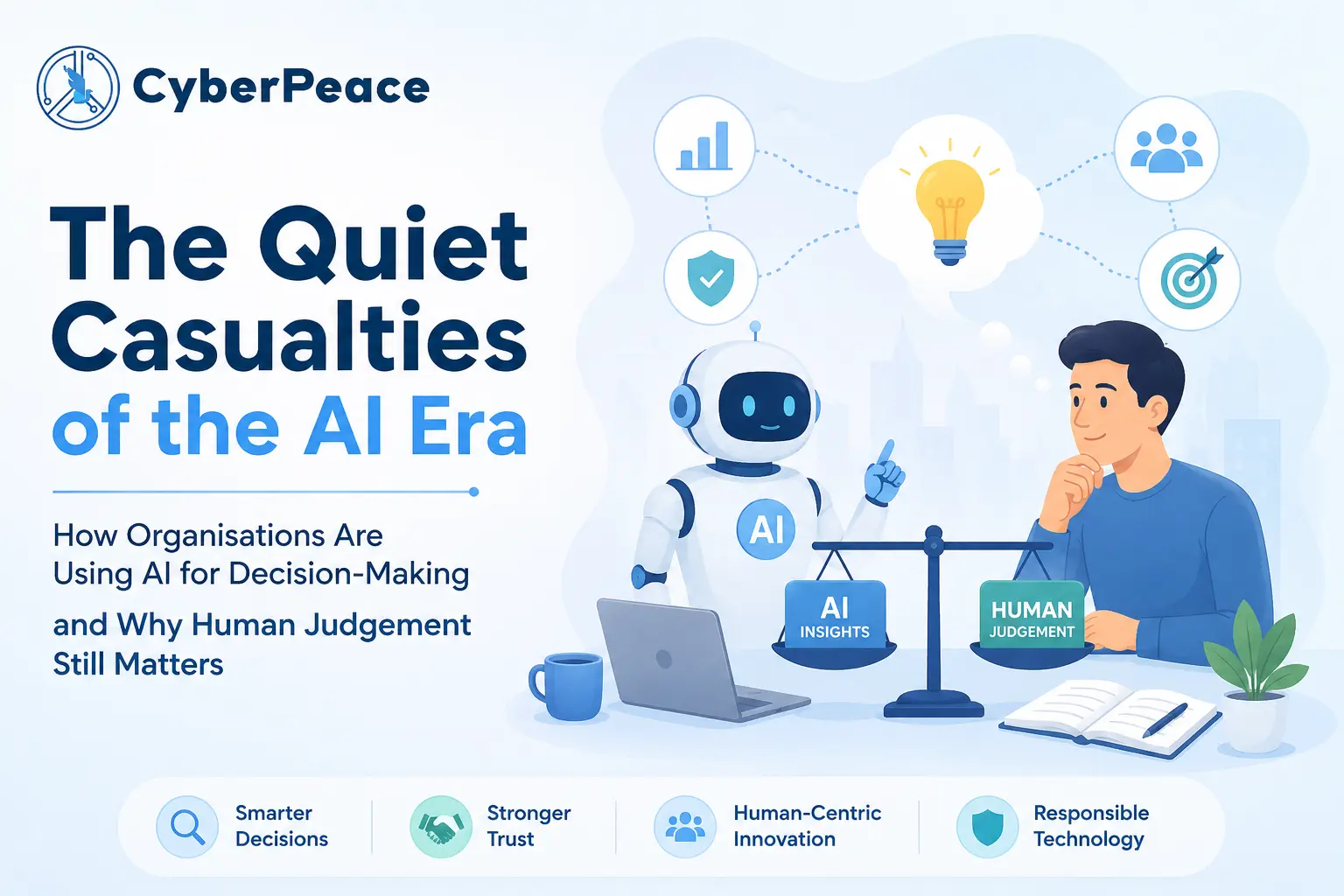
You ask an app for directions to a street you've driven down a hundred times. You let autocomplete finish your sentence before you've decided what you meant to say. You take a photo of a document instead of reading it, trusting the summary a model hands back. None of these moments feel like a loss. Each one is, on its own, a reasonable trade of effort for convenience. But add them up across a year, a career, an industry, and you start to wonder what exactly we've been trading away. Every technology wave produces its own founding myth. For AI, the myth is that intelligence can be manufactured at scale, bottled into a model, and dispensed on demand - cheaper, faster, and eventually better than the human original. It's a seductive story, and one we've been telling ourselves so uncritically that we've stopped noticing what it costs.
The casualties of this bet are rarely dramatic. Nobody announces that a skill has quietly atrophied, or that a habit of independent judgement has gone unused long enough to weaken. These losses don't show up as headlines; they show up later, as gaps, when the system that was supposed to think for us turns out not to have been thinking at all. Ford Motor Company's recent decision to rehire around 350 veteran engineers, after leaning heavily on AI-driven quality systems, is a small but telling data point.¹ The lesson isn't that automation failed outright — it's that a process can be automated without the judgement that made the process work ever being captured in the first place. That distinction between automating a task and actually preserving the human expertise behind it is the real subject of this AI moment.
How Organisations Are Using AI in Decision-Making
More organisations are now leaning on AI not just to execute tasks, but to help shape decisions. Deloitte's 2026 Global Human Capital Trends survey found that 60% of executives now regularly use AI to support their decisions, and the same report cites Gartner's projection that by 2027, half of all business decisions will be augmented or automated by AI agents. Companies like Netflix and Amazon are often pointed to as examples of this working well using AI to enhance recommendations and logistics while keeping people involved in the interpretation, generating significant value in the process. Elsewhere, results have been more mixed: MIT's "State of AI in Business 2025" study found that 95% of generative AI pilots showed no measurable P&L impact within six months, often because this initiative failed to integrate feedback or adapt to context rather than because the underlying model was flawed. Critics have noted the study used a narrow definition of success (six-month, bottom-line ROI), so the figure may understate the value AI creates in ways that aren't captured on the P&L. Notably, this is not an argument against using AI. It is an argument about how we use it and why the human-in-the-loop principle, keeping people actively involved in judgement rather than passively rubber-stamping outputs, is not a compliance checkbox but the thing that determines whether automation actually works. That distinction, between automating a task and preserving the human expertise behind it, is the point of contention.
Finding the Balance
The lesson isn't to use AI less, it's to be deliberate about where it sits in the process. The strongest results come from pairing AI's speed with human judgement, not swapping one for the other. That means keeping a clear owner for important decisions, checking that the model is optimising for the right goal, and treating its output as a strong first draft rather than a final answer. Used this way, AI doesn't replace thinking, it gives good judgement more room to work.
Two Framings We Should Retire
Conversations about AI adoption keep falling into two lazy framings. The first is AI versus humans, as if technology and workforce are locked in a zero-sum contest for relevance. The second is AI versus jobs, reducing every discussion to headcount and displacement. Both are legitimate concerns, but they crowd out a more urgent question: as AI gets embedded deeper into how decisions are made, what happens to the quality of the decisions themselves? This is not a question about whether AI is useful and it plainly is. It is a question about what gets quietly outsourced along with the task, and whether anyone notices before it matters.
Why “Wisdom of Crowds” Does Not Automatically Apply to AI
A comforting analogy often gets reached for: surely, with millions of people using the same models, errors will average out, the way independent forecasters tend to converge on accurate estimates.² That analogy breaks down where it matters most. The wisdom-of-crowds effect depends on independent thinking, genuinely diverse information, and an aggregation mechanism that does not distort the signal. When millions of people query the same underlying model, those conditions collapse. Everyone draws from the same statistical engine, trained on overlapping data, tuned toward similar “safe” answers. The apparent agreement is not corroboration, it is an echo. This creates a genuinely new risk: AI can be confidently, fluently, and uniformly wrong across an entire organisation at once, without the friction that would normally surface an error in a single person's judgement.
The Casualties, Named Plainly
Several things erode quietly when organisations are not deliberate about integrating AI into decisions. Independent judgement is the first casualty of the willingness to form a view before checking what the model says. Verification effort follows: generative AI collapses retrieval and generation into one fluent output, and people invest less effort checking something that already sounds complete and well-reasoned. Diversity of thought narrows as more decision-makers lean on the same handful of models for research and drafting, quietly reducing the range of framings available when it matters most. Accountability becomes harder to trace when a recommendation generated by a model and passed along with minimal scrutiny creates a strange vacuum where a decision was made but nobody quite owns it. And informational anchoring sets in, where a signal becomes a coordination point simply because everyone is looking at it, regardless of its accuracy.
Why Human-in-the-Loop Is a Design Requirement
“Human in the loop” often becomes a rubber-stamp step rather than genuine scrutiny. That is a mistake, because the functions humans provide are structural, not decorative. Context that a model cannot infer history, relationships, unstated constraints shapes whether a reasonable-sounding answer is right in a specific situation. Domain expertise built over years lets someone recognise when a fluent answer is subtly wrong. Ethical judgement decides trade-offs a model has no standing to make on an organisation's behalf. Accountability means someone can be asked why a decision was made and answer from reasoning, not from “the system recommended it.” And the rarest function of all is the willingness to challenge a convincing answer and resisting the very fluency that makes AI output persuasive.
What This Looks Like in Practice
For organisations, the goal is not slowing AI adoption but being deliberate about where human judgement stays load-bearing. AI output should default to draft status until a qualified person has actively tested its logic against context the model lacks. Teams using the same AI tools for analysis should build in a step that actively seeks disagreement, rather than assuming convergence means correctness. Ford's decision to bring engineers back to lead design reviews is instructive: expertise, once encoded into a system, is not safe to let atrophy in the people who built it.³ Verification should be visible and required for decisions with real financial, legal, safety, or reputational consequences. And organisations should track which decisions were AI-assisted and who owned the final call, so accountability stays traceable rather than quietly disappearing.
Conclusion
Decades ago, management thinkers warned that automating a broken process only helps an organisation fail faster. The AI era raises the stakes on that warning: judgement itself, the hard-won capacity to reason well under uncertainty, can be automated away without anyone deciding to give it up. Machines already process information faster than any team of people. What they cannot yet do is originate the wisdom that comes from human experience, accountability, and the willingness to be told one is wrong. That capacity erodes not because AI is powerful, but because organisations stop deliberately exercising it. The real task ahead is not resisting AI, but ensuring that as it takes on more of the work of deciding, humans deliberately keep hold of the responsibility of deciding.
References
- https://www.assemblymag.com/articles/100186-ford-rehires-veteran-engineers-to-improve-ai-vehicle-quality
- https://finance.yahoo.com/technology/ai/articles/ford-rehires-veteran-engineers-ai-144332497.html
- https://finance.yahoo.com/technology/ai/articles/ford-rehires-more-300-engineers-162210705.html
- https://www.msn.com/en-us/money/other/ford-rehires-hundreds-of-engineers-after-ai-struggles-to-improve-quality/ar-AA26P4QB?ocid=BingNewsSerp
- https://www.foxbusiness.com/technology/ford-rehires-experienced-engineers-after-ai-misses-mark
- https://www.livemint.com/opinion/online-views/artificial-wisdom-of-crowds-jobs-crisis-ai-technology-automation-openai-model-11785009289768.html
- https://www.deloitte.com/us/en/insights/topics/talent/human-capital-trends/2026/decision-making-with-ai.html
- https://www.hpcwire.com/aiwire/2026/03/04/deloittes-state-of-ai-2026-why-enterprise-execution-is-falling-behind-adoption/ and Legal.io summary: https://www.legal.io/blog/5719519/MIT-Report-Finds-95-of-AI-Pilots-Fail-to-Deliver-ROI-Exposing-GenAI-Divide
- https://www.marketingaiinstitute.com/blog/mit-study-ai-pilots

Introduction
Recently in July 2026, India's Cyber Crime Coordination Centre (I4C) under the Ministry of Home Affairs quietly tried to do something almost no government has managed before: switch off an app that doesn't need the internet to work. On July 23, 2026, I4C sent takedown notices to Google, Apple and GitHub, ordering them to pull three offline messaging apps – like BitChat, Briar and Bridgefy – from the Play Store, App Store and GitHub's code repository, respectively, giving a three-hour deadline. The notices followed a period of student-led demonstrations at Jantar Mantar, New Delhi, associated with a group "Cockroach Janata Party," a period that also saw a mobile internet shutdown in parts of central Delhi. When Twitter co-founder Jack Dorsey, who built and open-sourced BitChat, publicised the GitHub notice on X, the episode made international news. Google and Apple got near-identical orders the same night, and telecom operators were reportedly told, and then just as quickly untold, to block the apps at the network level. By July 29, all three apps were still live on both app stores, and BitChat's code was still on GitHub. This incident is worth unpacking carefully, because it sits at the intersection of three things most people care about but rarely see explained together: how this technology actually works, what the law actually allows, and why an app can be "banned" on paper while still working perfectly on your phone.
What makes these apps different
Ordinary apps like WhatsApp or Telegram are centralised: your message travels from your phone to a company's server, and then to the recipient's phone. Block or seize the server, and communication stops. BitChat, Briar and Bridgefy are built differently. They use Bluetooth mesh networking, a system where nearby phones talk directly to each other, and each device also relays messages onwards to phones further away, like a bucket brigade. No message ever touches a central server. Briar adds a further layer by routing traffic over Tor, an anonymity network, when internet access is available, and falls back to Bluetooth or Wi-Fi Direct when it isn't. Bridgefy is tuned for larger crowds, useful during concerts, natural disasters, or protests where thousands of phones are packed into a small area and cellular networks buckle under the load. This design, often called decentralised or peer-to-peer communication, is precisely why these apps are useful during disasters and precisely why they worry law enforcement: they keep working when the internet doesn't, whether that's because a cyclone knocked out cell towers or because the government itself ordered a shutdown.
The legal machinery behind a takedown notice
India's power to block online content mainly comes from Section 69A of the Information Technology Act, 2000, which lets the central government order blocking on grounds like sovereignty, public order or preventing incitement to an offence but only through a defined process set out in the IT (Blocking) Rules, 2009: a designated officer, a review committee, and recorded written reasons. The Supreme Court examined this exact provision in its landmark 2015 ruling, Shreya Singhal v. Union of India. While the judgement is best remembered for striking down the vague "offensive speech" law under Section 66A, it separately upheld Section 69A specifically because it came with procedural guardrails, a reasoned order, an opportunity to be heard, and the possibility of judicial review that stopped it from becoming an unchecked censorship tool. The July 23 notices, however, reportedly leaned on a different lever: Section 79(3)(b) of the IT Act, read with Rule 3(1)(d) of the IT Intermediary Guidelines and Digital Media Ethics Code Rules, 2021. That provision governs when an intermediary loses its legal immunity ("safe harbour") for user content if it fails to act on a government or court order, a mechanism built for content takedowns, not necessarily for pulling an entire app off a store shelf within three hours. Legal commentators have flagged this as significant, since Shreya Singhal itself read down Section 79(3)(b) to require action only pursuant to a court order or a properly authorised government direction, not an informal notice. This isn't the first time a mesh-messaging app has run into this machinery. In 2023, following an I4C request, the government blocked Briar and thirteen other apps in Jammu and Kashmir under Section 69A, citing use, the first known instance of Section 69A being used for a regional block. Briar's developers challenged this in the Delhi High Court; in 2024, the court dismissed the challenge, holding that principles of natural justice can give way in matters of national security.
Why you can't easily switch off a mesh network
Here's the technical wrinkle that made the July order largely symbolic: removing an app from the Play Store stops new downloads, but it does nothing to phones that already have it installed, and it does nothing at all to the Bluetooth radios exchanging messages between those phones. Unlike an internet shutdown, which works by controlling the pipes that all traffic must pass through, a mesh network has no chokepoint, no server to seize, no IP address to blacklist, and no single company to compel.
GitHub, for its part, said it followed its standard process of notifying the account holder and offering an appeal before taking any action, which is one reason BitChat's source code stayed publicly accessible throughout. Within a day, officials reportedly told the companies orally that enforcement wasn't necessary after all, though no public clarification or official document has been released explaining why the notices were issued or withdrawn.
Two legitimate, competing interests
None of this means the government's underlying worry is baseless. Law enforcement agencies genuinely lose visibility when communication moves off networks they can lawfully intercept, and coordination of unlawful assembly or violence is a real concern during volatile protests.
The transparency gap
The single biggest problem with how this played out isn't the underlying concern it's the absence of a public, reasoned order. Under the blocking rules, disclosure is restricted, and courts, including the Supreme Court in Anuradha Bhasin v. Union of India, have said that when access is restricted, reasons must be recorded and, where possible, made available. A three-hour notice, issued and then informally withdrawn without explanation, sits uneasily with that standard. A more durable approach, one that CyberPeace and other digital-rights researchers have called for, would combine clearly identified statutory authority; published (even if redacted) reasoning; proportionality review; and investment in lawful digital forensics, rather than blanket app-store takedowns that decentralised technology is, by design, built to survive.
CyberPeace's policy recommendations
Alongside the legal analysis above, CyberPeace puts forward a ten-point framework for how India should approach decentralised communication technologies going forward, instead of defaulting to blanket takedowns:
- Strengthen transparency in blocking decisions
- Ensure statutory clarity
- Apply legality, necessity and proportionality
- Differentiate technology from misuse
- Invest in advanced investigative capabilities
- Establish a multi-stakeholder advisory mechanism
- Develop a framework for emerging decentralised technologies
- Promote responsible innovation
- Enhance public awareness
- Foster international cooperation
Conclusion
The referred incident illustrates that regulating decentralised technologies requires more than swift takedown notices. As communication networks become increasingly resilient and distributed, effective governance must combine legal certainty, technical realism, transparency, and proportionate enforcement. India's challenge is not simply to regulate emerging technologies but to develop a kind of regulatory framework that safeguards national security and the constitutional values of privacy, free expression, and due process.
Sources
- MediaNama — Bitchat was not the only mesh-messaging app targeted by a government takedown notice
- Outlook Business — Beyond GitHub, Govt Also Directed Google To Take Down Bitchat, Briar And Bridgefy
- The Wire — Government Asks GitHub to Remove Bluetooth Messaging App Bitchat Over Concerns of 'Misuse'
- The Tech Trace (Substack) — The Indian govt's crackdown on Bluetooth-enabled messaging apps that wasn't?
- Bar and Bench — Section 69A IT Act and the expanding architecture of digital censorship in India
- Supreme Court Observer — X relies on 'Shreya Singhal' in arbitrary content-blocking case in Karnataka HC
- LiveLaw — Internet Freedom, Shreya Singhal v Union of India, IT Act, Blocking Rules 2009
- Manupatra — Full text, Shreya Singhal v. Union of India (2015) 5 SCC 1
- Open Magazine — CJP Protests at Jantar Mantar: How Offline Mesh Messaging Apps Powered a Network of Resistance
