
#FactCheck - Viral Video Falsely Claims Rajnath Singh Compared RSS With Afghan Taliban
A video circulating widely on social media claims that Defence Minister Rajnath Singh compared the Rashtriya Swayamsevak Sangh (RSS) with the Afghan Taliban. The clip allegedly shows Singh stating that both organisations share a common ideology and belief system and therefore “must walk together.” However, a research by the CyberPeace found that the video is digitally manipulated, and the audio attributed to Rajnath Singh has been fabricated using artificial intelligence.
Claim
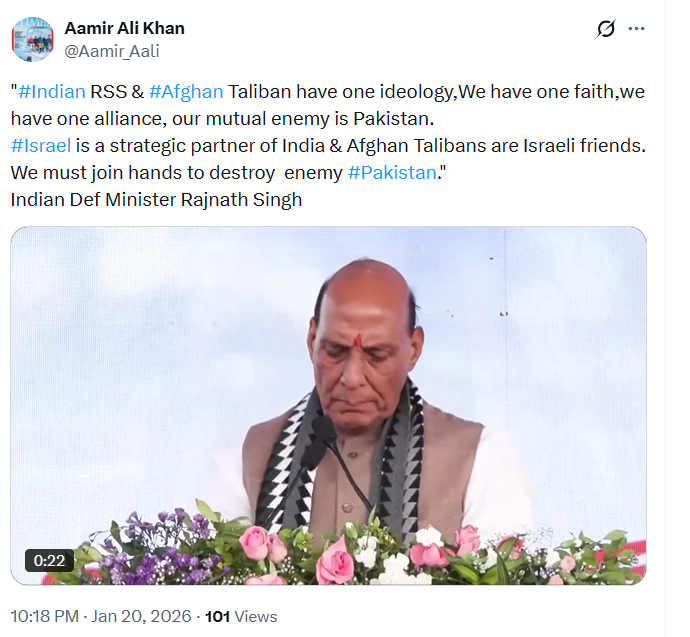
An X user, Aamir Ali Khan (@Aamir_Aali), on January 20 shared a video of Defence Minister Rajnath Singh, claiming that he drew parallels between the Rashtriya Swayamsevak Sangh (RSS) and the Afghan Taliban. The user alleged that Singh stated both organisations follow a similar ideology and belief system and therefore must “walk together.” The post further quoted Singh as allegedly saying: “Indian RSS & Afghan Taliban have one ideology, we have one faith, we have one alliance, our mutual enemy is Pakistan. Israel is a strategic partner of India & Afghan Taliban are Israeli friends. We must join hands to destroy the enemy Pakistan.” Here is the link and archive link to the post, along with a screenshot.
Fact Check:
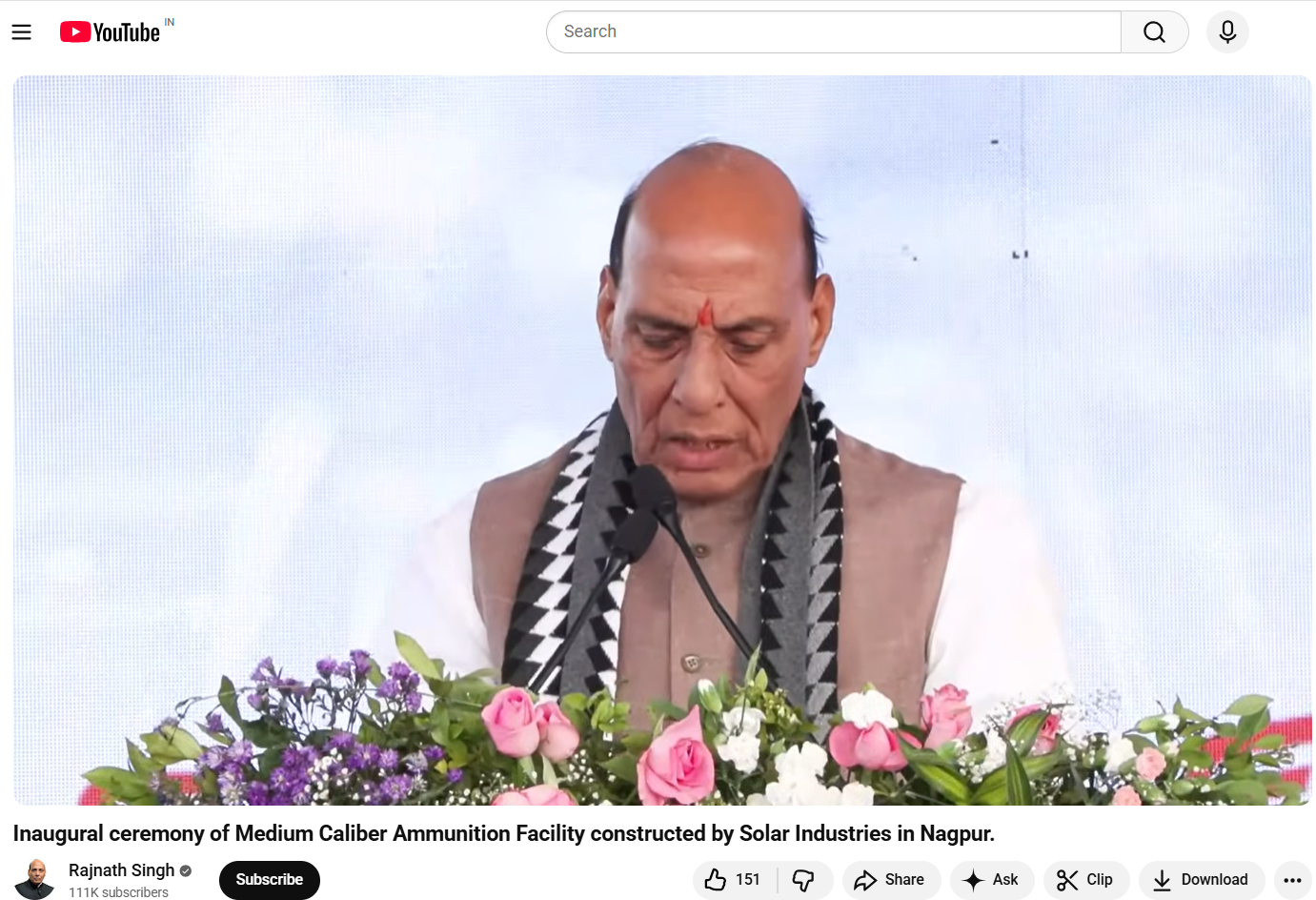
To verify the claim, the CyberPeace conducted a Google Lens search using keyframes extracted from the viral video. This search led to an extended version of the same footage uploaded on the official YouTube channel of Rajnath Singh. The original video was traced back to the inaugural ceremony of the Medium Calibre Ammunition Facility, constructed by Solar Industries in Nagpur. Upon reviewing the complete, unedited speech, the Desk found no instance where Rajnath Singh made any remarks comparing the RSS with the Afghan Taliban or spoke about shared ideology, alliances, or Pakistan in the manner claimed.
In the authentic footage, the Defence Minister spoke about:
" India’s push for Aatmanirbharta (self-reliance) in defence manufacturing
Strengthening domestic ammunition production
Positioning India as a global hub for defence exports "
The statements attributed to him in the viral clip were entirely absent from the original speech.
Here is the link to the original video, along with a screenshot.
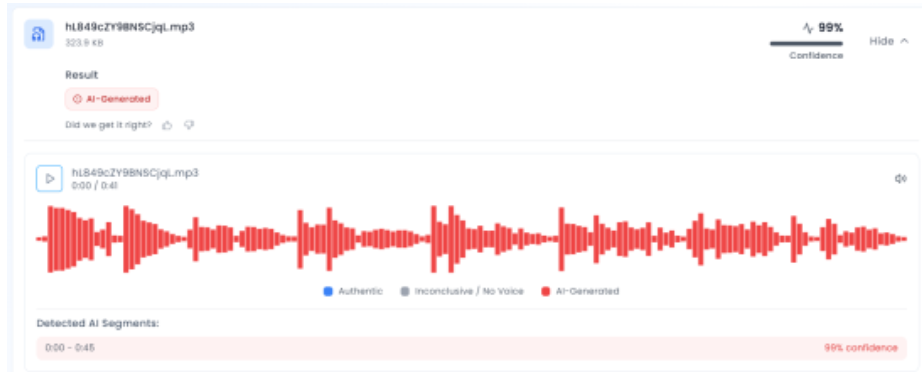
In the next stage of the research , the audio track from the viral video was extracted and analysed using the AI voice detection tool Aurigin. This confirmed that the original visuals were misused and overlaid with a synthetic voice track to create a misleading narrative.
Conclusion
The CyberPeace concluded that the viral video claiming Defence Minister Rajnath Singh compared the RSS with the Afghan Taliban is false and misleading. The video has been digitally manipulated, with an AI-generated audio track falsely attributed to Singh. The Defence Minister made no such remarks during the Nagpur event, and the claim circulating online is fabricated.

Related Blogs

Introduction
The 2023-24 annual report of the Union Home Ministry states that WhatsApp is among the primary platforms being targeted for cyber fraud in India, followed by Telegram and Instagram. Cybercriminals have been conducting frauds like lending and investment scams, digital arrests, romance scams, job scams, online phishing etc., through these platforms, creating trauma for victims and overburdening law enforcement, which is not always the best equipped to recover their money. WhatsApp’s scale, end-to-end encryption, and ease of mass messaging make it both a powerful medium of communication and a vulnerable target for bad actors. It has over 500 million users in India, which makes it a primary subject for scammers running illegal lending apps, phishing schemes, and identity fraud.
Action Taken by Whatsapp
As a response to this worrying trend and in keeping with Rule 4(1)(d) of the Information Technology (Intermediary Guidelines and Digital Media Ethics Code) Rules, 2021, [updated as of 6.4.2023], WhatsApp has been banning millions of Indian accounts through automated tools, AI-based detection systems, and behaviour analysis, which can detect suspicious activity and misuse. In July 2021, it banned over 2 million accounts. By February 2025, this number had shot up to over 9.7 million, with 1.4 million accounts removed proactively, that is, before any user reported them. While this may mean that the number of attacks has increased, or WhatsApp’s detection systems have improved, or both, what it surely signals is the acknowledgement of a deeper, systemic challenge to India’s digital ecosystem and the growing scale and sophistication of cyber fraud, especially on encrypted platforms.
CyberPeace Insights
- Under Rule 4(1)(d) of the IT Rules, 2021, significant social media intermediaries (SSMIs) are required to implement automated tools to detect harmful content. But enforcement has been uneven. WhatsApp’s enforcement action demonstrates what effective compliance with proactive moderation can look like because of the scale and transparency of its actions.
- Platforms must treat fraud not just as a content violation but as a systemic abuse of the platform’s infrastructure.
- India is not alone in facing this challenge. The EU’s Digital Services Act (DSA), for instance, mandates large platforms to conduct regular risk assessments, maintain algorithmic transparency, and allow independent audits of their safety mechanisms. These steps go beyond just removing bad content by addressing the design of the platform itself. India can draw from this by codifying a baseline standard for fraud detection, requiring platforms to publish detailed transparency reports, and clarifying the legal expectations around proactive monitoring. Importantly, regulators must ensure this is done without compromising encryption or user privacy.
- WhatsApp’s efforts are part of a broader, emerging ecosystem of threat detection. The Indian Cyber Crime Coordination Centre (I4C) is now sharing threat intelligence with platforms like Google and Meta to help take down scam domains, malicious apps, and sponsored Facebook ads promoting illegal digital lending. This model of public-private intelligence collaboration should be institutionalized and scaled across sectors.
Conclusion: Turning Enforcement into Policy
WhatsApp’s mass account ban is not just about enforcement but an example of how platforms must evolve. As India becomes increasingly digital, it needs a forward-looking policy framework that supports proactive monitoring, ethical AI use, cross-platform coordination, and user safety. The digital safety of users in India and those around the world must be built into the architecture of the internet.
References
- https://scontent.xx.fbcdn.net/v/t39.8562-6/486805827_1197340372070566_282096906288453586_n.pdf?_nc_cat=104&ccb=1-7&_nc_sid=b8d81d&_nc_ohc=BRGwyxF87MgQ7kNvwHyyW8u&_nc_oc=AdnNG2wXIN5F-Pefw_FTt2T4K6POllUyKpO7nxwzCWxNgQEkVLllHmh81AHT2742dH8&_nc_zt=14&_nc_ht=scontent.xx&_nc_gid=iaQzNQ8nBZzxuIS4rXLOkQ&oh=00_AfEnbac47YDXvymJ5vTVB-gXteibjpbTjY5uhP_sMN9ouw&oe=67F95BF0
- https://scontent.xx.fbcdn.net/v/t39.8562-6/217535270_342765227288666_5007519467044742276_n.pdf?_nc_cat=110&ccb=1-7&_nc_sid=b8d81d&_nc_ohc=aj6og9xy5WQQ7kNvwG9Vzkd&_nc_oc=AdnDtVbrQuo4lm3isKg5O4cw5PHkp1MoMGATVpuAdOUUz-xyJQgWztGV1PBovGACQ9c&_nc_zt=14&_nc_ht=scontent.xx&_nc_gid=gabMfhEICh_gJFiN7vwzcA&oh=00_AfE7lXd9JJlEZCpD4pxW4OOc03BYcp1e3KqHKN9-kaPGMQ&oe=67FD6FD3
- https://www.hindustantimes.com/india-news/whatsapp-is-most-used-platform-for-cyber-crimes-home-ministry-report-101735719475701.html
- https://www.indiatoday.in/technology/news/story/whatsapp-bans-over-97-lakhs-indian-accounts-to-protect-users-from-scam-2702781-2025-04-02

Executive Summary
Amid reports that AIIMS Delhi has initiated the process to implement the Supreme Court’s decision allowing passive euthanasia for Harish Rana, a video is being shared on social media claiming to show his emotional farewell. However, research by the CyberPeace found the viral claim to be misleading. Our research revealed that the video has no connection to the Harish Rana case. In reality, the footage is from Surat, Gujarat, where the family of a 45-year-old brain-dead woman donated her organs.
Claim:
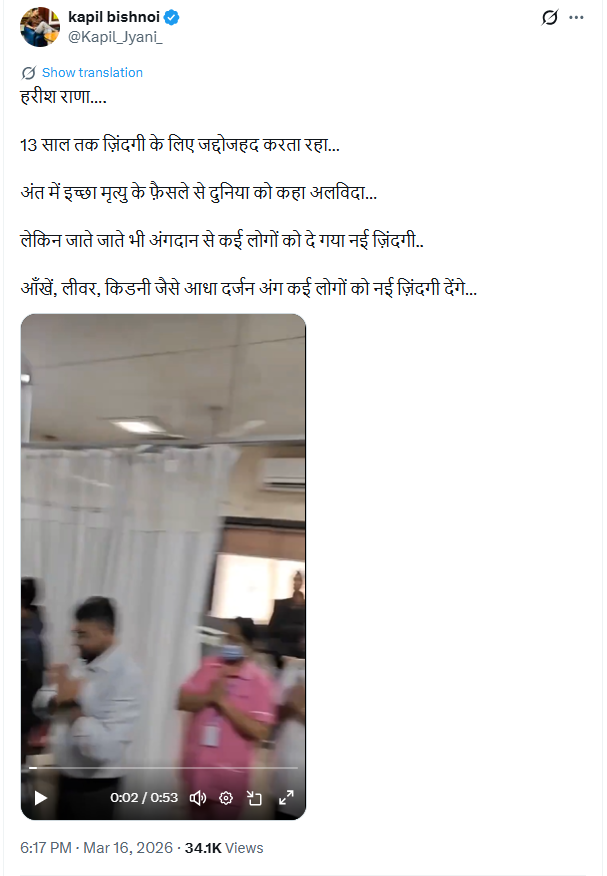
On social media platform X (formerly Twitter), a user shared the viral video on March 16, 2026, with the caption:
“Harish Rana… struggled for life for 13 years… in the end said goodbye to the world through euthanasia… but even while leaving, gave new life to many through organ donation… eyes, liver, kidneys and several other organs will give a new life to many…”
Post link and archive link are given below:
Fact Check
We took screenshots from the viral video and conducted a reverse image search. This led us to an Instagram handle where the same video was uploaded on January 27, 2026.
- https://www.instagram.com/reels/DUAt_42k2ME/
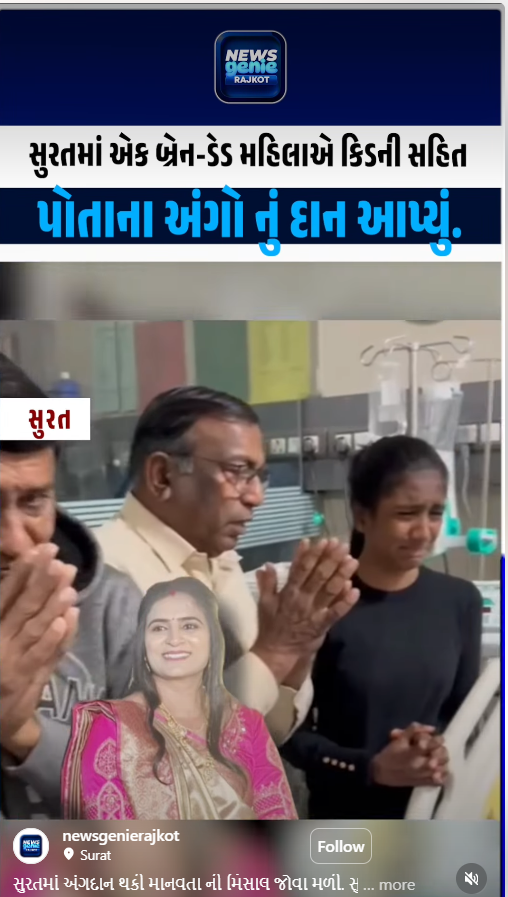
According to the caption on the Instagram post, the video shows a brain-dead woman in Surat whose liver, both kidneys, and eyes were donated. The post also included an image of the woman. Based on clues from the viral video, we conducted a keyword search on Google and found a report on the website of News18 Gujarati.

According to the report, organ donation by Ritaben Hareshbhai Korat in Surat gave a new life to five patients. The report also carried her photograph, matching the visuals seen in the viral video.
Conclusion:
Our research found that the viral video has no connection to Harish Rana. It actually shows an incident from Surat, Gujarat, where the family of a 45-year-old brain-dead woman, Ritaben Korat, donated her organs.
.webp)
At Semicon India 2025 held recently, the Prime Minister declared, “when the chips are down, you can bet on India”. The event showcased the country’s first indigenous microprocessor, Vikram, developed by ISRO’s Semiconductor Lab, and announced that commercial chip production will begin by the end of 2025. India aims to become a global player in semiconductor production, and build self-reliance in a world where global supply chains are shifting rapidly.
Why Semiconductors Matter
Semiconductors power almost everything around us, from laptops and air conditioners to cars and even the tiniest gadget we hardly notice . They’ve rightly been called the “oil of the digital age” because our entire digital world depends on them. But the global supply chain for chips is heavily concentrated. Taiwan alone makes over 60% of the world’s semiconductors and nearly 90% of the most advanced ones. Rising tensions between China and Taiwan have only shown how fragile and risky this dependence can be for the rest of the world. For India, building its own semiconductor base is not just about technology, it is about economic security and reduced dependence on imports.
India’s Push: The Numbers and Projects
The government has committed nearly US$18 billion across 10 projects, making it one of the country’s largest industrial bets in decades. Under the Production Linked Incentive (PLI) scheme, ₹76,000 crore (about US$9.1 billion) was set aside, of which most has already been allocated.
Key developments include:
- Vikram processor – developed at ISRO’s Semiconductor Lab, fabricated on 180nm technology.
- CG Power facility in Sanand, Gujarat – launched in 2024, scaling chip assembly and testing.
- Micron’s investment – ₹22,500+ crore in Gujarat for packaging and testing.
- Tata Electronics–PSMC partnership – ₹91,000 crore tie-up with Taiwan’s Powerchip for fabs.
The domestic market, valued at US$38 billion in 2023, is expected to touch US$100–110 billion by 2030 if growth sustains.
The Technology Gap
While the Vikram chip, a 32 bit microprocessor, is a proud milestone, it highlights the technology gap India faces. The chip was fabricated using a 180nm CMOS process, a process that was cutting-edge back in the early 2000s. Today, companies like TSMC and Samsung are already producing 3nm chips for smartphones and AI servers, whereas those like Nvidia and Apple have developed chips 2ith 64-bit processing capabilities.
This means India's main focus, to become self-reliant in the mature end of the spectrum useful for space, defense, and automotives and electronics, is far from the global cutting edge. Bridging this gap will require both time and deep technical expertise.
Talent and Design Strengths
On the positive side, India already contributes around 20% of global semiconductor design talent. Two advanced design centers—one in Noida and another in Bengaluru—are working on 3nm designs. The government’s Design Linked Incentive scheme has cleared 20+ projects to nurture startups in chip design.
Over 60,000 engineers have been trained under various programs, but scaling this to the hundreds of thousands needed for fabs remains a challenge. Unlike software development, semiconductor fabrication demands highly specialised skills in process engineering, yield optimization, and supply chain logistics.
Lessons from Global Players
Countries like Taiwan, South Korea, and the US didn’t build their chip industries overnight. Taiwan’s TSMC spent decades and billions of dollars mastering yield rates and building trust with clients. The US recently passed the CHIPS and Science Act to revive domestic production, while the EU has its own Chips Act. Japan, too, has pledged billions, including ¥10 trillion in cooperation with India.
These examples show that success depends not just on funding , but also on harmony between government and private players, consistent execution, ecosystem building, and global partnerships.
The Challenges Ahead
India’s ambitions face several hurdles:
- Capital intensity – A single leading-edge fab costs US$10–20 billion, and requires constant upgrades.
- Supply chain complexity – Hundreds of chemicals, gases, and precision tools are needed, many of which India doesn’t yet produce domestically.
- Technology transfer – Advanced lithography machines (from ASML in the Netherlands, for example) are tightly controlled and not easily available.
- Execution risks – Moving from announcements to commercially viable fabs with competitive yields is where many countries have stumbled.
The Way Forward
India has big ambitions in the field of semi-conductor design and manufacturing, with the goal of becoming a major global exporter instead of importer. The country appears to be adopting a step-by-step approach, starting with assembly, testing, and mature-node fabs, while simultaneously investing in design, research, and talent. Every successful global power in this industry first mastered older nodes before advancing to cutting-edge levels.
At the same time, international collaborations with players like Micron, Tata-PSMC, and Japan will be critical for technology transfer and capacity building. If India can combine its engineering talent, rising domestic demand, and government backing with the PLI scheme, and drive global collaborations, the outlook can be promising.
Conclusion
India’s semiconductor story is just beginning, but the direction is clear. The Vikram processor and investment announcement at Semicon 2025 shows the intent of the government. The hard part now lies ahead: moving from prototypes to large-scale production and globally competitive fabs in an industry that demands substantial investment, flawless execution, and years of patience.
Yet the stakes couldn’t be higher. Semiconductors will shape the future of economies and national security . If India plays its cards right by nurturing talent, innovating and researching, and driving global partnerships, the dream of becoming a global semiconductor hub may well move from ambition to reality.
References
- https://www.ndtv.com/india-news/when-chips-are-down-bet-on-india-pm-narendra-modis-big-semiconductor-push-6539317
- https://www.indiatoday.in/science/story/what-is-vikram-32-bit-chip-presented-to-pm-modi-at-semicon-india-2025-2780582-2025-09-02#
- https://www.visionofhumanity.org/the-worlds-dependency-on-taiwans-semiconductor-industry-is-increasing/
- https://m.economictimes.com/tech/artificial-intelligence/tata-electronics-and-powerchip-semiconductor-manufacturing-corporation-to-build-indias-first-semiconductor-fab/articleshow/113694273.cms
- https://www.business-standard.com/economy/news/10-trillion-yen-in-10-years-japan-pledges-big-investment-in-india-125082901564_1.html
- https://www.oecd.org/content/dam/oecd/en/publications/reports/2023/06/vulnerabilities-in-the-semiconductor-supply-chain_f4de7491/6bed616f-en.pdf
- https://techwireasia.com/2025/09/semiconductor-india-commercial-production-2025/
