
#FactCheck-2022 Video of Argentina’s FIFA World Cup Victory Celebrations Falsely Shared as Crowd at Rahul Gandhi’s ‘Chalo Delhi’ Rally
Executive Summary
A drone-footage video showing a massive crowd is going viral on social media. It is being shared with the claim that the visuals show the gathering at Ramlila Maidan in support of Rahul Gandhi’s ‘Chalo Delhi’ rally held on November 1. CyberPeace Research found that the video dates back to December 2022 and shows millions of football fans celebrating Argentina’s FIFA World Cup victory in Buenos Aires.
Claim
A video purportedly showing an aerial view of Ramlila Maidan is being widely shared on social media.
https://x.com/Anuragyadavjnp/status/2116859390112473267

Fact Check
To verify the claim, we first conducted a reverse image search using keyframes from the viral video. During this process, we found the video posted on the X account of a user named Trung Phan on December 21, 2022.According to the post’s caption, the footage shows the streets and highways of Buenos Aires, Argentina, where millions of people took to the streets to celebrate Argentina’s victory in the FIFA World Cup.
https://x.com/TrungTPhan/status/1605298648543547393?a=31Kw_jPjfiHrD55_um8&s=20

As part of our further research, we conducted a Google search using relevant keywords and found a report published by Al Jazeera on December 19, 2022. According to the report, millions of fans poured onto the streets of Buenos Aires, Argentina’s capital, to celebrate the country’s World Cup victory after it defeated France in the final. This establishes that the viral drone footage shows celebrations following Argentina’s World Cup victory in December 2022. It has no connection to Delhi’s Ramlila Maidan or Rahul Gandhi’s ‘Chalo Delhi’ rally.
https://www.aljazeera.com/news/2022/12/19/immense-joy-argentinas-fans-entranced-by-messis-world-cup

Conclusion
The video dates back to December 2022 and shows millions of football fans celebrating Argentina’s FIFA World Cup victory in Buenos Aires.

Related Blogs

What are Wi-Fi attacks?
Wi-fi is an important area of cyber security and there is no need for physical cable for the network. Wi-Fi has access to a network signal radius everywhere. The devices and systems can have a network without physical access due to Wi-fi. But everything comes with cons and pros, and if we talk about cybersecurity, it has been established that Wi-fi networks are extremely vulnerable to security breaches and it is very easy to be hacked by hackers. Wi-Fi can be accessed by almost every device in the modern day: it can be smartphones, tablets, computers, and laptops. To know whether someone has been tampering with your personal Wi-Fi there are certain signs that can prove it. The first and most important sign is that your internet speed gets slower, as someone else is using your Wi-Fi surf.
Why would anyone hack someone’s Wi-Fi network?
Usually, hackers hack the network because they want access to the confidential data of someone and they can observe all the online activities and data that have been sent through a network. An unauthorize hacker will pretty much be able to see everything you do online. Wi-Fi allows hackers o view information on sites. Any financial information which is saved in the browser can be accessed by hackers and they can alter it and can alter the content you see online. And all the information saved in Wi-fi networks can be used by hackers for their own benefit, they can sell it, impersonate you, or even take money out of your bank through Wi-Fi.
Avoiding vulnerable Wi-Fi networks
The first and foremost rule of protection is that you should not use public networks if that network is easily open to you then that is also available to others and from others, and someone can who wishes to use your confidential and sensitive information, can access that. If you really need to access the public network in an urgent situation, then you must make sure to limit your activities while connected. And avoid accessing your online banking or pages that require login information. Also, a good measure to take as well is to always delete your cookies after using public WIFI.
How To Secure Your Home Wi-Fi Network
Your home’s wireless internet connection is your Wi-Fi network. Typically, a wireless router is used, which broadcasts a signal into the atmosphere. You can connect to the internet using that signal. However, if your network is not password-protected, any nearby device can grab the signal off the air and connect to your internet. The benefit of Wi-Fi? Wireless access to the internet is possible. The negative? Your internet activity, including your personal information, may be visible to neighboring users who connect to your unprotected network. Furthermore, if someone uses your network to conduct a crime or send out unauthorized spam, you might be held accountable.
Wi-Fi or Li-Fi? –
The common consensus is that Li-Fi technology is more secure than Wi-Fi. Li-Fi systems can be made more secure by integrating a variety of security features. Although these qualities might appear when Li-Fi is widely used in the near future, it is already thought to be safer because of a number of security features. Since the connection’s characteristics make it simpler to lock connections, limit access, and track users even in the absence of encryption and other security features, Li-Fi is seen as being safer. Li-Fi systems will be able to support new security protocols, which will not only enable high-speed networking but also open the door for innovative security techniques to strengthen connections.
Conclusion
A hacker can sniff the network packets without having to be in the same building where the network is located. As wireless networks communicate through radio waves, a hacker can easily sniff the network from a nearby location. Most attackers use network sniffing to find the SSID and hack a wireless network.
Any wireless network can theoretically be attacked in a number of different ways. Use of the default SSID or password, WPS pin authentication, insufficient access control, and leaving the access point available in open locations are all examples of potential vulnerabilities that could allow for the theft of sensitive data. Kismet’s architecture in WIDS mode may guard against DOS, MiTM, and MAC spoofing attacks. routine software updates on the other hand, the use of firewalls may help defend the network against outside intrusion. The act of finding infrastructure issues that could allow harmful code to be injected into a service, system, or organization is known as ethical hacking. They use this technique to prevent invasions by lawfully breaking into networks and looking for weak spots.

Executive Summary
A video is being widely shared on social media claiming to show a Saudi Arabian F-15 fighter jet carrying out an airstrike on Sanaa International Airport in Yemen's capital. The footage shows several aircraft parked at what appears to be an airport before explosions erupt, followed by flames, thick smoke and people running in panic. The CyberPeace Research Wing found that the viral claim is false. Our research revealed that the circulating video is AI-generated and does not depict the actual airstrike. While it is true that Saudi Arabia carried out an airstrike at Sanaa International Airport, the viral footage is unrelated to that incident and is being shared with a misleading claim.
Claim
An Instagram post shared on July 15, 2026, claims that Saudi Arabia's F-15 fighter jets bombed Sanaa International Airport in Yemen. The post can be viewed here:
https://www.instagram.com/reel/DayBwufzn2N/?utm_source=ig_web_button_share_sheet

Fact Check
To verify the claim, we searched using relevant keywords but found no credible news reports or authentic footage matching the viral video. However, we found verified footage of the actual Saudi airstrike on The New York Post's YouTube channel. A comparison showed that the genuine footage is entirely different from the viral clip in terms of visuals, sequence and overall content.
https://www.instagram.com/reel/DawHCM_s_fn/?utm_source=ig_web_button_share_sheet

During our research, we also found the same viral video on an Instagram account named "warfarenextgen", which regularly publishes AI-generated war-related videos

We further examined the video using multiple AI detection tools: Hive Moderation assessed the video as 99.9% likely to be AI-generated.

DetectVideo AI found a 76% probability that the video was AI-generated.
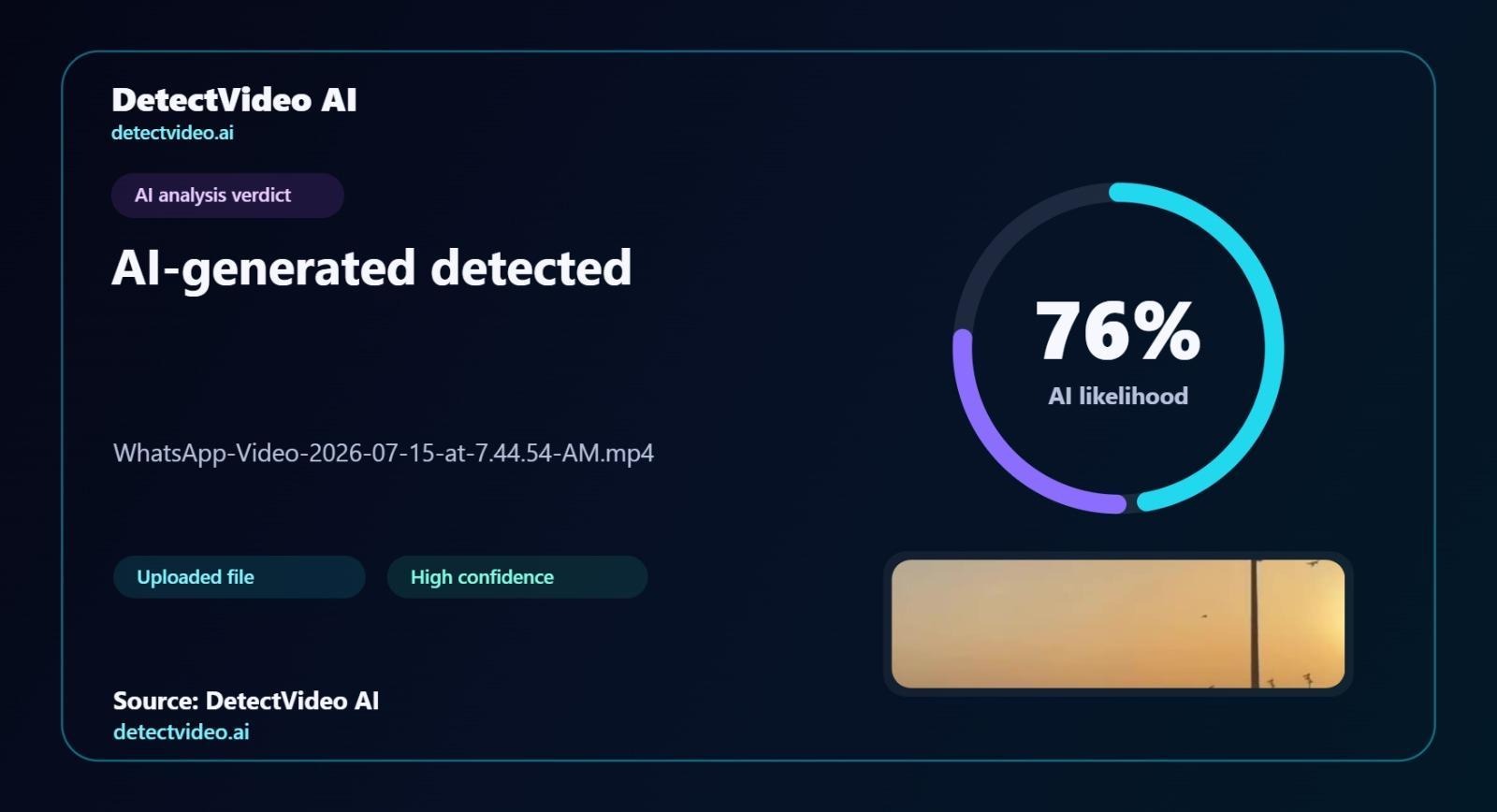
Sightengine also concluded that the video was approximately 99% likely to be AI-generated.

Conclusion
Our research found that Saudi Arabia did carry out an airstrike on Sanaa International Airport to prevent an Iranian aircraft carrying a Houthi delegation from landing. However, the viral video does not show that attack. It is an AI-generated video that is being falsely circulated as footage of the real incident, making the viral claim misleading.

Introduction
For years, the story of terror recruitment in Jammu & Kashmir followed a familiar arc: physical infiltration across the Line of Control, local Over Ground Workers (OGWs) acting as couriers, and recruitment pitches on mainstream apps like WhatsApp and Facebook Messenger. Indian security agencies built entire surveillance architectures around that arc. Now, officials say, the architecture is being outflanked in a way few anticipated: through pornography and dating platforms.
The New Front: Chat Rooms Nobody Is Watching
According to officials cited in recent reporting, Pakistan-based terror handlers working in coordination with Pakistan's ISI have begun exploiting the real-time chat features built into pornography and dating websites to reach recruits in Jammu & Kashmir. These pornography platforms feature real-time chat tools that operate under the guise of helping users find dates nearby, and handlers are exploiting that feature to broadcast messages and coordinate activities. It's a strikingly mundane pivot for an organisation engaged in violent extremism, but that is precisely the point that nobody expects a counter-terror dragnet to be watching a dating chatbox.
Officials say the tactic is designed to evade the surveillance that has become standard on conventional social media platforms, allowing handlers to convey instructions to recruits while staying off the radar of established monitoring tools. WhatsApp, Signal and Facebook Messenger have all, in various ways, become known quantities to Indian intelligence subject to legal intercepts, metadata analysis and years of institutional familiarity. A chat window buried inside an adult content site is not.
Tor, Encrypted Nodes, and Apps Built to Disappear
Other than porn sites, investigators have also flagged a cluster of niche, privacy-first messaging apps that route traffic through Tor-based, encrypted nodes to mask user identity. Security agencies have placed a wide array of specialised digital tools under scrutiny, with terror handlers relying on Tor-based messaging applications like Coatex and Conion to route data through encrypted nodes and obscure user identities. Access to at least one of these apps' installation files is reportedly already restricted within India, though enforcement against sideloaded Android packages remains an uphill battle.
What makes these platforms attractive to handlers isn't unique code so much as the design philosophy behind privacy-first messaging generally. Some of these apps offer only basic encryption, while others go further with end-to-end encryption, self-destructing messages, and strong on-device encryption algorithms that keep data processing off any third-party server. Several reportedly allow account creation without a phone number or SIM verification, stripping away one of the most basic identity anchors that Indian telecom-linked surveillance depends on.
There's also an operational, almost logistical, reason for the shift: connectivity. Officials note that some of these applications provide end-to-end encryption, self-destructing messages and registration without a phone number or email, making it difficult for security agencies to trace users, even as terror networks also shift away from commonly used platforms. In the hilly, forested and often poorly connected terrain of Jammu's border districts, apps engineered to function on weak 2G or EDGE networks have an obvious tactical advantage over data-hungry mainstream platforms.
VPNs, Banned Apps, and a Cat-and-Mouse Game
Virtual Private Networks add another layer of obfuscation, letting operatives access apps banned in India and mask the geographic origin of their traffic. This isn't new tradecraft, but its pairing with adult-content chat infrastructure and Tor-routed messaging represents a genuinely novel combination in the Kashmir context, according to the officials describing the pattern to reporters.
The broader trend line, officials say, is a steady migration away from platforms Indian agencies have learned to monitor. Terror networks are increasingly moving away from mainstream, commonly used platforms in favour of more obscure alternatives, forcing intelligence agencies into a perpetual game of catch-up: each time a monitoring capability matures against one platform, handlers migrate to the next.
This is not the first time investigators have flagged this cat-and-mouse dynamic. Reporting on a recent case in Jammu's Bathindi area described a 19-year-old allegedly radicalised through the encrypted app. Session the same platform reportedly linked to suspects in a Delhi bomb plot investigation after months of contact with Pakistan-based handlers. Investigators in that case noted that terror organisations have increasingly turned to multi-layered encrypted messaging services specifically to evade monitoring by intelligence agencies.
The Virtual SIM Problem
Alongside app-layer evasion, foreign-issued virtual SIM cards remain a persistent headache for investigators. The most cited example remains the 2019 Pulwama attack investigation, in which agencies reportedly traced more than 40 virtual SIM cards to the Jaish-e-Mohammed suicide bomber and his network numbers that could be provisioned and abandoned without ever touching an Indian telecom's KYC system. That case became something of a template for how virtual and foreign-registered numbers can be used to build communication chains that are extremely difficult to map after the fact, since there is no physical SIM, no retail purchase record, and often no domestic carrier data trail at all.
More recent J&K cases echo the same pattern in a different form. Police investigating a cross-border radicalisation network noted that intelligence agencies now suspect unauthorised SIM card distribution is being used by terrorists to communicate with handlers across the border, part of a broader push to choke off the logistical and communication backbone that keeps sleeper modules alive even when direct physical contact with a local handler is minimal or non-existent.
How Agencies Are Responding
To their credit, security agencies aren't standing still. Officials say cyber-surveillance frameworks are actively being redesigned to map and intercept these "off-grid" communication channels, a phrase that itself signals how far outside traditional monitoring territory this recruitment method has moved. Agencies say they continue to adapt their cyber-surveillance frameworks specifically to map and intercept these off-grid communication channels. That has included moving to restrict access to specific APKs, tightening scrutiny of virtual number providers, and, as seen in recent CIK (Counter Intelligence Kashmir) operations, proactively disrupting online propaganda networks before recruitment pitches can mature into operational plots. One recent CIK operation, for instance, intercepted attempts to recruit two teenage boys who were allegedly being fed terror content in the direction of a Pakistan-based handler, underlining how young the target pool for these campaigns has become.
Conclusion
What this episode really illustrates isn't a single clever trick but a structural truth about counter-terror surveillance: it is inherently reactive. Every time agencies build competence around a platform, handlers find a low-attention, high-friction-to-monitor alternative: first fringe messaging apps, then Tor-routed clients, and now the sprawling, largely unregulated back-end of adult content platforms, which few people would ever think to associate with national security. It's a reminder that the fight against radicalisation online is no longer confined to obviously "extremist" corners of the internet; it can hide in plain sight, inside the most ordinary-looking corners of the web.
Sources
- New J-K terror tactic: Pornography apps, Tor network used for secret messaging — The Tribune
- New J&K terror tactic: Handlers turn to porn sites, encrypted apps to contact recruits — Deccan Herald
- Terrorists using porn website, encrypted apps for chats with recruits — Organiser
- New J&K Terror Tactic: Pornography Apps, Tor Network Used For Secret Messaging — Kashmir Dot Com
- From WhatsApp to Porn Sites: Terror Groups Adopt New Digital Tactic in J&K — Jammu Kashmir Now
- Jammu teenager's arrest exposes cross-border radicalisation network — The Tribune
- After OGW network, J&K cops target communication channel of terrorists — The Tribune
- CIK busts online radical network, foils recruitment of two minors — The Tribune
