
#FactCheck-16-Year-Old Bronx Fire Rescue Video Misrepresented as Lucknow Incident
Executive Summary
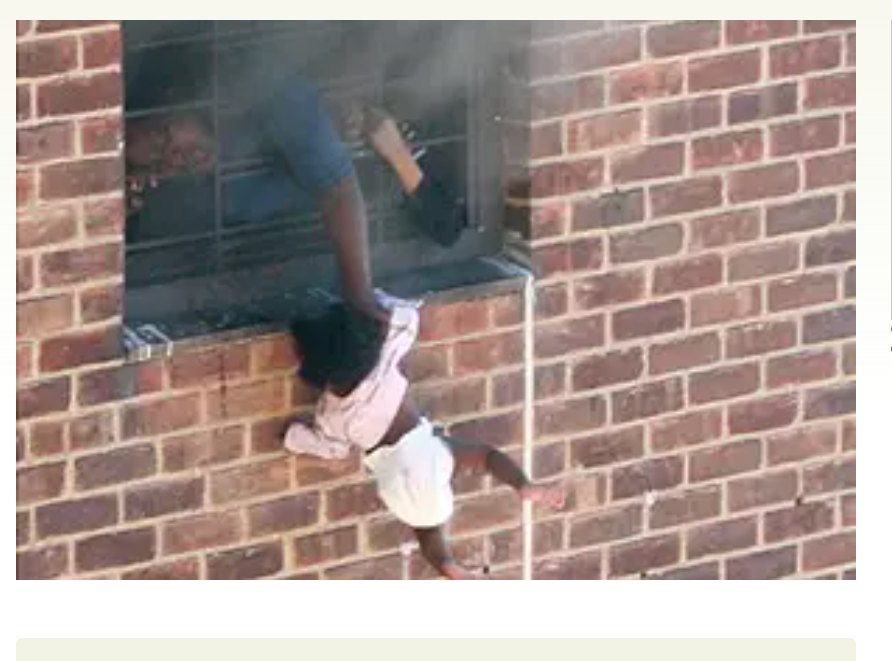
A video is being widely shared on social media after a fire incident in Aliganj, Lucknow. The approximately 15-second clip shows a building engulfed in flames, where a woman is seen hanging her small child outside a window while desperately seeking help. The video is being circulated as if it shows the recent Lucknow fire incident. CyberPeace Research Wing research found the claim to be misleading. The viral video is not related to the Lucknow fire incident. In fact, the clip is around 16 years old and originates from a completely different incident in the United States. It is being falsely shared on social media with a misleading context.
Claim:
A Facebook user shared the viral video on June 22, 2026, claiming: “A mother’s love is so powerful that even in front of death, she goes to any extent to save her child.” The post link, archived link, and screenshots are provided below.
https://www.facebook.com/reel/1168968548755052

Factcheck
To verify the claim, we conducted a reverse image search of the video keyframes using Google Lens. During the research, we found the same visuals published in a HuffPost report dated 2010. According to the report, the incident shows a fire in an apartment in the Bronx, New York, USA. https://www.huffpost.com/entry/photo-captures-baby-dangl_n_463780

Further research led us to another report published by Gothamist in 2010, which also confirmed that the footage is related to a fire incident in the Bronx apartment building in New York. https://gothamist.com/news/baby-held-out-window-in-bronx-fire-is-healthy-adorable
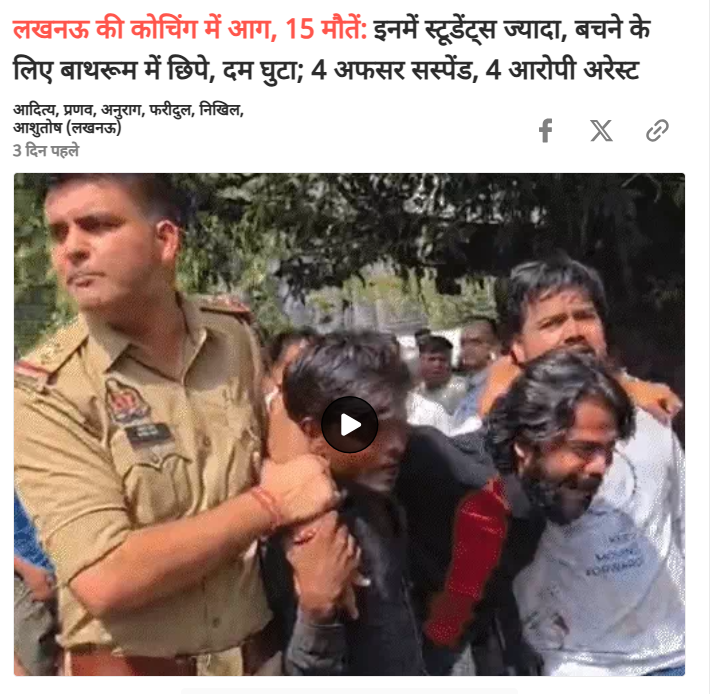
According to a report by Dainik Bhaskar, a fire incident at a coaching center in Aliganj, Lucknow resulted in the death of around 15 people. The government suspended four officials and police arrested four accused in connection with the incident. However, it was confirmed that the actual footage from the Lucknow coaching center fire is different from the viral video and has no relation to it. https://www.bhaskar.com/local/uttar-pradesh/lucknow/news/lucknow-coaching-center-fire-children-rescue-effort-138258629.html
Conclusion:
Our research confirms that the viral video is not related to the Lucknow fire incident. The footage is actually from a 16-year-old fire incident in the Bronx, New York, USA, and is being falsely shared with a misleading context on social media.

Related Blogs

Introduction
Snapchat's Snap Map redefined location sharing with an ultra-personalised feature that allows users to track where they and their friends are, discover hotspots, and even explore events worldwide. In November 2024, Snapchat introduced a new addition to its Family Center, aiming to bolster teen safety. This update enables parents to request and share live locations with their teens, set alerts for specific locations, and monitor who their child shares their location with.
While designed with keeping safety in mind, such tracking tools raise significant privacy concerns. Misusing these features could expose teens to potential harm, amplifying the debate around safeguarding children’s online privacy. This blog delves into the privacy and safety challenges Snap Map poses under existing data protection laws, highlighting critical gaps and potential risks.
Understanding Snapmap: How It Works and Why It’s Controversial
Snap Map, built on technology from Snap's acquisition of social mapping startup Zenly, revolutionises real-time location sharing by letting users track friends, send messages, and explore the world through an interactive map. With over 350 million active users by Q4 2023, and India leading with 202.51 million Snapchat users, Snap Map has become a global phenomenon.
This opt-in feature allows users to customise their location-sharing settings, offering modes like "Ghost Mode" for privacy, sharing with all friends, or selectively with specific contacts. However, location updates occur only when the app is in use, adding a layer of complexity to privacy management.
While empowering users to connect and share, Snap Map’s location-sharing capabilities raise serious concerns. Unintentional sharing or misuse of this tool could expose users—especially teens—to risks like stalking or predatory behaviour. As Snap Map becomes increasingly popular, ensuring its safe use and addressing its potential for harm remains a critical challenge for users and regulators.
The Policy Vacuum: Protecting Children’s Data Privacy
Given the potential misuse of location-sharing features, evaluating the existing regulatory frameworks for protecting children's geolocation privacy is important. Geolocation features remain under-regulated in many jurisdictions, creating opportunities for misuse, such as stalking or unauthorised surveillance. Presently, multiple international and national jurisdictions are in the process of creating and implementing privacy laws. The most notable examples are the COPPA in the US, GDPR in the EU and the DPDP Act which have made considerable progress in privacy for children and their online safety. COPPA and GDPR prioritise children’s online safety through strict data protections, consent requirements, and limits on profiling. India’s DPDP Act, 2023, prohibits behavioral tracking and targeted ads for children, enhancing privacy. However, it lacks safeguards against geolocation tracking, leaving a critical gap in protecting children from risks posed by location-based features.
Balancing Innovation and Privacy: The Role of Social Media Platforms
Privacy is an essential element that needs to be safeguarded and this is specifically important for children as they are vulnerable to harm they cannot always foresee. Social media companies must uphold their responsibility to create platforms that do not become a breeding ground for offences against children. Some of the challenges that platforms face in implementing a safe online environment are robust parental control and consent mechanisms to ensure parents are informed about their children’s online presence and options to opt out of services that they feel are not safe for their children. Platforms need to maintain a level of privacy that allows users to know what data is collected by the platform, sharing and retention data policies.
Policy Recommendations: Addressing the Gaps
Some of the recommendations for addressing the gaps in the safety of minors are as follows:
- Enhancing privacy and safety for minors by taking measures such as mandatory geolocation restrictions for underage users.
- Integrating clear consent guidelines for data protection for users.
- Collaboration between stakeholders such as government, social media platforms, and civil society is necessary to create awareness about location-sharing risks among parents and children.
Conclusion
Safeguarding privacy, especially of children, with the introduction of real-time geolocation tools like Snap Map, is critical. While these features offer safety benefits, they also present the danger of misuse, potentially harming vulnerable teens. Policymakers must urgently update data protection laws and incorporate child-specific safeguards, particularly around geolocation tracking. Strengthening regulations and enhancing parental controls are essential to protect young users. However, this must be done without stifling technological innovation. A balanced approach is needed, where safety is prioritised, but innovation can still thrive. Through collaboration between governments, social media platforms, and civil society, we can create a digital environment that ensures safety and progress.
References
- https://indianexpress.com/article/technology/tech-news-technology/snapchat-family-center-real-time-location-sharing-travel-notifications-9669270/
- https://economictimes.indiatimes.com/tech/technology/snapchat-unveils-location-sharing-features-to-safeguard-teen-users/articleshow/115297065.cms?from=mdr
- https://www.thehindu.com/sci-tech/technology/snapchat-adds-more-location-safety-features-for-teens/article68871301.ece
- https://www.moneycontrol.com/technology/snapchat-expands-parental-control-with-location-tracking-to-make-it-easier-for-parents-to-track-their-kids-article-12868336.html
- https://www.statista.com/statistics/545967/snapchat-app-dau/
Introduction
The Ministry of Electronics and Information Technology (MEITy) released the Draft Information Technology (Intermediary Guidelines and Digital Media Ethics Code) Second Amendment Rules, 2026 on March 30, 2026, inviting public comments with a response window closing on April 14. This is a limited 15-day period for public input on proposed rules that will have major constitutional impacts. The brevity and timing of this opportunity demonstrate debatable commitment to stakeholder engagement and meaningful consultation by the drafting agency.
While MEITY describes the proposed amendments as "clarificatory and procedural nature," an analysis shows they will have substantive effects. Collectively, the amended language changes significantly how online speech will be regulated in India by providing the executive with more concentrated regulatory authority, limiting the required transparency of content enforcement, mandating greater retention of data without proportionality-based safeguards, and placing excessive compliance burden on intermediaries. Each of these changes has consequences beyond just changes in process and together, these changes collectively raise substantial concerns regarding compliance with Articles 14, 19, and 21 of the Constitution of India.
The Constitutional Baseline: Shreya Singhal and the Limits of Intermediary Liability
India’s Supreme Court decision in Shreya Singhal v Union of India (2015) 5 SCC 1 provides the foundation for intermediary liability, wherein the Court read down Section 79(3)(b) of the IT Act, 2000, holding that intermediaries are required to act upon receiving actual knowledge only through a court order or a valid notification by the appropriate government authority. The Supreme Court’s decision intended to provide a constitutional protection to intermediaries from being subjected to informal, unverified executive pressure to take down content by requiring that any such order be subject to some level of legal objective credibility or threshold.
Rule 3(4) of the proposed amendments places that balance under significant strain. By requiring intermediaries to comply with advisories, directions, standard operating procedures, codes of practice, and guidelines issued by the Ministry — and tying non-compliance to the loss of safe harbour — the draft effectively lowers the constitutional threshold that Shreya Singhal was designed to maintain. Compliance obligations now potentially arise from instruments that carry no judicial sanction and no mandatory public disclosure.
Rule 3(4): Delegated Legislation or Executive Overreach
The rule-making power conferred on the Central Government under Section 87 of the IT Act is limited to carrying out the provisions of the Act. It does not authorise the creation of new substantive obligations. This principle has been consistently affirmed in Indian Express Newspapers v. Union of India (1985) 1 SCC 641 and Confederation of Ex-Servicemen Associations v. Union of India (2006) 8 SCC 399, where the Court held that delegated legislation must remain within the four corners of the parent statute.
Rule 3(4) tests those limits. It converts executive advisories into binding compliance instruments without a clear statutory foundation in either Section 79 or Section 87. Although the proposed rule requires that such instruments specify their legal basis, there is no requirement that they be published or made publicly accessible. This creates a framework in which legality risks becoming circular — instruments claimed to be lawful solely by reference to a provision that does not clearly authorise them, shielded from scrutiny by their own opacity. Justice Chandurkar’s judgment in Kunal Kamra v. Union of India identified precisely this defect in the Fact Check Unit amendment. Rule 3(4) replicates the structural problem in a broader form.
Compliance Pressure and the Logic of Over-Censorship
The practical consequence of Rule 3(4) lies not only in its legality but in how it reshapes incentive structures for platforms. An intermediary facing the permanent threat of safe harbour loss will not wait to assess the legal merit of each advisory. The rational calculation is to comply early, broadly, and without friction. Lawful content — particularly satire, political commentary, and journalism — becomes vulnerable not because it is unlawful, but because it presents regulatory risk.
This dynamic was visible on 18 March 2026, when stand-up comedian Pulkit Mani (@hunnywhoisfunny) found his satirical Instagram reel being restricted across India. The video had accumulated over 16.5 million views. Users encountered a notice citing Section 79(3)(b) of the IT Act. No reasons were publicly provided. No prior hearing was offered. The same night, several political parody and satire accounts were withheld on X.
Data Retention, Privacy, and the Proportionality Test
The amendments to Rules 3(1)(g) and 3(1)(h) extend data retention obligations by making them additional to requirements under any other law. The existing 180-day floor for retained user data — covering removed content, registration information, and associated records — becomes a minimum rather than a ceiling. No maximum is specified, and no proportionality requirement accompanies the extension.
This raises direct concerns under Article 21 as interpreted in Justice K.S. Puttaswamy v. Union of India (2017) 10 SCC 1, which held that any state intrusion into privacy must satisfy the triple test of legality, necessity, and proportionality. Undefined retention periods, with no statutory ceiling and no requirement of purpose limitation, risk failing all three. The longer user data is held, including metadata, device information, and records of removed content, the greater the exposure to surveillance, unauthorised access, and use beyond the original justification.
Circumventing Judicial Scrutiny Through Procedural Redesign
The Bombay High Court, in its August 2021 order, stayed provisions of the IT Rules’ oversight mechanism as prima facie violative of Article 19(1)(a). The Madras High Court in T.M. Krishna v. Union of India affirmed that stay, cautioning that government-controlled media oversight risked undermining press independence. Both matters remain pending before the Delhi High Court.
The amendments to Rules 8(1) and 14 restructure the same oversight machinery through a modified procedural design. By extending the Inter-Departmental Committee’s jurisdiction to cover “matters” referred by the Ministry with no requirement of a complainant, no defined subject matter, and no guaranteed prior hearing, the proposed rules effectively reconstitute what courts found constitutionally suspect. Individual users posting news and current affairs content are now brought within reach of blocking mechanisms originally designed for institutional publishers.
Conclusion
As seen above, the Draft IT Rules 2026 are unable to meet the constitutional and judicial requirements to regulate free speech. What the proposed amendments construct is a durable system in which platforms self-censor under liability pressure, data is retained without proportionate justification, and content oversight expands through procedural adjustment rather than parliamentary legislation. Regulation of the digital public sphere is both legitimate and necessary. But it must be anchored in law, not in the quiet authority of executive advisories. The law must ultimately remain anchored in constitutional values, guided by the enduring principles of justice, equity, and good conscience.
The comment period closes on 14 April 2026.
Submissions may be sent to itrules.consultation@meity.gov.in.
References
- https://www.meity.gov.in/static/uploads/2026/03/30591fc6e322dcbcc9dae84a0f02e9e7.pdf
- https://www.meity.gov.in/static/uploads/2026/03/a71a21d35c107f2e528363d3eb17646a.pdf
- https://www.meity.gov.in/static/uploads/2026/02/550681ab908f8afb135b0ad42816a1c9.pdf
- https://neopolitico.com/india/government-blocks-viral-satirical-reel-impersonating-pm-modi-raising-fresh-questions-on-free-speech-and-digital-regulation/
- https://internetfreedom.in/sound-the-alarm-iffs-first-read-on-meitys-draft-it-rules-second-amendment-2026/
.webp)
Introduction
In today’s cybersecurity landscape, ransomware has emerged as one of the most significant and rapidly growing cyber threats. What began as attacks carried out by individual hackers has evolved into a highly organised criminal enterprise, with groups operating through structured business models and global networks. The emergence of The Gentlemen ransomware group reflects this transformation, demonstrating how modern threat actors can quickly expand their operations and target organisations across multiple sectors. Their rise highlights the increasing sophistication of ransomware campaigns and the growing challenges faced by organisations in defending against them. The attribution of the group's administrator to an identified individual in Izhevsk, Russia, provides a valuable lens through which to examine three interconnected developments: the maturation of ransomware-as-a-service (RaaS) business models, the inherent operational security (OPSEC) weaknesses that emerge over the course of cybercriminal careers, and the geopolitical environments that enable such actors to operate with relative impunity. Together, these dynamics illustrate the industrialisation of modern cybercrime.
The Industrialisation of Ransomware-as-a-Service
The remarkable rapid rise of The Gentlemen is impossible without discussing the maturation of ransomware-as-a-service (RaaS). RaaS systems utilize network intrusion experts as affiliates who conduct networks intrusions and secure access in exchange for a cut of the total ransoms paid, while a core group builds and maintains the ransomware framework itself. Although Reveton, one of the earliest Raas providers, can be credited with bringing early iterations of RaaS to fruition in 2012, the potential scale was truly evident in the mid-2020s. By 2025 it was estimated that there were over 100 active ransomware gangs operating; this proliferation is the direct result of the franchise-like system, which has lowered the barriers to entry for cybercrime.
The marketplace surrounding RaaS is intensely competitive, and this is clearly exemplified in the business structure of The Gentlemen: while many of the top ransomware groups provide an 80/20 profit share (with the majority of the profit going to the affiliates), The Gentlemen has an exceptionally profitable 90/10 split (affiliates keep 90% of the profit share) for affiliates, likely to draw experienced operators away from their rivals given recent decreases in victim willingness to pay and corresponding increases in the incentives RaaS platforms are required to offer.
The operational efficiency of the group is representative of a successful enterprise. They attack vulnerable internet-facing VPNs and firewalls and generally complete the network encryption within a matter of hours, leaving defenders with very little time to respond, as confirmed by Check Point Software, a renowned cybersecurity vendor.
Additionally, PRODAFT reports that the administrator of The Gentlemen, known by the alias Zeta88 (previously known as Hastalamuerte), directly provides affiliates with SSL VPN credentials, often obtained through brutal force attacks or their own private leaked databases, indicating an unusually high level of vertical integration for RaaS groups.
AI as a Force Multiplier in Ransomware Development
A particularly significant aspect of the Hastalamuerte case is PRODAFT's finding that the administrator employs artificial intelligence to develop and maintain ransomware, support associated tooling, and assist post-exploitation operations. This reflects a broader trend observed across the 2025–2026 threat landscape, where AI has increasingly lowered the capability threshold for participation in organised cybercrime. Researchers have documented its role in automating stages of intrusion, accelerating malware development cycles, and simplifying the maintenance of malicious infrastructure. These capabilities have been leveraged by both nation-state actors and criminal enterprises.
The trajectory of Hastalamuerte is especially illustrative. Cybersecurity Forum posts during 2019-2020 depict a hacker who is fairly novice at fundamental penetration testing procedures. A subsequent emergence as the operator of a top-tier ransomware-as-a-service operation indicates that AI-assisted development may be responsible for dramatically reducing the skill level and time necessary to create a successful criminal enterprise in cyberspace. The evolution of these tools should make the route from novice forum user to accomplished ransomware operator more attainable for a wider array of perpetrators in the future.
The OPSEC Paradox: How Cybercriminals Leave a Trail
The attribution of Hastalamuerte's identity by researchers from Intel 471, Flashpoint, and Constella Intelligence demonstrates the effectiveness of modern open-source and commercial intelligence methodologies. A forum registration traceable to an IP address from Izhevsk, Russia linked a Protonmail address, which linked to an Apple account, a GitHub profile, a Telegram handle, a Russian phone number, and finally to a 36 year old marketing professional named Alexander Andreevich Yapaev who was also living in Izhevsk. Investigators did not use an advanced capability in their attribution, but rather a simple OPSEC mistake of consistently reusing credentials. Every username and email address and every phone number creates a linkage between disparate data points, eventually building into a real-world persona.
It has also come out in the forum discussion that while training for a penetration testing course in 2020, Hastalamuerte displayed the kind of inexperience that a novice would display in traceable, recorded fashion to intelligence databases. It's an example of a broader rule about attribution; attacker mistakes provide the most value. With Russians the lack of apparent consequences may contribute to a lack of need to maintain tight OPSEC from the start.
The Russian Safe Haven: Conditional Impunity and Its Limits
Yapaev's base in Izhevsk is emblematic of the geostrategic situation that has allowed Russian cybercriminality to prosper. Security researchers routinely label Russia's policy as one of "controlled impunity," where the cybercriminality directed at foreign entities is ignored or implicitly condoned, while that directed at Russian interests will prompt a law enforcement response. This constitutes what has been called a "managed market" rather than an "unconditional sanctuary," where many of the named defendants could and likely will continue their illegal enterprise with little fear of reprisal, provided that they do not threaten the interests of the Russian state and do not attempt to move their operations outside of Russian control.
Yet this protection is neither absolute nor permanent. In May 2024, the transnational Operation Endgame campaign highlighted the growing global appetite for damaging the cybercrime ecosystem rooted in Russia. Russian authorities did indeed pursue and seize some assets and operators, but arrests seem largely confined to the lower-rung facilitators of these attacks (hosting providers and payment services), and it seems higher-end ransomware operators continue to evade scrutiny. Selective enforcement thus further bolsters the perception that protection is accorded according to strategic value, not legal standards. For operators such as Hastalamuerte, who possess no publicly documented intelligence connections, growing attribution capabilities, and sustained international pressure may gradually erode the security traditionally associated with operating from within Russia.
Attribution as a Deterrence Instrument
The public identification of Alexander Andreevich Yapaev as Hastalamuerte/Zeta88 shows the continued struggle with the utility of attribution in situations where immediate prosecution is not feasible. Its utility is far more extensive than simply an ability to make an arrest. Functionally, public naming forces a perpetrator into an open evidentiary space and can lead to alterations in their operational habits and effectiveness. Strategically, attribution provides future leverage for sanctions, indictments, financial restrictions, or extradition if the target can leave their safe haven country. The logic behind US rewards programs (paying up to $10 million for the capture and conviction of ransomware operators) relies on this principle. The analytical insight provided by the case cannot be understated either. Hastalamuerte's trajectory from a relative amateur forum participant on Nulled and Raidforums in 2019 to leading a significant ransomware operation by 2026 offers an invaluable look into the career progression of a cyber criminal. It confirms one of the lessons learned through deterrence and attribution: pseudonymity is not everlasting, and many years of OPSEC failures can be pieced together to establish a real-world identity.
Conclusion
The Gentlemen incident is emblematic of the three broad themes that currently characterise cyber warfare: ransomware-as-a-service through innovative competition, common OPSEC failures that enable attribution, and a new, conditional regime of protection for Russian cybercriminals. The obvious defense lesson: increasing attack surfaces require stronger identity, behavioural monitoring, and intelligence capacities. The policy lesson: effective attribution is still an essential tool for comprehension, deterrence, and disruption in an increasingly industrialised environment of criminals supporting each other's operations in ransomware-as-a-service.
References
- https://krebsonsecurity.com/2026/06/who-runs-the-ransomware-group-the-gentlemen/
- https://www.recordedfuture.com/
- https://www.vectra.ai/topics/ransomware-as-a-service
- https://www.trmlabs.com/es/resources/blog/new-disruption-opportunities-in-the-evolving-ransomware-ecosystem
