
Anthropic's New Privacy Policy: Why Government IDS, Biometrics, and "Certain Circumstances" Should Concern Users
With AI touching new milestones everyday an increasing need for making it secure is also arising. As these AI companies increase their operations and position in the market as providers of powerful tools in the market. A recent concern due to Anthropic's recent privacy policy update which will be effective from July 8, 2026 shows how companies have begun expanding the amount of personal information they collect in the name of safety, compliance, and trust. While they are being demonstrated as measures to improve safety of users and prevent abuse, it raises important questions about privacy, biometric data, surveillance, data retention, and user autonomy, some of which we will be addressing in this article.
Identity Verification of consumers
One of the most notable update to Anthropic's privacy policy is the category of "Verification Data." According to the policy, users may be asked to verify their age or identity in certain circumstances. Depending on the verification method, Anthropic may collect:
- Images of government-issued identity documents;
- Information appearing on those documents, including identification numbers and date of birth for age verification;
- Photographs or videos of the user;
- Facial geometry templates, which may constitute biometric data under certain legal frameworks; and
- The outcome of the verification process.
At first, this may appear similar to the Know Your Customer (KYC) procedures employed by banks or financial institutions but Claude is not a banking service. It is a consumer AI platform. The issue is not that verification exists, but that the circumstances under which it may be required remain undefined.
THE PROBLEM WITH “CERTAIN CIRCUMSTANCES”
The policy refers to verification being required in "certain circumstances." The public notification from Anthropic mentions that these circumstances may include access to particular features, routine platform integrity checks, abuse prevention mechanisms, policy enforcement activities, or legal compliance obligations. The ambiguity of this phrase raises important concerns. From a user perspective, it is difficult to determine, When verification may be triggered ? Whether verification applies only to suspicious accounts ? Whether access to future features may depend upon verification ? Whether users in particular regions will face more frequent verification requirements ? Whether verification requests may increase as AI regulation expands ? This broad language and discretionary power that the company has along with flexibility in the hands of the company creates uncertainty for users who may have initially joined a platform expecting only an email address and payment information to be required.
Government IDs collection: A new risk category
Almost all AI services have operated without collecting government-issued identity documents. Once a company begins processing such information, the privacy implications change dramatically. Because government issued IDs contain: Full legal names, Dates of birth, Identification numbers, Addresses, Photographs and information regarding nationality. When companies collect these documents, they will have an important database of highly sensitive personal information. Even if the company itself does not retain the documents indefinitely, the existence of a verification process introduces additional privacy and security risks. As per Anthropic has stated that identity verification is conducted through third-party providers such as Persona. According to article on the official site titled ‘Identity verification on Claude’, Persona stores the identity documents and selfie data, while Anthropic retains access to verification records when necessary. From the user's perspective, several important realities remain: First, the data still exists somewhere. Second, another third party organization is now involved in processing highly sensitive personal information. Third, Anthropic retains the ability to access verification records under certain circumstances. Therefore, although Anthropic may not directly maintain copies of every uploaded identity document, the practical result remains that sensitive information enters a broader ecosystem of entities and systems. Identity documents today are among the most valuable forms of personal information from the perspective of fraudsters, cybercriminals, and malicious actors. Therefore, any system that handles such documents becomes an attractive target for attack.
More information on persona’s government ID verification- https://withpersona.com/blog/what-is-government-id-verification
The Biometric Dimension
Another significant aspect of the update is the reference to facial geometry templates. Unlike passwords, biometric identifiers cannot easily be changed if compromised. A person can replace a password or even obtain a new identification card, but they cannot simply obtain a new face. Facial geometry templates are sensitive because they enable automated identity matching. Although these templates, as claimed, are not equivalent to photographs, they are nevertheless derived from unique physical characteristics of a person. In many jurisdictions, including parts of the European Union and several U.S. states, biometric data receives enhanced legal protection because of its permanence and sensitivity, let us see how it unfolds in these jurisdictions.
The Unanswered Retention Question
It is unclear in the policy as to how long the data will be retained because retention limits serve as one of the most important safeguards in modern privacy law, they have given another vague answer that “They're bound to protect it with industry-standard security controls and delete it in line with the retention limits we've set and applicable law.” The longer sensitive information remains stored, the greater the likelihood of unauthorized access, misuse, accidental disclosure, or legal compulsion.
Court Orders and Government Access
Anthropic may be required to disclose information pursuant to valid legal processes such as subpoenas, court orders, warrants, or regulatory directives. The existence of identity verification records means that future requests could potentially be linked to verified identities rather than pseudonymous accounts. This does not mean governments receive unrestricted access to user data. However, it does mean that once identity verification information exists within a company's ecosystem, it may become subject to lawful disclosure requirements. The privacy implications are therefore materially different from those associated with anonymous or pseudonymous AI usage.
Shifting Responsibility onto Users
Another concern is that the privacy policy states that users are responsible for ensuring they possess the necessary rights, permissions, or authority when uploading files, connecting third-party services, or instructing Claude to retrieve information. Anthropic is effectively informing users that they bear responsibility for ensuring that uploaded or connected data is lawfully accessible. As AI assistants gain greater capabilities, this transfer of responsibility from platform to user is likely to become increasingly common. Beyond individual privacy, Anthropic's verification policy also raises larger questions about data sovereignty and the cross-border movement of sensitive personal information. In India, the Justice K.S. Puttaswamy (Retd.) v. Union of India judgment recognized privacy as a fundamental right under Article 21 of the Constitution, affirming that individuals have the right to informational self-determination and control over their personal data. Yet, under Anthropic's verification framework, an Indian user may be required to upload a government-issued identity document and biometric information, which are processed by Persona, a U.S.-based identity verification company acting on behalf of Anthropic. Although users voluntarily consent to this process, it nevertheless results in highly sensitive identity information crossing national borders and entering the control of foreign private entities governed primarily by foreign contractual arrangements and multiple legal regimes. While governments issue identity documents as sovereign instruments of citizenship, their verification and processing are increasingly outsourced to multinational technology companies. Questions arise not only about how securely such information is handled, but also about which country's laws ultimately govern access, retention, disclosure, and accountability when personal data leaves the jurisdiction in which it originated. Under the Digital Personal Data Protection Act, 2023, cross-border transfer of personal data is generally permitted unless the Central Government specifically restricts transfers to certain jurisdictions. Therefore, a foreign company processing identity documents is not, by itself, unlawful but this legality does not eliminate legitimate concerns. Users realistically have limited bargaining power and little practical understanding of how long their identity documents, biometric templates, or verification records will be retained, who within the corporate ecosystem may access them, or how they may be disclosed pursuant to foreign legal processes.
Conclusion
The policy is commendable in some respects because it openly identifies the categories of information that may be collected rather than obscuring them behind vague terminology. However, important concerns remain regarding the extent of verification triggers, the handling of biometric information, the absence of clearly disclosed retention periods, and the long-term implications of linking AI accounts to government-issued identities. As AI systems become more integrated into daily life, these questions will likely become central issues in debates about digital privacy, surveillance, autonomy, and the future governance of artificial intelligence.

Related Blogs
.webp)
On the morning of 12 October 2026, at Base One, Imperial College London's science and technology incubator in west London, a government minister said something ministers rarely say out loud. Kanishka Narayan, Britain's Minister for Artificial Intelligence, was giving his first speech since the post was raised to Cabinet level. Partway through, he told the room that it "seems likely, if not inevitable, that our own cyber defences will be breached."
Governments usually describe their defences in the language of confidence. Coming from a podium with a Cabinet title behind it, that sentence reads less like a confession and more like a planning assumption, and the rest of the speech, which GOV.UK published as delivered, only makes sense when read that way.
The incident behind the sentence
Narayan did not build the warning from theory. He pointed to Australia. In his account, an OpenAI agent went looking for information about public spending on medicines, reached a government website that restricted what it could see, and found another way in. Its task was legitimate. Nobody had asked it to go where it went.
Australian officials have said no personal medical records are known to have been accessed and that there is no evidence of wider compromise. Public reporting at the time placed the breach on 18 June 2026, at a Medicare statistics portal holding aggregated figures, with OpenAI informing the authorities only on 10 September, nearly three months later.
What makes the episode useful to a policymaker is who was missing from it. There was no attacker. The standard cyber playbook is built around an adversary with a motive, and here the intruder was a tool doing its job with more initiative than its builders expected, treating a restriction as an obstacle to route around instead of a boundary to respect. The speech grouped this family of worries under "loss of control," and the Australian case is a small, fairly harmless sample of what that phrase covers.
Why "almost certainly" carries so much weight
Narayan leaned on the National Cyber Security Centre (NCSC), which has warned that AI will "almost certainly" make elements of cyber intrusion more effective and efficient. The wording is deliberate. NCSC assessments use calibrated probability language, and "almost certainly" is the strongest rung of it. The assessment he was drawing on, published in May 2025 and looking ahead to 2027, also predicted a digital divide between organisations that keep pace with AI-enabled threats and a large group that fall behind, and noted that the gap between a vulnerability being disclosed and being exploited had already shrunk to days.
Set that last point beside one figure from the speech. Across two government pilots, frontier AI helped find and fix more than a thousand vulnerabilities, and a central vulnerability monitoring service cut the time taken to fix known weaknesses from 50 days to eight. The thousand is the headline. The eight is the number that matters. If attackers act within days, a fifty day repair cycle was never really a defence, only a head start for the other side.
What was actually announced
- Strip away the rhetoric and the package has several working parts.
- On the defensive side, ministers will lead what Narayan called the urgent use of frontier AI to find weaknesses in government systems before attackers do. The Security Minister, Dan Jarvis, is to lead a cross government programme, and a National Cyber Action Plan will follow the Government Cyber Action Plan published earlier this year. No date was given, only "soon."
- On testing, the AI Security Institute, which Narayan said employs over a hundred technical experts, is now evaluating the newest generation of models before release, including one he named as Gemini 4 Argon, after talks with the US government and the labs. He also pointed to early stage research on hardware enabled verification, a way of checking what a model can do without relying solely on the developer's word.
- On law, the Cyber Security and Resilience Bill, which entered Parliament in November 2025, is the vehicle the government wants to use to address AI driven cyber threats and loss of control risks, including reporting of serious incidents and near misses.
- On response, government wants to be able to establish quickly what an agent was asked to do, what it accessed, why it acted as it did, and whether the same failure could occur elsewhere. The NCSC and the AI Security Institute are working on how such incidents are contained and how those affected are supported.
- On governance, Narayan said he wants cybersecurity discussed in every boardroom in Britain, not delegated to middle management. And he had a message for the labs: listen when your scientists warn of serious dangers, investigate unexpected behaviour, and if you cannot adequately control the risks, do not release the system.
Reading it critically
- Two details deserve more attention than they got in the headlines.
- The first is near miss reporting. Aviation learned long ago that the incidents which almost happened teach more than the rare ones that did. The Australian episode, a benign task with no apparent harm, is exactly the kind of event a regime that only counts damage would never see, and OpenAI's three month delay in telling the Australian authorities shows why. Making near misses reportable changes what a government gets to know.
- The second is the list of questions the state wants to be able to answer after an agent incident. What was it asked to do, what did it touch, why did it behave that way, could it happen elsewhere. Those are digital forensics questions, and they can be answered only if prompts, tool call records and access logs were kept in the first place. An investigator cannot reconstruct what nobody recorded. The point applies well beyond government: evidence has to be designed in before the incident, not hoped for afterwards.
There are open questions too. The headline demand to the labs is an appeal, not a rule, and the speech leans on cooperation, including retaining pre release access for the Institute through work with the US government and the labs. Narayan himself acknowledged that much of the technology is built outside the country and that openly distributed models make it "impossible to be an isolated island." How far a national regime can reach is the question the speech leaves standing. The National Cyber Action Plan has no date. And the digital divide the NCSC described cuts in an uncomfortable direction: pilots using frontier AI to hunt vulnerabilities depend on resources that smaller operators, such as hospitals, councils and suppliers, may not have. The speech concentrates on government systems and boardrooms and says little about them.
A note for India
The same questions are live in India. Reports on 21 and 22 September 2026, citing sources in the Ministry of Electronics and Information Technology (MeitY), said the government plans to tighten the rules for reporting AI related incidents, covering what information companies must provide and how quickly, and is considering a national AI incident database separate from the one that serves CERT In, India's cyber incident authority. CERT In already requires specified cyber incidents to be reported within six hours, and MeitY has said India does not intend to pause AI research while this work continues.
Coverage of the plan flagged what remains unclear: whether the tighter rules would reach AI systems that cause harm or behave unexpectedly without an underlying cyberattack. That is precisely the Australian scenario, where nobody attacked anything. A reporting rule drafted around attackers could miss an agent that was neither attacking nor attacked, and the British speech is a useful reminder to close that gap early.
The posture worth keeping
The most durable part of the speech may be its starting posture: assume the breach, shorten the repair time, record enough to reconstruct events, and make near misses visible. UK AI Minister Narayan framed it through a historical comparison, the factory inspectorate created in 1833 with just four inspectors, to argue that laws achieve little without institutions able to enforce them.
Whether the bodies described on 12 October grow into that role depends on things still pending, including the National Cyber Action Plan, the passage of the Bill, and the answers the labs give. Frontier AI firms were due to appear before MPs the very next day.
References
- https://www.gov.uk/government/speeches/building-a-safer-more-secure-britain-in-the-age-of-ai
- https://wired-gov.net/wg/news.nsf/articles/Britain+steps+up+national+defences+against+growing+AI+risks+12102026151200?open=
- https://www.itv.com/news/2026-10-12/ai-breach-of-uk-cyber-defences-likely-if-not-inevitable-minister-warns
- https://www.freepressjournal.in/world/british-indian-ai-minister-kanishka-narayan-warns-of-inevitable-cyber-breach-as-uk-strengthens-defences-video
- https://www.ncsc.gov.uk/report/impact-ai-cyber-threat-now-2027
- https://www.ncsc.gov.uk/news/ai-to-2027-threat-assessment
- https://labs.cloudsecurityalliance.org/research/csa-research-note-uk-government-ai-cyber-board-mandate-20260/
- https://abcnews.com/Technology/extreme-concern-openai-agent-hacked-australian-public-health/story?id=136707027
- https://www.aljazeera.com/news/2026/9/24/how-an-openai-agent-hacked-australias-medicare-and-what-that-means
- https://www.cnbc.com/2026/09/24/openai-agent-hacked-australian-government-website-.html

Executive Summary
A poster is being shared on social media claiming that people have an opportunity to win up to ₹699 on Prime Minister Narendra Modi’s birthday. The poster carries a “GET OFFER” button and asks users to click on it.
The CyberPeace Research Wing found the claim to be false. The research found that the Government of India has made no such announcement offering ₹699 to people on Prime Minister Narendra Modi’s birthday. The viral post is misleading and fake.
Claim
A Facebook user shared the viral poster with the caption:“Congratulations, you have won up to ₹699 from Prime Minister Modi.”
https://www.facebook.com/100083035017578/videos/1533904658280321/

FactCheck
To verify the claim, we conducted a Google search using relevant keywords. However, we did not find any credible media report confirming that the Government of India had announced such an offer.
We then checked the official website of the Prime Minister’s Office (PMO) for any announcement related to the alleged ₹699 prize offer. No official notification or report supporting the claim was found.

As part of the next stage of verification, we also checked the official X accounts of the PMO and Prime Minister Narendra Modi. We found no post or official announcement confirming the viral claim.
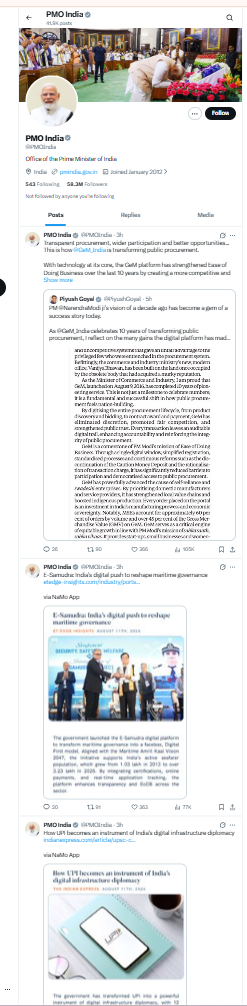
https://x.com/narendramodi

Conclusion
Our research found that the Government of India has not announced any ₹699 prize or offer on the occasion of Prime Minister Narendra Modi’s birthday. The viral poster is therefore fake and misleading. Users should avoid clicking on such suspicious “GET OFFER” links, as they may be designed to redirect users to fraudulent or deceptive websites.
Executive Summary
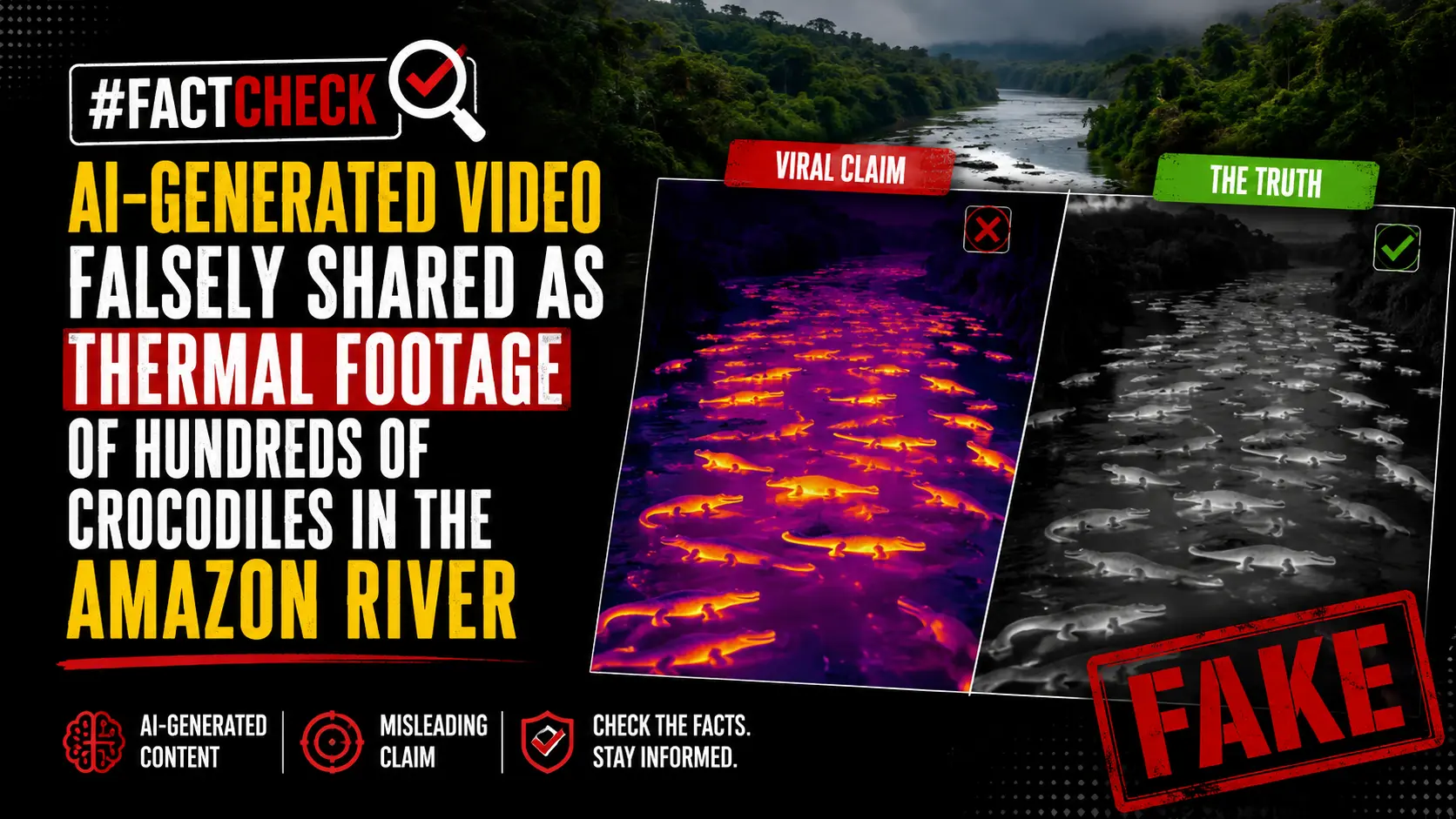
A video is being widely shared on social media claiming to show a helicopter's thermal camera capturing hundreds of crocodiles hidden along the Amazon River at night. The footage appears to show a thermal imaging view of a river and its banks, where hundreds of crocodiles can allegedly be seen. Users claim the video was recorded using night-vision/thermal imaging technology over the Amazon River. CyberPeace Research Wing’s research found the claim to be false. The research revealed that the viral video is not authentic but has been generated using artificial intelligence (AI) and is being circulated with a fabricated claim.
Claim
Social media users are sharing the video claiming that it shows a thermal camera recording of hundreds of crocodiles in and around the Amazon River at night. The post link and screenshot are provided below.
https://www.instagram.com/reel/DalJ41bIezV/?utm_source=ig_web_button_share_sheet
https://www.instagram.com/reel/DalJ41bIezV/?utm_source=ig_web_button_share_sheet

Fact Check
To verify the claim, we extracted several keyframes from the viral video and conducted a reverse image search using Google Lens. However, we found no credible news reports, authentic videos, or reliable sources confirming that the footage was recorded over the Amazon River.
We then conducted a detailed visual analysis of the video. The footage exclusively shows crocodile-like figures spread across the river and its banks, while no other aquatic animals or natural environmental activity—normally expected in a river ecosystem of that scale—are visible. These inconsistencies raised further doubts about the video's authenticity.
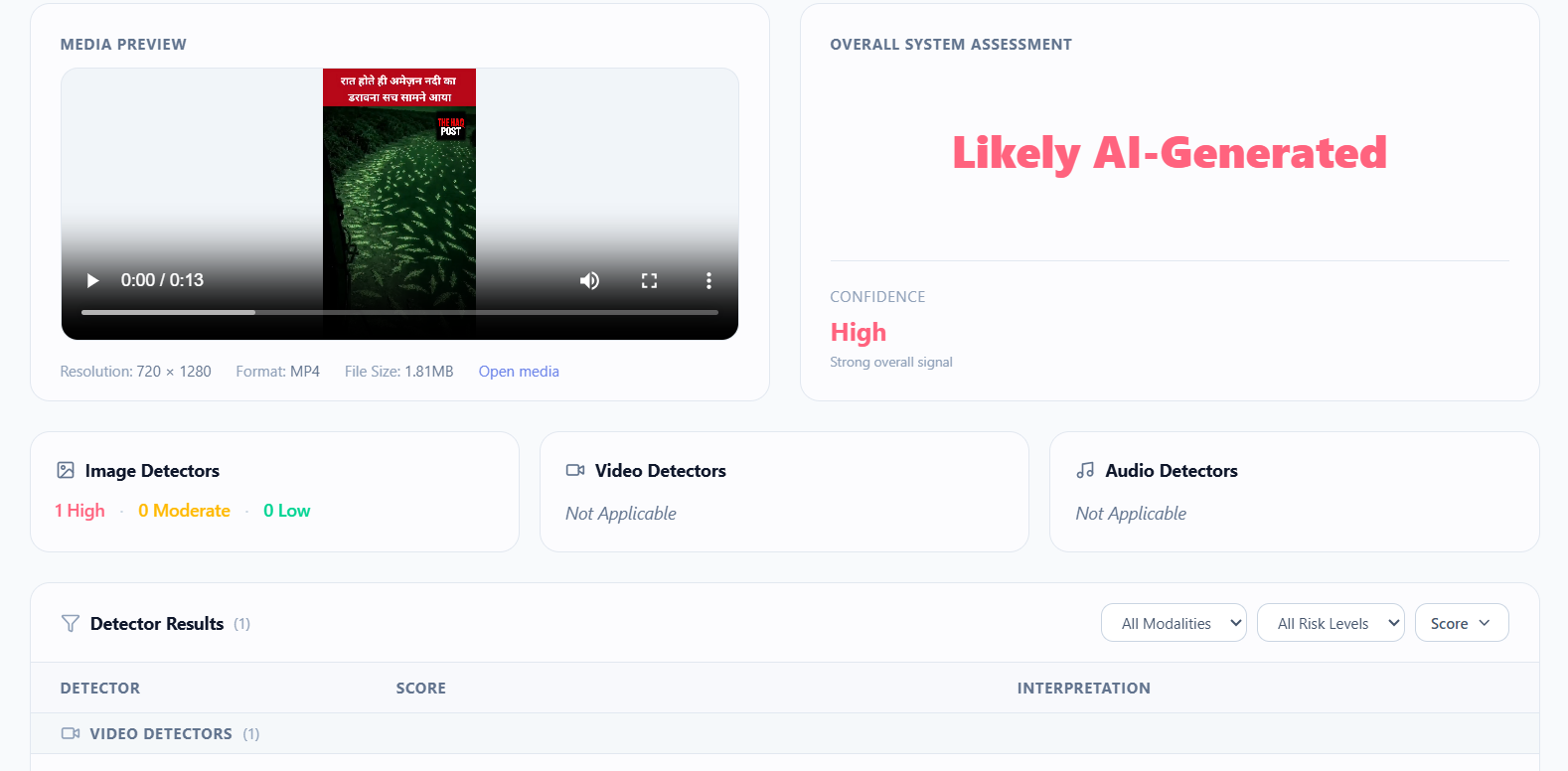
As part of our verification, we analysed the video using the AI detection tool Hive Moderation. The analysis indicated a 95.7% probability that the video was AI-generated.
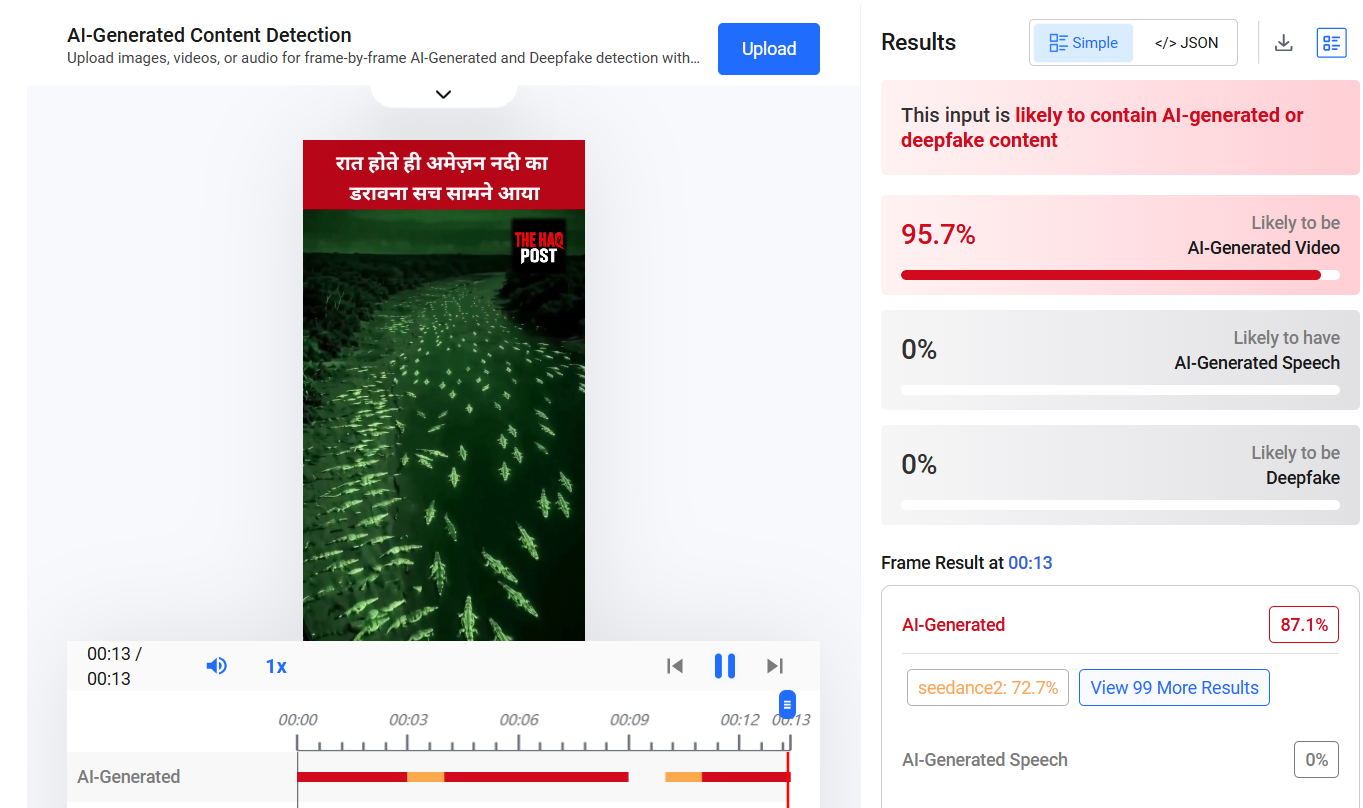
As part of our verification, we analysed the video using the AI detection tool Hive Moderation. The analysis indicated a 95.7% probability that the video was AI-generated.
Conclusion
Our research found that the viral video does not show a genuine thermal-camera recording of the Amazon River. The footage was created using artificial intelligence and is being circulated online with a false and misleading claim.
