
#FactCheck -Viral Video Falsely Linked to Baramati Plane Crash Involving Ajit Pawar
Executive Summary:
A video claiming to show the plane crash that allegedly killed Maharashtra Deputy Chief Minister Ajit Pawar has been widely circulated on social media. The circulation began soon after reports emerged of a tragic aircraft accident in Baramati, Maharashtra, on January 28, 2026, in which Ajit Pawar and five others were reported to have died. The viral video shows a plane crashing to the ground moments after take-off. Social media users have claimed that the footage captures the exact incident in which Ajit Pawar was on board. However, an research by the CyberPeacehas found that this claim is false.
Claim:
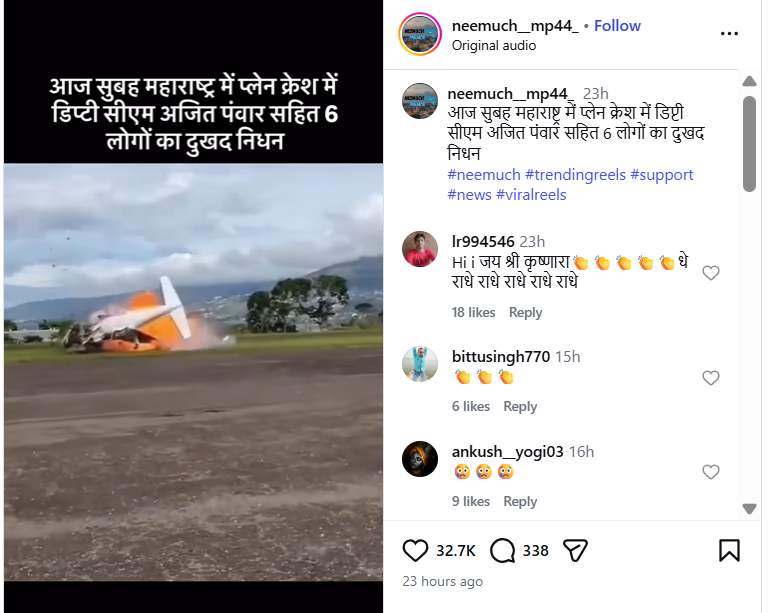
An Instagram user shared the video on January 28, 2026, claiming that it showed the plane crash in Maharashtra in which Deputy Chief Minister Ajit Pawar and others allegedly lost their lives. The caption accompanying the video read:“This morning, Deputy CM Ajit Pawar and six others tragically died in a plane crash in Maharashtra.”
Links to the post and its archived version are provided below.
Fact Check:
To verify the authenticity of the viral video, the CyberPeaceconducted a reverse image search of its keyframes. During this process, the same visuals were found in a video report uploaded on News9 Live’s official YouTube channel on October 23, 2025.
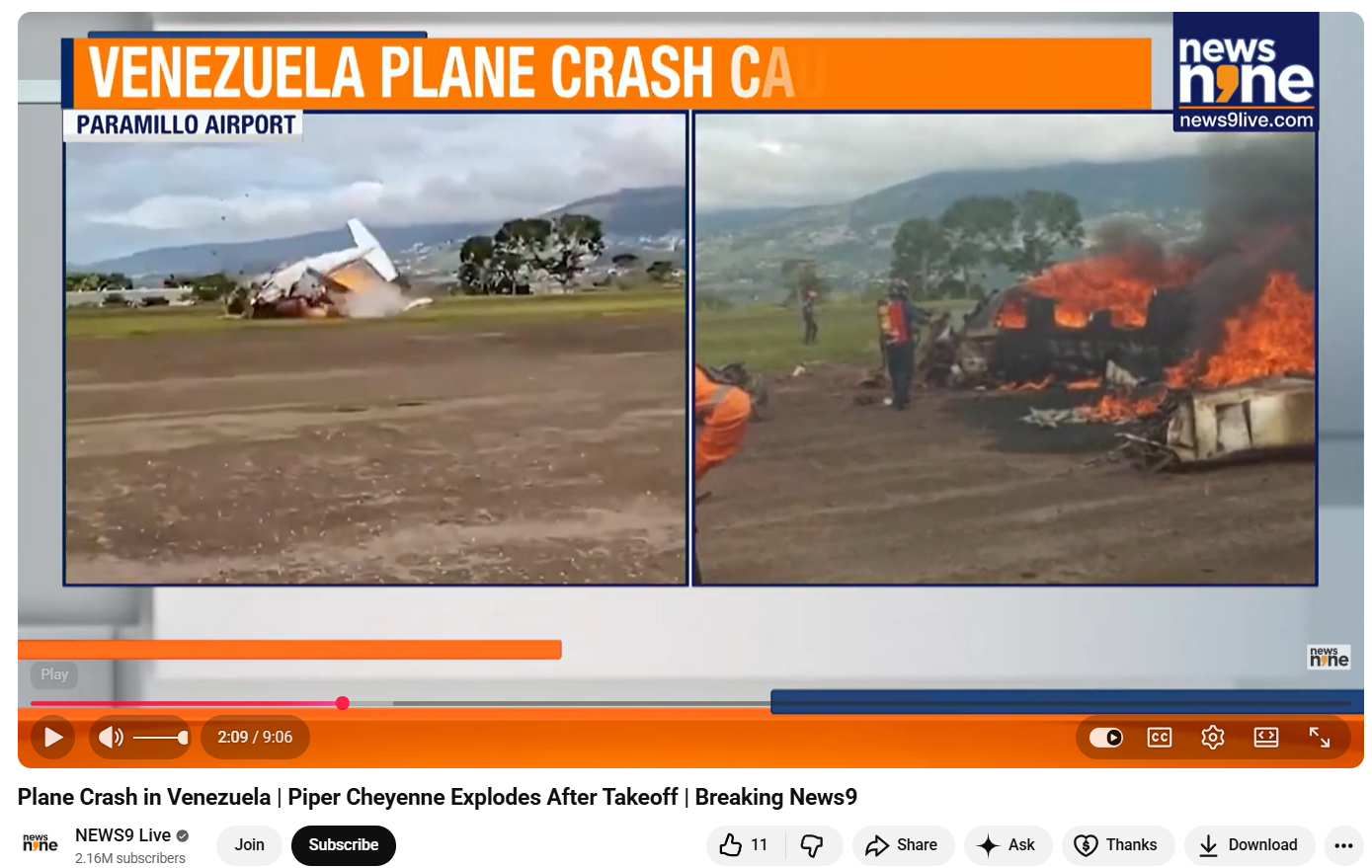
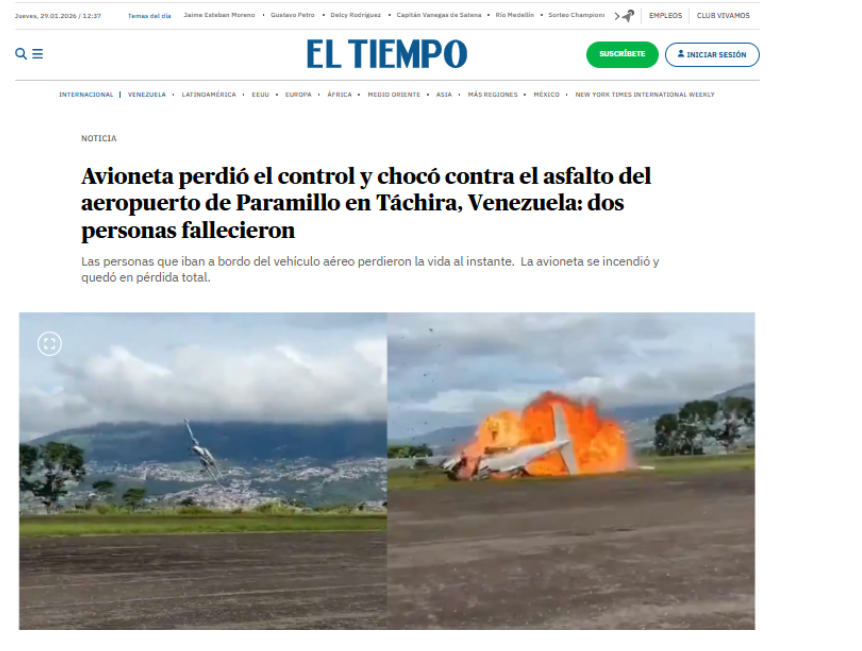
According to the report, the footage shows a plane crash in Venezuela, not India. The incident occurred shortly after a Piper Cheyenne aircraft took off from Paramillo Airport in Táchira, Venezuela. The aircraft crashed within seconds of take-off, killing both occupants on board. The deceased were identified as pilot José Bortone and co-pilot Juan Maldonado. Further confirmation came from a report published on October 22, 2025, by Latin American news outlet El Tiempo. The Spanish-language report also featured the same video visuals and stated that a small aircraft lost control and crashed on the runway at Paramillo Airport in Venezuela, resulting in the deaths of the pilot and co-pilot.
Conclusion
The CyberPeace’s research clearly establishes that the viral video being shared as footage of Ajit Pawar’s alleged plane crash in Baramati is misleading. The video actually shows a plane crash that occurred in Venezuela in October 2025 and has been falsely linked to a tragic claim in India.

Related Blogs
Risk Management
The ‘Information Security Profile’ prioritises and informs cybersecurity operations based on the company's risk administration procedures. It assists in choosing areas of focus for security operations that represent the desired results for producers by supporting periodic risk evaluations and validating company motivations. A thorough grasp of the business motivations and safety requirements unique to the Production system and its surroundings is necessary in order to manage cybersecurity threats. Because every organisation has different risks and uses ICS and IT in different ways, there will be variations in how the profile is implemented.
Companies are currently adopting industry principles and cybersecurity requirements, which the Manufacturing Information is intended to supplement, not replace. Manufacturers have the ability to identify crucial operations for key supply chains and can order expenditures in a way that will optimise their impact on each dollar. The Profile's primary objective is to lessen and manage dangers associated with cybersecurity more effectively. The Cybersecurity Framework and the Profile are not universally applicable methods for controlling security risks for essential infrastructure.
Producers will always face distinct risks due to their distinct dangers, weaknesses, and tolerances for danger. Consequently, the ways in which companies adopt security protocols will also change.
Key Cybersecurity Functions: Identify, Protect, Detect, Respond, and Recover
- Determine
Create the organisational knowledge necessary to control the potential hazards of cybersecurity to information, systems, resources, and competencies. The Identify Function's tasks are essential for using the Framework effectively. An organisation can concentrate its efforts in a way that aligns with its approach to risk mitigation and company needs by having a clear understanding of the business environment, the financial resources that assist with vital operations, and the associated cybersecurity threats. Among the outcome characteristics that fall under this function are risk evaluation, mitigation strategy, the administration of assets, leadership, and the business environment.
- Protect
Create and put into place the necessary measures to guarantee the provision of crucial infrastructure amenities. The Protect Function's operations enable the limitation or containment of the possible impact of a cybersecurity incident. Instances of results Access Management, Knowledge and Instruction, Data Safety and Security, Data Protection Processes and Instructions, Repair, and Defensive Systems are some of the classifications that fall under this role.
- Detect
Create and carry out the necessary actions to determine whether a cybersecurity event has occurred. The Detect Function's operations make it possible to find vulnerability occurrences in an efficient way. This function's result subcategories include things like abnormalities and incidents, constant security monitoring, and identification processes.
- React
Create and carry out the necessary plans to address a cybersecurity event that has been discovered. The Response Function's operations facilitate the capacity to mitigate the effects of a possible cybersecurity incident. Within this Scope, emergency planning, interactions, analysis, prevention, and enhancements are a few examples of result categories.
- Recover
Create and carry out the necessary actions to uphold resilience tactics and restore any services or competencies that were hampered by a cybersecurity incident. In order to lessen the effects of a vulnerability incident, the Recovery Function's efforts facilitate a prompt return to regular operations. The following are a few instances of outcome subcategories under this role: communications, enhancements, and recovery planning.
Conclusion
The Information Security Profile, when seen in the framework of risk mitigation, offers producers a tactical method to deal with the ever-changing cybersecurity danger scenario. The assessment directs safeguarding operations prioritisation by recognising specific business reasons and connecting with corporate goals. The Profile enhances the cybersecurity standards and established industry guidelines by taking into account the differences in vulnerabilities and organisational subtleties among producers. It highlights the significance of a customised strategy, acknowledging that every business has unique risks and weaknesses.
The fundamental tasks of the Framework, to Identify, Protect, Detect, Respond, and Recover, serve as a thorough roadmap, guaranteeing a proactive and flexible approach to cybersecurity. The Profile's ultimate goal is to increase the efficacy of risk mitigation techniques, understanding that cybersecurity is a constantly shifting and evolving subject for the manufacturing sector.
References
- https://csrc.nist.gov/news/2020/cybersecurity-framework-v1-1-manufacturing-profile
- https://nvlpubs.nist.gov/nistpubs/ir/2020/NIST.IR.8183r1.pdf
- https://mysecuritymarketplace.com/reports/cybersecurity-framework-version-1-1-manufacturing-profile/

In the 21st century, wars are no longer confined to land, sea, and air. Rather, they are increasingly playing out across the digital domain, where effective dominance over networks, data, and communications determines who holds the upper hand. Among these, 5G networks are becoming a defining factor on modern battlefields. The ultra-low latency, massive bandwidth capability, and the ability to connect many devices at a single time are transforming the scale and level of military operations, intelligence, and logistics. This unprecedented connectivity is also met with a host of cybersecurity vulnerabilities that the governments and the militaries have to address.
As India faces a challenging security environment, the emergence of 5G presents both an opportunity and a dilemma. On one hand, it can enhance our command, control, surveillance and battlefield coordination. On the other hand, it also exposes the military and the security establishments to risks of espionage and supply chain vulnerabilities. So in this case, it will be important to strike a balance between innovation and security for turning 5G into a strength rather than a liability.
How can 5G networks be a military asset?
In comparison to its predecessors, 5G is not just about faster downloads. Rather, it is a complete overhaul of network architectures that are designed to support services and technologies according to modern technological requirements. In terms of military application of 5G networks, it can prove a series of game-changing capabilities, such as:-
- Enhanced Command and Control in the form of real-time data sharing between troops, UAVs, Radar systems and the Command Cells to ensure a faster and coordinated decision-making approach.
- Tactical Situational Awareness with the help of 5G-enabled devices can give soldiers instant updates on the terrain, troop movements, or positions and enemy movements.
- Advanced Intelligence, Surveillance and Reconnaissance (ISR) with high-resolution sensors, radars and UAVs that can operate at their full potential by transmitting vast data streams with minimal legacy.
However, 5G networks can also help to become a key component of the communication component of the military command establishments that would allow machines, sensors and human operators to function as a single and integrated force.
Understanding the importance of 5G networks as the Double-Edged Swords of Connectivity-
The potential of 5G is undeniable, but its vulnerabilities cannot be ignored. Because they are software-driven and reliant on dense networks of small cells. For the military, this shows that adversaries could exploit their weaknesses to disrupt the communication, jam signals, and intercept sensitive data, leaving behind some key risks, such as;
- Cybersecurity threats from software-based architectures make 5G networks prone to malware and data breaches.
- Supply chain risks can arise from reliance on foreign hardware and software components with raising fears of embedded backdoors or compromised systems.
- Signal jamming and interface in terms of millimetre-wave spectrum, 5G signals are vulnerable to disruption in contested environments.
- There can also be insider threats and physical sabotage over personnel or unsecured installations that could compromise network integrity.
Securing the Backbone: Cyber Defence Imperatives
To safeguard 5G networks as the backbone for future warfare, the defence establishments need to adopt a layered, proactive cybersecurity strategy. Several measures can be considered, such as;
- Ensuring robust encryption and authentication to protect sensitive data, which requires the installation of advanced protocols like Subscription Concealed Identifiers and zero-trust frameworks to eliminate implicit trust.
- Investing in domestic R&D for 5G components to reduce dependency on foreign suppliers. India’s adoption of the 5Gi standard is a step in this direction, but upgrading it into a military grade remains vital.
- To ensure collaboration across different sectors, the defence forces need to work with civilian agencies and private telecoms support providers to create unified standards and best practices.
Thus, with embedding cybersecurity into every layer of the 5G architecture, India can work in the direction to reduce risks to maintain its operational resilience.
The geopolitical domains of 5G Network as a tool of warfare-
The introduction of 5G networks has definitely come as a tool of technological advancement in the communication sector. But at the same time, it has also posed a geopolitical context as well. The strategic competition between the US and China to dominate the 5G infrastructure has global security implications. For India, aligning closely with either of the blocs will pose a risk to its strategic autonomy, but pursuing non-alignment can give India some leverage to develop its capability on its own.
In this case, partnerships with the QUAD with the US, Japan and Australia can open avenues for cooperating on shared standards, cost sharing, and interoperability in 5G-enabled military systems. Learning from countries like the US and Israel, which are developing their defence communication and network infrastructure to secure 5G networks, or revisiting existing frameworks like COMCASA or BECA with the US can serve as platforms to explore joint protocols for 5G networks.
Conclusion: Opportunities and the way forward-
The 5G network is becoming a part of the central nervous system of the future battlefields. It can offer immense opportunities for India to modernise its defence capabilities and enhance the situational awareness by integrating AI-driven systems. The future lies in adopting a balanced strategy by developing indigenous capabilities, forging trusted partnerships, embedding cybersecurity into every layer of the networking architecture and preparing a skilled workforce to analyse and counter evolving threats. However, by adopting a foresighted preparedness, India can turn the double-edged sword of 5G into a decisive advantage by ensuring that it not only adapts to the digital battlefield, rather India can also lead it.
References
- https://chanakyaforum.com/5g-poised-to-usher-in-a-paradigm-shift-in-military-communications
- https://www.ijert.org/secure-5g-network-architecture-for-armed-forces
- https://www.airforce-technology.com/sponsored/data-is-becoming-more-powerful-than-any-weaponry-on-the-battlefield-and-5g-is-the-backbone/
- https://www.upguard.com/blog/how-5g-technology-affects-cybersecurity
- https://agileblue.com/exploring-the-impact-of-5g-technology-on-cybersecurity-practices/

Executive Summary
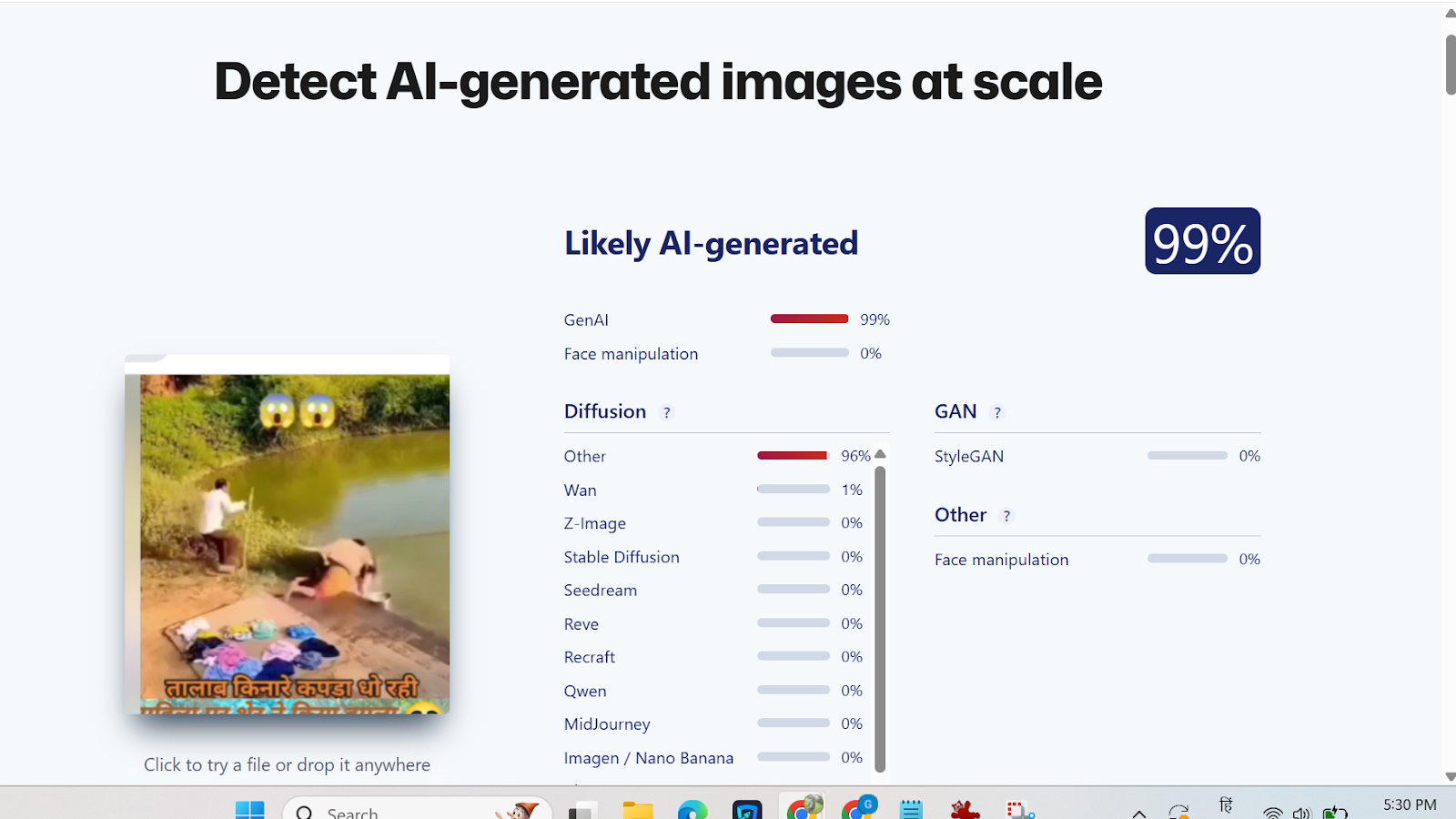
A video circulating on social media shows a lion carrying away a woman who was washing clothes near a pond. Users are sharing the clip claiming it depicts a real incident. However, research by CyberPeace found the viral claim to be false. The research revealed that the video is not real but AI-generated.
Claim
A user on Facebook shared the viral video claiming that a lion attacked and carried away a woman from a pond while she was washing clothes. The link to the post and its archived version are provided below

Fact Check:
Upon closely examining the viral clip, we noticed several visual inconsistencies that raised suspicion about its authenticity. The video was then analyzed using the AI-detection tool Sightengine. According to the analysis results, the viral video was identified as AI-generated.
Conclusion
The research confirms that the viral video does not depict a real incident. The clip is digitally created using artificial intelligence and is being falsely shared as a genuine event.
