
Empowering India's AI Vision: A Global Leap with the Paris Accelerator Programme
Introduction
In a landmark move for India’s growing artificial intelligence (AI) ecosystem, ten cutting-edge Indian startups have been selected to participate in the prestigious Global AI Accelerator Programme in Paris. This initiative, jointly facilitated by the Ministry of Electronics and Information Technology (MeitY) under the IndiaAI mission, aims to project India’s AI innovation on the global stage, empower startups to scale impactful solutions while fostering cross-border collaboration.
Launched in alignment with the vision of India as a global AI powerhouse, the IndiaAI initiative has been working on strengthening domestic AI capabilities. Participation in the Paris Accelerator Programme is a direct extension of this mission, offering Indian startups access to world-class mentorship, investor networks, and a thriving innovation ecosystem in France, one of Europe’s AI capitals.
Global Acceleration for Local Impact
The ten selected startups represent diverse verticals, from conversational AI to cybersecurity, edtech and surveillance intelligence. This selection was made after a rigorous evaluation of innovation potential, scalability, and societal impact. Each of these ventures represents India's technological ambition and capacity to solve real-world problems through AI.
The significance of this opportunity goes beyond business growth. It sets the foundation for collaborative policy dialogues, ethical AI development, and bilateral innovation frameworks. With rising global scrutiny on issues such as AI safety, bias, and misinformation, the need for making efforts for a more responsible innovation takes centre stage.
CyberPeace Outlook
India’s participation opens up a pivotal chapter in India's AI diplomacy. Through such initiatives, the importance of AI is not confined just to commercial tools but also as a cornerstone of national security, citizen safety, and digital sovereignty can be explored. As AI systems increasingly integrate with critical infrastructure from health to law enforcement, the role of cyber resilience becomes significant. With the increasing engagement of AI in several sensitive sectors like audio-video surveillance and digital edtech, there is an urgent need for secure-by-design innovation. Including parameters such as security, ethics, and accountability into the development lifecycle becomes important, aligning with its broader goal of harmonising with digital progress.
Conclusion
India’s participation in the Paris Accelerator Programme signifies its commitment to shaping global AI norms and innovation diplomacy. As Indian startups interact with European regulators, investors, and technologists, they carry the responsibility of representing not just business acumen but the values of an open, inclusive, and secure digital future.
This global exposure also feeds directly into India’s domestic AI strategies, a global platform informing policy evolution, enhancing research and development networks, and building a robust talent pipeline. Programmes like these act as bridges, ensuring India remains adaptive in the ever-evolving AI landscape. Encouraging such global engagements while actively working with stakeholders to build frameworks safeguarding national interests, protecting civil liberties, and fostering innovation becomes paramount. As India takes this global leap, the journey ahead must be shaped by innovation, collaboration, and vigilance.
References
- https://egov.eletsonline.com/2025/05/indiaai-selects-10-innovative-startups-for-prestigious-ai-accelerator-programme-in-paris/#:~:text=The%2010%20startups%20selected%20for,audio%2Dvideo%20analytics%20for%20surveillance.
- https://www.pib.gov.in/PressReleasePage.aspx?PRID=2132377
- https://inc42.com/buzz/meet-the-10-indian-ai-startups-selected-for-global-acceleration-programme/
- https://www.businessworld.in/article/govt-to-send-10-ai-startups-to-paris-accelerator-in-push-for-global-reach-558251

Related Blogs
.webp)
Introduction
If we look at the concept of scams, they have existed for as long as human societies have. A few decades ago, it was quite common to see scams being carried out in the form of fake landline calls, forged documents or persuasive salesmen. And ‘trust’, being the fundamental aspect of human interaction, has been at the forefront of such interactions. This ‘trust’ factor has been consistently exploited by nefarious individuals all over the world through various acts of deception and a plethora of fraudulent activities.
As the years have gone by, the very same scamming methods have simply shifted mediums. They have transitioned from the geographies of markets and doorsteps to the virtual world of smartphones and digital devices. The senior citizens of today are sitting at a juncture where they come equipped with the ‘habits’ and ‘understanding’ of the offline world. And this is why in today’s technologically driven and fast paced digital environment, they are being targeted via ‘unfamiliar’ digital mediums and tactics, making them highly susceptible to cyber frauds and online scams.
Back in the simpler days, it wasn’t too difficult to catch the whiff of a scammer. One could pick up on their practiced speech patterns, spot their overly polished and formal tone or their sheepish body language and even notice the minute inconsistencies in their statements. This back-and-forth communication would take place in real time, over phone calls and even face to face.
But the scenario today is worse. Since our reliance on digital devices has expanded at an unparalleled pace, it has become all the more difficult to distinguish between what’s fake and what’s genuine. All of a sudden, our entire essential daily activities have become encompassed in the realm of the digital world, ranging from banking, shopping, healthcare to everyday communication. And to further exacerbate the situation, today’s scammers have quietly adapted to this newfound circumstance, as they hide behind screens.
Fake messages or emails can be easily mistaken for being ‘real’ in the current modern digital age. Especially for senior citizens, this shift is presenting a serious challenge. They are being forced to evaluate authenticity and legitimacy through links, messages and apps that basically all look familiar. For example, the logo in an online correspondence might seem to be genuine or its language might look official and credible. At first glance, even the format or the layout of an email or a message may seem familiar enough to not raise any suspicion. This is the point where the danger lies. When there are no warning signs, no rude tones, no spelling errors and no weird behaviour. It becomes very difficult for people to tell what’s real and what’s a trap, especially for the seniors. And in that brief period of confusion, scammers manage to fool people into divulging personal information, clicking dangerous links or even parting with their hard-earned money.
What makes the senior population so vulnerable?
Trapped in the Convenience of Digital Dependence
As the senior population embraces the new and sophisticated digital tools of today, alongside they are also risking their exposure to the online world of cyber security risks and cyber criminals. New devices such as smartphones and tablets do offer unprecedented convenience but they also come with various underlying dangers. Modern technology has made everyday tasks quite easy. Smartphone based UPI applications, bank applications and even online healthcare platforms have simplified life not just for the elderly, but for everyone across society. But many senior citizens may not be as well versed with the usage of these technologies and the digital risks they carry. They may get influenced easily or they may not exercise the same level of caution as the younger generations (who have literally grown up being surrounded by the dynamics of technology). This ‘familiarity gap’ adds up to the vulnerability of seniors. Without any prior visible warning signs they can easily end up getting exposed to online scams, fraudulent transactions and data misuse.
Cybercriminals’ Goldmine: Cash-rich Seniors
Although a person’s vulnerability towards becoming a target or a victim of a cyber crime is mostly shaped by their circumstance and not by age alone. But still, from the point of view of a cyber criminal, senior citizens do seem to be the perfect victims. Most of them are retired and financially sound with lifetime savings, consistent pensions, accumulated assets and anticipated income streams. As they enjoy their solid financial footing, they may not keep a regular check on their online banking accounts and financial records. This ‘financial ease’ can inadvertently make them more prone to cyber crimes, especially when they are simultaneously getting increasingly dependent on digital tools. This lack of oversight may allow suspicious activities or fraudulent transactions to go unnoticed and sometimes even lead to huge losses of money. This is where digital literacy comes in. Keeping the seniors well informed on the safe usage of the internet can significantly lower their chance of getting intertwined in an online scam. It has therefore become crucial to promote and encourage regular account checks, setting up of alerts and foster awareness regarding common online threats that can help seniors safeguard their hard-earned resources.
India itself witnessed an increase of 86% from the years 2020 to 2022 in cyber crime cases related to senior citizens.
Targeting the Psychological Aspects: Panic, Overwhelm, Manipulation and Isolation
Senior citizens are often at an age and stage in life where their routines slow down and the general pace of life shifts towards a gentler rhythm. Thought processes may not be as swift as they used to be, some may even experience mild cognitive decline and many live alone or away from their children or immediate support systems. Research also shows that aging can lead to low memory function which in turn can increase an individual’s susceptibility to digital traps such as phishing emails and financial abuse. According to a comprehensive analysis of senior fraud victims, it has been noted that victimisation increases with advancing age. There are significant associations between fraud victimisation and human cognitive factors, such as: diminished executive functioning, reduced ability of the brain to process information and even impairments in comprehending complex everyday information.
Cybercriminals, who are aware of these soft spots, deliberately exploit the seniors’ psychological and mental space. They strategically deploy methods that create confusion and cognitive overload. They may create a fictitious scenario depicting some kind of ‘urgency’ and use the elderly’s ‘panic response’ to their advantage. They may create false warnings of a blocked bank account, a missed or delayed medical update or inform them of a sudden (but fake) legal issue. They aim at creating a situation of ‘overwhelm, anxiety and severe distress’. And it is common knowledge that when fear encapsulates an individual, the process of rational decision making deeply gets affected. In this scenario elderly victims often fall for the cyber criminals’ malicious antics and end up complying with them without actually verifying their intent and authenticity.
The senior population of the current times was raised in an era where they were rarely taught to question authoritative figures. This is where ‘manipulation’ steps in. The concept of manipulation thrives on the sense of ‘authority, power, position and trust’. Cyber fraudsters use this mechanism and convincingly impersonate government representatives, senior bank officials, healthcare providers, etc. They may project credibility and legitimacy by using authoritative sounding language, creating a sense of power over the victim and manipulating them.
Another important factor that scammers leverage to their advantage is ‘isolation’. A lot of seniors live alone or just with their spouse, with no immediate support systems nearby. They navigate and tread their daily routines on their own, trying hard to adapt to the dynamic digital world. This life of solitude or isolation leaves them in a vulnerable state. They may not even have someone to talk to, or get a second opinion, or even guidance regarding some suspicious online activity that they may be experiencing. This state of isolation combined with their limited digital competence creates the perfect stance for a cybercriminal to manipulate these individuals.
Understanding this psychological dimension has become critical to prevent cyber crimes amongst the elderly. Proper awareness campaigns, reassurance, encouragement of think-and-verify habits can reduce the occurrence of such scams and protect our senior citizens.
Clickbait Cures, Bogus Health Remedies and Expensive False Hopes
It is a known fact that for most senior citizens, their health ranks highest in the list of their priorities. They are always on the lookout for information regarding treatments, medications, dietary supplements and even wellness programs. In an effort to live a healthy and fuller life in this digital age, unknowingly, senior citizens can become easy targets for cybercriminals.
The internet is flooded with eye-catching headlines, ads and clickbaits that promise quick relief and miracle cures. Their wordings may appear like: ‘miracle joint and arthritis relief’, ‘reverse diabetes in seven days’, ‘secret anti-ageing formulas that doctors won’t divulge’, etc. These promises seem all flashy and shiny, but the reality is generally painful. Elderly people can easily get attracted to such ads. Scammers use reassuring language that instantly appeals to the seniors’ attention and their emotions. They create fake doctor profiles or publish fabricated patient reviews with overly dramatised testimonials and false research. In order to seem authentic, some scammers may even use the names and logos of respectable health institutions and organisations such as the ‘World Health Organisation’. They claim to sell products like miracle pills, teas, devices, virtual health services, etc., all at extremely high prices along with pressure inducing statements such as: ‘offer ends tonight’ or ‘only 20 spots left’.
When the elderly fall for this scam and end up paying the amount, either the promised product doesn’t turn up or it proves to be completely ineffective. In worst case scenarios, it may even harm the user’s health. These bogus health products are not regulated by any health association or authority. They may contain unsafe ingredients, incorrect dosages and other toxic substances that can severely impact the elderly’s health. An adverse reaction can take place or an existing medical condition may worsen. What begins as a hopeful step towards better health can eventually lead to loss of finances, physical harm and a deep sense of disappointment and hurt.
Sharing of card details, Adhaar numbers, insurance and medical reports on fake websites can further lead to identity theft and other dangerous cyber crimes.
Protection starts with simple habits. And here families have a big role to play. Making our senior citizens aware of this scenario is the first step. Education brings along ‘awareness’, and with awareness comes ‘caution and confidence’. Teaching the seniors to be wary of any warning signs, to not share any personal or financial details online and to make sure to consult a doctor first before starting any new treatments, are a few ways that can definitely help in reducing the risk of such scams.
Risky Digital Routines: Overexposure and Oversharing
The senior citizens of today are heavily invested in their daily digital routines. They stay virtually connected through various messaging apps (such as WhatsApp), they eagerly curate and maintain their digital identities on online platforms (such as Instagram and Facebook) and they regularly use emails to share messages, articles and forwards within their social circles. Many of us have seen it in our own family groups, that the seniors are the most enthusiastic lot. They are the first to send in their morning salutation messages, photos and other daily updates. This eagerness reflects both their genuine commitment towards staying in touch and also the pure joy that they derive from being active members of these online communities. It is important to understand that these platforms don’t just serve as mere communication tools for them. Beyond messaging and sharing of updates, these online spaces offer a sense of community, belongingness and self-expression to the elderly.
But these everyday digital routines can cause an overexposure to the virtual world which further creates opportunities for scammers. Clicking on unfamiliar links, downloading unknown softwares and giving quick responses to alerts and notifications (without first identifying the source), are a few examples of how seniors end up getting embroiled in risky situations. At the same time, online oversharing of personal details such as addresses, birthdays, travel plans, family updates, phone numbers, even investment plans, etc., can seem to be quite harmless on the face of it. But all of this information builds a goldmine for the scammers. They may be able to piece it together and use it to send highly convincing phishing emails, create fake online offers or even impersonate a loved one.
Senior citizens also tend to take online messages at face value. AI generated videos, images, false news, etc., are all generally shared under the garb of sensational claims or urgent warnings and are therefore easily assumed to be true, especially by the elderly. They may not even take a minute to factcheck the information and instead may forward it to ten other people in their circle.
The above risks can significantly be reduced by practicing safer digital habits. Seniors should be mindful in their digital usage. Pausing and thinking before clicking on a link, fact checking a piece of news, using strong privacy settings and trusted apps, etc., can help protect both their personal data as well as their digital wellbeing.
Silent Suffering: Shame, Underreporting and Systemic Gaps
Research suggests that senior citizens do not always report a cybercrime. This can be due to shame, self blame, ridicule, fear of being judged as incompetent and a general opinion that even if they report it, nothing will come out of it. They may feel embarrassed about getting deceived, believing that they should have known better. This may create an emotional burden which further amplifies underreporting. Informing their family members or just reaching out for some help can seem like a mammoth task for them.
Existing institutional gaps in our systems compounds this silent suffering. While there are law enforcement and consumer protection agencies in place, but the first step, which is the ‘reporting mechanism’, can seem to be inaccessible or too overbearing for the seniors. These systems may not have a very proactive outreach and can fail to tackle the distinct set of challenges faced by the seniors (such as clear guidance on scams or support for recovering lost funds).
This combination of ‘shame, underreporting and weak system support’ creates a dangerous cycle. Senior citizens are left as open prey, exploited and repeatedly targeted without sufficient help or any recognition for their plight.
The Way Forward
Society has to first acknowledge and identify the inimitable vulnerabilities of the seniors. This cycle can be broken by developing information drives that are specially tailored for the seniors. Moreover, along with family involvement, user friendly reporting channels and stronger protections from fraudulent online practices, seniors can see a ray of hope.
Targeted training programs, senior friendly cybersecurity workshops and courses can be a starting point. Teaching them about password creations, safe browsing tactics, phishing recognition and specific mentor-led sessions can empower them with the basic understanding of the online world.
Being able to navigate the digital world with adequate competence and confidence, and without the fear of exploitation, is ultimately what every senior citizen needs.
References
- https://www.staysafeonline.org/articles/why-do-scammers-target-older-adults
- https://pmc.ncbi.nlm.nih.gov/articles/PMC12074955/
- https://cybersecurityasia.net/rise-cyber-crime-targeting-older-adults/
- https://news.ufl.edu/2024/06/older-adults-vulnerable-to-scams/
- https://oklaw.org/resource/why-are-older-people-vulnerable-to-scams
- https://www.crimrxiv.com/pub/g7u4rb9v
- https://www.norc.org/research/library/majority-of-older-adults-experience-cyber-abuse-in-their-lifetim.html
- https://www.sbigeneral.in/blog/cyber-insurance/cyber-tips-and-tricks/how-senior-citizens-can-avoid-internet-scams

Introduction:
This Op-ed sheds light on the perspectives of the US and China regarding cyber espionage. Additionally, it seeks to analyze China's response to the US accusation regarding cyber espionage.
What is Cyber espionage?
Cyber espionage or cyber spying is the act of obtaining personal, sensitive, or proprietary information from individuals without their knowledge or consent. In an increasingly transparent and technological society, the ability to control the private information an individual reveals on the Internet and the ability of others to access that information are a growing concern. This includes storage and retrieval of e-mail by third parties, social media, search engines, data mining, GPS tracking, the explosion of smartphone usage, and many other technology considerations. In the age of big data, there is a growing concern for privacy issues surrounding the storage and misuse of personal data and non-consensual mining of private information by companies, criminals, and governments.
Cyber espionage aims for economic, political, and technological gain. Fox example Stuxnet (2010) cyber-attack by the US and its allies Israel against Iran’s Nuclear facilities. Three espionage tools were discovered connected to Stuxnet, such as Gauss, FLAME and DuQu, for stealing data such as passwords, screenshots, Bluetooth, Skype functions, etc.
Cyber espionage is one of the most significant and intriguing international challenges globally. Many nations and international bodies, such as the US and China, have created their definitions and have always struggled over cyber espionage norms.
The US Perspective
In 2009, US officials (along with other allied countries) mentioned that cyber espionage was acceptable if it safeguarded national security, although they condemned economically motivated cyber espionage. Even the Director of National Intelligence said in 2013 that foreign intelligence capabilities cannot steal foreign companies' trade secrets to benefit their firms. This stance is consistent with the Economic Espionage Act (EEA) of 1996, particularly Section 1831, which prohibits economic espionage. This includes the theft of a trade secret that "will benefit any foreign government, foreign agent or foreign instrumentality.
Second, the US advocates for cybersecurity market standards and strongly opposes transferring personal data extracted from the US Office of Personnel Management (OPM) to cybercrime markets. Furthermore, China has been reported to sell OPM data on illicit markets. It became a grave concern for the US government when the Chinese government managed to acquire sensitive details of 22.1 million US government workers through cyber intrusions in 2014.
Third, Cyber-espionage is acceptable unless it’s utilized for Doxing, which involves disclosing personal information about someone online without their consent and using it as a tool for political influence operations. However, Western academics and scholars have endeavoured to distinguish between doxing and whistleblowing. They argue that whistleblowing, exemplified by events like the Snowden Leaks and Vault 7 disclosures, serves the interests of US citizens. In the US, being regarded as an open society, certain disclosures are not promoted but rather required by mandate.
Fourth, the US argues that there is no cyber espionage against critical infrastructure during peacetime. According to the US, there are 16 critical infrastructure sectors, including chemical, nuclear, energy, defence, food, water, and so on. These sectors are considered essential to the US, and any disruption or harm would impact security, national public health and national economic security.
The US concern regarding China’s cyber espionage
According to James Lewis (a senior vice president at the Center for US-China Economic and Security Review Commission), the US faces losses between $ 20 billion and $30 billion annually due to China’s cyberespionage. The 2018 U.S. Trade Representative (USTR) Section 301 report highlighted instances, where the Chinese government and executives from Chinese companies engaged in clandestine cyber intrusions to obtaining commercially valuable information from the U.S. businesses, such as in 2018 where officials from China’s Ministry of State Security, stole trade from General Electric aviation and other aerospace companies.
China's response to the US accusations of cyber espionage
China's perspective on cyber espionage is outlined by its 2014 anti-espionage law, which was revised in 2023. Article 1 of this legislation is formulated to prevent, halt, and punish espionage actions to maintain national security. Article 4 addresses the act of espionage and does not differentiate between state-sponsored cyber espionage for economic purposes and state-sponsored cyber espionage for national security purposes. However, China doesn't make a clear difference between government-to-government hacking (spying) and government-to-corporate sector hacking, unlike the US. This distinction is less apparent in China due to its strong state-owned enterprise (SOE) sector. However, military spying is considered part of the national interest in the US, while corporate spying is considered a crime.
China asserts that the US has established cyber norms concerning cyber espionage to normalize public attribution as acceptable conduct. This is achieved by targeting China for cyber operations, imposing sanctions on accused Chinese individuals, and making political accusations, such as blaming China and Russia for meddling in US elections. Despite all this, Washington D.C has never taken responsibility for the infamous Flame and Stuxnet cyber operations, which were widely recognized as part of a broader collaborative initiative known as Operation Olympic Games between the US and Israel. Additionally, the US takes the lead in surveillance activities conducted against China, Russia, German Chancellor Angela Merkel, the United Nations (UN) Secretary-General, and several French presidents. Surveillance programs such as Irritant Horn, Stellar Wind, Bvp47, the Hive, and PRISM are recognized as tools used by the US to monitor both allies and adversaries to maintain global hegemony.
China urges the US to cease its smear campaign associated with Volt Typhoon’s cyberattack for cyber espionage, citing the publication of a report titled “Volt Typhoon: A Conspiratorial Swindling Campaign Targets with U.S. Congress and Taxpayers Conducted by U.S. Intelligence Community” by China's National Computer Virus Emergency Response Centre and the 360 Digital Security Group on 15 April. According to the report, 'Volt Typhoon' is a ransomware cyber criminal group self-identified as the 'Dark Power' and is not affiliated with any state or region. Multiple cybersecurity authorities in the US collaborated to fabricate this story just for more budgets from Congress. In the meantime, Microsoft and other U.S. cybersecurity firms are seeking more big contracts from US cybersecurity authorities. The reality behind “Volt Typhoon '' is a conspiratorial swindling campaign to achieve two objectives by amplifying the "China threat theory" and cheating money from the U.S. Congress and taxpayers.
Beijing condemned the US claims of cyber espionage without any solid evidence. China also blames the US for economic espionage by citing the European Parliament report that the National Security Agency (NSA) was also involved in assisting Boeing in beating Airbus for a multi-billion dollar contract. Furthermore, Brazilian President Dilma Rousseff also accused the US authorities of spying against the state-owned oil company “Petrobras” for economic reasons.
Conclusion
In 2015, the US and China marked a milestone as both President Xi Jinping and Barack Obama signed an agreement, committing that neither country's government would conduct or knowingly support cyber-enabled theft of trade secrets, intellectual property, or other confidential business information to grant competitive advantages to firms or commercial sectors. However, the China Cybersecurity Industry Alliance (CCIA) published a report titled 'US Threats and Sabotage to the Security and Development of Global Cyberspace' in 2024, highlighting the US escalating cyber-attack and espionage activities against China and other nations. Additionally, there has been a considerable increase in the volume and sophistication of Chinese hacking since 2016. According to a survey by the Center for International and Strategic Studies, out of 224 cyber espionage incidents reported since 2000, 69% occurred after Xi assumed office. Therefore, China and the US must address cybersecurity issues through dialogue and cooperation, utilizing bilateral and multilateral agreements.
Introduction
" सर्वे भवन्तु सुखिनः, सर्वे सन्तु निरामयाः " May all be happy, may all be free from suffering. This timeless invocation reflects a vision of collective well-being, where progress is meaningful only when shared, and protection extends to every individual in society. This very philosophy lies at the heart of Corporate Social Responsibility, which seeks to ensure that growth is not isolated or unequal, but inclusive, ethical, and mindful of the broader social good.
At its core, Corporate Social Responsibility is not merely a statutory obligation, it is a reflection of a deeper ethical commitment, an acknowledgement that growth must carry with it a sense of duty towards society. In many ways, CSR embodies the idea that progress without responsibility is incomplete, and that corporations, as key actors shaping modern life, must help safeguard the very communities they engage with.
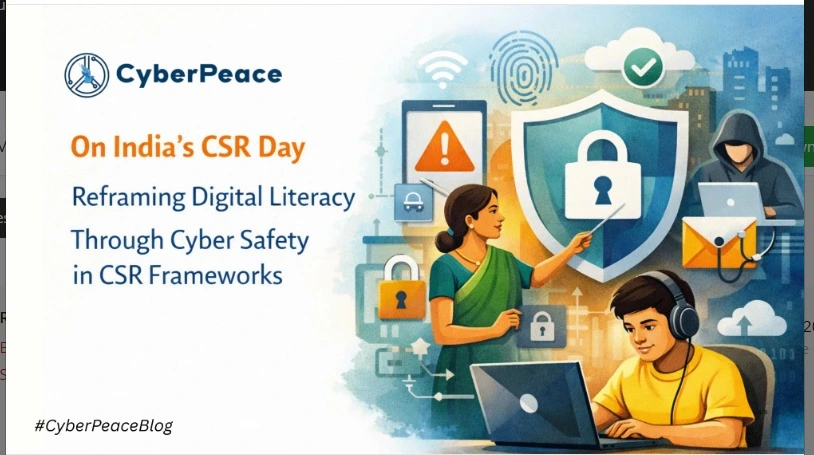
Reframing Digital Literacy Through Cyber Safety in CSR Frameworks
In India, this moral vision has been given a legal structure under the Companies Act, 2013, CSR Schedule VII, which mandates certain classes of companies to allocate a portion of their profits towards socially beneficial activities. Section 135 of the Act requires companies meeting specified financial thresholds to undertake CSR initiatives, guided by principles of inclusivity, sustainability, and social welfare. The underlying values are clear, CSR is intended not as charity, but as a strategic and accountable contribution to societal development.
Schedule VII of the Act further outlines the broad areas that qualify as CSR, including “Education and Digital Literacy”, gender equality, rural development, and measures for reducing inequalities. Within this framework, promoting “digital literacy” has increasingly been recognised as a legitimate and necessary CSR activity, especially in the context of a rapidly digitising society like India.
However, the current understanding of digital literacy within CSR remains incomplete. It often emphasises access and usage, teaching individuals how to navigate digital platforms, use devices, and engage with online services. What remains insufficiently addressed is the question of safety. In an environment where cyber fraud, data breaches, online harassment, and identity theft are becoming increasingly common, digital literacy without cyber awareness risks becoming a partial and potentially harmful intervention.
Embedding cyber awareness and capacity building within ‘digital literacy’ in explicit form is therefore not optional, it is essential. This includes equipping individuals with the ability to recognise online threats, protect personal data, understand digital consent, and respond effectively to cyber risks. It also requires recognising that vulnerable populations, including first-time internet users, women, and marginalised communities, often face disproportionate exposure to cyber harm.
“It is pertinent to note that Cybersecurity awareness training is relevant to CSR but is not yet consistently implemented as an explicit CSR activity. It is often included indirectly within digital literacy programs, highlighting the need for a more structured, progressive and integrated approach.”
Given this reality, there is a strong case for explicitly recognising cyber awareness as a distinct and integral component of CSR activities, rather than treating it as an implicit subset of digital literacy. Doing so would not only align CSR with contemporary societal risks but also ensure that corporate interventions move beyond enabling access to actively ensuring safety.
In a digital society, empowerment without protection is incomplete. If CSR is to truly reflect its foundational values, it must evolve to address not just the opportunities of the digital age, but also its risks.
Why Cyber Safety Must Be Central to CSR
The current state of digital ecosystems, which used to operate as secondary systems, now functions as essential systems that support government operations, banking systems, educational institutions, and social communication. The digital environment has its vulnerabilities, which create direct dangers for people in society. The elderly, first-time internet users, and rural communities face higher cyber threat risks because they often lack knowledge and protective resources on responsible use. The implementation of CSR initiatives that provide digital access to these groups, along with how to handle risks, will create greater benefit for their safety. Organisations must encourage the implementation of cyber safety training in their CSR programs because doing so will create value while fulfilling their ethical obligations. The empowerment process needs to achieve complete success, which protects people from any potential dangers according to the "do no harm" principle.
Key Components of CyberPeace-Aligned Digital Literacy
To make CSR initiatives more effective and future-ready, organisations should incorporate the following elements into their digital literacy programs:
- Cyber Awareness and Risk Recognition: The training program teaches participants how to recognise typical security threats, which include phishing attacks and scams, deepfake technology and misinformation.
- Data Protection and Privacy Literacy: The program teaches users how to protect their personal information, together with the process of giving consent and the methods used to handle their online presence.
- Responsible Digital Behaviour: The program teaches people how to use the internet responsibly by showing them how to make ethical decisions that require both respect and accountability while understanding the legal consequences of their actions.
- Incident Response and Reporting Mechanisms: The program teaches users about cyber incident response, which includes all reporting methods and available support resources.
- Inclusion-Focused Design: The program develops specific solutions which protect various demographic groups from their particular vulnerabilities while maintaining accessibility and essential programmatic relevance.
Policy and Institutional Alignment
The integration of cyber safety into corporate social responsibility lets organisations achieve their national objectives, which include:
- Strengthening digital trust and resilience
- Supporting safe digital inclusion initiatives
- Complementing the efforts of institutions working on cybersecurity awareness and capacity building
The structured approach requires organisations to execute three specific steps, which include:
- Partnering with cybersecurity organisations and civil society
- Developing standardised cyber awareness modules
- The organisation will use behavioural change indicators to evaluate its impact instead of relying on access metrics.
The Way Forward
Digital-era Corporate Social Responsibility needs to transition from its present state of providing access to digital resources toward establishing secure online platforms for users. The understanding of digital literacy needs to shift from its current status as a technical ability toward its new definition as a social competency that encompasses safety, responsibility and resilience training.
Companies need to understand their digital transformation obligations because their digital transformation efforts require them to handle all associated risks. The implementation of cyber safety within corporate social responsibility frameworks will enable organisations to develop a secure and trustworthy digital environment that includes all users.
Conclusion
The implementation of corporate social responsibility needs to fulfil its core mission of creating societal benefits through inclusive practices that span all current digital possibilities and their associated security threats. The field of digital literacy requires a new framework that combines digital safety practices with its existing educational materials.
The digital safety practice ensures that people obtain essential knowledge and skills that enable them to use digital resources securely when they access online content. The process of accomplishing shared community prosperity needs to establish a framework that benefits every person through social advancement and the protection of their rights.
References
- https://upload.indiacode.nic.in/schedulefile?aid=AC_CEN_22_29_00008_201318_1517807327856&rid=79
- https://www.allresearchjournal.com/archives/2025/vol11issue4/PartF/11-5-60-511.pdf
- https://www.unesco.org/en/dtc-finance-toolkit-factsheets/corporate-social-responsibility-csr
- https://www.investopedia.com/terms/c/corp-social-responsibility.asp
- https://digitalmarketinginstitute.com/blog/corporate-16-brands-doing-corporate-social-responsibility-successfully
- https://www.imd.org/blog/sustainability/csr-strategy/
