
#FactCheck -Viral Image of ‘Saudi Son’ Meeting Hindu Mother Found to Be Misleading
Executive Summary
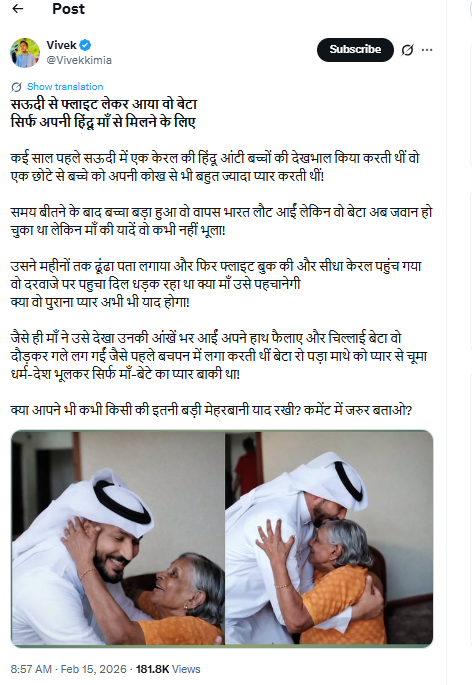
A photo is going viral on social media showing a young man dressed in traditional Arab attire warmly embracing an elderly woman. The post claims that the man flew in from Saudi Arabia to Kerala just to meet his “Hindu mother,” portraying the image as a heartwarming example of communal harmony. However, research by the CyberPeace found that the claim being shared with the image is misleading.
Claim
The viral post narrates an emotional story, alleging that years ago a Hindu woman from Kerala worked in Saudi Arabia caring for children and loved a young boy like her own son. After she returned to India, the boy—now grown up—reportedly searched for her for months, booked a flight, and finally reached Kerala to reunite with her. The post describes an emotional reunion filled with tears, affection, and a bond beyond religion and nationality.
Fact Check
A reverse image search of the viral picture led us to a video uploaded on August 18, 2023, on the YouTube channel of social media influencer Hashim Abbas. In the video, he is seen meeting and hugging the elderly woman while extending Onam greetings.

Further examination of Hashim Abbas’ social media accounts revealed several other videos from his Kerala visit. Our research also found that Abbas played a significant role in the Malayalam film Kondotty Pooram.

Additionally, we found a video posted on August 13, 2023, by actress and theatre artist Sandhya Rajendran, daughter of veteran Malayalam actress Vijayakumari. The video shows Vijayakumari teaching Onam songs to Hashim Abbas.

Conclusion
The evidence clearly establishes that the viral claim is misleading. The man seen in the image is Hashim Abbas, who was meeting senior Malayalam actress Vijayakumari to extend Onam greetings. The emotional story about a son flying from Saudi Arabia to reunite with his Hindu mother is fictional and not connected to the viral image.

Related Blogs

Introduction
The Data Security Council of India’s India Cyber Threat Report 2025 calculates that a staggering 702 potential attacks happened per minute on average in the country in 2024. Recent alleged data breaches on organisations such as Star Health, WazirX, Indian Council of Medical Research (ICMR), BSNL, etc. highlight the vulnerabilities of government organisations, critical industries, businesses, and individuals in managing their digital assets. India is the second most targeted country for cyber attacks globally, which warrants the development and adoption of cybersecurity governance frameworks essential for the structured management of cyber environments. The following global models offer valuable insights and lessons that can help strengthen cybersecurity governance.
Overview of Global Cybersecurity Governance Models
Cybersecurity governance frameworks provide a structured strategy to mitigate and address cyber threats. Different regions have developed their own governance models for cybersecurity, but they all emphasize risk management, compliance, and cross-sector collaboration for the protection of digital assets. Four such major models are:
- NIST CSF 2.0 (U.S.A): The National Institute of Standards and Technology Cyber Security Framework provides a flexible, voluntary, risk-based approach rather than a one-size-fits-all solution to manage cybersecurity risks. It endorses six core functions, which are: Govern, Identify, Protect, Detect, Respond, and Recover. This is a widely adopted framework used by both public and private sector organizations even outside the U.S.A.
- ISO/IEC 27001: This is a globally recognized standard developed jointly by the International Organization for Standardization (ISO) and the International Electrotechnical Commission (IEC). It provides a risk-based approach to help organizations of all sizes and types to identify, assess, and mitigate potential cybersecurity threats to Information Security Management Systems (ISMS) and preserve the confidentiality, integrity, and availability of information. Organizations can seek ISO 27001 certification to demonstrate compliance with laws and regulations.
- EU NIS2 Directive: The Network and Information Security Directive 2 (NIS2) is an updated EU cybersecurity law that imposes strict obligations on critical services providers in four overarching areas: risk management, corporate accountability, reporting obligations, and business continuity. It is the most comprehensive cybersecurity directive in the EU to date, and non-compliance may attract non-monetary remedies, administrative fines up to at least €10 million or 2% of the global annual revenue (whichever is higher), or even criminal sanctions for top managers.
- GDPR: The General Data Protection Regulation (GDPR)of the EU is a comprehensive data privacy law that also has major cybersecurity implications. It mandates that organizations must integrate cybersecurity into their data protection policies and report breaches within 72 hours, and it prescribes a fine of up to €20 million or 4% of global turnover for non-compliance.
India’s Cybersecurity Governance Landscape
In light of the growing nature of cyber threats, it is notable that the Indian government has taken comprehensive measures along with efforts by relevant agencies such as the Ministry of Electronics and Information Technology, Reserve Bank of India (RBI), National Payments Corporation (NPCI) and Indian Cyber Crime Coordination Centre (I4C), CERT-In. However, there is still a lack of an overarching cybersecurity governance framework or comprehensive law in this area. Multiple regulatory bodies in India oversee cybersecurity for various sectors. Key mechanisms are:
- CERT-In Guidelines: The Indian Computer Emergency Response Team, under the Ministry of Electronics and Information Technology (MeitY), is the nodal agency responsible for cybersecurity incident response, threat intelligence sharing, and capacity building. Organizations are mandated to maintain logs for 180 days and report cyber incidents to CERT-In within six hours of noticing them according to directions under the Information Technology Act, 2000 (IT Act).
- IT Act & DPDP Act: These Acts, along with their associated rules, lay down the legal framework for the protection of ICT systems in India. While some sections mandate that “reasonable” cybersecurity standards be followed, specifics are left to the discretion of the organisations. Enforcement frameworks are vague, which leaves sectoral regulators to fill the gaps.
- Sectoral regulations: The Reserve Bank of India (RBI), the Insurance Regulatory and Development Authority of India (IRDAI), the Department of Telecommunications, the Securities Exchange Board of India (SEBI), National Critical Information Infrastructure Protection Centre (NCIIPC) and other regulatory bodies require that cybersecurity standards be maintained by their regulated entities.
Lessons for India & Way Forward
As the world faces unprecedented security and privacy threats to its digital ecosystem, the need for more comprehensive cybersecurity policies, awareness, and capacity building has perhaps never been greater. While cybersecurity practices may vary with the size, nature, and complexity of an organization (hence “reasonableness” informing measures taken), there is a need for a centralized governance framework in India similar to NIST2 to unify sectoral requirements for simplified compliance and improve enforcement. India ranks 10th on the World Cybercrime Index and was found to be "specialising" in scams and mid-tech crimes- those which affect mid-range businesses and individuals the most. To protect them, India needs to strengthen its enforcement mechanisms across more than just the critical sectors. This can be explored by penalizing bigger organizations handling user data susceptible to breaches more stringently, creating an enabling environment for strong cybersecurity practices through incentives for MSMEs, and investing in cybersecurity workforce training and capacity building. Finally, there is a scope for increased public-private collaboration for real-time cyber intelligence sharing. Thus, a unified, risk-based national cybersecurity governance framework encompassing the current multi-pronged cybersecurity landscape would give direction to siloed efforts. It would help standardize best practices, streamline compliance, and strengthen overall cybersecurity resilience across all sectors in India.
References
- https://cdn.prod.website-files.com/635e632477408d12d1811a64/676e56ee4cc30a320aecf231_Cloudsek%20Annual%20Threat%20Landscape%20Report%202024%20(1).pdf
- https://strobes.co/blog/top-data-breaches-in-2024-month-wise/#:~:text=In%20a%20large%2Dscale%20data,emails%2C%20and%20even%20identity%20theft.
- https://www.google.com/search?q=nist+2.0&oq=nist+&gs_lcrp=EgZjaHJvbWUqBggBEEUYOzIHCAAQABiPAjIGCAEQRRg7MgYIAhBFGDsyCggDEAAYsQMYgAQyBwgEEAAYgAQyBwgFEAAYgAQyBwgGEAAYgAQyBggHEEUYPNIBCDE2MTJqMGo3qAIAsAIA&sourceid=chrome&ie=UTF-8
- https://www.iso.org/standard/27001
- https://nis2directive.eu/nis2-requirements/
- https://economictimes.indiatimes.com/tech/technology/india-ranks-number-10-in-cybercrime-study-finds/articleshow/109223208.cms?from=mdr

Introduction
The increase in consumer demands has resulted in a sharp increase in digital financing in India. As a result, the reputation of the digital lending sector has been impacted, as bad actors increasingly deploy illicit lending platforms such as fraudulent loans and trading apps. As millions of Indians download fast loan applications to help them meet their financial ends, the fraudulent apps result in cyber crimes including financial fraud. Consumers need to be vigilant of dubious trading or loan applications as bad actors frequently use illegitimate apps to trick victims by advertising limited-period offers and applying pressure.
Recently the Indian Cyber Crime Coordination Centre (I4C) led handel CyberDost has issued a cybercrime alert against the ‘CashExpand-U’ finance assistant app, which has been now removed from the Google Play Store. The app was found to be associated with hostile foreign entities, and the app had made it easier to raise small loans. However, such loan apps are seldom credible and may compromise financial information.
Raising cases of Fraudulent Loan Apps
The finance minister had stated that the government is constantly engaged with the Reserve Bank of India and other regulators and stakeholders to control fraudulent loan apps. In FY23, there were 1,062 complaints against such apps, the Finance Minister shared during a Lok Sabha session. Google removed almost 134 fake apps from the Play Store in a single week in September 2023 after multiple complaints were registered against such apps. The Reserve Bank of India (RBI) had also issued regulatory guidelines on digital lending in April 2023 to bring transparency in the digital loan space.
CyberPeace Policy Wing Advisory for Users
- Be cautious of App Permissions
Fake lending apps collect data by fraudulently taking numerous app permissions from consumers and misusing them later. The users must effectively manage their app permissions to avoid denying any extra permissions such as access to contacts, location, and photos. This is because fraudulent digital lenders access users' personal data to extort additional money even after loan repayment.
- Practice Due Diligence
Consumers must exercise care & caution before applying for a loan from digital lending platforms. Before applying for a loan or downloading any such apps, consumers must conduct due diligence by verifying the app's name, rating, reviews, physical address, and contact information. Always double-verify the paperwork before signing any agreement or contract. Always apply for loans from RBI-approved and compliant banking and financial services providers.
- Download from Official Sources
To avoid downloading counterfeit apps, only download lending apps from official stores like Google Play Store or Apple App Store, and avoid downloading apps from web links sent via SMS, email, or social media, even if shared by your known persons.
- Be sceptical of too-good-to-be-true offerings
Be cautious of deals that seem too good to be true, like hassle-free easy loans as they can be fraudulent. If an offer seems too good to be true, it might be a red flag. Hence always conduct your own research to verify the lender and avoid making hasty decisions.
- Reporting Mechanism
In case of facing a scam by such fraudulent apps, victims can file a complaint with the ‘National Cyber Crime Reporting Portal’ or Cyber Crime Helpline ‘1930’, or they can also contact us at CyberPeace Helpline +919570000066 and helpline@cyberpeace.net to get assistance in reporting their cases.
Final Words
Illegitimate loan/trading apps have been raising concerns by defrauding innocent consumers who seek financial assistance. The Center has recently warned against the CashExpand-U app, which has been now removed from the Google Play Store. Users are advised to exercise due care and caution while downloading loan apps and applying for loans to prevent any potential scams. keep up to date with news from concerned authorities about common scams and fraudulent practices in the lending space and stay safe in the online world.
References:
- https://www.livemint.com/news/beware-govt-issues-cybercrime-alert-against-loan-app-cashexpand-u-finance-assistant-11720338996430.html
- https://timesofindia.indiatimes.com/technology/tech-news/government-has-issued-an-important-warning-for-this-loan-app/articleshow/111541577.cms
Executive Summary
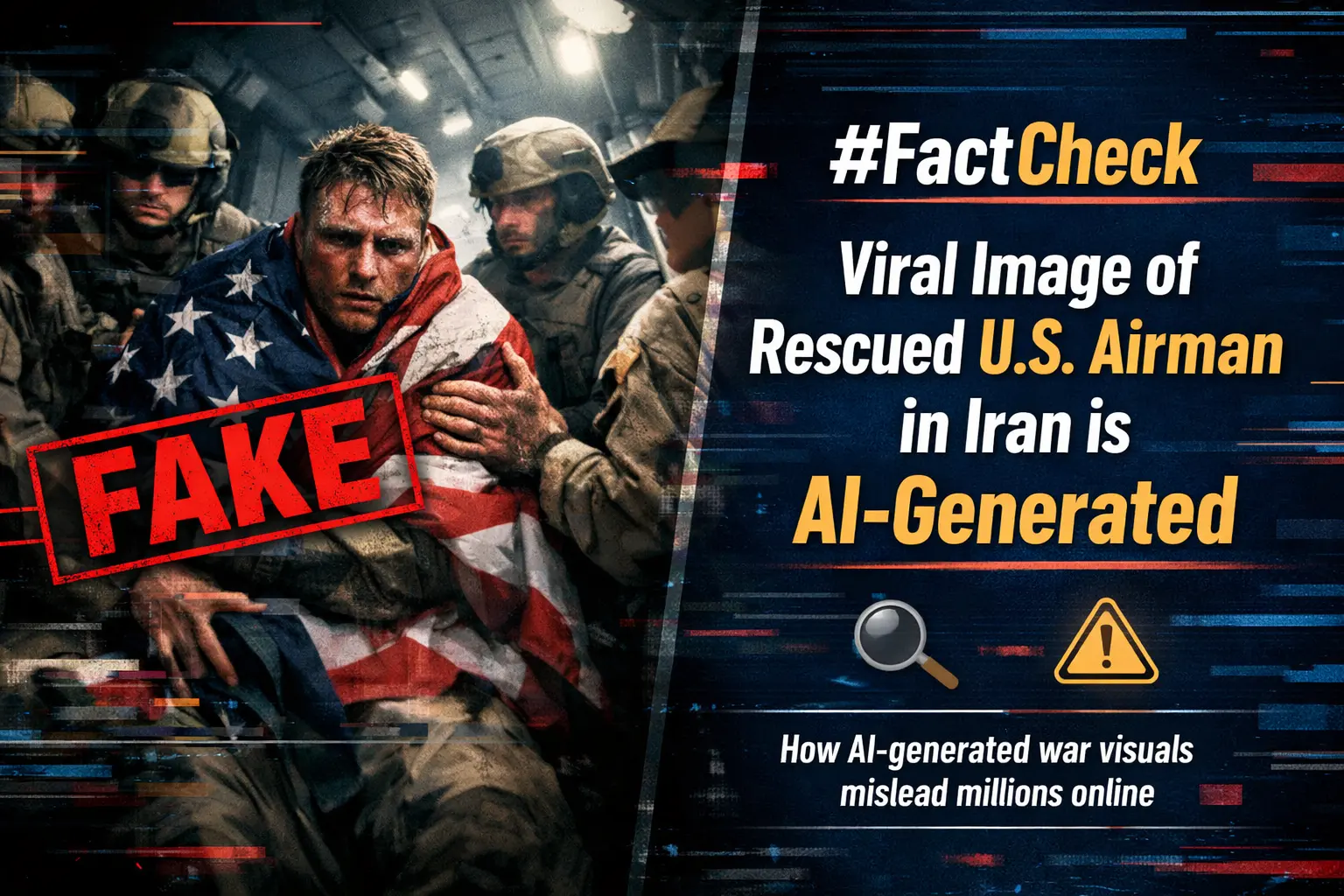
A claim is circulating on social media that the U.S. military successfully rescued a missing crew member of an F-15E fighter jet in Iran. Along with this claim, a photo is being widely shared, allegedly showing the rescued U.S. airman after the high-risk operation. However, researches reveal that the viral image is not authentic and has been generated using artificial intelligence tools.
The Claim
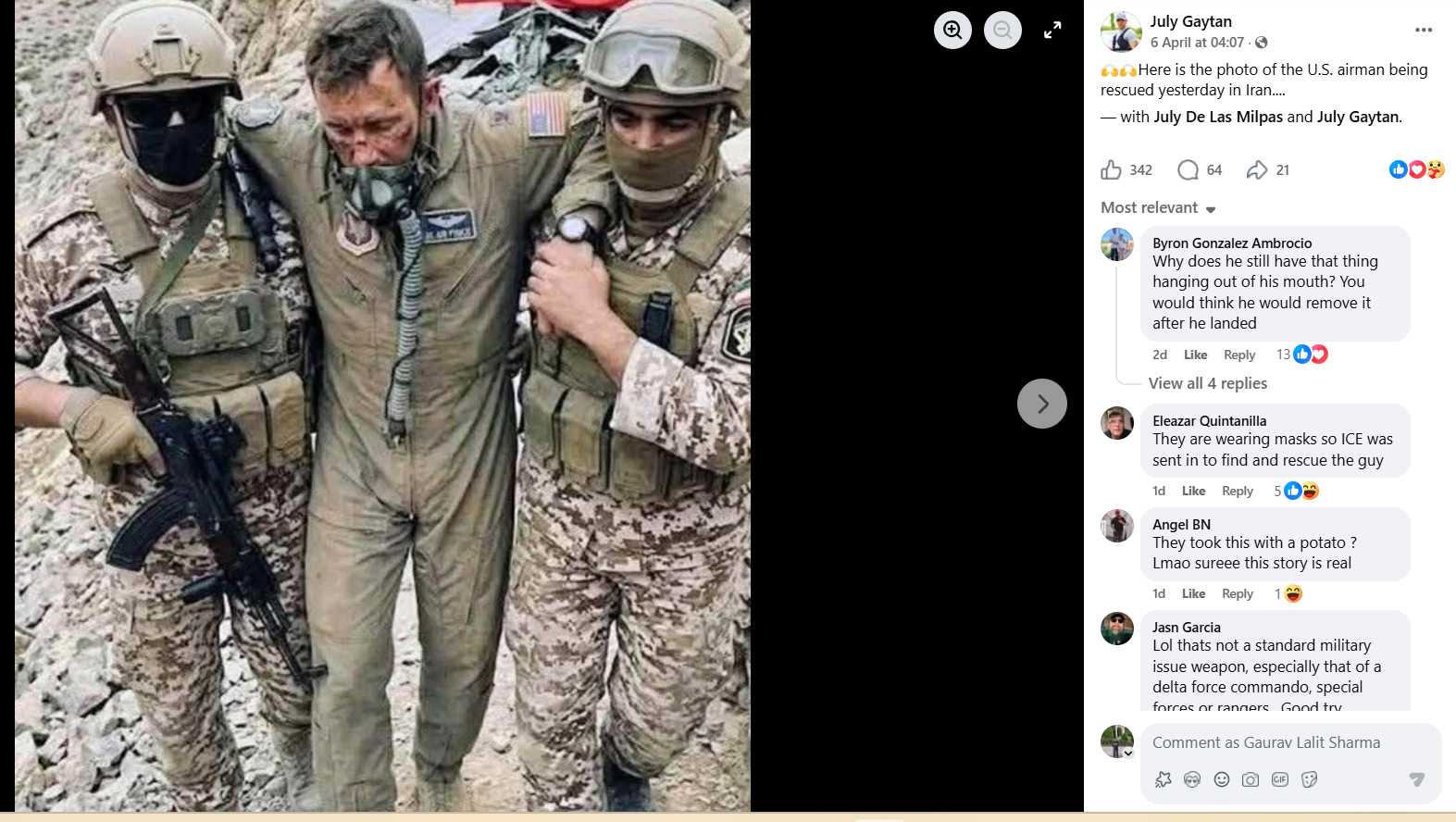
On April 6, 2026, a social media user named “July Gaytan” shared the viral image with the caption: “Here is the photo of the U.S. airman being rescued yesterday in Iran.”
The post quickly gained traction, with many users believing it to be genuine.
- https://www.facebook.com/photo/?fbid=1724007721903888&set=a.116284172676259
- https://perma.cc/URM4-KEJA
Fact Check
Despite extensive searches, no credible media report or official source has published any real image of the rescued crew members. This raised suspicion about the authenticity of the viral photo. Hive Moderation analysis indicated a 100% probability that the image was generated using Google’s Gemini AI.
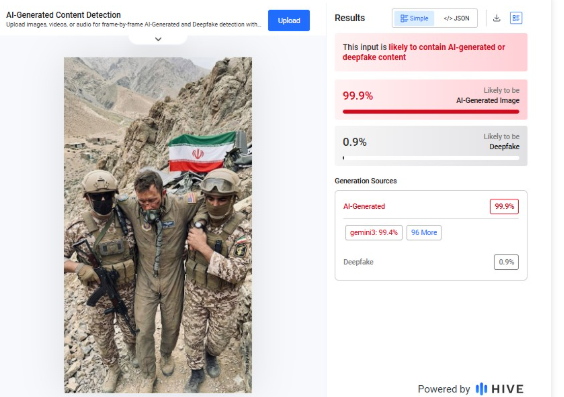
A second scan using Undetectable AI also concluded that the image is AI-generated.
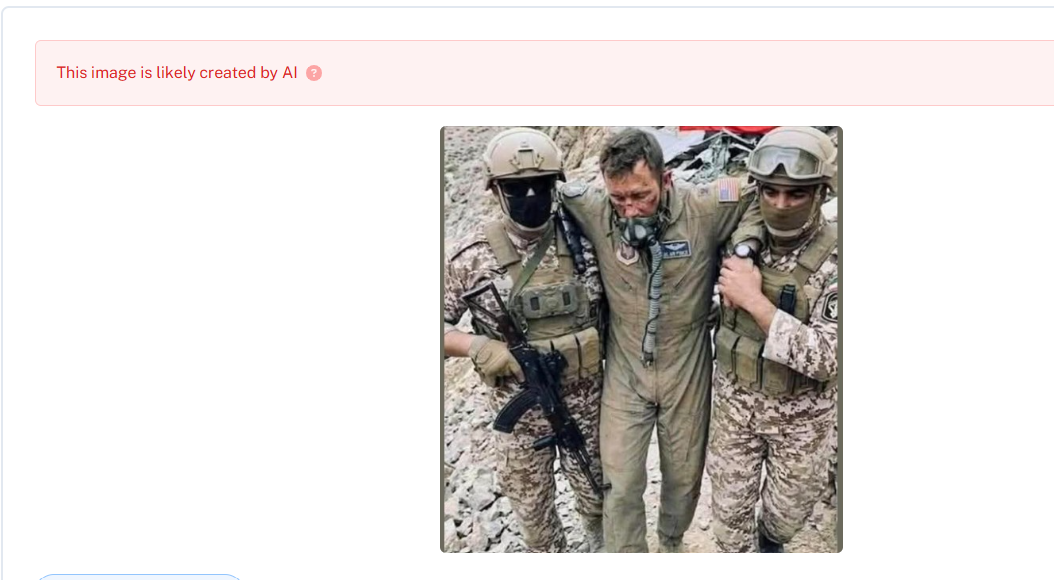
Reports indicate that a U.S. Air Force F-15E Strike Eagle was shot down in Iran. The aircraft had two crew members on board: a pilot and a Weapon Systems Officer (WSO).
- The pilot was rescued shortly after the incident.
- The WSO was initially missing and remained inside Iranian territory in an injured condition.
- The U.S. later carried out a high-risk rescue operation and successfully evacuated the WSO from Iran.
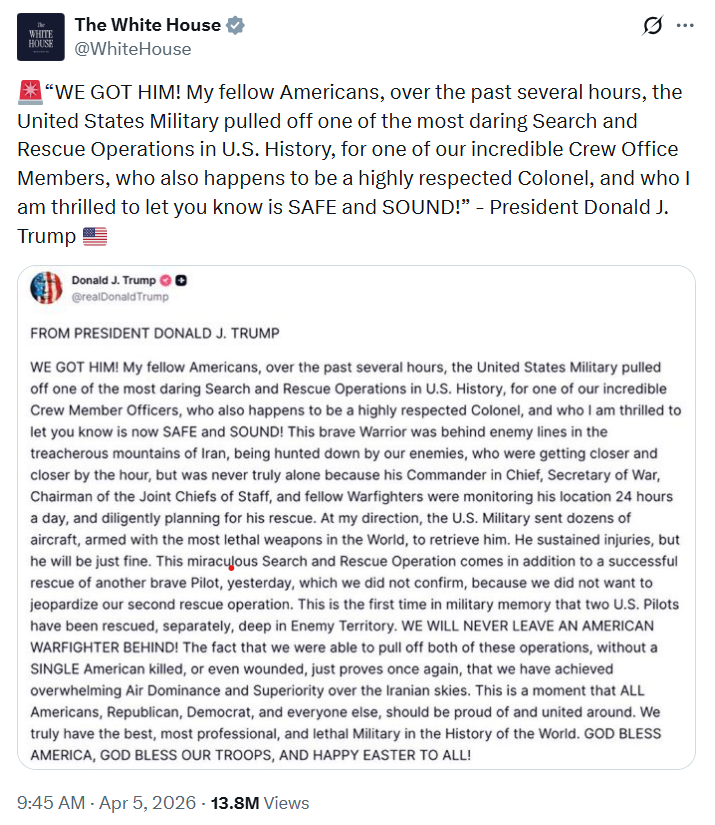
U.S. President Donald Trump also confirmed the “brave and risky” rescue mission in a detailed post on his platform, Truth Social. The statement was further shared by the official White House account.
- https://x.com/WhiteHouse/status/2040644451513598220?s=20
Conclusion
The viral image claiming to show a rescued U.S. airman in Iran is not real. It has been created using AI tools, likely Google’s Gemini. While it is true that the U.S. conducted a high-risk operation to rescue the missing crew member, no authentic image of the rescue or the personnel has been publicly released.
