
#FactCheck -Viral Claim About Air India Cancelling All International Flights Until July Is False
Executive Summary
A video circulating on social media falsely claims that Air India has cancelled all of its international flights until July due to a fuel shortage. However, research conducted by CyberPeace Research Wing found the claim to be misleading and false. Our research revealed that Air India has made no announcement regarding the cancellation of all international flights. In reality, the airline has only made temporary reductions and adjustments on select international routes due to increasing operational pressure and the impact on profitability.
Claim
An X (formerly Twitter) user shared the viral video on May 3, 2026, claiming: “Due to a fuel shortage, Air India has cancelled all its international flights until July.”he post quickly gained attention and was widely shared on social media platforms.

Fact Check
To verify the claim, we examined the official social media accounts of Air India. During the research, we found a post on X in which the airline itself described the viral claim as fake and misleading.
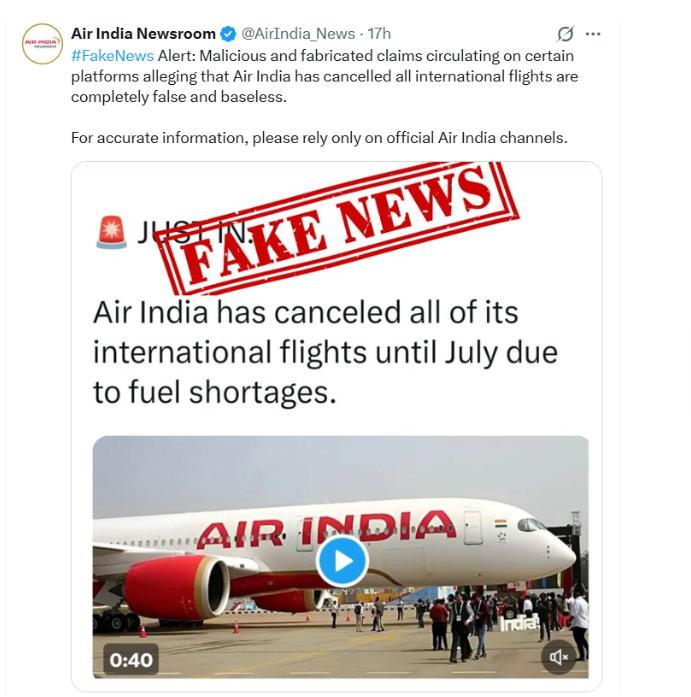
Taking the research further, we searched using relevant keywords and found a report published by ETNOW Swadesh on May 13, 2026. According to the report, Air India has not cancelled all international flights. Instead, due to mounting operational costs and pressure on profitability, the airline has temporarily reduced or modified services on a few select international routes.

Conclusion
Our research found that Air India has not announced the cancellation of all international flights until July. The viral claim circulating on social media is false and misleading. The airline has only implemented temporary adjustments and reductions on certain international routes, not a complete suspension of global operations.

Related Blogs
.webp)
Introduction to Grooming
The term grooming is believed to have been first used by a group of investigators in the 1970s to describe patterns of seduction of an offender towards a child. It eventually evolved and began being commonly used by law enforcement agencies and has now replaced the term seduction for this behavioural pattern. At its core, grooming refers to conditioning a child by an adult offender to further their wrong motives. In its most popular sense, it refers to the sexual victimisation of children whereby an adult befriends a minor and builds an emotional connection to sexually abuse, exploit and even trafficking such a victim. The onset of technology has shifted the offline physical proximity of perpetrators to the internet, enabling groomers to integrate themselves completely into the victim’s life by maintaining consistent contact. It is noted that while grooming can occur online and offline, groomers often establish online contact before moving the ‘relationship’ offline to commit sexual offences.
Underreporting and Vulnerability of Teenagers
Given the elusive nature of the crime, cyber grooming remains one of the most underreported crimes by victims, who are often unaware or embarrassed to share their experiences. Teenagers are particularly more susceptible to cyber grooming since they not only have more access to the internet but also engage in more online risk-taking behaviours such as posting sensitive and personal pictures. Studies indicate that individuals aged 18 to 23 often lack awareness regarding the grooming process. They frequently engage in relationships with groomers without recognising the deceptive and manipulative tactics employed, mistakenly perceiving these relationships as consensual rather than abusive.
Rise of Cyber Grooming incidents after COVID-19 pandemic
There has been an uptick in cyber grooming after the COVID-19 pandemic, whereby an adult poses as a teenager or a child and befriends a minor on child-friendly websites or social media outlets and builds an emotional connection with the victim. The main goal is to obtain intimate and personal data of the minor, often in the form of sexual chats, pictures or videos, to threaten and coerce them into continuing such acts. The grooming process usually begins with seemingly harmless inquiries about the minor's age, interests, and family background. Over time, these questions gradually shift to topics concerning sexual experiences and desires. Research and data indicate that online grooming is primarily carried out by males, who frequently choose their victims based on attractiveness, ease of access, and the ability to exploit the minor's vulnerabilities.
Beyond Sexual Exploitation: Ideological and Commercial Grooming
Grooming is not confined to sexual exploitation. The rise of technology has expanded the influence of extremist ideological groups, granting them access to children who can be coerced into adopting their beliefs. This phenomenon, known as ideological grooming, presents significant personal, social, national security, and law enforcement challenges. Additionally, a new trend, termed digital commercial grooming, involves malicious actors manipulating minors into procuring and using drugs. Violent extremists are improving their online recruitment strategies, learning from each other to target and recruit supporters more effectively and are constantly leveraging children’s vulnerabilities to reinforce anti-government ideologies.
Policy Recommendations to Combat Cyber Grooming
To address the pervasive issue of cyber grooming and child recruitment by extremist groups, several policy recommendations can be implemented. Social media and online platforms should enhance their monitoring and reporting systems to swiftly detect and remove grooming behaviours. This includes investing in AI technologies for content moderation and employing dedicated teams to respond to reports promptly. Additionally, collaborative efforts with cybersecurity experts and child psychologists to develop educational campaigns and tools that teach children about online safety and identify grooming tactics should be mandated. Legislation should also be strengthened to include provisions specifically addressing cyber grooming, ensuring strict penalties for offenders and protections for victims. In this regard, international cooperation among law enforcement agencies and tech companies is essential to create a unified approach to tackling cross-border online threats to children's safety and security.
References:
- Lanning, Kenneth “The Evolution of Grooming: Concept and Term”, Journal of Interpersonal Violence, 2018, Vol. 33 (1) 5-16. https://www.nationalcac.org/wp-content/uploads/2019/05/The-evolution-of-grooming-Concept-and-term.pdf
- Jonie Chiu, Ethel Quayle, “Understanding online grooming: An interpretative phenomenological analysis of adolescents' offline meetings with adult perpetrators”, Child Abuse & Neglect, Volume 128, 2022, 105600, ISSN 0145-2134,https://doi.org/10.1016/j.chiabu.2022.105600. https://www.sciencedirect.com/science/article/pii/S014521342200120X
- “Online child sexual exploitation and abuse”, Sharinnf Electronic Resources on Laws and Crime, United Nations Office for Drugs and Crime. https://sherloc.unodc.org/cld/en/education/tertiary/cybercrime/module-12/key-issues/online-child-sexual-exploitation-and-abuse.html
- Mehrotra, Karishma, “In the pandemic, more Indian children are falling victim to online grooming for sexual exploitation” The Scroll.in, 18 September 2021. https://scroll.in/magazine/1005389/in-the-pandemic-more-indian-children-are-falling-victim-to-online-grooming-for-sexual-exploitation
- Lorenzo-Dus, Nuria, “Digital Grooming: Discourses of Manipulation and Cyber-Crime”, 18 December 2022 https://academic.oup.com/book/45362
- Strategic orientations on a coordinated EU approach to prevention of radicalisation in 2022-2023 https://home-affairs.ec.europa.eu/system/files/2022-03/2022-2023%20Strategic%20orientations%20on%20a%20coordinated%20EU%20approach%20to%20prevention%20of%20radicalisation_en.pdf
- “Handbook on Children Recruited and Exploited by Terrorist and Violent Extremist Groups: The Role of the Justice System”, United Nations Office on Drugs and Crime, 2017. https://www.unodc.org/documents/justice-and-prison-reform/Child-Victims/Handbook_on_Children_Recruited_and_Exploited_by_Terrorist_and_Violent_Extremist_Groups_the_Role_of_the_Justice_System.E.pdf

Introduction
In the dynamic realm of online gaming, where virtual worlds and competitive landscapes converge, ensuring the safety of players has become an imperative task. As the digital gaming community expands, so do the challenges of navigating potential risks and threats. There is a need for crucial strategies and measures aimed at safeguarding players and fostering a secure environment where gamers can fully immerse themselves in their passion without compromising their well-being. Online gaming, a thriving industry, makes gamers attractive targets for cyber theft, including account takeovers (ATO). ATO involves stealing characters, inventory, in-game currencies, achievements, and skins, with high-level accounts as prime targets. Gamers face real-life consequences as fraud within games can compromise personal information, including location, credentials, credit card details, and more. Protecting oneself involves maintaining privacy in sharing information, enabling two-factor authentication, and employing strong, unique passwords with security solutions that provide additional safeguards for an uninterrupted gaming experience.
Online Gaming Carries The Following Major Risks
Viruses and malware: Searching for less expensive or free downloads of your preferred games puts you in danger of accidentally downloading malware and viruses.
Theft of identity: Hackers gather information that is personally identifiable to create victimised identities. The chat feature is one of the possible risks of playing video games online with random people.
Invasion of a profile: It's not advisable to use an identical password and username across all of your preferred video game platforms since if hackers manage to obtain your login information, they may hack all of your player accounts and perhaps take control of them.
Swatting and doxing: Doxxing is the practice of hackers publishing your residential location or telephone number online after obtaining your private data. Swatting is a dangerous harassment tactic originating from online gaming, involving false emergency reports to provoke an excessive police response at the unsuspecting victim's location.
How Hacking Poses Serious Risks to Online Gaming Security
The video game industry has experienced rapid growth in recent times, catering to millions of players throughout the globe who relish an extensive array of engaging adventures. But because of its widespread use, hackers are now more likely to target it in an attempt to take advantage of its weaknesses.
Hackers are drawn to the gaming business for a number of reasons.
Due to its enormous income potential, this sector is an appealing option for investment. Players' large audience offers a treasure trove of private data that can be used for fraudulent transactions and other nefarious activities. Because of its high exposure, the sector is a tempting target for attackers looking to achieve recognition or make an impression. Customers wish to add modifications, cheats, or other external software to their contest, which increases the threat. In this sector, there is fierce competition, and winners take home large cash awards. This encourages players to use DDoS attacks to their advantage in order to outperform their rivals.
Importance of Secure Servers
Upgrade server applications and Modifications
Maintaining the most recent versions of all server software is a basic step in gaming server security. Updates and patches are regularly released by developers to address security flaws, therefore it's imperative to install them right away. If you ignore updates, your server becomes vulnerable to known vulnerabilities and a prime target for cybercriminals.
Put Strict Access Controls in Place
It is essential to manage who has permission to access your gaming system to avoid violations and unwanted access. Use strong password regulations and mandate complicated passwords for administrators on the system.
Two-factor authentication (2FA) into place
Restrict access rights to those who need them for administrative tasks to lessen the possibility of unlicensed individuals taking over a server.Safety Measures Players should be urged to adhere to best practices, which include:
Using secure passwords.
Avoid clicking on dubious links.
Updating software & apps regularly.
Upgrading antivirus software regularlyImproving cybersecurity practices and bringing attention to possible risks can greatly improve the general population's safety in gaming.
Conclusion
The internet gaming industry's rapid expansion has resulted in increased security threats in addition to recreation. Players confront various threats, including growing hacking attempts, sensitive information leaks, malware, identity theft, and doxing. To reduce these dangers, secure servers are essential. They emphasise the importance of frequent upgrades, restricting access, and user training. It becomes essential to enable security measures to keep ahead of emerging dangers. Enhancing safety measures guarantees a more secure gaming environment, safeguarding the large population that participates in this quickly changing digital space.
References
https://www.kaspersky.com/resource-center/threats/top-10-online-gaming-risks
https://www.imperva.com/blog/cyber-attacks-gaming-industry/
https://www.techslang.com/securing-gaming-servers-cybersecurity-best-practices-for-online-gaming-communities/
https://www.vox.com/policy-and-politics/2018/1/13/16888710/barris-swatting-death-charges
.webp)
Introduction
Cyber slavery is a form of modern exploitation that begins with online deception and evolves into physical human trafficking. In recent times, cyber slavery has emerged as a serious threat that involves exploiting individuals through digital means under coercive or deceptive conditions. Offenders target innocent individuals and lure them by giving fake promises to offer them employment or alike. Cyber slavery can occur on a global scale, targeting vulnerable individuals worldwide through the internet and is a disturbing continuum of online manipulation that leads to real-world abuse and exploitation, where individuals are entrapped by false promises and subjected to severe human rights violations. It can take many different forms, such as coercive involvement in cybercrime, forced employment in online frauds, exploitation in the gig economy, or involuntary slavery. This issue has escalated to the highest level where Indians are being trafficked for jobs in countries like Laos and Cambodia. Recently over 5,000 Indians were reported to be trapped in Southeast Asia, where they are allegedly being coerced into carrying out cyber fraud. It was reported that particularly Indian techies were lured to Cambodia for high-paying jobs and later they found themselves trapped in cyber fraud schemes, forced to work 16 hours a day under severe conditions. This is the harsh reality for thousands of Indian tech professionals who are lured under false pretences to employment in Southeast Asia, where they are forced into committing cyber crimes.
Over 5,000 Indians Held in Cyber Slavery and Human Trafficking Rings
India has rescued 250 citizens in Cambodia who were forced to run online scams, with more than 5,000 Indians stuck in Southeast Asia. The victims, mostly young and tech-savvy, are lured into illegal online work ranging from money laundering and crypto fraud to love scams, where they pose as lovers online. It was reported that Indians are being trafficked for jobs in countries like Laos and Cambodia, where they are forced to conduct cybercrime activities. Victims are often deceived about where they would be working, thinking it will be in Thailand or the Philippines. Instead, they are sent to Cambodia, where their travel documents are confiscated and they are forced to carry out a variety of cybercrimes, from stealing life savings to attacking international governmental or non-governmental organizations. The Indian embassy in Phnom Penh has also released an advisory warning Indian nationals of advertisements for fake jobs in the country through which victims are coerced to undertake online financial scams and other illegal activities.
Regulatory Landscape
Trafficking in Human Beings (THB) is prohibited under the Constitution of India under Article
23 (1). The Immoral Traffic (Prevention) Act, of 1956 (ITPA) is the premier legislation for the prevention of trafficking for commercial sexual exploitation. Section 111 of the Bharatiya Nyaya Sanhita (BNS), 2023, is a comprehensive legal provision aimed at combating organized crime and will be useful in persecuting people involved in such large-scale scams. India has also ratified certain bilateral agreements with several countries to facilitate intelligence sharing and coordinated efforts to combat transnational organized crime and human trafficking.
CyberPeace Policy Recommendations
● Misuse of Technology has exploited the new genre of cybercrimes whereby cybercriminals utilise social media platforms as a tool for targeting innocent individuals. It requires collective efforts from social media companies and regulatory authorities to time to time address the new emerging cybercrimes and develop robust preventive measures to counter them.
● Despite the regulatory mechanism in place, there are certain challenges such as jurisdictional challenges, challenges in detection due to anonymity, and investigations challenges which significantly make the issue of cyber human trafficking a serious evolving threat. Hence International collaboration between the countries is encouraged to address the issue considering the present situation in a technologically driven world. Robust legislation that addresses both national and international cases of human trafficking and contains strict penalties for offenders must be enforced.
● Cybercriminals target innocent people by offering fake high-pay job opportunities, building trust and luring them. It is high time that all netizens should be aware of such tactics deployed by bad actors and recognise the early signs of them. By staying vigilant and cross-verifying the details from authentic sources, netizens can safeguard themselves from such serious threats which even endanger their life by putting them under restrictions once they are being trafficked. It is a notable fact that the Indian government and its agencies are continuously making efforts to rescue the victims of cyber human trafficking or cyber slavery, they must further develop robust mechanisms in place to conduct specialised operations by specialised government agencies to rescue the victims in a timely manner.
● Capacity building and support mechanisms must be encouraged by government entities, cyber security experts and Non-Governmental Organisations (NGOs) to empower the netizens to follow best practices while navigating the online landscape, providing them with helpline or help centres to report any suspicious activity or behaviour they encounter, and making them empowered to feel safe on the Internet while simultaneously building defenses to stay protected from cyber threats.
References:
2. https://www.bbc.com/news/world-asia-india-68705913
3. https://therecord.media/india-rescued-cambodia-scam-centers-citizens
4. https://www.the420.in/rescue-indian-tech-workers-cambodia-cyber-fraud-awareness/
7. https://www.dyami.services/post/intel-brief-250-indian-citizens-rescued-from-cyber-slavery
8. https://www.mea.gov.in/human-trafficking.htm
9. https://www.drishtiias.com/blog/the-vicious-cycle-of-human-trafficking-and-cybercrime
