
#FactCheck- Old US Troops Homecoming Video Falsely Linked to Iran Ceasefire
Executive Summary
Talks between the United States and Iran over a ceasefire reportedly held in Islamabad on Saturday ended without a resolution. Meanwhile, a video circulating on social media claims to show US troops returning home following a ceasefire in the Middle East conflict.
However, a research by the CyberPeace found the claim to be false. The viral video is not linked to any recent ceasefire. It actually dates back to March and shows the return of Iowa National Guard troops after months of deployment in the Middle East.
Claim
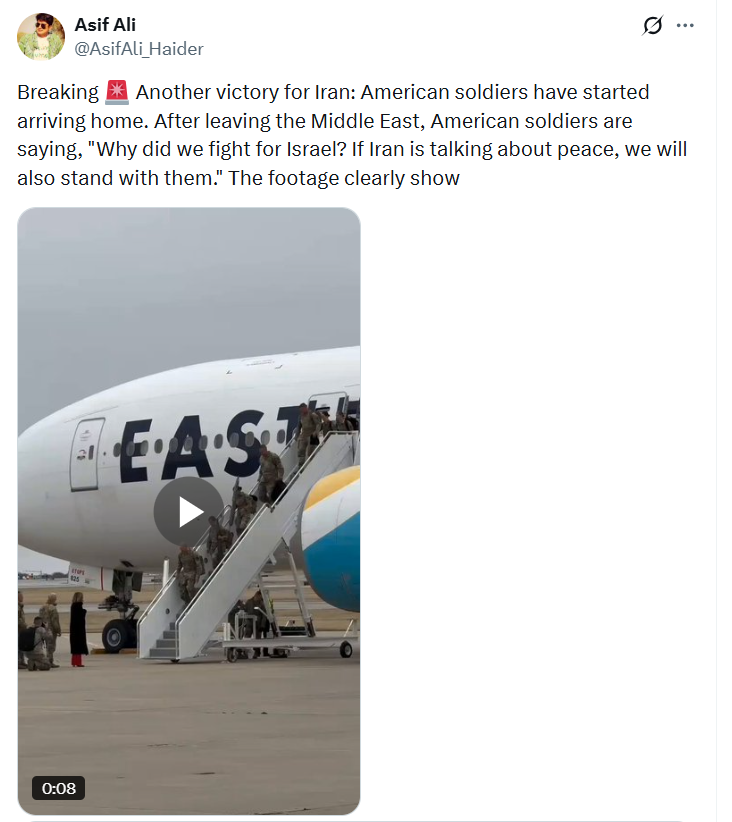
An X (formerly Twitter) user posted the video on April 7, 2026, claiming,“Another victory for Iran: American soldiers have started arriving home. After leaving the Middle East, American soldiers are saying, ‘Why did we fight for Israel? If Iran is talking about peace, we will also stand with them.’”
Fact Check
To verify the claim, we extracted keyframes from the viral video and conducted a reverse image search using Google Lens. This led us to posts by Newsradio 1040 WHO, which had shared the same footage on March 12 across Facebook and Instagram.
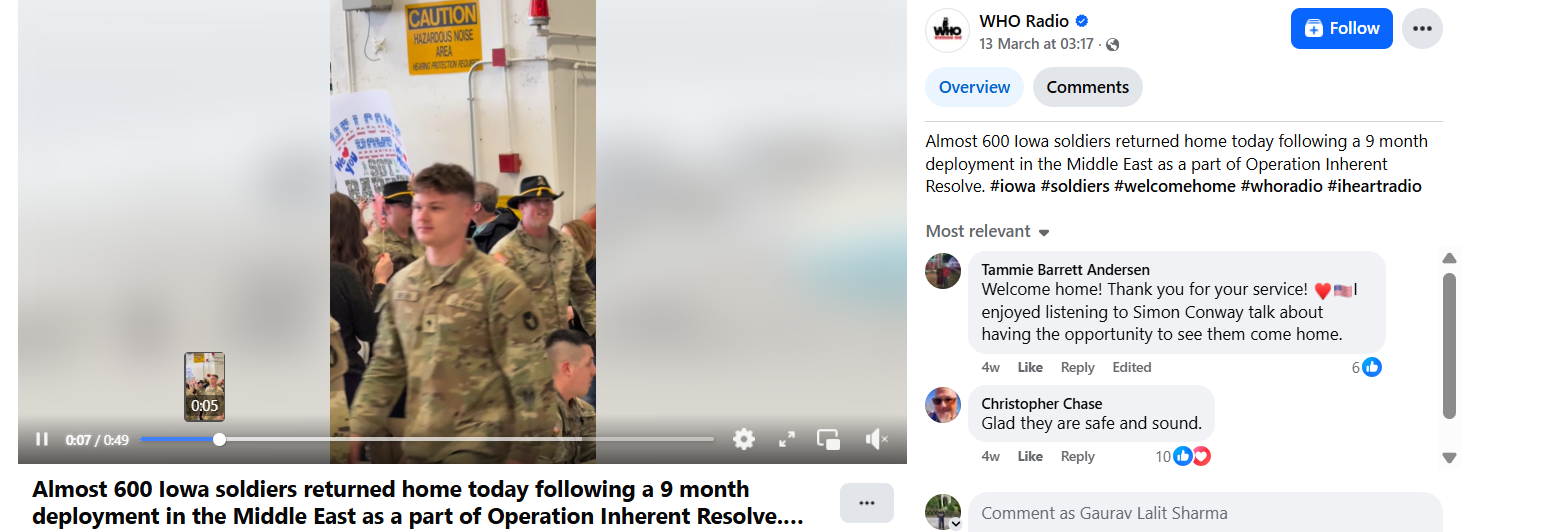
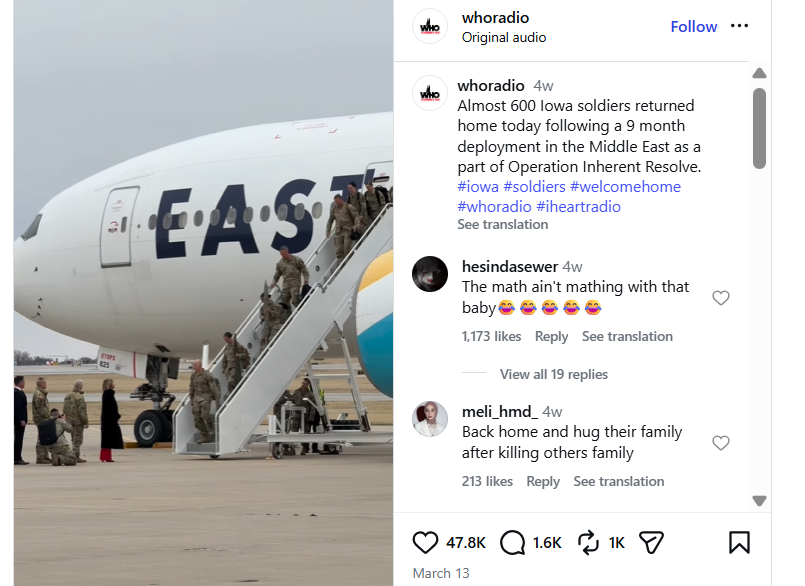
In its caption, the radio station stated that nearly 600 Iowa soldiers had returned home after a nine-month deployment in the Middle East as part of Operation Inherent Resolve. The segment, narrated by journalist Claire Burnett, explained that the soldiers belonged to the 2nd Brigade Combat Team, 34th Infantry Division, and had been deployed to Iraq and Syria. The footage was recorded at the 132nd Wing base of the Iowa Air National Guard in Des Moines.
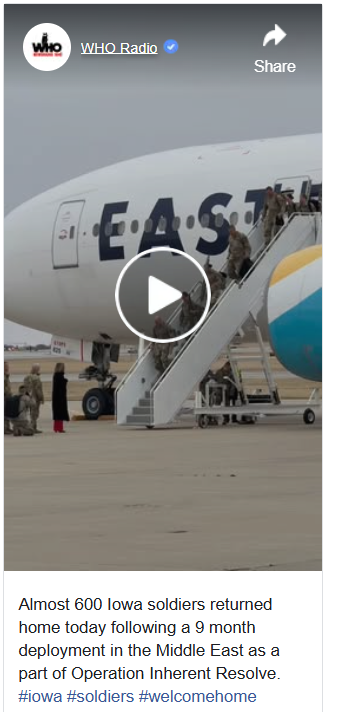
For further confirmation, a March 12 report by KCCI 8 News also showed the same aircraft and troops, verifying the authenticity and timeline of the footage
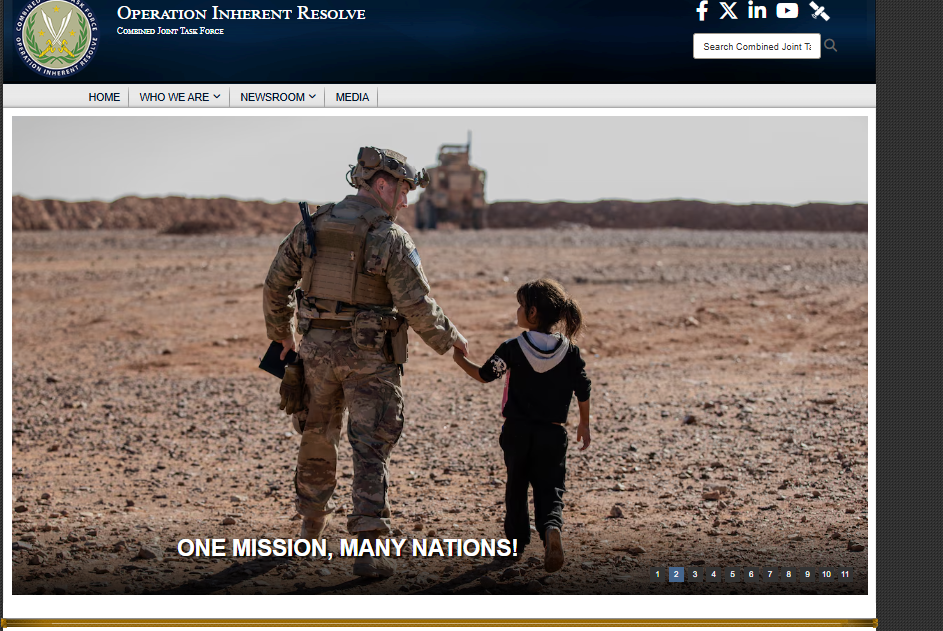
Operation Inherent Resolve, launched in 2014, is a US-led campaign aimed at supporting local forces in the fight against the Islamic State (ISIS) and ensuring its lasting defeat.
https://www.kcci.com/article/iowans-welcome-national-guard-unit-home-from-deployment-in-middle-east/70729105

Conclusion
The viral claim is false and misleading. The video does not show US troops returning due to any recent ceasefire between the United States and Iran. Instead, it captures the routine homecoming of Iowa National Guard soldiers in March after completing a scheduled deployment in the Middle East.There is no evidence linking the footage to current geopolitical developments or any ceasefire agreement. The claim has been taken out of context and shared with a misleading narrative to create confusion around ongoing international events.

Related Blogs

Introduction
The Telecom Regulatory Authority of India (TRAI) has directed all telcos to set up detection systems based on Artificial Intelligence and Machine Learning (AI/ML) technologies in order to identify and control spam calls and text messages from unregistered telemarketers (UTMs).
The TRAI Directed telcos
The telecom regulator, TRAI, has directed all Access Providers to detect Unsolicited commercial communication (UCC)by systems, which is based on Artificial Intelligence and Machine Learning to detect, identify, and act against senders of Commercial Communication who are not registered in accordance with the provisions of the Telecom Commercial Communication Customer Preference Regulations, 2018 (TCCCPR-2018). Unregistered Telemarketers (UTMs) are entities that do not register with Access Providers and use 10-digit mobile numbers to send commercial communications via SMS or calls.
TRAI steps to curb Unsolicited commercial communication
TRAI has taken several initiatives to reduce Unsolicited Commercial Communication (UCC), which is a major source of annoyance for the public. It has resulted in fewer complaints filed against Registered Telemarketers (RTMs). Despite the TSPs’ efforts, UCC from Unregistered Telemarketers (UTMs) continues. Sometimes, these UTMs use messages with bogus URLs and phone numbers to trick clients into revealing crucial information, leading to financial loss.
To detect, identify, and prosecute all Unregistered Telemarketers (UTMs), the TRAI has mandated that Access Service Providers implement the UCC.
Detect the System with the necessary functionalities within the TRAI’s Telecom Commercial Communication Customer Preference Regulations, 2018 framework.
Access service providers have implemented such detection systems based on their applicability and practicality. However, because UTMs are constantly creating new strategies for sending unwanted communications, the present UCC detection systems provided by Access Service providers cannot detect such UCC.
TRAI also Directs Telecom Providers to Set Up Digital Platform for Customer Consent to Curb Promotional Calls and Messages.
Unregistered Telemarketers (UTMs) sometimes use messages with fake URLs and phone numbers to trick customers into revealing essential information, resulting in financial loss.

TRAI has urged businesses like banks, insurance companies, financial institutions, and others to re-verify their SMS content templates with telcos within two weeks. It also directed telecom companies to stop misusing commercial messaging templates within the next 45 days.
The telecom regulator has also instructed operators to limit the number of variables in a content template to three. However, if any business intends to utilise more than three variables in a content template for communicating with their users, this should be permitted only after examining the example message, as well as adequate justifications and justification.
In order to ensure consistency in UCC Detect System implementations, TRAI has directed all Access Providers to deploy UCC and detect systems based on artificial intelligence and Machine Learning that are capable of constantly evolving to deal with new signatures, patterns, and techniques used by UTMs.
Access Providers have also been directed to use the DLT platform to share intelligence with others. Access Providers have also been asked to ensure that such UCC Detect System detects senders that send unsolicited commercial communications in bulk and do not comply with the requirements. All Access Providers are directed to follow the instructions and provide an update on actions done within thirty days.
The move by TRAI is to curb the menacing calls as due to this, the number of scam cases is increasing, and now a new trend of scams started as recently, a Twitter user reported receiving an automated call from +91 96681 9555 with the message “This call is from Delhi Police.” It then asked her to stay in the queue since some of her documents needed to be picked up. Then he said he works as a sub-inspector at the Kirti Nagar police station in New Delhi. He then inquired whether she had recently misplaced her Aadhaar card, PAN card, or ATM card, to which she replied ‘no’. The scammer then poses as a cop and requests that she authenticate the last four digits of her card because they have found a card with her name on it. And a lot of other people tweeted about it.

Conclusion
TRAI directed the telcos to check the calls and messages from Unregistered numbers. This step of TRAI will curb the pesky calls and messages and catch the Frauds who are not registered with the regulation. Sometimes the unregistered sender sends fraudulent links, and through these fraudulent calls and messages, the sender tries to take the personal information of the customers, which results in financial losses.

Introduction
All citizens are using tech to their advantage, and so we see a lot of upskilling among the population leading to innovation in India. As we go deeper into cyberspace, we must maintain our cyber security efficiently and effectively. When bad actors use technology to their advantage, we often see data loss or financial loss of the victim, In this blog, we will shine light upon two new forms of cyber attacks, causing havoc upon the innocent. The “Daam” Malware and a new malicious app are the two new issues.
Daam Botnet
Since 2021, the DAAM Android botnet has been used to acquire unauthorised access to targeted devices. Cybercriminals use it to carry out different destructive actions. Using the DAAM Android botnet’s APK binding service, threat actors can combine malicious code with a legitimate application. Keylogging, ransomware, VOIP call records, runtime code execution, browser history collecting, incoming call recording, PII data theft, phishing URL opening, photo capture, clipboard data theft, WiFi and data status switching, and browser history gathering are just a few of the functions offered by the DAAM Android botnet. The DAAM botnet tracks user activity using the Accessibility Service and stores keystrokes it has recorded together with the name of the programme package in a database. It also contains a ransomware module that encrypts and decrypts data on the infected device using the AES method.
Additionally, the botnet uses the Accessibility service to monitor the VOIP call-making features of social media apps like WhatsApp, Skype, Telegram, and others. When a user engages with these elements, the virus begins audio recording.
The Malware
CERT-IN, the central nodal institution that reacts to computer security-related issues, claims that Daam connects with various Android APK files to access a phone. The files on the phone are encrypted using the AES encryption technique, and it is distributed through third-party websites.
It is claimed that the malware can damage call recordings and contacts, gain access to the camera, change passwords, take screenshots, steal SMS, download/upload files, and perform a variety of other things.

Safeguards and Guidelines by Cert-In
Cert-In has released the guideline for combating malware. These were issued in the public interest. The recommendations by Cert-In are as follows-
Only download from official app stores to limit the risk of potentially harmful apps.
Before downloading an app, always read the details and user reviews; likewise, always give permissions that are related to the program’s purpose.
Install Android updates solely from Android device vendors as they become available.
Avoid visiting untrustworthy websites or clicking on untrustworthy
Install and keep anti-virus and anti-spyware software up to date.
Be cautious if you see mobile numbers that appear to be something other than genuine/regular mobile numbers.
Conduct sufficient investigation Before clicking on a link supplied in a communication.
Only click on URLs that clearly display the website domain; avoid abbreviated URLs, particularly those employing bit.ly and tinyurl.
Use secure browsing technologies and filtering tools in antivirus, firewall, and filtering services.
Before providing sensitive information, look for authentic encryption certificates by looking for the green lock in your browser’s URL information, look for authentic encryption certificates by looking for the green lock in your browser’s URL bar.
Any ‘strange’ activity in a user’s bank account must be reported immediately to the appropriate bank.
New Malicious App
From the remote parts of Jharkhand, a new form of malicious application has been circulated among people on the pretext of a bank account closure. The bad actors have always used messaging platforms like Whatsapp and Telegram to circulate malicious links among unaware and uneducated people to dupe them of their hard-earned money.
They send an ordinary-looking message on Whatsapp or Telegram where they mention that the user has a bank account at ICICI bank and, due to irregularity with the credentials, their account is being deactivated. Further, they ask users to update their PAN card to reactivate their account by uploading the PAN card on an application. This app, in turn, is a malicious app that downloads all the user’s personal credentials and shares them with the bad actors via text message, allowing them to bypass banks’ two-factor authentication and drain the money from their accounts. The Jharkhand Police Cyber Cells have registered numerous FIRs pertaining to this type of cybercrime and are conducting full-scale investigations to apprehend the criminals.
Conclusion
Malware and phishing attacks have gained momentum in the previous years and have become a major contributor to the tally of cybercrimes in the country. DaaM malware is one of the examples brought into light due to the timely action by Cert-In, but still, a lot of such malware are deployed by bad actors, and we as netizens need to use our best practices to keep such criminals at bay. Phishing crimes are often substantiated by exploiting vulnerabilities and social engineering. Thus working towards a rise in awareness is the need of the hour to safeguard the population by and large.
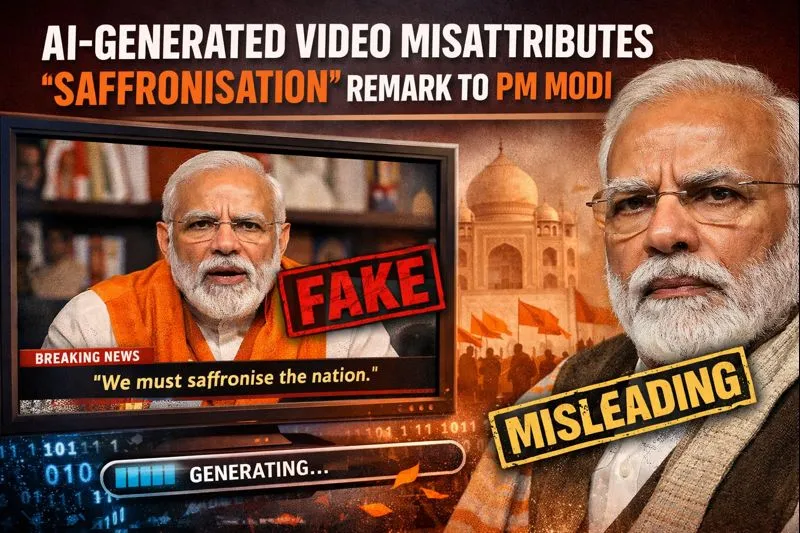
A video purportedly showing Prime Minister Narendra Modi delivering a politically charged warning during a public address has been widely circulated on social media. The clip is being shared with claims that the Prime Minister spoke about the “saffronisation” of the Indian Army and issued a stern message to Bangladesh by invoking India’s role in the 1971 war.
A detailed verification by the CyberPeace Foundation found these claims to be misleading. The investigation revealed that the viral video has been digitally altered, and the statements attributed to the Prime Minister do not appear in the original speech. The misleading narrative appears to have been created by inserting manipulated audio into authentic video footage.
Claim
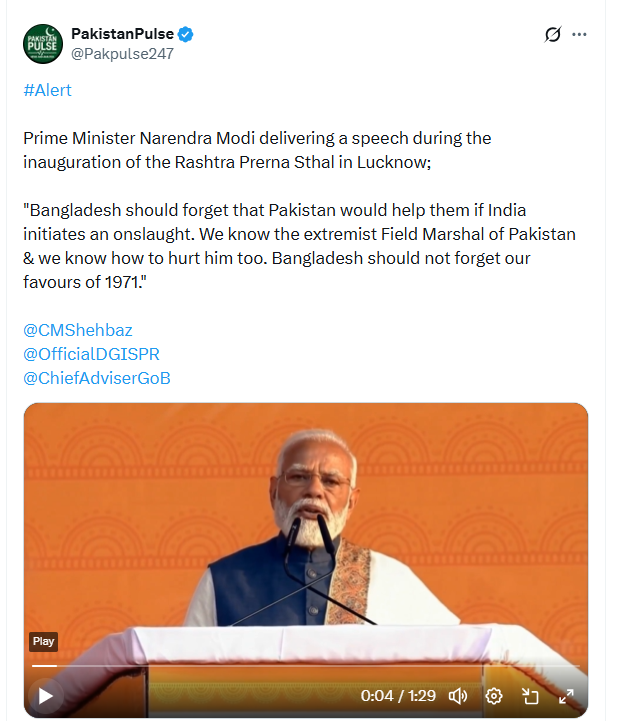
An X user, “@Pakpulse247,” shared a video on December 26 claiming that Prime Minister Narendra Modi, while addressing a public gathering, made remarks about the “saffronisation” of the Indian Army and issued a warning to Bangladesh by invoking India’s role in the 1971 war.
The post’s caption alleged that the Prime Minister made these statements during the inauguration of the Rashtra Prerna Sthal in Lucknow, suggesting that Bangladesh should not expect support from Pakistan in the event of an Indian offensive and should remember India’s contribution during the 1971 conflict.
The link to the post is provided below, along with a screenshot of the viral claim.
Fact Check:
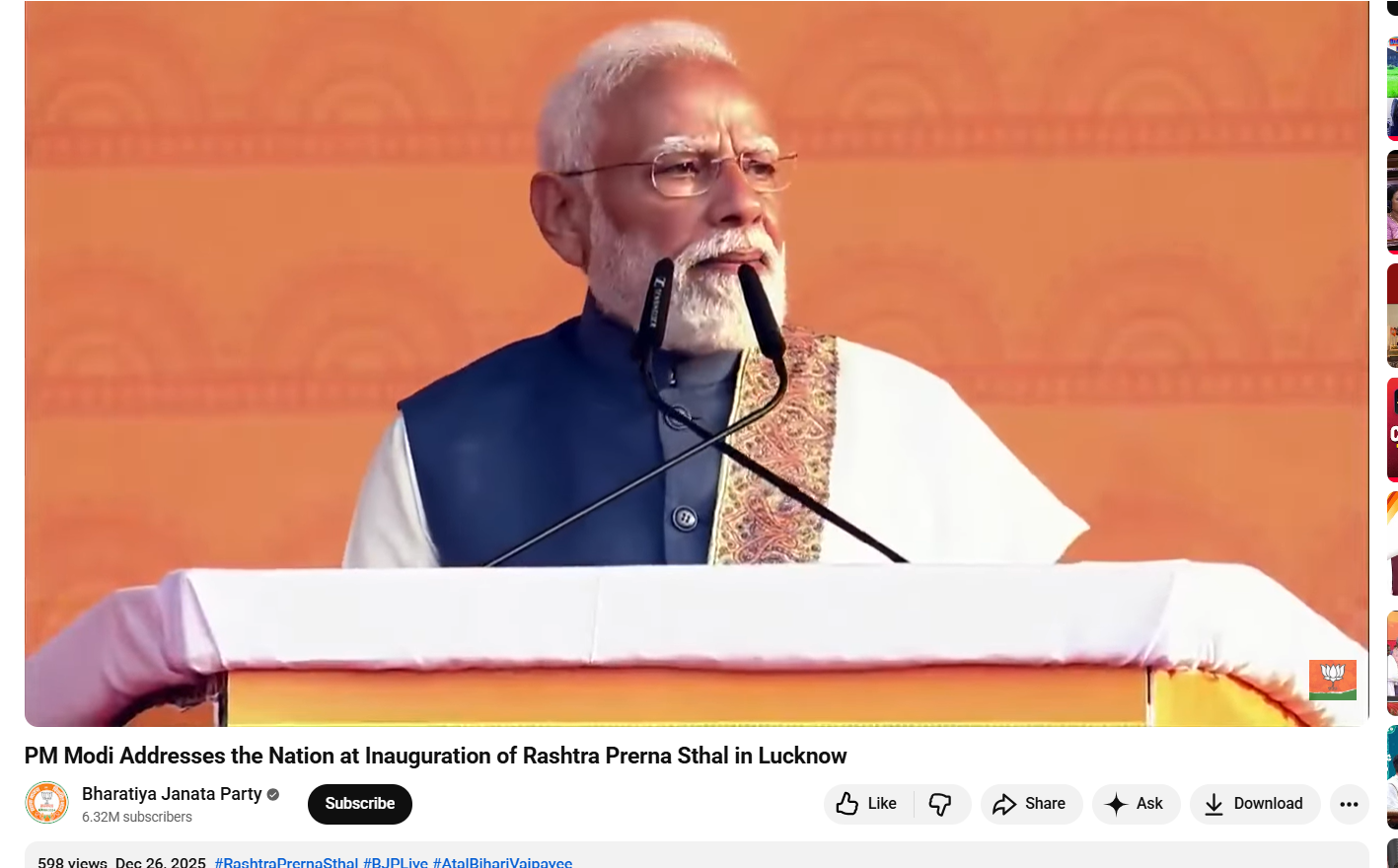
During the verification process, the Desk carried out a targeted keyword search and located the complete, original version of the video on the official YouTube channel of the Bharatiya Janata Party, uploaded on December 26, 2025. The video description confirmed that Prime Minister Narendra Modi was addressing the gathering at the inauguration of the Rashtra Prerna Sthal in Lucknow.
A comparison of the visuals showed that the venue, backdrop, and the Prime Minister’s attire were identical to those seen in the viral clip circulating on social media. However, after carefully reviewing the full speech, the Desk found no reference to Pakistan, Bangladesh, or the claims being attributed to him in the viral post.
The link to the original video is provided below, along with a relevant screenshot.
https://www.youtube.com/watch?v=L9rbzU0m30o
Upon further examination of the search results, the Desk located the official English transcript of Prime Minister Narendra Modi’s speech on the PM India website. A thorough review of the complete transcript revealed no mention of the statements attributed to him in the viral social media post.
The link to the official transcription is provided below.
On further examination of the search results, the Desk accessed the official English transcript of Prime Minister Narendra Modi’s speech published on the PM India website. A careful review of the complete transcript confirmed that none of the claims made in the viral social media post appear in the official record.
The link to the transcription is provided below.
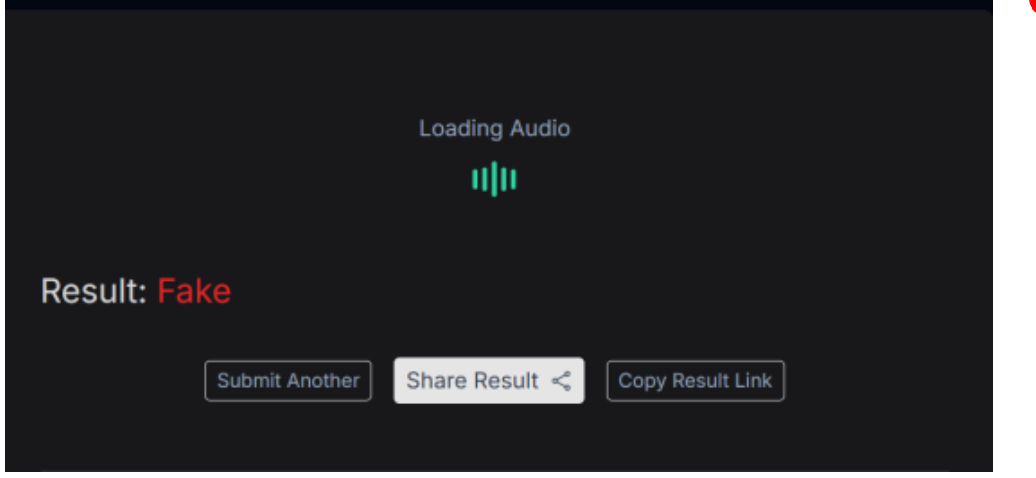
Building on these findings, the Desk extracted the audio track from the viral video and analysed it using Resemble AI, an audio-detection tool. The analysis flagged the audio as fake, indicating that it had been digitally manipulated.
Conclusion
The CyberPeace Foundation’s research clearly establishes that the viral video claiming Prime Minister Narendra Modi made remarks about the saffronisation of the Indian Army and issued warnings to Bangladesh is false and misleading. The full original video and official transcript of the speech contain no such references to Pakistan, Bangladesh, or the 1971 war. Furthermore, audio analysis using AI-detection tools confirms that the voice in the viral clip has been digitally manipulated.
