
#FactCheck -Prayagraj Celebration Video Falsely Shared as BJP Victory Celebration in West Bengal
Executive Summary
Assembly election results for West Bengal, Assam, Kerala, Tamil Nadu and the Union Territory of Puducherry have been declared, with the Bharatiya Janata Party (BJP) set to form the government in West Bengal after defeating the Trinamool Congress (TMC). Amid celebrations and reports of violence in the state, several misleading videos and images are also circulating on social media. One such viral clip shows people waving the Indian tricolour and saffron flags during a street celebration. Social media users are claiming that the video captures people celebrating a political change and BJP’s victory in West Bengal. Research by CyberPeace Research Wing found that the claim is false. The viral video is not from West Bengal but from Prayagraj and actually shows celebrations after India’s victory in the ICC Men's T20 World Cup 2026.
Claim
An X user named “Ashok Shrivastav” shared the video on May 6, 2026, claiming that people in West Bengal were celebrating the departure of Mamata Banerjee and the TMC government. The user further claimed that people were waving only the national flag and saffron flags, not BJP flags.

Fact Check
To verify the claim, we extracted several keyframes from the viral video and conducted a reverse image search using Google Lens. The clip was found on multiple social media handles falsely linked to West Bengal.

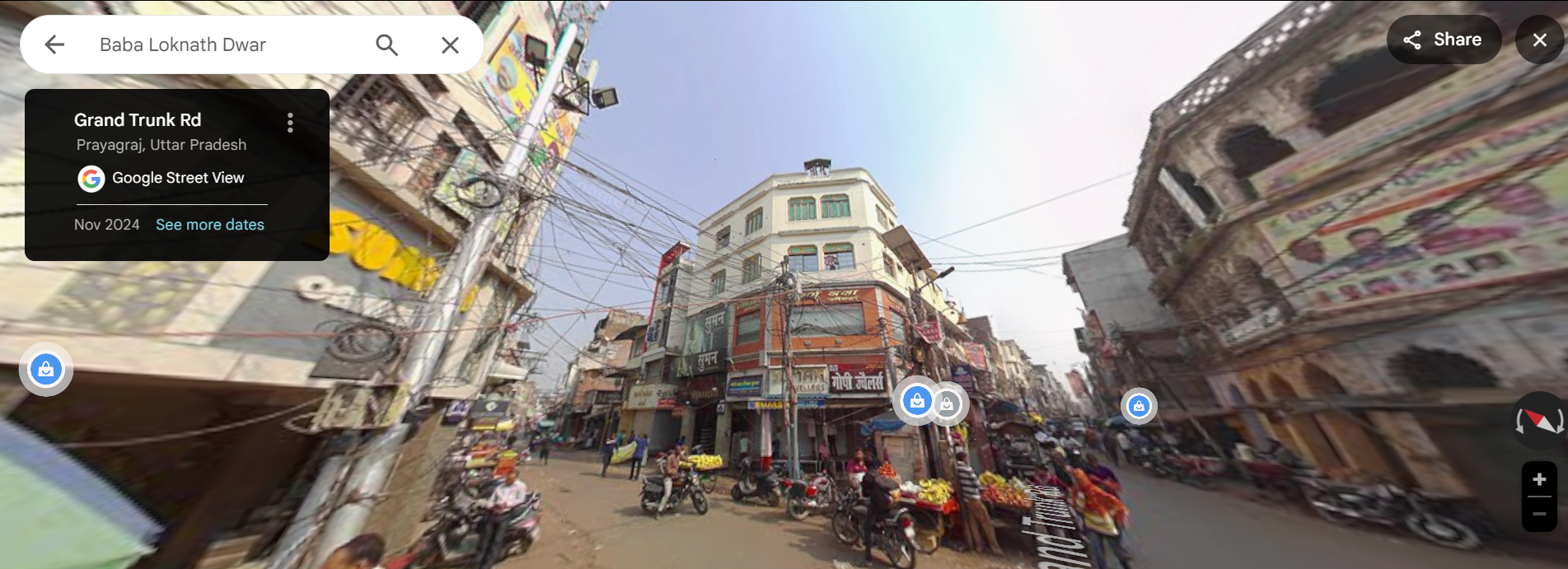
However, the oldest version of the video was uploaded on March 8, 2026, by an Instagram page named “Streets of Sangam.” The caption identified the location as Prayagraj and included hashtags related to the World Cup and Loknath. During the comparison of the viral and original videos, we noticed a shop sign reading “Suman Ornaments.” Using Google Street View, we traced the location to Baba Loknath area in Prayagraj, where the same shop could be identified near Loknath Gate.
Conclusion
Our research confirms that the viral claim is fake. The video being shared as BJP victory celebrations in West Bengal is actually from Prayagraj, Uttar Pradesh, and dates back to March 2026, when locals celebrated Team India’s T20 World Cup victory. The old clip is now being misleadingly circulated with a false political narrative.

Related Blogs

Executive Summary:
A photographer breaking down in tears in a viral photo is not connected to the Ram Mandir opening. Social media users are sharing a collage of images of the recently dedicated Lord Ram idol at the Ayodhya Ram Mandir, along with a claimed shot of the photographer crying at the sight of the deity. A Facebook post that posts this video says, "Even the cameraman couldn't stop his emotions." The CyberPeace Research team found that the event happened during the AFC Asian Cup football match in 2019. During a match between Iraq and Qatar, an Iraqi photographer started crying since Iraq had lost and was out of the competition.
Claims:
The photographer in the widely shared images broke down in tears at seeing the icon of Lord Ram during the Ayodhya Ram Mandir's consecration. The Collage was also shared by many users in other Social Media like X, Reddit, Facebook. An Facebook user shared and the Caption of the Post reads,


Fact Check:
CyberPeace Research team reverse image searched the Photographer, and it landed to several memes from where the picture was taken, from there we landed to a Pinterest Post where it reads, “An Iraqi photographer as his team is knocked out of the Asian Cup of Nations”

Taking an indication from this we did some keyword search and tried to find the actual news behind this Image. We landed at the official Asian Cup X (formerly Twitter) handle where the image was shared 5 years ago on 24 Jan, 2019. The Post reads, “Passionate. Emotional moment for an Iraqi photographer during the Round of 16 clash against ! #AsianCup2019”

We are now confirmed about the News and the origin of this image. To be noted that while we were investigating the Fact Check we also found several other Misinformation news with the Same photographer image and different Post Captions which was all a Misinformation like this one.
Conclusion:
The recent Viral Image of the Photographer claiming to be associated with Ram Mandir Opening is Misleading, the Image of the Photographer was a 5 years old image where the Iraqi Photographer was seen Crying during the Asian Cup Football Competition but not of recent Ram Mandir Opening. Netizens are advised not to believe and share such misinformation posts around Social Media.
- Claim: A person in the widely shared images broke down in tears at seeing the icon of Lord Ram during the Ayodhya Ram Mandir's consecration.
- Claimed on: Facebook, X, Reddit
- Fact Check: Fake
.webp)
Introduction
The judiciary as an institution has always been kept on a pedestal and is often seen as the embodiment of justice. From Dictatorship to Democracy, the judiciary plays a central role; even where the judiciary is controlled, the legitimacy of the policies, in one sense or another, is derived from it. In democracies around the world, the independence and well-being of the judiciary are seen as the barometer of democracy’s strength. In this global age, where technology is omnipresent, it seems the judiciary is no exception. Now more than ever, when the judiciary is at the centre of evaluative focus, it becomes imperative to make the judiciary transparent. Digitisation of the judiciary is not just an administrative reform; it is an extension of constitutionalism into the technological realm, an effort to ensure that justice is accessible, transparent, and efficient. On July 25, which is the International Day on Judicial Well-being, is commemorated every year with a clear message that judicial well-being supports “anti-corruption, access to justice, and sustainable peace.”
Digitisation by Design: Justice in the Age of Transformation
The Prime Minister of India envisioned the future of the Indian legal system in alignment with the digitised world, as when he said, “Technology will integrate police, forensics, jails, and courts, and will speed up their work as well. We are moving towards a justice system that will be fully future-ready,” he said, almost predicting the future. Although there are many challenges in the face of this future, there are various initiatives that ease the transition. To clarify, India is streamlining operations, reducing delays, and enhancing access to justice for all by integrating AI into legal research, case management, judicial procedures, and law enforcement. Machine Learning (ML), Natural Language Processing (NLP), Optical Character Recognition (OCR), and predictive analytics are just a few of the AI-powered technologies that are currently being used to increase crime prevention, automate administrative duties, and improve case monitoring.
The digitisation of Indian courts is a structural necessity rather than just a question of contemporary convenience. Miscarriages of justice have frequently resulted from the growing backlog of cases, challenges with maintaining records, and the loss of physical files. In the seminal case of State of U.P. v. Abhay Raj Singh, the courts acknowledged that a conviction could be overturned by missing records alone. With millions of legal documents at risk, digitisation becomes a shield against such a collapse and a tool for preserving judicial memory.
Judicial Digitalisation in India: Institutional Initiatives and Infrastructural Advancements
For centuries, towering bundles of courtroom files stood as dusty monuments to knowledge, sacred, chaotic, and accessible to a select few. But as we now stand in 2025, the physical boundaries of a traditional courtroom have blurred, and the Indian government is actively working towards transforming the legal system. The e-Courts Mission Mode Project is a flagship initiative that aims to utilise Information and Communication Technology (ICT) to modernise and advance the Indian judiciary. This groundbreaking effort, led by the Department of Justice, Government of India, is being carried out in close coordination with the Supreme Court of India’s e-Committee. As a news report suggests, the Supreme Court (SC) held 7.5 lakh hearings through video conferencing between 2020 and 2024, as stated by the Ministry of Law and Justice, responding to a query in the Rajya Sabha on Thursday. Technological tools such as the Supreme Court Vidhik Anuvaad Software (SUVAS), the Case Information Software (CIS), and the Supreme Court Portal for Assistance in Court’s Efficiency (SUPACE) were established to make all pertinent case facts easily available. In another move, the Registry, SC, in close coordination with IIT, Madras, has created and implemented AI and ML-based technologies that are integrated with the Registry’s electronic filing software. This serves as a statement to the fact that cybersecurity and digital infrastructure are no longer administrative add-ons but essential building blocks for ensuring judicial transparency, efficiency, and resilience.
E-Governance and Integrity: The Judiciary in Transition
The United Nations recognises the fundamentals of the judiciary’s well-being and how corruption acts like water to the rust and taints the integrity of not a single judge in general but creates a perception of the whole institution. This threat of corruption is recognised by the United Nations Convention against Corruption (UNCAC), particularly Article 11, which urges the protection of the judiciary’s independence and integrity. Digitisation, while it cannot operate in a vacuum, acts as a structural antidote to corruption by embedding transparency into the fabric of justice delivery as automated registry systems, e-filing, and real-time access to case data drastically reduce discretionary power and the potential for behind-the-scenes manipulation. However, digital systems are only as ethical as the people who design, maintain, and oversee them, bringing their own limitations.
Conclusion: CyberPeace and the Future of Ethical Digital Justice
The potential of digitalisation resides not just in efficiency but also in equity, as India’s judiciary balances tradition and change. A robust democracy, where justice is lit by code rather than hidden under files, is built on a foundation of an open, accessible, and technologically advanced court. This change is not risk-free, though. Secure justice must also be a component of digital justice. The very values that digitisation seeks to preserve are at risk from algorithmic opacity, data breaches, and insecure technologies.
Our vision is not just of a digitalised court system but of a digitally just society, one where judicial data is protected, legal processes are democratised, and innovation upholds constitutionalism. Therefore, as a step forward, CyberPeace resolves to support AI upskilling for legal professionals, advocate for secure-by-design court infrastructure, and facilitate dialogue between technologists and judicial actors to build trust in the digital justice ecosystem. CyberPeace is dedicated to cyber transparency, privacy protection, and ethical AI.
References
- https://www.un.org/en/observances/judicial-well-being
- https://www.pib.gov.in/PressReleasePage.aspx?PRID=2106239
- https://www.pib.gov.in/PressReleasePage.aspx?PRID=2106239
- https://www.barandbench.com/view-point/facilitating-legal-access-digitalization-of-supreme-court-high-court-records
- https://www.pib.gov.in/PressReleaseIframePage.aspx?PRID=2085127
- https://www.medianama.com/2024/12/223-supreme-court-seven-lakh-video-conferences-four-year-rajya-sabha/

Executive Summary
Amid rising tensions between the United States, Israel, and Iran, a video is circulating on social media claiming that Burj Khalifa in Dubai has been attacked. The clip is being widely shared with users alleging that a strike took place near the iconic skyscraper. However, research by CyberPeace found the claim to be misleading. Our research revealed that the viral video is not real and was generated using artificial intelligence.
Claim
On March 1, 2026, a Facebook user shared the viral clip claiming that an attack had taken place in Dubai. The post was shared with the caption: “Dubai has been attacked.” The link to the post and its archive is provided below along with a screenshot.

Fact Check
To verify the claim, we first searched Google using relevant keywords. During this process, we found a report published on March 1, 2026, by the Indian news outlet Dainik Bhaskar.

According to the report, tensions in the Middle East escalated amid the Israel–Iran conflict, impacting several countries in the region. A drone incident reportedly occurred near Burj Khalifa, prompting authorities to evacuate the building as a precautionary measure and temporarily switch off its lights. However, the visuals seen in the viral video do not match the details or imagery described in the report. Upon closely examining the viral clip, we noticed several technical inconsistencies and unusual visual elements, raising suspicions that the video might have been generated using artificial intelligence. To verify this, we analyzed the video using the AI detection tool Sightengine. The results indicated a 99% probability that the video was AI-generated.

Conclusion
Our research found that the viral video circulating on social media is not authentic. The footage was created using artificial intelligence and does not depict a real attack on Burj Khalifa.
